


How to Get More Leads From Facebook Ads

You boosted a post, picked a few interests, set a $20 daily budget, and waited. A week later you had 3,000 impressions, a handful of likes from people in another state, and zero phone calls. Sound familiar?
Here is the good news: the problem is almost never Facebook itself. With more than three billion people using Meta’s apps every month, Facebook and Instagram remain one of the most reliable places to find new customers for local services, B2B companies, clinics, contractors, coaches, and online brands alike. Average lead campaigns in 2026 report a cost per lead of roughly $27 and a conversion rate above 8% (Coupler.io). Plenty of advertisers beat those numbers. Plenty more pay double.
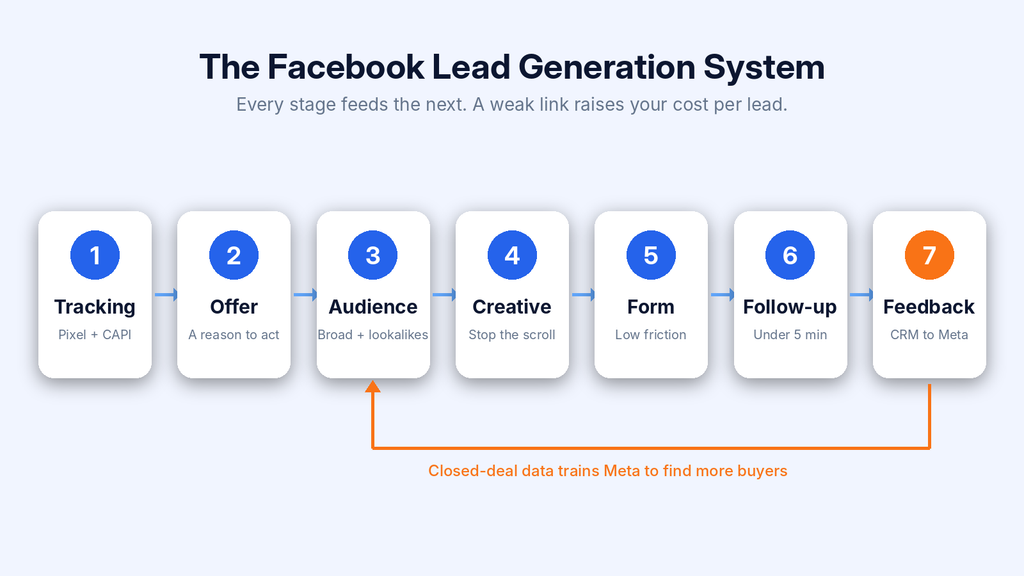
The difference between the two groups isn’t luck or budget. It’s a system: a strong offer, clean tracking, the right audience signals, creative that stops the scroll, a frictionless form, and a fast follow-up process that turns a name and phone number into revenue.
In this guide, we’ll walk through that system step by step. Whether you manage your own campaigns or work with a Facebook advertising agency, you’ll come away knowing exactly how to get more leads from Facebook Ads, and better ones, without simply throwing more money at the problem.
Step 1: Fix the Foundations Before You Spend a Dollar
Most underperforming campaigns fail before the first ad is ever served. Three foundations decide whether Meta’s algorithm can find you leads at all.
Know your numbers: what a lead is worth
Before you judge any campaign, work out the most you can afford to pay for a lead. The formula is simple:
Maximum cost per lead = average profit per customer × lead-to-customer close rate
If a new roofing customer is worth $3,000 in gross profit and you close 10% of leads, you can pay up to $300 per lead and still break even. A $60 lead is a bargain. A med spa with $400 in profit per client and a 25% close rate breaks even at $100. Knowing this number stops you from killing profitable campaigns because the CPL “looks high” and from scaling cheap campaigns that never produce customers.
Choose the right campaign objective
Meta optimizes for exactly what you ask for. Pick Traffic and it finds people who click. Pick Engagement and it finds people who like posts. If you want leads, choose the Leads objective (or Sales with a lead event, if your form lives on your website). Then set the conversion location: Instant Forms, your website, Messenger, WhatsApp, or calls.
Install bulletproof tracking
The algorithm learns from conversion data. If it can’t see your leads, it can’t find more of them. At minimum:
- Install the Meta Pixel on every page of your site.
- Set up the Conversions API (CAPI) so lead events are sent server-to-server. Browser privacy settings and ad blockers drop a meaningful share of Pixel-only events.
- Fire a Lead event only on the thank-you page or a confirmed form submission, never on page load.
- Verify your domain in Business Manager and check your Event Match Quality score in Events Manager.
- Send offline outcomes back to Meta. When a lead becomes a booked appointment or a closed deal, upload that event from your CRM so Meta learns which leads actually matter.
That last step is the one most businesses skip, and it is often the single biggest lever for lead quality.
Step 2: Target the People Most Likely to Raise Their Hand
Targeting on Facebook has changed more in the last three years than in the previous ten. Stacking a dozen narrow interests used to be the playbook. Today, Meta’s machine learning usually outperforms manual micro-targeting, as long as you give it strong signals.
Start broader than feels comfortable
For most lead campaigns, a broad audience (location, age range, and little else) or Advantage+ audience with a few suggestions will beat a hyper-narrow interest stack. Narrow audiences get expensive fast, exhaust quickly, and limit the algorithm’s ability to find pockets of cheap, high-intent users you’d never have guessed. Your creative now does much of the targeting: an ad that speaks clearly to “homeowners in Phoenix with a 15-year-old AC unit” will naturally attract exactly those people.
The exception is local businesses with a tight service area. Keep the geography tight, use radius or ZIP code targeting, and let everything else stay open.
Use your first-party data
Your own data is the best targeting asset you have. Build Custom Audiences from:
- Website visitors (all visitors, service-page visitors, pricing-page visitors)
- People who opened or submitted your Instant Form
- Video viewers who watched 50% or more
- Facebook and Instagram profile engagers
- Your customer list (emails and phone numbers, hashed automatically by Meta)
Build lookalikes from your best customers, not all leads
Lookalike Audiences find new people who resemble a source audience. The quality of the source matters enormously. A 1% lookalike built from your 500 best paying customers will usually produce far better leads than one built from 5,000 raw form fills, many of which never answered the phone. If you have the data, seed lookalikes from closed deals or high-value customers.
Segment by funnel stage
Cold audiences and warm audiences need different messages. Keep prospecting (people who don’t know you) and retargeting (people who do) in separate campaigns or ad sets, so you can match the offer and copy to how familiar each group already is with your brand.
Step 3: Choose the Right Conversion Path (Instant Forms vs. Landing Pages)
Where a lead fills in their details matters as much as who sees the ad. You have two main options, and each has a place.
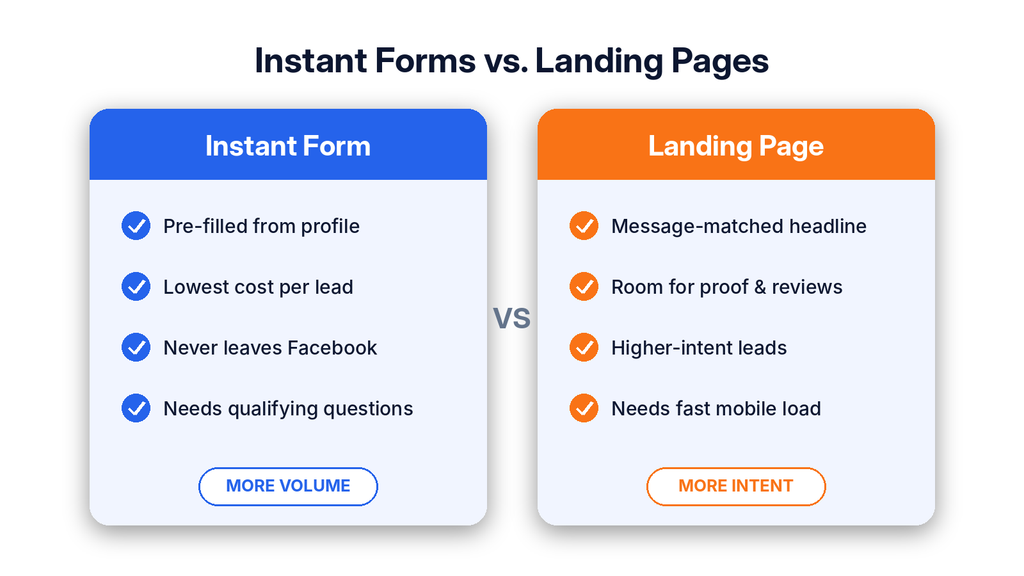
| Instant Forms (Lead Ads) | Landing page on your website | |
|---|---|---|
| Friction | Very low, pre-filled with profile data | Higher, user leaves Facebook |
| Cost per lead | Usually lower | Usually higher |
| Lead quality | Mixed without qualifying questions | Often higher intent |
| Best for | Local services, quotes, events, list building | High-ticket services, B2B, complex offers |
| Tracking | Built in | Needs Pixel + Conversions API |
In a 2026 study of 138 Meta campaigns, lead form ads produced the lowest average cost per lead at $34.10, compared with $49.70 for Instant Experience ads (Focus Digital). Cheap leads are only good leads if they turn into customers, though, so optimize each path for quality as well as volume.
How to get better leads from Instant Forms
- Use the “Higher intent” form type. It adds a review screen before submission, which filters out accidental taps.
- Add one or two qualifying questions. Multiple choice works best: budget range, timeline, service needed, or “Are you the homeowner?”
- Use conditional logic to route people to different follow-up paths based on their answers.
- Write a strong intro screen that restates the offer and what happens next.
- Make the thank-you screen work hard. Add a call button, a booking link, or a link to a short video about what to expect.
How to get more leads from a landing page
- Match the message. The headline should repeat the promise from the ad, word for word if possible.
- One page, one goal. Remove navigation menus, extra links, and competing offers.
- Load in under three seconds on mobile. Most Facebook traffic is on phones, and slow pages leak leads.
- Keep the form short. Ask only what you need to follow up. Every extra field costs conversions.
- Show proof near the form: reviews, star ratings, before-and-after photos, client logos, guarantees.
- Put the call to action above the fold and repeat it further down the page.
Step 4: Create Scroll-Stopping Ads That Generate Leads
With targeting increasingly automated, creative has become the biggest lever you control. Your ad has about a second to earn attention in a crowded feed. Here’s how to win that second.
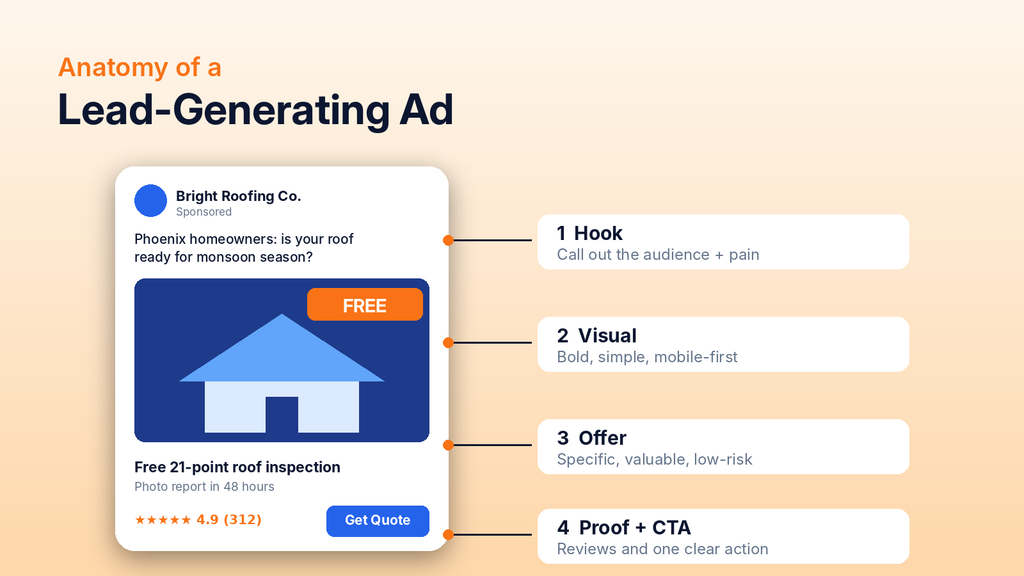
Lead with the hook
The first line of copy and the first three seconds of video do most of the work. Strong hooks usually do one of these:
- Call out the audience: “Phoenix homeowners: your AC is probably costing you $80 a month too much.”
- Name the pain: “Tired of paying for leads that never answer the phone?”
- Promise a specific outcome: “Get a full roof inspection report in 48 hours, free.”
- Open a loop: “The one question we ask every new patient before treatment.”
Use formats that fit how people scroll
- Short vertical video (9:16 for Reels and Stories, 4:5 for Feed). Talking-head videos from the owner or a team member feel native and build trust fast. Add captions, since most people watch without sound.
- User-generated content and testimonials. A real customer explaining their result often outperforms polished studio creative.
- Before-and-after images for visual services like cleaning, landscaping, aesthetics, and remodeling.
- Carousels to walk through steps, packages, or multiple results.
- Simple static images with bold text that state the offer clearly. Don’t underestimate them; they’re cheap to make and quick to test.
Write copy that converts
Keep the structure simple: hook, problem, solution, proof, call to action. Speak to one person. Use the words your customers use in reviews and sales calls. Be specific: “Save up to 30% on your energy bill” beats “Save money.” And always tell people exactly what to do next and what happens after they do it: “Tap Get Quote. We’ll text you a price within an hour.”
Feed the algorithm variety
Meta’s delivery system rewards creative diversity. Instead of five near-identical versions of one image, test genuinely different concepts: a video testimonial, a founder explainer, a before-and-after, a bold-text static, a carousel. Then iterate on the winners.
Step 5: Make an Offer People Actually Want
You can have perfect targeting and beautiful creative, but if the offer is “Contact us to learn more,” your leads will be thin. People scrolling Facebook aren’t actively searching for you the way Google users are. You need to give them a reason to stop and act now.
Offers that consistently generate leads
| Offer type | Works well for | Example |
|---|---|---|
| Free quote or estimate | Home services, contractors, insurance | “Get your free solar savings estimate in 60 seconds” |
| Free consultation or audit | Agencies, legal, financial, B2B | “Book a free 20-minute ad account audit” |
| First-visit discount or trial | Med spas, gyms, salons, clinics | “First facial for $49 (normally $129)” |
| Downloadable guide or checklist | B2B, education, real estate | “The 2026 first-time homebuyer checklist” |
| Quiz or assessment | Coaching, health, financial planning | “Find out which treatment fits your skin type” |
| Webinar or live event | Consultants, SaaS, education | “Free workshop: hire your first salesperson” |
Make the offer irresistible
- Be specific about value. “Free inspection” is fine; “Free 21-point roof inspection with photo report” is better.
- Add urgency honestly. Limited monthly spots, seasonal pricing, or a real deadline all lift response.
- Reduce risk. Guarantees, no-obligation language, and “no credit card required” lower the barrier.
- Match the offer to temperature. Cold audiences respond to low-commitment offers like guides and quizzes. Warm retargeting audiences are ready for consultations and bookings.
A useful test: if you wouldn’t personally stop scrolling for your offer, neither will your audience.
Step 6: Structure, Budget, and Test Like a Pro
A clean account structure helps Meta’s algorithm learn faster, and a fast-learning algorithm finds cheaper leads.
Keep the structure simple
Fragmented accounts with dozens of tiny ad sets starve each one of data. A strong starting structure for most lead-gen businesses looks like this:
- Prospecting campaign (Leads objective): one or two broad ad sets, 3 to 6 distinct creatives each.
- Retargeting campaign: website visitors, form openers, and video viewers from the last 30 to 90 days, with a stronger, more direct offer.
- Testing campaign (optional): a smaller budget for trying new creative concepts before promoting winners into prospecting.
Budget enough to exit the learning phase
Each ad set needs roughly 50 optimization events per week to exit the learning phase and stabilize. If your target cost per lead is $30, that means about $1,500 a week, or roughly $215 a day, per ad set. If that’s more than you can spend, consolidate into fewer ad sets rather than spreading a small budget thin. Campaign budget (Advantage campaign budget) can help Meta shift spend toward the best-performing ad sets automatically.
Test one variable at a time
Testing is how good campaigns become great ones. Prioritize tests in this order, because each has a bigger impact than the next:
- Offer (free audit vs. discount vs. guide)
- Creative concept (testimonial video vs. before-and-after vs. founder explainer)
- Hook and headline
- Form type and questions
- Audience
Give each test enough time and spend to reach a meaningful number of leads, ideally 20 to 30 per variant, before calling a winner. Avoid editing live ad sets every day; each significant change can reset learning.
Scale carefully
When something works, increase budgets gradually, around 15 to 20% every few days, rather than doubling overnight. To scale faster, duplicate winning ads into new ad sets or broaden the audience, and keep a steady pipeline of fresh creative to fight ad fatigue.
Step 7: Retarget Warm Prospects and Follow Up Fast
Most people won’t convert the first time they see your ad. Retargeting and follow-up are where a lot of the easy leads, and most of the revenue, are hiding.
Build a retargeting layer
Retargeting audiences are small but warm, so they usually convert at a much lower cost. Set up ads for:
- Form openers who didn’t submit: remind them of the offer and remove an objection (“No obligation. Takes 30 seconds.”).
- Website visitors from the last 30 days: show testimonials, case studies, and a direct booking offer.
- Video viewers: follow a 50% view with a stronger call to action.
- Past leads who didn’t buy: a new offer, a seasonal promotion, or fresh proof can reopen the conversation.
Refresh retargeting creative often. Small audiences see the same ads frequently, so fatigue sets in faster.
Speed to lead is everything
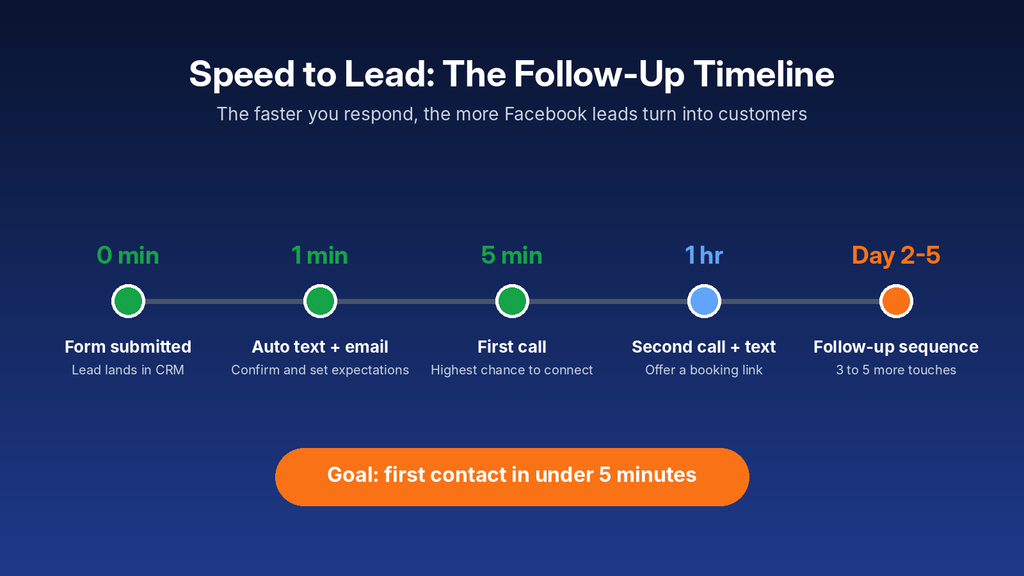
A Facebook lead is at their most interested in the minutes after they hit Submit. Wait a day and many won’t remember filling in your form. Leads contacted within five minutes are far more likely to convert than those contacted hours later. To move fast:
- Connect your lead forms to your CRM (HubSpot, GoHighLevel, Salesforce, Zoho, or similar) so leads arrive instantly instead of sitting in a CSV download.
- Send an automatic text and email the moment someone submits, confirming you received their request and what happens next.
- Alert your sales team in real time by text, Slack, or app notification.
- Use a follow-up sequence: call immediately, then text, then call again over several days. Many leads convert on the third or fourth touch.
- Offer self-booking with a calendar link so ready-to-buy leads can schedule without waiting.
Close the loop
Tag every lead in your CRM by outcome: contacted, qualified, booked, won, lost. Send those outcomes back to Meta through the Conversions API. Over time, the algorithm learns the difference between a form-filler and a buyer, and shifts your budget toward people who look like buyers.
Step 8: Track the Metrics That Actually Matter
Likes and reach feel good, but they don’t pay the bills. Focus on the metrics that tell you whether your ads are producing customers.
| Metric | What it tells you | 2026 reference point |
|---|---|---|
| Cost per lead (CPL) | What you pay for each form fill or conversion | About $27 average for lead campaigns (Coupler.io) |
| Lead conversion rate | Share of clicks that become leads | About 8.5% for lead campaigns (Coupler.io) |
| Click-through rate (CTR) | Whether your creative and hook earn attention | Around 2.5% for lead campaigns (The Digital) |
| CPM | What it costs to reach 1,000 people | Varies widely by industry, season, and location |
| Cost per qualified lead | What you pay for leads that meet your criteria | Set by your own close rate and customer value |
| Cost per customer | The number that decides profitability | Should sit well below customer lifetime value |
Benchmarks vary a lot by industry. Fitness businesses, for example, report Facebook conversion rates above 14% (Web Tonic), while SaaS and B2B advertisers often pay several times the average CPL. Compare yourself to your own past performance and your break-even CPL first, and to industry averages second.
Diagnose problems with the funnel math
Cost per lead is the product of three things: what you pay for impressions, how many people click, and how many clickers convert. When CPL rises, find the weak link:
- High CPM: your audience is too narrow, competition is seasonal, or your ad quality ranking is low.
- Low CTR: your hook, creative, or offer isn’t landing. Test new concepts.
- Low conversion rate: your form or landing page has friction, or the message doesn’t match the ad.
- Good CPL, poor sales: your lead quality or follow-up is the problem. Add qualifying questions and speed up response time.
8 Common Mistakes That Kill Facebook Lead Generation
Even experienced advertisers fall into these traps. Avoid them and you’re already ahead of most of your competitors.
- Boosting posts instead of running real campaigns. The Boost button optimizes for engagement, not leads.
- Choosing the wrong objective. Traffic and engagement objectives find clickers and likers, not prospects.
- Broken or missing tracking. Without the Pixel, Conversions API, and a properly firing Lead event, Meta is optimizing blind.
- Weak, generic offers. “Contact us today” gives nobody a reason to act.
- Too many tiny ad sets. Splitting a small budget across many audiences keeps every ad set stuck in learning.
- Judging campaigns too fast. Turning ads off after two days and $40 of spend tells you nothing.
- Running the same creative for months. Ad fatigue quietly drives up CPMs and CPL. Refresh creative every few weeks.
- Slow or no follow-up. Paying for a lead and calling them back two days later is like paying for a meal and leaving it on the table.
Turn Facebook Ads Into a Predictable Lead Engine
Getting more leads from Facebook Ads isn’t about one secret hack. It’s about stacking small advantages: accurate tracking, an offer worth responding to, creative that earns attention, a low-friction form, a clean campaign structure, steady testing, and follow-up that happens in minutes instead of days. Get each piece right and your cost per lead drops while your lead quality climbs.
If you’d rather have experts handle it, Social Market Way’s Facebook advertising services cover the full system: campaign strategy, audience targeting, ad creative and copy, Pixel and conversion tracking, ongoing optimization, and clear reporting focused on leads and cost per result, not vanity metrics. Our team builds Facebook and Instagram campaigns around your business goals so your ad spend turns into measurable growth.
Ready to see what’s holding your campaigns back? Book a free strategy call and we’ll review your current Facebook Ads setup and show you where the extra leads are hiding.
Frequently Asked Questions
How much should I spend on Facebook Ads to get leads?
There’s no universal number. Start with your break-even cost per lead and aim for enough budget to generate around 50 leads per ad set per week. Many small businesses start between $1,000 and $3,000 a month and scale up once they find a winning offer and creative.
Are Facebook lead forms better than landing pages?
Instant forms usually deliver more leads at a lower cost because users never leave Facebook. Landing pages often deliver higher-intent leads. Many advertisers run both and compare cost per qualified lead, not just cost per lead.
Why are my Facebook leads low quality?
Usually it’s a mix of too little friction in the form, a vague offer, and slow follow-up. Use the higher-intent form type, add qualifying questions, and send CRM outcomes back to Meta so it learns which leads become customers.
How long does it take to see results from Facebook lead ads?
Campaigns often produce leads within the first few days, but expect two to four weeks of data and testing before performance stabilizes and you can scale confidently.
Should I use Advantage+ or manual targeting?
For most lead campaigns, broad or Advantage+ audiences combined with strong creative and accurate conversion tracking now outperform narrow manual interest targeting. Keep location targeting tight if you serve a specific area.