




Dental SEO Keyword Research: How to Find Keywords That Attract New Patients

Every week, people in your city type questions into Google like “emergency dentist open now,” “how much do Invisalign braces cost,” or “dentist near me that takes Delta Dental.” Each of those searches is a patient raising their hand. The practices that show up for them get the phone call. The practices that don’t, never even get considered.
That is why choosing the right dental SEO keywords is the foundation of every successful dental marketing campaign. Your website design, your blog posts, your Google Business Profile, and your link building all depend on one question: which words are your future patients actually using?
In this guide, you’ll learn how to research keywords specifically for a dental practice. We’ll cover search intent, treatment-specific keywords, location modifiers, competitor analysis, and, most importantly, how to map each keyword to the right page on your site so Google knows exactly what to rank. If you want the bigger picture of how keywords fit into a full strategy, start with our complete dental SEO marketing guide and come back here for the deep dive.
What Is Dental SEO Keyword Research (and Why It Matters)?
Dental SEO keyword research is the process of finding the exact search terms prospective patients use when looking for dental care, then deciding which of those terms your practice should target. It sounds simple, but it is where most dental websites go wrong.
Many practices build pages around the words dentists use, not the words patients use. A dentist might write a page titled “Endodontic Therapy.” Patients, meanwhile, are searching for “root canal,” “tooth pain that won’t go away,” and “root canal cost.” Same treatment, completely different vocabulary.
Good keyword research closes that gap. It helps you:
- Attract the right patients, not just traffic. Ranking for “what causes bad breath” brings curious readers; ranking for “teeth whitening near me” brings people ready to book.
- Prioritize high-value treatments. One implant or Invisalign case can be worth more than dozens of cleanings, so those keywords deserve dedicated attention.
- Avoid wasted effort. There is no point fighting for a term nobody in your area searches, or one dominated by national brands you can’t realistically beat.
- Build a clear site structure. When every important keyword has a home, Google understands what each page is about and your pages stop competing against each other.
Think of keyword research as listening to your market before you start talking to it.
Understanding Search Intent for Dental Patients
Search intent is the reason behind a search. Two keywords can look similar but come from people at very different stages of the patient journey. Matching your content to that intent is what turns rankings into appointments.
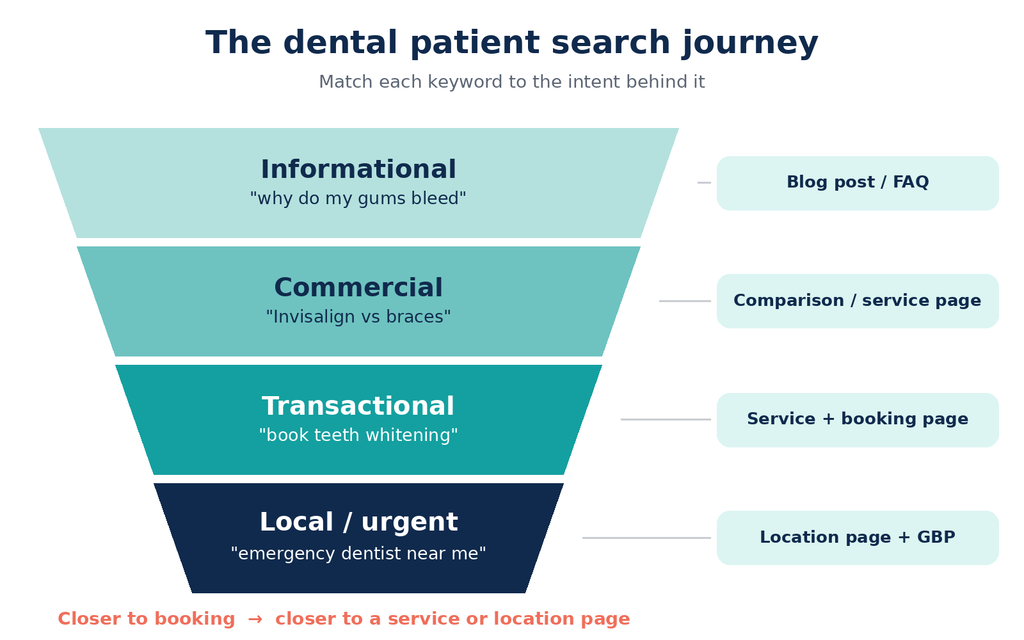
Dental searches generally fall into four intent types:
| Intent type | What the patient wants | Example keywords | Best page type |
|---|---|---|---|
| Informational | To learn or understand a problem | “why do my gums bleed,” “how long do veneers last” | Blog post, FAQ |
| Commercial investigation | To compare options before deciding | “Invisalign vs braces,” “best dentist for implants in Miami” | Comparison post, service page |
| Transactional | To book or buy now | “book dental cleaning,” “same-day crowns near me” | Service page, booking page |
| Navigational / local | To find a specific practice or nearby option | “Smile Dental Group hours,” “dentist open Saturday near me” | Homepage, location page, Google Business Profile |
A useful rule: the closer a keyword is to booking, the closer it should sit to a service or location page. Informational keywords belong in your blog, where you can educate readers and then link them to the relevant treatment page.
To check intent, simply Google the keyword and look at what already ranks. If the top results are all blog articles, Google believes searchers want information. If they’re mostly practice homepages and the local map pack, the intent is local and transactional. Build the type of page Google is already rewarding.
Emergency keywords deserve special mention. Searches like “emergency dentist,” “broken tooth,” or “dental abscess swelling” carry urgent, high-conversion intent. Patients searching these terms often call the first practice they find, so a fast-loading emergency page with a click-to-call button can be one of the most profitable pages on your site.
Treatment-Specific Keywords: Where the Revenue Lives
Generic terms like “dentist” are extremely competitive and vague. Treatment-specific keywords are narrower, easier to rank for, and tell you exactly what the patient needs. They also let you focus your SEO budget on the services that matter most to your practice’s growth.
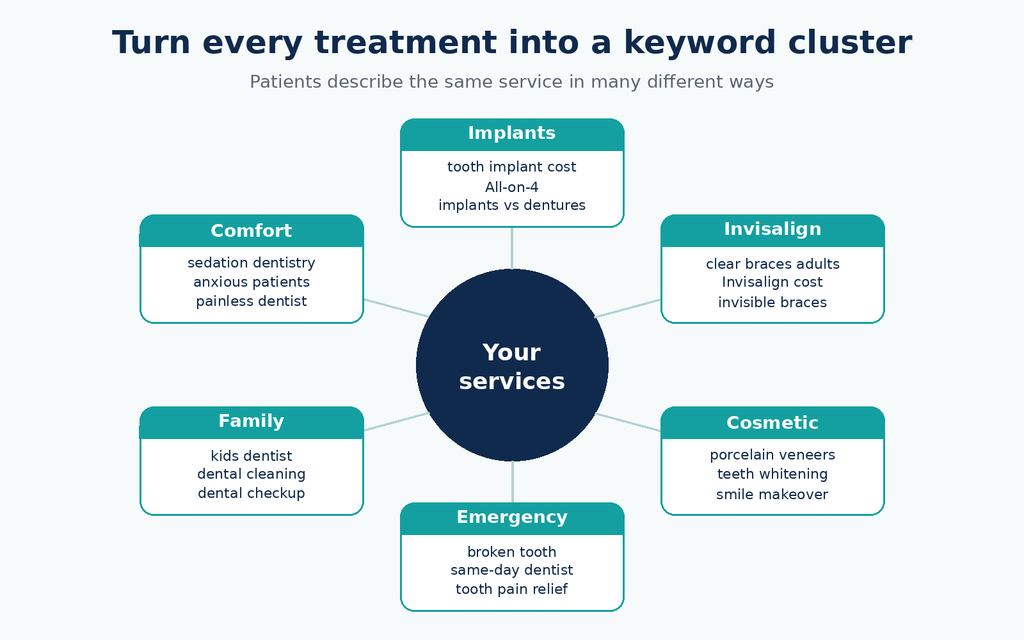
Start by listing every service you offer, then expand each one into the many ways patients describe it:
- Dental implants: “dental implants,” “tooth implant cost,” “single tooth replacement,” “All-on-4 implants,” “implants vs dentures”
- Clear aligners: “Invisalign,” “clear braces for adults,” “Invisalign cost,” “invisible braces near me”
- Cosmetic dentistry: “porcelain veneers,” “smile makeover,” “teeth whitening,” “fix chipped tooth”
- Restorative care: “dental crowns,” “same-day crowns,” “root canal,” “tooth-colored fillings”
- Family and preventive care: “pediatric dentist,” “kids dentist,” “dental cleaning,” “dental checkup”
- Specialty and comfort: “sedation dentistry,” “dentist for anxious patients,” “sleep apnea dentist,” “TMJ treatment”
Notice the patterns. Patients search using symptoms (“tooth sensitive to cold”), cost (“how much are veneers”), comparisons (“crown vs filling”), fears (“painless dentist”), and insurance or payment (“dentist that accepts Medicaid,” “dental financing”). Each pattern is an opportunity for a page, an FAQ section, or a blog post.
Long-tail keywords, longer and more specific phrases, are especially valuable for dentists. “Dentist” might get huge search volume, but “affordable dental implants for seniors in Tampa” tells you precisely who the searcher is and what they want. Long-tail terms usually have lower competition and higher conversion rates, which makes them ideal for newer websites building authority.
Location Modifiers: Winning the Searches in Your Area
Dentistry is a local business. Almost nobody drives two hours for a cleaning, so the most valuable dental SEO keywords almost always include a location, whether the patient types it or not.
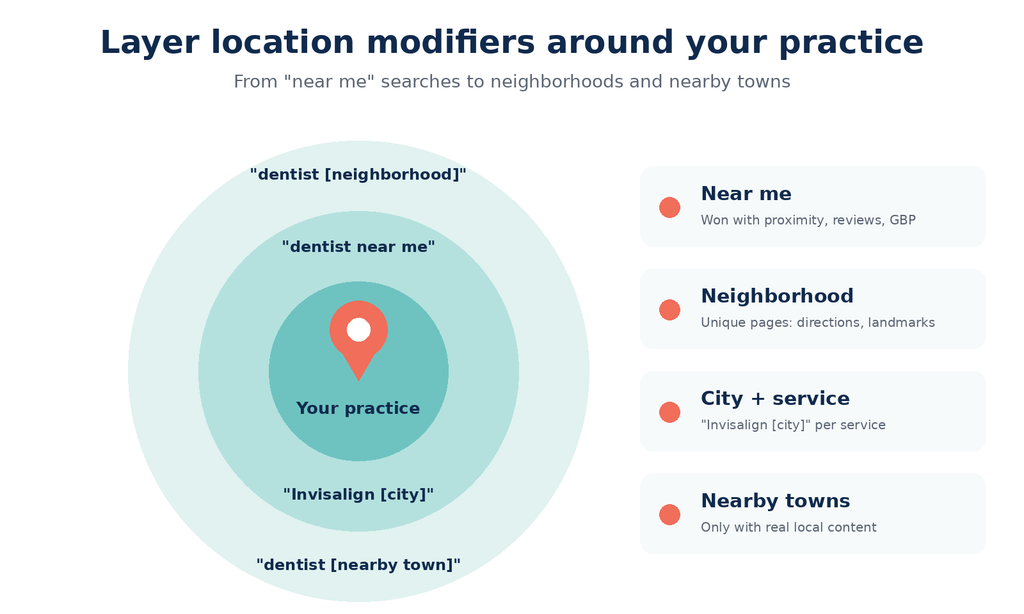
There are three kinds of location keywords to target:
- Explicit city or neighborhood terms: “dentist in Austin,” “cosmetic dentist Brooklyn,” “Invisalign Upper East Side.”
- “Near me” searches: “emergency dentist near me,” “pediatric dentist near me.” Google uses the searcher’s location, so you rank for these through strong local signals rather than by stuffing “near me” into your copy.
- Implicit local searches: Someone types just “teeth whitening” on their phone, and Google still shows nearby practices because it assumes local intent.
To build your location list, go beyond your city name. Include surrounding suburbs, neighborhoods, ZIP-area names, and local landmarks patients use (“dentist near Downtown Mall”). Combine them with your core services to create keyword pairs like “dental implants + [suburb].”
Be careful not to create dozens of near-identical city pages with only the town name swapped. Google treats these as thin, low-value content. A location page should earn its place with unique details: directions, parking, nearby landmarks, local reviews, team members at that office, and services offered there.
Location keywords also power your Google Business Profile, which drives the map pack results that appear above organic listings. Your primary category, services list, business description, and review responses all reinforce your local relevance. For a deeper strategy on ranking in the map pack, explore our local SEO services.
How to Do Dental Keyword Research, Step by Step
You don’t need to be an SEO expert to build a strong keyword list. Follow this process:
- Brainstorm seed keywords. List your services, the conditions you treat, and the questions your front desk hears every day. Your team is a goldmine here: ask them what new patients say on the phone.
- Expand with keyword tools. Enter each seed term into a tool such as Google Keyword Planner, Ahrefs, Semrush, or Ubersuggest. Export related keywords, questions, and variations along with their monthly search volume and difficulty score.
- Mine Google itself. Type a keyword and note the autocomplete suggestions, the “People also ask” questions, and the “Related searches” at the bottom of the page. These are real patient queries, for free.
- Check Google Search Console. If your site is already live, Search Console shows which queries trigger impressions for your pages. Look for terms where you rank on page two; they are often the quickest wins.
- Add location modifiers. Pair your service keywords with your city, neighborhoods, and suburbs.
- Group keywords into topics. Cluster terms that mean the same thing (“tooth implant,” “dental implant,” “implant teeth”) so they can be targeted by one page.
- Prioritize. Score each cluster on three factors: business value (how profitable is the treatment?), intent (how close is it to booking?), and difficulty (can you realistically rank?).
Don’t obsess over search volume alone. In local dentistry, a keyword with just 40 searches a month can be worth thousands of dollars if it’s “All-on-4 dental implants [your city].” Volume tells you how many people search; value and intent tell you whether it’s worth winning.
Competitor Analysis: Learn From the Practices Already Ranking
Your competitors have already done some of your keyword research for you. By studying the dental practices that rank in your area, you can spot proven opportunities and gaps they’ve missed.
Step 1: Identify your real search competitors. Search your most important keywords, such as “dentist [city]” and “dental implants [city].” Note which practices appear repeatedly in the map pack and the top organic results. These may not be the offices you consider rivals; they are simply the ones Google rewards.
Step 2: See which keywords they rank for. Plug their domains into a tool like Semrush or Ahrefs and review their organic keywords. Sort by traffic to see which pages bring them the most visitors.
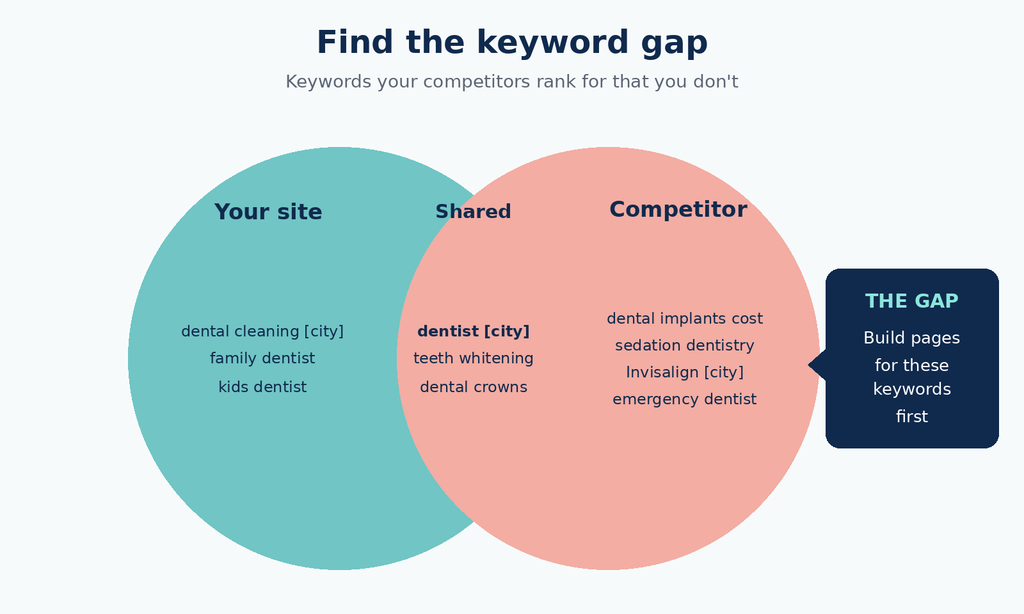
Step 3: Run a keyword gap analysis. Most tools let you compare your domain against several competitors to reveal keywords they rank for and you don’t. These gaps often point to entire services or topics missing from your site.
Step 4: Study their pages, not just their keywords. Open their top-ranking service pages. How long are they? Do they include pricing ranges, FAQs, before-and-after photos, doctor bios, or financing details? Your goal isn’t to copy them; it’s to create a more helpful, more complete page.
Step 5: Look for weaknesses. Outdated blog posts, thin service pages, slow websites, or few reviews are all openings. If no local competitor has a strong page for “sedation dentistry” or “dental implants cost,” that’s a keyword you can own.
Mapping Keywords to the Right Pages
A keyword list is useless until each term has a home. Keyword mapping means assigning every keyword cluster to one specific page on your website. It is the step that turns research into rankings.
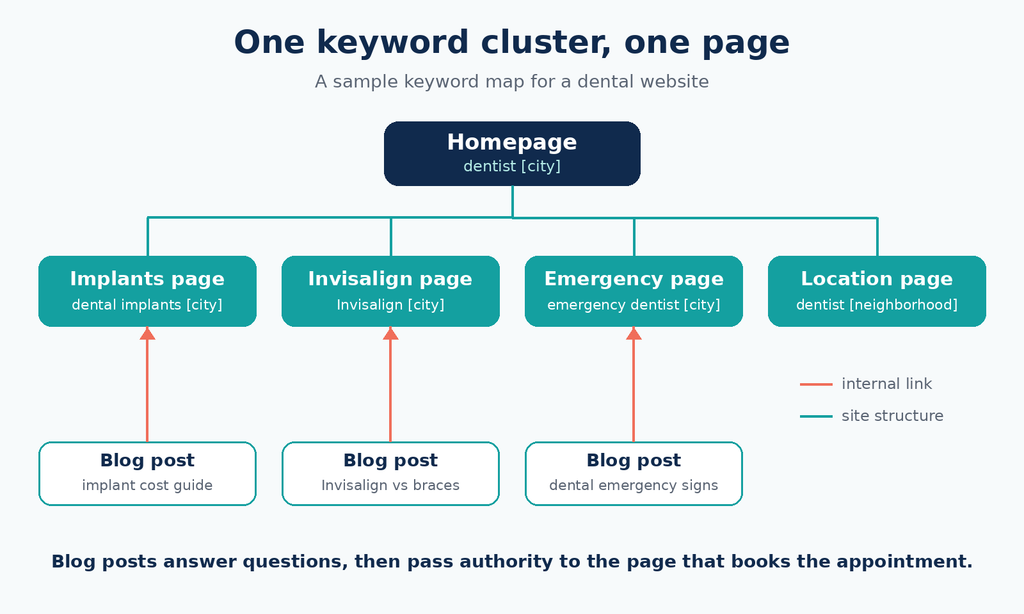
The golden rule: one primary keyword cluster per page. If your homepage, your “Services” page, and a blog post all target “dental implants,” they compete with each other. This problem, called keyword cannibalization, confuses Google and often means none of the pages rank well.
Here is a simple keyword map for a typical dental practice:
| Page | Primary keyword | Supporting keywords | Intent |
|---|---|---|---|
| Homepage | dentist [city] | family dentist [city], dental office [city] | Navigational / local |
| Dental implants page | dental implants [city] | tooth implants, All-on-4, implant cost | Transactional |
| Invisalign page | Invisalign [city] | clear aligners, invisible braces for adults | Transactional |
| Emergency page | emergency dentist [city] | same-day dentist, broken tooth repair | Urgent / transactional |
| Location page | dentist [neighborhood] | dental office near [landmark] | Local |
| Blog post | how much do dental implants cost | implant price, are implants worth it | Informational |
| Blog post | Invisalign vs braces | which is better, aligner pros and cons | Commercial investigation |
Once a keyword is mapped, optimize the page around it:
- Put the primary keyword in the title tag, H1, and URL (for example, /dental-implants-austin/).
- Write a compelling meta description that includes the keyword and a reason to click.
- Use supporting keywords naturally in subheadings and body copy.
- Add image alt text that describes the image and, where it fits, the topic.
- Answer common questions in an FAQ section, which can also win “People also ask” spots.
- Link from blog posts to service pages with descriptive anchor text, so authority flows toward the pages that generate bookings.
These on-page details are where many practices leave rankings on the table. If you want an expert team to handle titles, headers, content structure, and internal linking for you, see our on-page SEO services.
Keep your keyword map in a simple spreadsheet and update it each time you publish a new page. It becomes your content roadmap: any important cluster without a page is your next piece of content.
Question Keywords and Voice Search: Turning FAQs Into Traffic
Some of the most valuable dental SEO keywords are full questions. Patients are nervous, curious, and cost-conscious, so they ask Google the same things they’re too shy to ask at the chair. “Does a root canal hurt?” “How long does teeth whitening last?” “Can I get implants if I have bone loss?”
Question keywords are powerful for three reasons. First, they usually have low competition, because few dental websites answer them directly. Second, they can win the “People also ask” boxes and featured snippets that appear above regular results. Third, they build trust: a patient who gets a clear, friendly answer from your website is far more likely to book with you than with a practice they’ve never heard of.
Voice search makes questions even more important. When someone asks their phone, “Hey Google, where’s a dentist open on Sunday?”, they speak in full, conversational sentences. Those searches tend to be local and urgent, which is exactly the kind of patient you want.
Here’s how to capture question keywords:
- Collect real questions. Ask your hygienists and front desk team to note every question patients ask for two weeks. Add the “People also ask” questions you find during research.
- Group them by treatment. Questions about implants belong on the implants page or a linked implants blog post, not scattered randomly across your site.
- Answer in the first sentence. Give a direct 40 to 60 word answer right under the question, then expand with detail. This is the format Google most often pulls into featured snippets.
- Use FAQ sections on service pages. Five or six well-chosen questions at the bottom of each service page add relevant keywords, handle objections, and keep visitors on the page longer.
- Write like you talk. Conversational phrasing such as “Yes, most patients feel little to no pain” matches how voice searches are spoken.
Insurance, Payment and Seasonal Keywords
Cost is one of the biggest barriers to dental care, so many patients search with money in mind before they search for a dentist. Keywords like “dentist that accepts Cigna,” “Medicaid dentist for kids,” “no insurance dentist,” and “dental implants payment plans” signal a patient who is ready to book as long as the finances work out.
If your practice accepts specific insurance plans, create a clear insurance page that names each provider you work with. Patients search for those brand names directly, and a page that lists them helps you appear for those searches. If you offer in-house membership plans, third-party financing, or discounts for cash payment, give each a short, keyword-rich section that explains how it works.
Seasonal keywords are another overlooked opportunity. Search patterns shift through the year in predictable ways:
- January: New-year resolution searches like “teeth whitening” and “Invisalign” rise.
- Spring: Wedding season drives interest in “smile makeover” and “veneers before wedding.”
- Summer: “Kids dentist” and “back to school dental checkup” climb as families prepare for the school year.
- October to December: “Use your dental benefits before year end” becomes timely, since many insurance benefits reset on January 1.
Use Google Trends to confirm these patterns for your own area, then publish or refresh related content four to six weeks before each peak. That gives Google time to index the page before demand arrives.
How to Track Whether Your Keywords Are Working
Keyword research is only worthwhile if you measure the results. Rankings alone don’t pay the bills, so track the full path from search to appointment.
| Metric | Where to find it | What it tells you |
|---|---|---|
| Keyword rankings | Rank tracker (Semrush, Ahrefs, BrightLocal) | Whether target pages are moving up for mapped keywords |
| Impressions and clicks | Google Search Console | How often you appear and how often searchers choose you |
| Click-through rate | Google Search Console | Whether your title tags and meta descriptions are compelling |
| Map pack visibility | Local rank grid tool | How you rank across different parts of your service area |
| Calls, directions, website clicks | Google Business Profile insights | How local searches turn into real actions |
| Form fills and booked appointments | Google Analytics 4, call tracking, practice software | Which keywords and pages actually produce new patients |
Track local rankings from several points across your city, not just from your office. A practice can rank first for “dentist near me” a block away and not appear at all three miles out. Grid-based tools show this clearly.
Review your numbers monthly and look for patterns. Pages with high impressions but low clicks need better titles. Pages stuck in positions 8 to 15 often need more depth, more internal links, or a few quality backlinks. Keywords that bring traffic but no calls may have the wrong intent, or the page may need a clearer call to action. SEO results typically build over three to six months, so judge trends rather than single weeks.
A 30-Day Dental Keyword Research Action Plan
If this feels like a lot, break it into four focused weeks:
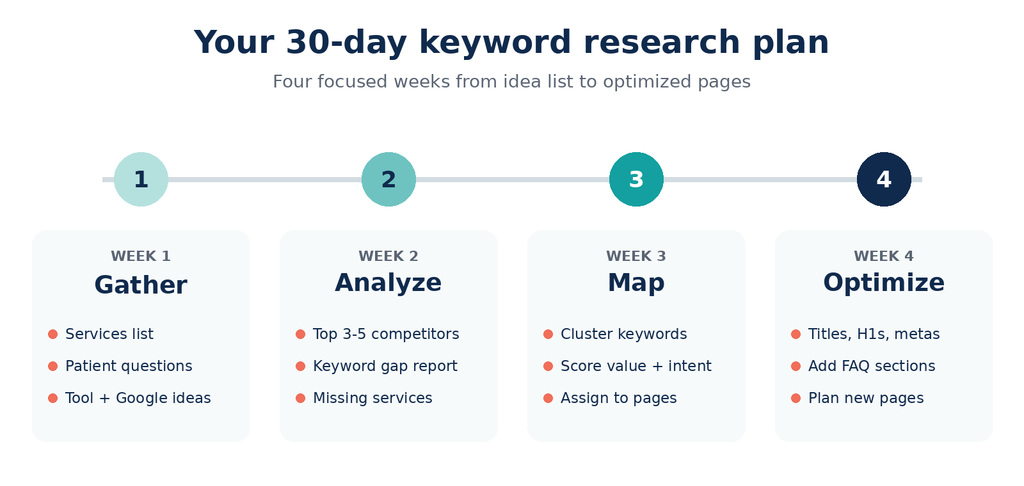
- Week 1: Gather. List every service, collect patient questions from your team, and pull 10 to 20 keyword ideas per service from your keyword tool, Google autocomplete, and “People also ask.”
- Week 2: Analyze. Identify your top three to five local search competitors, run a keyword gap report, and note which services they cover that you don’t.
- Week 3: Prioritize and map. Group keywords into clusters, score them on value, intent, and difficulty, and assign each cluster to a page in your keyword map spreadsheet.
- Week 4: Optimize and plan. Update title tags, H1s, and meta descriptions on your existing service pages, add FAQ sections, and schedule new pages and blog posts for any clusters that don’t yet have a home.
At the end of the month, you’ll have something most dental practices never create: a clear, prioritized roadmap that tells you exactly which keywords to target, on which pages, in what order.
Common Dental Keyword Mistakes to Avoid
- Using clinical jargon. “Periodontal therapy” matters, but “gum disease treatment” is what most patients type. Use both, leading with patient language.
- Chasing only high-volume terms. “Dentist” alone is nearly impossible to win and too vague to convert. Specific, local, treatment-focused terms bring better patients.
- Keyword stuffing. Repeating “best dentist in Dallas” ten times in a paragraph reads badly and can hurt rankings. Write for people first.
- Ignoring intent. Trying to rank a sales-focused service page for an informational question rarely works. Match the page type to the search.
- Forgetting mobile and voice search. Many dental searches happen on phones, often as spoken questions like “Is there a dentist open now near me?” Conversational FAQs help capture these.
- Setting and forgetting. Search behavior changes, new treatments emerge, and competitors improve. Revisit your keyword research at least every six months.
Turn Keywords Into New Patients
The best dental SEO keywords aren’t necessarily the ones with the biggest numbers. They are the terms that match what your ideal patients search, at the moment they’re ready to act, in the area you serve.
To recap the process: understand search intent, build treatment-specific keyword lists, add location modifiers, learn from competitors, and map every keyword cluster to a single, well-optimized page. Do this consistently, and your website becomes a steady source of new patient calls rather than a digital brochure.
Keyword research is just one piece of a winning strategy. Pair it with the tactics in our dental SEO marketing guide to strengthen your technical SEO, content, reviews, and local presence.
Ready to put this into action without spending your evenings in keyword tools? Explore our SEO packages to find a plan that fits your practice, and let our team handle the research, mapping, and optimization while you focus on your patients.