


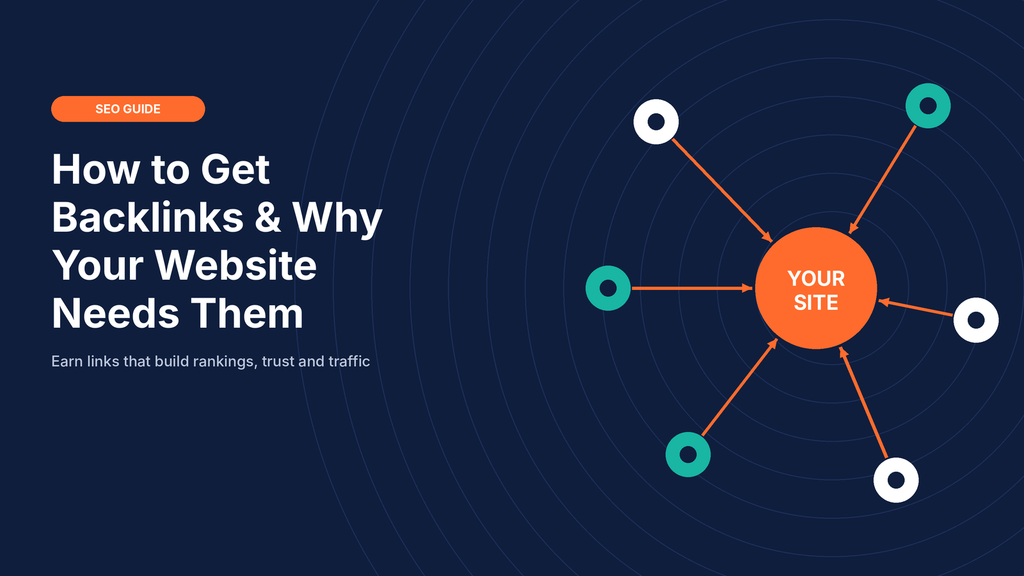
How to Get Backlinks and Why Your Website Needs Them

You can publish the best content in your industry and still sit on page three of Google. More often than not, the missing piece isn’t your writing, your design, or even your keywords. It’s that nobody else on the internet is vouching for you.
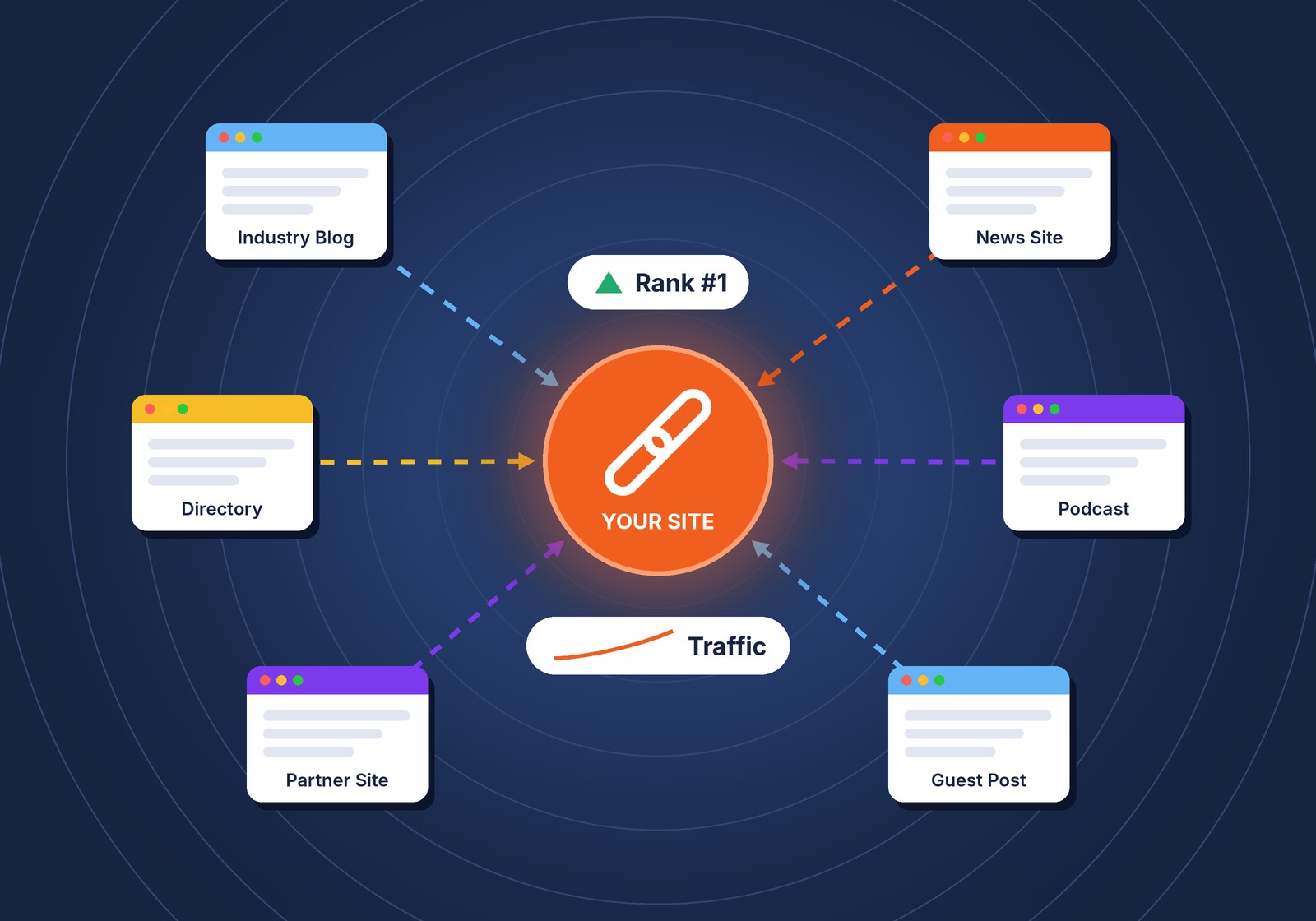
That vouching comes in the form of backlinks. Every time another website links to yours, it sends a signal to search engines: this page is worth visiting. Collect enough of those signals from the right places, and your pages start climbing. Ignore them, and even great content struggles to get seen.
Backlinks have been part of how search engines rank pages since the earliest days of Google, and they still matter today. What has changed is which links count and how you earn them. Shortcuts that worked a decade ago can now get a site penalized, while genuine relationships and genuinely useful content earn links that keep paying off for years.
In this guide, we’ll break down exactly what backlinks are, why your website needs them, what separates a valuable link from a worthless one, and nine practical strategies you can start using this week to earn links the right way.
What Exactly Is a Backlink?
A backlink is simply a link on another website that points to a page on your website. If a local news site writes about your bakery and links to your homepage, that’s a backlink. If an industry blog cites your research and links to your article, that’s a backlink too.
Think of each link as a recommendation. One recommendation from a stranger doesn’t mean much. A dozen from respected experts in your field means a lot. Search engines read the web the same way.
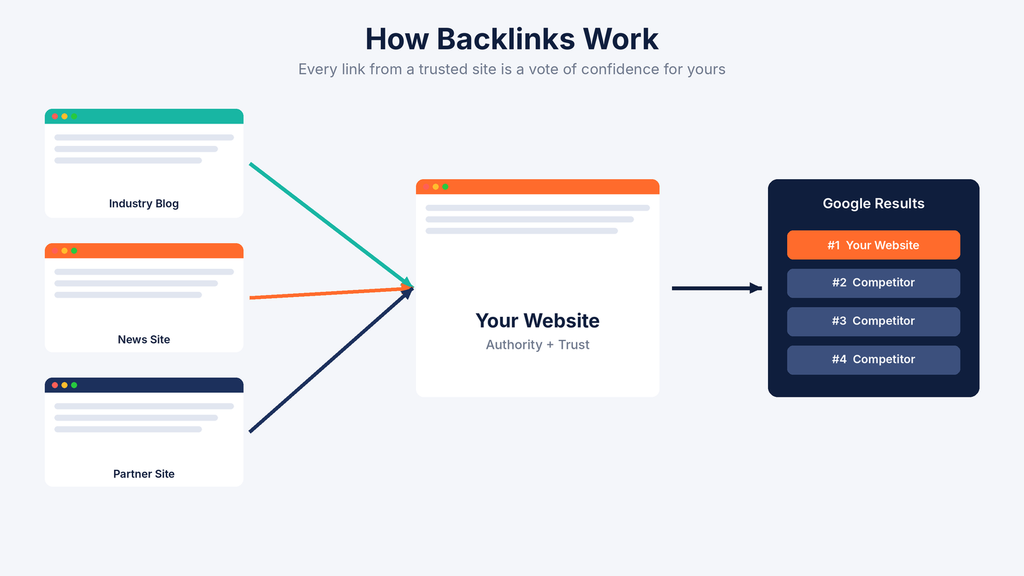
Backlinks are the backbone of off-page SEO, the work you do outside your own website to build its reputation. On-page SEO makes your site understandable; off-page SEO makes it trusted.
The Different Types of Links
Not every link passes the same value. Google lets site owners tag links with attributes that describe the relationship:
- Follow (standard) links: The default. These pass ranking value (often called “link equity”) from one page to another.
- Nofollow links (
rel="nofollow"): A hint that the linking site doesn’t want to endorse the page. Google treats it as a hint rather than a strict rule, so these can still carry some benefit, plus real referral traffic. - Sponsored links (
rel="sponsored"): Used for paid placements, ads, and affiliate links. Paid links should always carry this tag. - UGC links (
rel="ugc"): Links in user-generated content such as comments and forum posts.
A healthy backlink profile includes a natural mix of all of these. A profile made entirely of follow links with exact-match keywords looks manufactured, because real people don’t link that way.
Anchor Text Matters Too
Anchor text is the clickable wording of a link. It gives search engines context about the page being linked to. Natural anchor text varies: your brand name, a bare URL, phrases like “this guide,” and occasionally a descriptive keyword phrase. Over-optimizing anchors with the same keyword again and again is one of the fastest ways to look spammy.
Why Your Website Needs Backlinks
Backlinks aren’t just an SEO checkbox. They affect how search engines see you, how fast your pages are discovered, and how many real people find their way to your business. Here’s how.
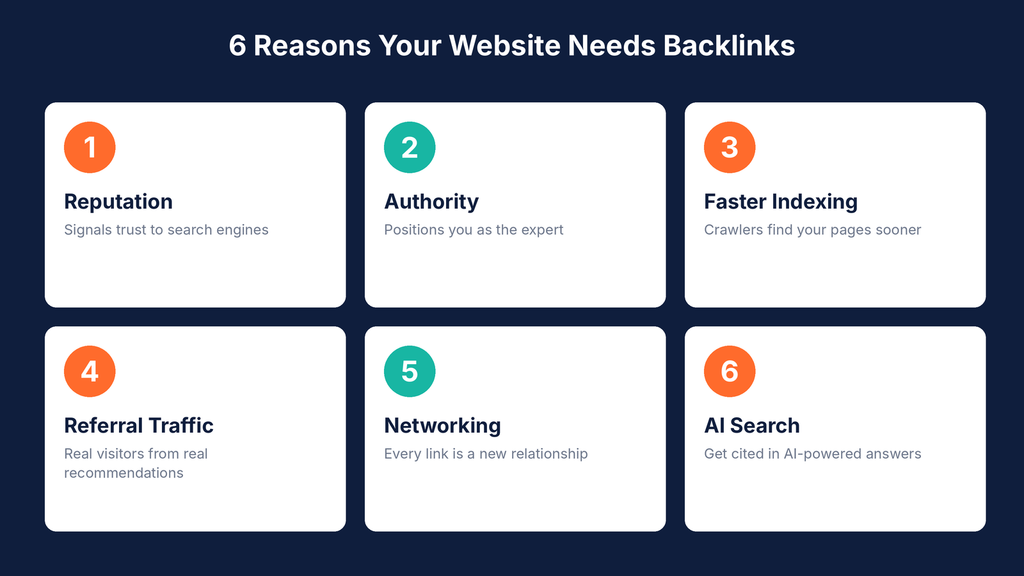
1. Backlinks Build Your Site’s Reputation
Search engines want to show users the most trustworthy result for every search. One of the strongest ways they judge trust is by looking at who links to you. A link from a respected, relevant website works like a reference on a job application. The more credible references you have, the more confident Google becomes that your page deserves a top spot.
2. Backlinks Position You as an Authority
When other businesses, journalists, and bloggers cite your content, they’re telling their own audiences that you know what you’re talking about. Over time, a consistent stream of links around one subject builds topical authority. That makes it easier for every page on your site to rank for related searches, not just the pages that earned the links.
3. Backlinks Help Your Pages Get Indexed Faster
Search engine crawlers discover new pages by following links. If your new blog post is linked from a popular site that gets crawled several times a day, Google will find your post much sooner than if it relied on your sitemap alone. For new websites especially, a few good backlinks can be the difference between being indexed in days rather than weeks.
4. Backlinks Send Real Referral Traffic
It’s easy to forget that links were made for people before they were made for algorithms. A well-placed link on a relevant blog, directory, or news article sends visitors who are already interested in your topic. Those visitors often convert better than cold traffic because they arrived on a recommendation.
5. Backlinks Boost Your Networking Power
Earning links requires reaching out to other site owners, editors, and creators. Each of those conversations is a relationship. Today’s guest post becomes tomorrow’s joint webinar, referral partnership, or co-marketing campaign. Good link building quietly grows your professional network.
6. Backlinks Support Visibility in AI-Powered Search
AI search experiences, such as Google’s AI Overviews and chat-based assistants, tend to draw on sources that are well cited across the web. Brands that are frequently mentioned and linked by trusted publications are more likely to show up when those tools summarize a topic. Building authoritative links today helps future-proof your visibility.
Backlinks deliver the most value when they’re part of a planned effort with clear goals, timelines, and tracking. If you’re mapping that out, our guide to SEO campaign management walks through how to structure a campaign from keyword research to reporting.
What Makes a Backlink High Quality?
One great link can outweigh a hundred weak ones. Before you chase any opportunity, run it through these six questions.
| Quality factor | What to look for | Red flag |
|---|---|---|
| Relevance | The linking site covers your industry or a closely related topic | A pet blog linking to a law firm |
| Authority | The site has its own strong backlinks and steady organic traffic | High “domain score” but almost no real visitors |
| Placement | The link sits inside the main body of useful content | Footer, sidebar, or a page full of unrelated links |
| Anchor text | Natural wording: brand name, URL, or descriptive phrase | The same exact-match keyword every time |
| Traffic potential | Real readers who might click through | Pages that exist only to host links |
| Uniqueness | A new referring domain you don’t already have | The 40th link from the same site |
Relevance is king. A link from a small but highly relevant niche blog will usually do more for you than a link from a huge site that has nothing to do with your business. Search engines look at the context around a link, not just the strength of the site.
Diversity matters. Ten links from ten different trustworthy websites are far more valuable than ten links from one. A natural profile also includes a mix of link types: editorial mentions, guest contributions, directory listings, partner pages, and press coverage.
Metrics are a guide, not a goal. Third-party scores such as Domain Rating or Domain Authority are useful for quick comparisons, but Google doesn’t use them. Always check whether a site has real traffic and real readers before you pursue it.
How to Get Quality Backlinks: 9 Proven Strategies
Now for the part you came for. These strategies work for small local businesses and national brands alike. You don’t need to do all nine at once. Pick the two or three that fit your resources and do them consistently.
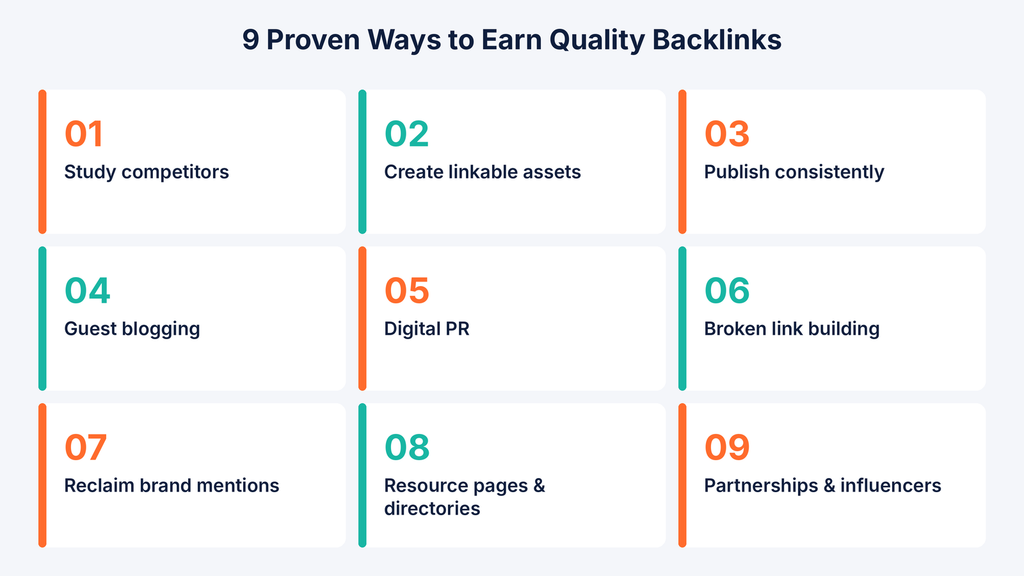
1. Study (and Imitate) Your Competitors
Your competitors have already done some of your research for you. Use a backlink tool such as Ahrefs, Semrush, or Moz to see which sites link to the businesses ranking above you. Look for patterns: industry directories, local news outlets, association pages, podcasts, or blogs that accept guest posts. If a site links to three of your competitors, there’s a good chance it would consider linking to you too, especially if you can offer something better.
2. Create Linkable Assets
People link to content that helps them make a point. That means original data, in-depth guides, free tools, templates, checklists, and visual resources like infographics. A “State of [Your Industry]” survey, a cost calculator, or the most complete how-to guide on a topic can earn links for years with very little additional effort. Ask yourself: would a journalist or blogger cite this? If the answer is no, it’s not a linkable asset yet.
3. Publish Fresh, Engaging Content Consistently
Links don’t come to sites that go quiet. A blog that publishes useful, well-researched content on a steady schedule gives others more reasons to reference you. Update older posts with new statistics and examples so they stay link-worthy. Content that answers real customer questions also tends to attract natural links from forums, Q&A sites, and roundup posts.
4. Become a Guest Blogger
Guest posting on respected sites in your industry puts your expertise in front of a new audience and typically earns a link back to your site in your author bio or within the content. The key is to deliver genuine value. Editors can spot a thinly disguised sales pitch from a mile away. Pitch topics their readers actually care about, write your best work, and treat each post as a portfolio piece rather than a link vehicle.
5. Use Digital PR and Journalist Requests
Reporters are always looking for expert sources. Platforms that connect journalists with experts, along with relationships you build with local and trade press, can land you mentions on high-authority news sites. Newsworthy angles help: company milestones, original research, community initiatives, or a fresh expert take on a trending topic.
6. Fix Broken Links for Other Websites
Broken link building is a win-win tactic. Find pages in your niche that link to resources that no longer exist, create (or point to) a relevant replacement on your site, and politely let the site owner know. You’re helping them fix a problem on their site, which makes them far more receptive to linking to you.
7. Reclaim Unlinked Brand Mentions
Sometimes people mention your business without linking to it. Set up alerts for your brand name, products, and key team members. When you find an unlinked mention, send a short, friendly note thanking the author and asking whether they’d add a link so readers can find you. Because they already like you enough to mention you, the success rate is often high.
8. Get Listed on Resource Pages and Trusted Directories
Many websites maintain curated lists of helpful tools, local businesses, or industry resources. Search for phrases like “[your topic] + resources” or “[your city] + business directory” to find them. Stick to directories that are relevant, well maintained, and actually used by people; avoid mass-submission directories that exist only to sell links.
9. Expand Your Network Through Partnerships and Influencers
Suppliers, clients, local organizations, nonprofits, and complementary businesses are natural link partners. Testimonials, case studies, event sponsorships, and co-created content all produce legitimate links. Influencers can help too, as long as their audience truly matches yours. A creator with a smaller, highly engaged following in your niche is usually worth more than a celebrity with a broad, unrelated audience.
Doing all of this consistently takes time, outreach skills, and the right tools. If you’d rather have experts handle the research, outreach, and relationship-building for you, our link building services focus on earning relevant, high-authority links that are safe for the long term.
Don’t Take Shortcuts: Backlink Tactics That Can Hurt You
When results feel slow, shortcuts are tempting. But Google’s spam policies specifically target manipulative link building, and its algorithms have become very good at spotting it. A penalty or algorithmic downgrade can wipe out months of progress overnight. Steer clear of these:
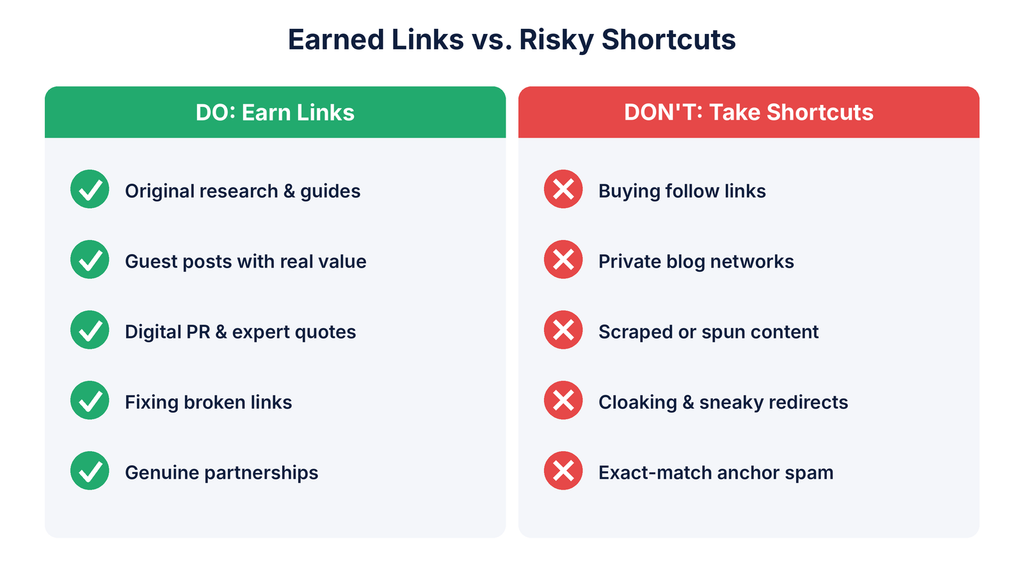
- Buying links that pass ranking value. Paying for a follow link with no
sponsoredtag is a clear violation of Google’s guidelines. - Private blog networks (PBNs). Networks of sites built only to link to each other or to clients are a well-known footprint that search engines actively hunt down.
- Excessive link exchanges. An occasional “you link to me, I link to you” between related businesses is normal. Large-scale swapping schemes are not.
- Scraped or spun content. Copying other people’s content, or running it through a rewriter to post on low-quality sites, adds no value and attracts spam signals.
- Cloaking and sneaky redirects. Showing search engines different content than users see, or redirecting visitors somewhere unexpected, is deceptive and can lead to removal from search results.
- Automated comment and forum spam. Dropping links in blog comments and forums at scale rarely helps and can damage your brand’s reputation.
- Over-optimized anchor text. If most of your links use the exact same money keyword, it looks unnatural.
The rule of thumb is simple: if a link would only exist to manipulate search rankings, and you’d be uncomfortable explaining it to a Google employee, don’t build it. Earned links take longer, but they keep their value.
How to Measure Your Backlink Success
Link building is an investment, so track it like one. These are the numbers worth watching each month:
- Referring domains. The number of unique websites linking to you. This usually matters more than the raw number of backlinks.
- Link quality and relevance. Review new links regularly. Are they coming from relevant, trustworthy sites?
- Keyword rankings. Watch the positions of the pages you’re building links to. Movement often shows up within a few weeks to a few months.
- Organic traffic. Use Google Analytics and Google Search Console to see whether linked pages are attracting more search visitors.
- Referral traffic and conversions. Check which linking sites send visitors, and whether those visitors become leads or customers.
- Lost links. Links disappear when pages are deleted or redesigned. Catching them early gives you a chance to ask for them back.
Google Search Console’s Links report is a free place to start. For deeper competitive analysis, tools like Ahrefs, Semrush, and Moz show new and lost links, anchor text distribution, and how your profile compares to competitors.
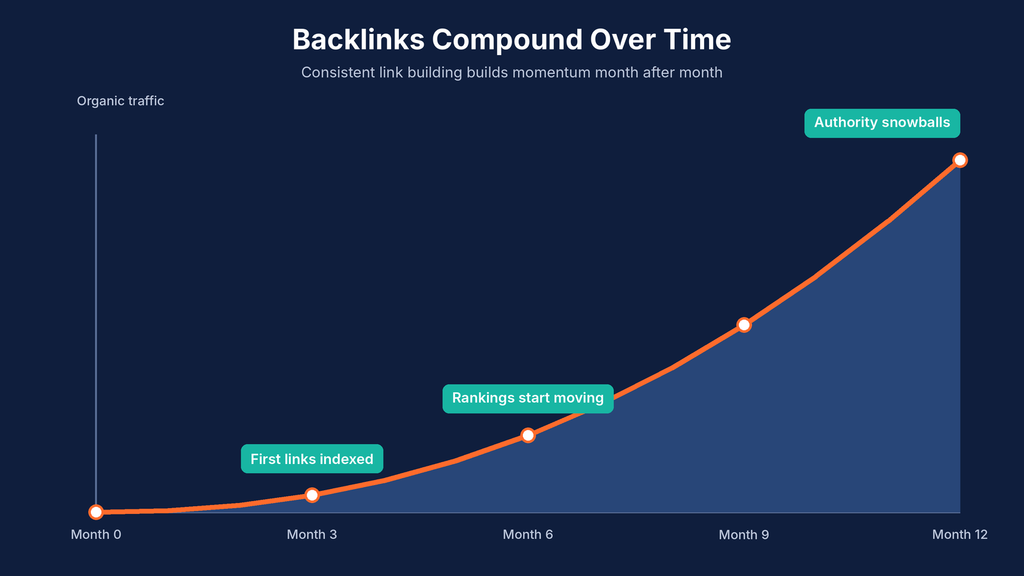
Be patient. Backlinks rarely move rankings overnight. Most businesses see meaningful movement after three to six months of consistent effort, and the benefits compound the longer you keep going.
Backlinks and AI Search: Getting Cited by ChatGPT, Gemini, Perplexity and More
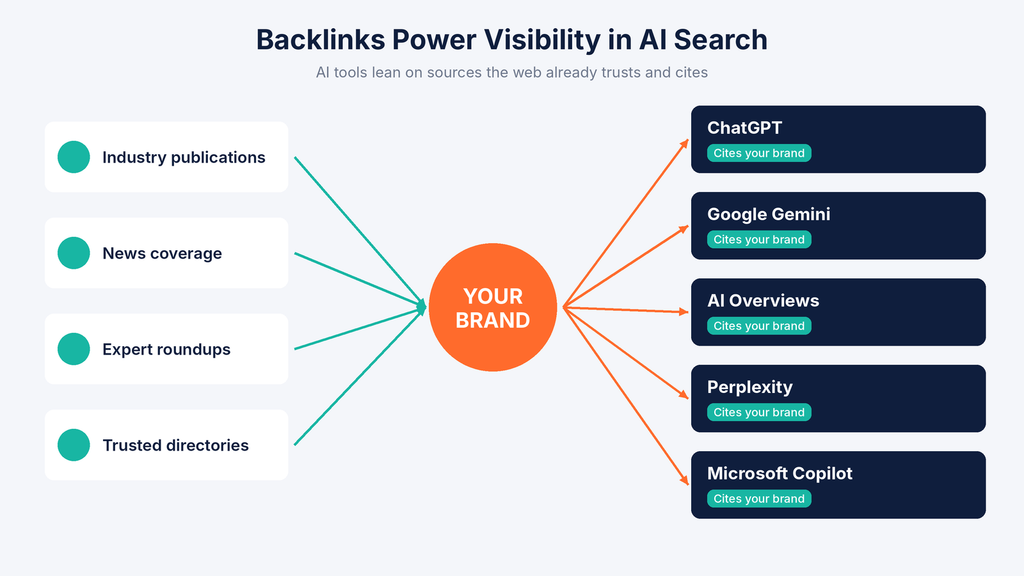
Search no longer happens only on Google’s blue links. Millions of people now ask ChatGPT, Google Gemini, Perplexity, and Microsoft Copilot for recommendations, and Google shows AI Overviews at the top of many results. These tools build their answers from content across the web, and they tend to favor brands that trusted sources already talk about.
That makes backlinks and brand mentions more valuable, not less. The same signals that help you rank on Google (authority, relevance, and being cited by respected sites) also make it more likely that an AI assistant will mention or link to your business when someone asks about your industry. This newer discipline is often called generative engine optimization (GEO) or AI search optimization.
How to Improve Your Visibility in AI Answers
- Earn mentions on trusted, relevant sites. AI tools lean on sources that are widely cited. Being featured in industry publications, news coverage, and expert roundups puts your brand in the material they draw from.
- Get included in “best of” lists and comparisons. When users ask an AI tool for “the best SEO agency for small businesses,” it often pulls from listicles and review roundups. Pitch your business to the publishers who create them.
- Don’t ignore unlinked brand mentions. Even without a link, consistent mentions of your brand alongside your topic help AI systems connect you with that subject. Reclaiming those mentions as links is a bonus.
- Keep reviews and profiles consistent. Accurate listings on Google Business Profile, industry directories, and review platforms help AI tools describe your business correctly.
- Write answer-first content. Clear headings, direct answers to common questions, and well-structured FAQs make your pages easier for AI systems to quote.
- Don’t forget Bing. Microsoft Copilot runs on Bing’s index, and other AI assistants draw on Bing results too. Verify your site in Bing Webmaster Tools and submit your sitemap.
- Use structured data. Schema markup, like the FAQ schema included at the end of this article, helps search engines and AI tools understand your content.
The bottom line: a strong backlink profile is your ticket into both traditional rankings and AI-generated answers. Brands that build authority now will be the ones AI assistants recommend tomorrow.
Backlinks Are One Piece of the SEO Puzzle
Backlinks matter, but they aren’t the whole story. Google weighs hundreds of signals, and links work best when the rest of your site is ready to make the most of them. Strong links pointing at a slow, confusing, or thin page won’t hold rankings for long.
To get the full benefit, pair your link building with:
- Technical SEO: Fast load times, mobile-friendly design, secure HTTPS, clean site structure, and pages search engines can crawl and index.
- On-page optimization: Clear titles, helpful headings, well-targeted keywords, and content that fully answers the searcher’s question.
- Internal linking: Passing authority from your most-linked pages to the pages you want to rank.
- Local SEO: An optimized Google Business Profile, consistent business listings, and reviews if you serve a specific area.
- Content strategy: A steady pipeline of useful content that gives people something worth linking to.
When all of these work together, each new backlink has a bigger impact. That’s why we treat link building as one part of a complete strategy rather than a standalone tactic. You can see how the pieces fit together in our full range of SEO services, from technical audits to content and off-page growth.
Frequently Asked Questions About Backlinks
How many backlinks do I need to rank? There’s no magic number. It depends on how competitive your keywords are and how strong the sites already ranking are. Compare the number of referring domains of the top three results for your target keyword; that gives you a realistic benchmark.
How long does it take for backlinks to work? Google has to crawl both the linking page and your page before a link counts. Most sites see an effect within a few weeks to a few months, with bigger gains building over three to six months of consistent work.
Are nofollow links worthless? No. Google treats nofollow as a hint, so these links can still help. They also send referral traffic and make your link profile look natural.
Is it ever okay to pay for backlinks? You can pay for sponsorships, advertising, or placements, as long as those links are tagged rel="sponsored" or nofollow. Paying for links designed to pass ranking value breaks Google’s guidelines.
Can bad backlinks hurt my website? Google is good at ignoring most random spammy links. If you’ve actively built manipulative links in the past, though, it’s worth auditing your profile and cleaning them up, with an SEO professional’s help if needed.
Should I do link building myself or hire an agency? If you have time for research, content creation, and consistent outreach, you can start on your own using the strategies above. If you’d rather focus on running your business, an experienced team can scale the work faster and avoid costly mistakes.
Do backlinks help my business show up in ChatGPT, Gemini, and other AI tools? Yes, indirectly. AI assistants such as ChatGPT, Google Gemini, Perplexity, and Microsoft Copilot build answers from content across the web and tend to favor brands that trusted sites already cite. Earning links and mentions from respected, relevant publications makes it more likely those tools will mention or recommend your business.
Do brand mentions without a link matter for AI search? They can. Consistent mentions of your brand alongside your topic help AI systems connect your business with that subject, even without a link. Turning those mentions into links adds traditional SEO value on top.
Final Thoughts on Getting Backlinks to Your Website
Backlinks remain one of the clearest signals search engines use to decide who deserves to rank. They build your reputation, establish your authority, speed up indexing, send qualified visitors, and grow your network along the way.
The winning formula hasn’t changed much, even as the tactics have evolved: create content worth linking to, build real relationships, and never cut corners. Start by studying your competitors, pick two or three strategies from this guide, and commit to them for the next 90 days. You’ll be surprised how quickly the momentum builds.
If you’re ready to grow your rankings without spending your evenings on outreach emails, Social Market Way can help. Explore our SEO packages to find a plan that fits your goals and budget, or reach out and we’ll build a link strategy tailored to your business.