


MSP SEO Agency: The Complete Guide to SEO for MSP Providers Who Want More Clients

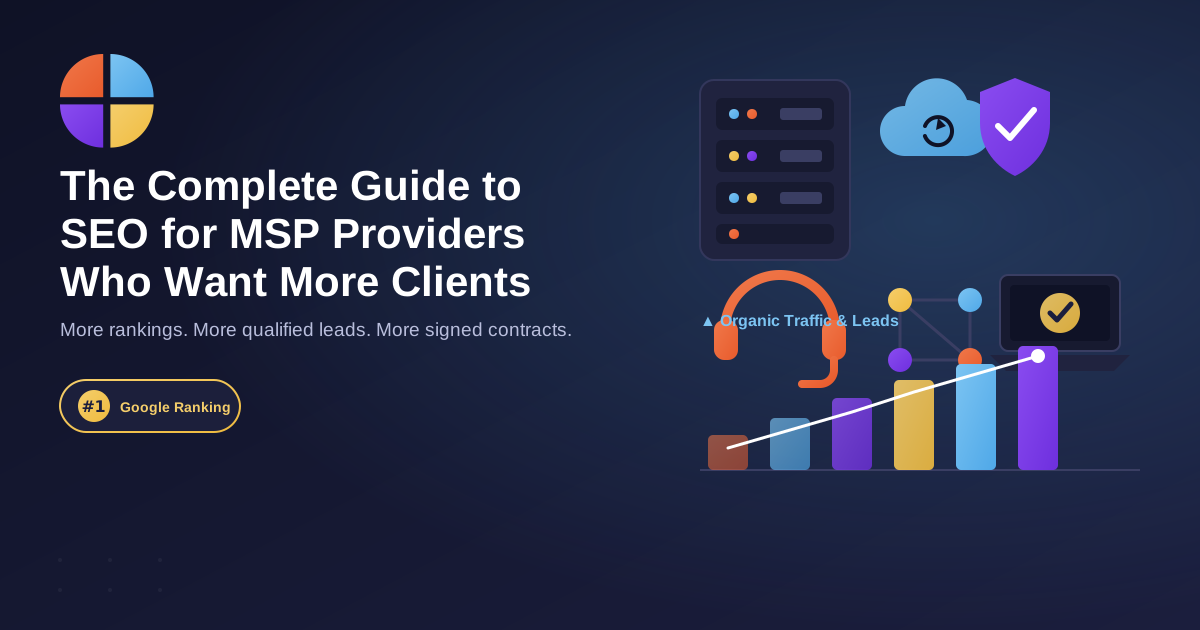
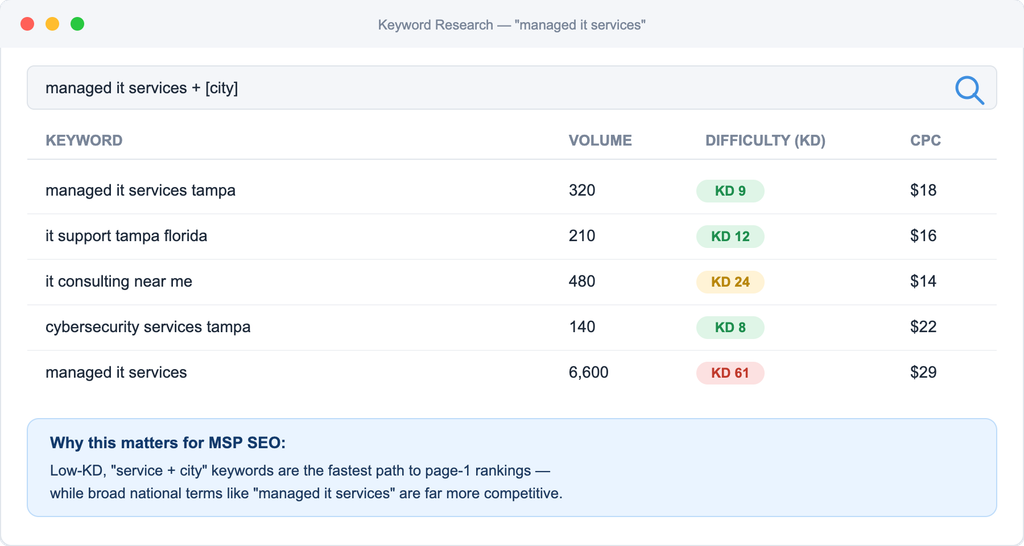
If you run a managed service provider, you already know the IT services market is crowded. Every city has a dozen MSPs claiming the same things: 24/7 support, proactive monitoring, enterprise-grade cybersecurity. So when a business owner types “managed IT services near me” or “IT support for small business” into Google, why should your company show up first?
That’s the entire job of MSP SEO services — and it’s why more managed service providers are hiring a dedicated MSP SEO agency instead of trying to bolt SEO onto a generalist marketing plan. Generic marketing agencies understand keywords. They don’t understand MRR, ticket volume, churn, or why “cloud services” means something completely different to an MSP prospect than it does to a SaaS company.
This guide breaks down exactly what search engine optimization for MSP providers looks like in practice — the keyword research, the on-page structure, the local SEO tactics, the content strategy, and the link building that, together, turn your website into a predictable source of qualified leads. By the end, you’ll understand not just what to do, but why it works for IT service businesses specifically.
What Is MSP SEO?
MSP SEO is the practice of optimizing a managed service provider’s website and online presence so it ranks higher in search engines for the terms IT buyers actually use — things like “managed IT services [city],” “IT support for small business,” “cybersecurity services near me,” and “cloud migration consultant.” Done well, it also extends to how your content shows up in AI-powered answers from tools like ChatGPT, Perplexity, and Google’s AI Overviews, since more B2B buyers are now researching vendors through conversational search before they ever visit a website.
Unlike generic SEO, SEO for MSP businesses has to account for a few unique realities:
- The sales cycle is longer and more relationship-driven. A prospect might read five blog posts before they ever fill out a contact form.
- Trust matters more than almost any other B2B category. You’re asking a business owner to hand over their network, their data, and their liability.
- Most MSPs are “service area” businesses. You don’t rely on foot traffic to one address — you serve an entire region, which changes how your site should be structured.
- Buyers use very specific language. “Managed IT services,” “co-managed IT,” “IT support,” and “computer repair” all attract different searchers with different intent.
Getting this right is a full discipline, which is exactly why so many MSPs eventually bring in specialists instead of handling it internally.
Why MSPs Hire a Dedicated MSP SEO Agency
Most internal marketing hires — and most general-purpose digital agencies — are stretched across dozens of industries. They know how to run ad campaigns and post on social media, but they don’t know the difference between a break-fix client and a managed services client, or why “HIPAA compliant IT support” is a phrase worth an entire landing page.
A specialized MSP SEO agency brings three things a generalist can’t:
- Industry-specific keyword intelligence. They already know which terms convert (managed IT services, IT consulting, network security) and which ones waste your budget.
- Proven page templates. Service pages, location pages, and industry pages that have already been tested against real MSP competitors — not built from scratch through trial and error.
- A repeatable content engine. Blog posts, FAQs, and resource pages built around the actual questions prospects ask sales reps — which is exactly the kind of content search engines (and AI search tools) reward.
If you want the fastest path from “invisible on Google” to “the obvious choice in my market,” working with a team that lives and breathes MSP marketing is almost always faster — and cheaper in the long run — than a slow, expensive trial-and-error approach.
The 3 Pillars of SEO for MSP Providers
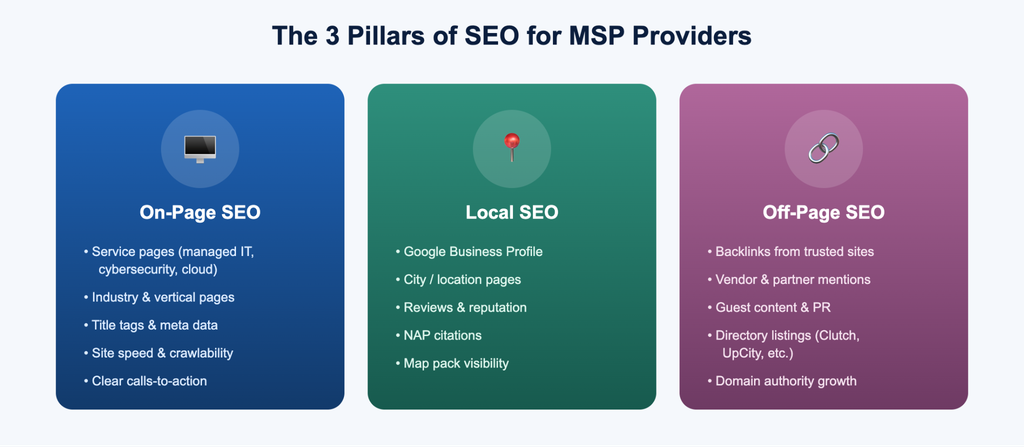
Nearly everything in search engine optimization for MSP providers falls into one of three buckets. Get all three working together and rankings — plus leads — follow.
1. On-Page SEO: Give Google (and Buyers) a Reason to Rank You
On-page SEO is everything that lives directly on your website. For MSPs, this means:
- Dedicated service pages for every offering — managed IT services, cybersecurity, cloud services, help desk support, VoIP, compliance consulting. If a service doesn’t have its own page, it has almost no chance of ranking for its own keyword.
- Industry pages for verticals you specialize in. If you serve medical practices, a page addressing HIPAA compliance and healthcare-specific pain points does double duty: it helps SEO, and it gives your sales team something to send prospects.
- Clear, benefit-driven copywriting. Skip the jargon. Speak to the business owner’s actual fear: downtime, ransomware, losing client trust, compliance fines.
- Technical fundamentals — fast load times, mobile-friendly design, clean site architecture, and no broken links. If Google’s crawlers struggle with your site, your rankings will suffer no matter how good your copy is.
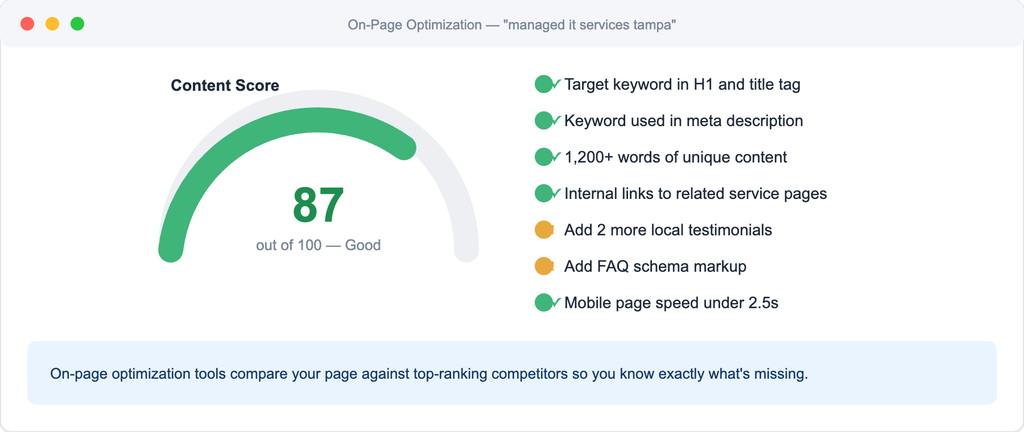
Tools like this compare your page against the top-ranking competitors for your target keyword and flag exactly what’s missing — whether that’s word count, internal links, schema markup, or local testimonials. It takes the guesswork out of on-page optimization.
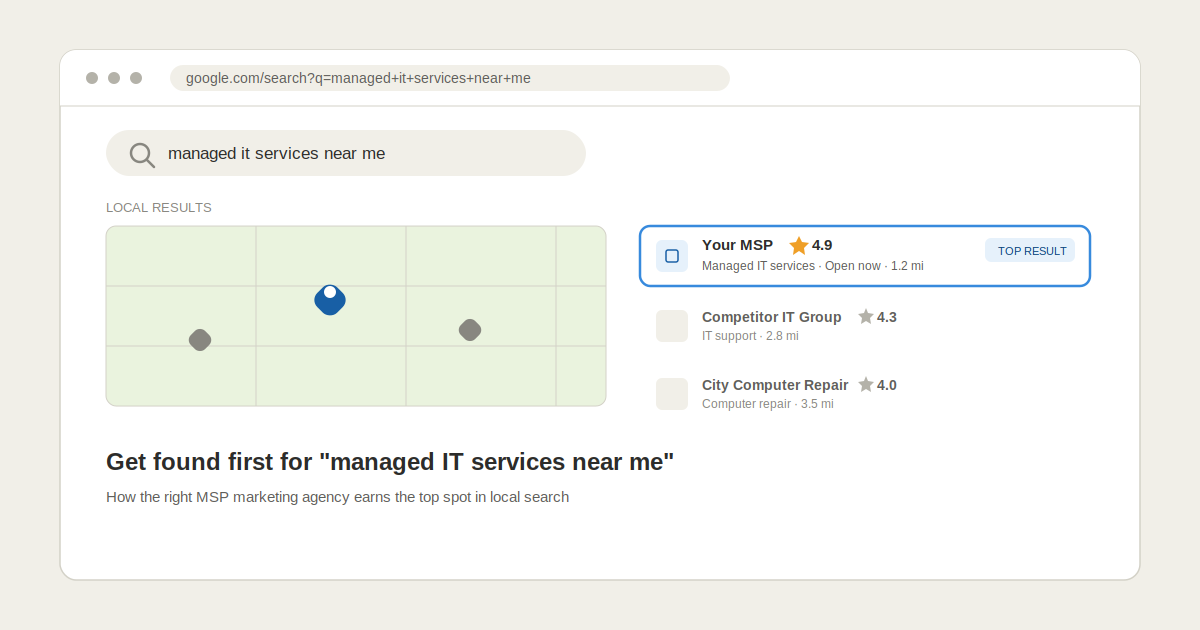
2. Local SEO: Win the Map Pack in Every City You Serve
Because most MSPs are “service area businesses” covering an entire metro or region rather than a single storefront, local SEO deserves special attention. This includes:
- Optimizing and actively posting to your Google Business Profile
- Building and maintaining location pages for each city or region you serve (for example, “Managed IT Services in [City]”)
- Collecting and showcasing reviews — both on Google and on trusted directories like Clutch, UpCity, and Cloudtango, which frequently outrank individual MSP websites for competitive terms
- Keeping your business name, address, and phone number (NAP) consistent everywhere you’re listed online
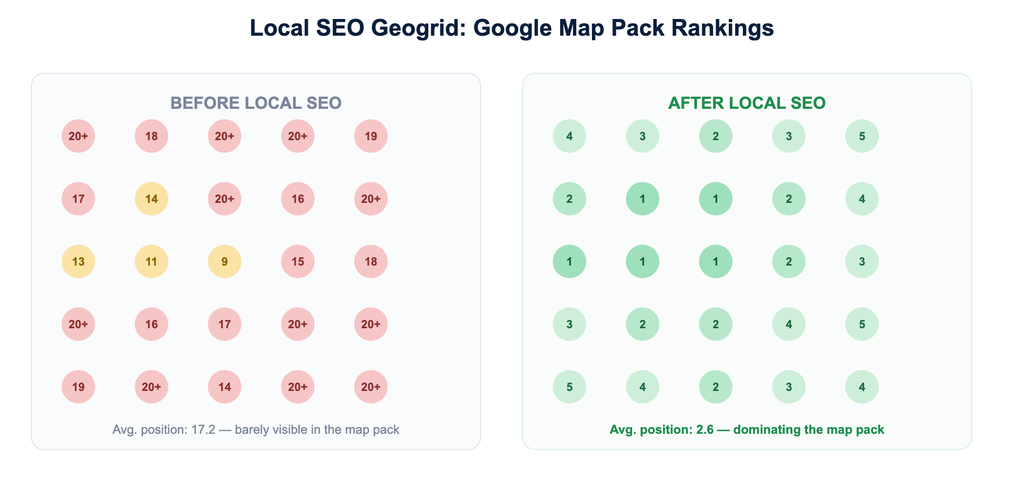
A geogrid like this maps your Google Business Profile ranking position across every neighborhood in your service area — not just one location. It’s the clearest way to see whether local SEO work is actually translating into map pack visibility where your prospects are searching.
If you’re not sure where to start with the local side of things, our dedicated local SEO services page walks through exactly how we help service-area businesses like MSPs dominate the map pack in every city they cover.
3. Off-Page SEO: Build the Authority Google Trusts
Off-page SEO is about proving to search engines that other credible sources vouch for you. For MSPs, this typically comes from:
- Backlinks from vendor partner pages, local Chambers of Commerce, and industry associations
- Guest content on relevant IT and business publications
- Directory listings on Clutch, UpCity, GoodFirms, and similar sites, which not only send referral traffic but also build the kind of link profile Google rewards
- Digital PR around case studies, certifications, or community involvement
None of these pillars work in isolation. A beautifully written service page with zero authority behind it will struggle to outrank a mediocre page from a competitor with ten years of backlinks. That’s why an effective MSP SEO agency builds a strategy that works all three levers at once.
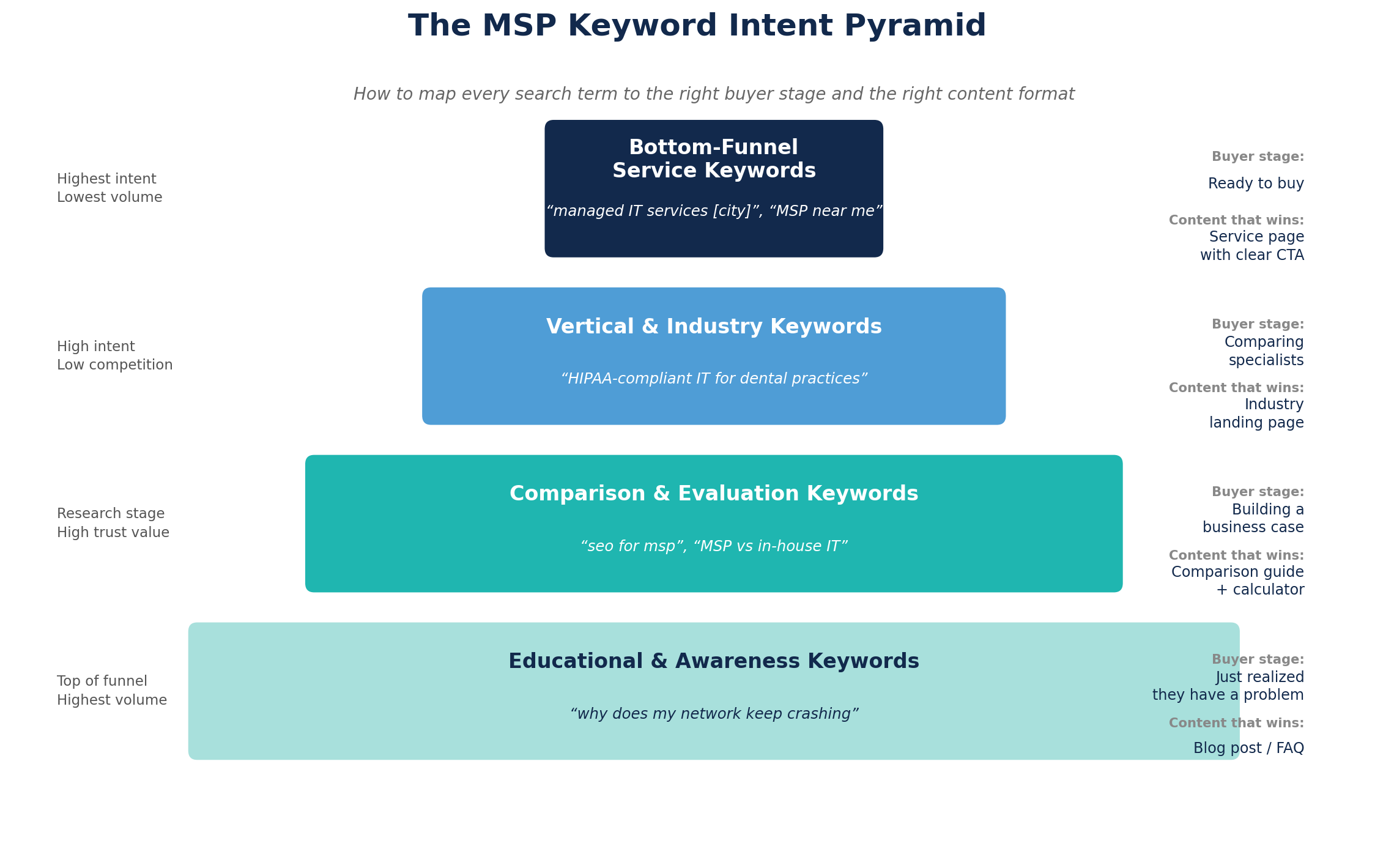
MSP Keyword Research: Finding What Your Buyers Actually Type
Keyword research is the foundation everything else is built on. Skip it, and you risk writing beautiful content for search terms nobody uses.
For MSPs, the highest-converting keyword pattern almost always follows this formula:
[Service] + [Location]
For example:
- managed IT services + [city]
- IT support + [city]
- cybersecurity services + [city]
- IT consulting + [city]
These location-modified keywords tend to have lower competition and higher buyer intent than broad national terms like “managed IT services” on its own — because the person searching is actively looking for a provider who can service their specific area today.
Beyond location-based terms, it’s worth building out content around the long-tail, question-based searches your sales team hears every week — things like “how much does managed IT cost for a small business” or “what’s included in a managed cybersecurity package.” These lower-volume, high-intent searches are often easier to rank for, and they’re also exactly the kind of clear, structured, question-and-answer content that AI search tools favor when deciding which businesses to cite as trustworthy sources.
Location Pages: The Most Underrated MSP SEO Asset
If your MSP covers multiple cities or counties — even without a physical office in each one — dedicated location pages are one of the highest-leverage moves in MSP SEO services. A location page targeting “IT support in [City]” gives Google a clear, relevant page to show local searchers, rather than forcing your homepage to try to rank for every city at once (which almost never works).
A strong location page typically includes:
- The target keyword in the title tag, meta description, and H1
- Content addressing local pain points or industries common to that area
- Testimonials from clients based in or near that city, if available
- An embedded map if your office is nearby
- A clear call-to-action to book a consultation or request a quote
Content Marketing: The Engine Behind Long-Term MSP SEO Results
Service and location pages capture people who already know what they want. Blog content captures everyone else — the much larger group of prospects still researching, comparing, or trying to solve a problem before they’re ready to talk to sales.
The MSPs that win at content consistently publish material that answers real questions their prospects and clients ask, such as:
- “How much should I budget for managed IT services?”
- “What’s the difference between managed IT and break-fix support?”
- “Is my business a target for ransomware?”
- “What should be included in a cybersecurity audit?”
This kind of content does three things at once: it captures long-tail search traffic, it builds trust before the first sales call even happens, and it gives AI search tools clean, well-structured answers to cite when someone asks a chatbot for IT service recommendations.
Of course, ranking for content and local terms is only half the equation — traffic means nothing if it doesn’t turn into signed contracts. If you want the follow-through strategy for converting that visibility into actual business, our complete guide on how to get more MSP clients breaks down the full growth playbook, from lead capture to closing.
Off-Site Authority and Link Building for MSPs
Search engines treat backlinks like votes of confidence. A link from a respected, relevant website tells Google, “other credible sources trust this business” — and that trust translates directly into higher rankings for competitive terms like “managed IT services” or “IT support.”
Practical ways MSPs build this authority include:
- Local Chamber of Commerce and business association listings — high-authority, highly relevant, and often an easy first link
- Vendor and partner co-marketing — many software and hardware vendors will link to certified partners
- Guest posts on industry publications or local business blogs
- Case studies published on a vendor’s site in exchange for a backlink to yours
- Directory profiles on platforms like Clutch and UpCity, which are notoriously difficult for individual MSP websites to outrank in search results — so appearing prominently on them is valuable in its own right
The goal isn’t just link volume. Contextual relevance matters. A link from a site actually discussing IT services or small business technology is worth far more than a random, unrelated backlink.
Technical SEO Checklist for MSP Websites
Even the best content and backlink strategy will underperform if your website itself has technical issues holding it back. Before investing heavily in content or links, make sure your site covers the basics:
- Site speed — slow-loading pages hurt both rankings and conversion rates
- Mobile responsiveness — a large share of MSP research now happens on phones and tablets
- Clean URL structure and logical site architecture
- SSL security (HTTPS) — non-negotiable for a business selling cybersecurity services
- No broken links or crawl errors that prevent Google from indexing your pages
- Schema markup for local business, services, and reviews, which helps both traditional search engines and AI search tools understand your content
How Long Does MSP SEO Take to Show Results?
This is the question every MSP owner asks, and the honest answer is: it depends on your market’s competitiveness, your site’s current authority, and how consistently the strategy is executed. That said, a realistic timeline looks like this:
- Months 1–3: Technical fixes, keyword research, and foundational on-page and local SEO work go live.
- Months 3–6: Early rankings begin to move for lower-competition, long-tail keywords and local terms.
- Months 6–12: Rankings for competitive service and location pages climb, organic traffic compounds, and lead volume becomes noticeably more consistent.
Unlike paid ads, which stop producing the moment you stop paying, SEO builds an asset. Content and rankings you earn today keep generating leads for years — which is exactly why so many MSPs treat SEO as one of their highest-ROI marketing investments over time.
This is the kind of month-over-month reporting you should expect from any agency running your campaign — tying rankings and traffic directly back to leads and closed-won clients, not just vanity metrics.
Choosing the Right MSP SEO Agency
Not every agency that claims to “do SEO” understands the MSP space. When evaluating a potential MSP SEO agency, look for:
- Proven experience with IT and MSP clients specifically — ask for real examples, not generic case studies
- Transparent reporting tied to rankings, traffic, and — most importantly — actual leads generated, not vanity metrics
- A strategy that covers all three pillars (on-page, local, off-page) rather than a narrow focus on just one
- Content that’s written for humans first, not stuffed with keywords in a way that reads awkwardly to a real prospect
- A clear understanding of your service area, your ideal client profile, and your sales process
If a proposed strategy sounds identical to what a law firm, dentist, or e-commerce store would get, that’s a red flag. SEO for MSP businesses requires a fundamentally different playbook than most other industries — the buyer psychology, sales cycle, and keyword intent are all unique to IT services. For a deeper look at how this plays out specifically for technology companies, our guide to SEO for IT providers covers the practical steps for building trust and ranking as a technology business, beyond what generic SEO advice will tell you.
Common MSP SEO Mistakes to Avoid
Even well-intentioned MSPs sabotage their own SEO efforts with a few recurring mistakes:
- Trying to rank the homepage for everything. One page can’t compete for “managed IT services,” “cybersecurity,” and five city names simultaneously. Dedicated pages win.
- Publishing thin, generic content. A 300-word blog post that could apply to any industry provides little value to readers or search engines.
- Ignoring reviews. Skipping review generation means missing one of the strongest local ranking and trust signals available.
- Treating SEO as a one-time project. Search algorithms evolve constantly. A “set it and forget it” mentality leads to rankings quietly eroding over time.
- Copying competitor content. Search engines can detect duplicate or unoriginal content, and it provides zero unique value to your prospects.
Avoiding these pitfalls alone will put your MSP ahead of a large share of competitors who are still making them.
Bringing It All Together
Search engine optimization for MSP providers isn’t a single tactic — it’s a system. Strong on-page foundations, aggressive local SEO, consistent content that answers real buyer questions, and a steady stream of authoritative backlinks all work together to make your MSP the obvious choice when a business owner searches for IT support in your area.
The MSPs winning the most business online right now aren’t necessarily the biggest or the most established — they’re the ones showing up, again and again, with genuinely helpful content exactly where and when their ideal clients are searching.
If you’d like a clear picture of where your MSP currently stands and what it would take to compete for the terms that actually drive revenue, take a look at our MSP SEO packages for a customized price built around your specific market and goals, or contact us directly and we’ll walk you through exactly what a tailored strategy would look like for your business.