


Why Is Web Design Important? 15 Benefits of Professional Website Design Services

Why is web design important? Because your website is the first place most customers meet your business, and they decide in seconds whether to stay or leave. Before anyone calls you, books an appointment or adds a product to their cart, they look at your site. If it loads slowly, looks dated or is confusing to use, they quietly click back to Google and pick a competitor. You never even find out you lost them.
That is the uncomfortable truth behind every website. It is either working for you around the clock, or it is working against you around the clock. There is no neutral setting.
The good news is that the opposite is also true. A well-designed website builds trust before you say a word. It answers questions, removes doubts, guides visitors to the next step and turns casual browsers into paying customers. It ranks better on search engines, works perfectly on phones and gives your marketing a home base that every ad, post and email can point to.
In this guide, we will cover everything a business owner needs to know about the value of a professional website:
- What web design actually is, and the most common uses of web design today
- Why website design is important for trust, sales and search rankings
- 15 concrete benefits of web design you can measure
- Why use a professional web designer instead of a DIY builder
- How design and SEO work together on WordPress, Shopify and Magento
- The warning signs that your current site is costing you money
- What to expect when you hire a web design service
Whether you are launching your first website or wondering why your current one is not bringing in leads, by the end of this article you will know exactly what a strong website can do for your business and how to get one. At Social Market Way, we have helped businesses of every size answer this question with results, not guesses, and we will share what we have learned along the way.
What Is Web Design? Understanding the Uses of Web Design
Web design is the planning and creation of everything a visitor sees and experiences on a website. It covers the layout, colors, fonts, images and buttons, but it goes much deeper than looks. Good web design also decides how pages are organized, how fast they load, how easily people find what they need and how smoothly they move from “just looking” to “ready to buy.”
Think of it like a physical store. The paint and signage matter, but so do the aisles, the lighting, the checkout counter and how easy it is to find a staff member. Web design is all of that, online.
A professional web design project usually includes:
- Visual design: branding, color palettes, typography, imagery and the overall look and feel
- User experience (UX): how visitors navigate, what they see first and how few clicks it takes to act
- User interface (UI): buttons, menus, forms and every element people click or tap
- Responsive design: layouts that adapt to phones, tablets and desktops
- Content structure: headings, page hierarchy and copy that speaks to your customer
- Technical foundations: clean code, fast loading, security and search engine readiness
The most common uses of web design
The uses of web design are as varied as businesses themselves. Here are the ones we see most often:
- Generating leads. Service businesses such as contractors, law firms, clinics and agencies use their website to collect calls, quote requests and booked appointments.
- Selling products online. Ecommerce stores rely on design to showcase products, build confidence and make checkout painless.
- Building brand credibility. A polished site proves you are a real, established business and not a fly-by-night operation.
- Educating customers. Blogs, guides, FAQs and resource centers answer questions before prospects ever pick up the phone.
- Supporting existing customers. Help centers, portals and booking systems cut down on repetitive support calls.
- Recruiting talent. Career pages show job seekers what it is like to work with you.
- Powering marketing campaigns. Landing pages turn ad clicks and email traffic into measurable conversions.
- Ranking on search engines. A well-structured site is the foundation that SEO is built on.
In short, web design is not decoration. It is the system that turns attention into revenue.
Why Is Website Design Important? The Real Reasons
Website design is important because it directly controls three things every business depends on: first impressions, trust and conversions. Let’s look at each one.
1. People judge your business in a fraction of a second
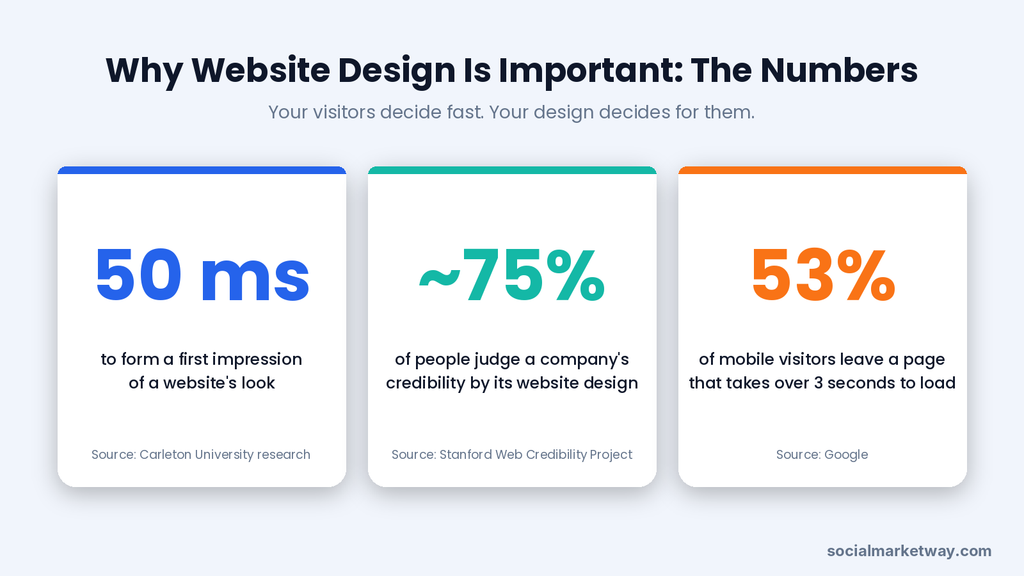
Research published by Carleton University found that people form an opinion about a web page’s visual appeal in about 50 milliseconds. That is faster than a blink. Visitors are not reading your carefully written “About Us” page in that moment. They are reacting to spacing, colors, images and how organized everything feels.
If that gut reaction is “this looks outdated” or “this feels cluttered,” many visitors leave before they ever learn what makes you great. A professionally designed website wins that split-second test so your message gets a chance to land.
2. Design is how visitors decide if you are trustworthy
The Stanford Web Credibility Project found that roughly three out of four people admit to judging a company’s credibility based on its website design. Think about your own habits. Would you enter your credit card on a site that looks like it was built in 2009? Would you trust a surgeon whose website has broken images and spelling errors?
Your customers make the same calls. Clean design, consistent branding, real photos, visible reviews and clear contact details all send the same signal: this business is legitimate, established and safe to deal with.
3. Design decides whether visitors take action
Traffic alone pays no bills. What matters is how many visitors call, book, buy or fill out a form. Web design shapes every step of that path:
- Where the call-to-action button sits and whether it stands out
- How many fields are on your contact form
- Whether pricing, services and next steps are easy to find
- How quickly the page loads on a phone with weak signal
Small design choices compound. A button moved above the fold, a form cut from ten fields to four or a page that loads two seconds faster can each lift conversions noticeably. Multiply that across thousands of visitors a year and the difference between a good and a bad design becomes the difference between a growing business and a stagnant one.
Why web design is important for mobile users
Most web traffic today comes from smartphones. Google has reported that more than half of mobile visitors abandon a page that takes longer than three seconds to load. If your site is slow, hard to tap through or forces people to pinch and zoom, you are turning away the majority of your audience. Responsive, mobile-first design is no longer a nice extra. It is the baseline.
15 Web Design Benefits Every Business Should Know
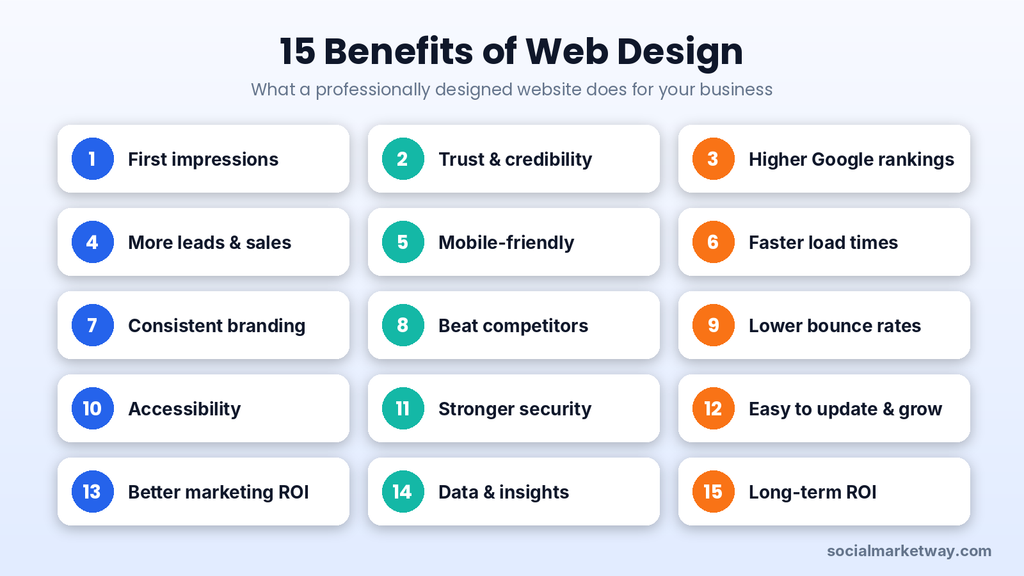
Now for the practical side. Here are the biggest benefits of web design, the ones that show up in your traffic reports, your inbox and your bank account.
1. A powerful first impression
Your homepage is your digital storefront. A modern, polished design tells visitors you are professional and current before they read a single word. That first impression colors everything that follows, from how they read your prices to how seriously they take your reviews.
2. Higher trust and credibility
Trust is the currency of online business. Professional design builds it with consistent branding, real team photos, client logos, testimonials, security badges and clear policies. When visitors trust you, they are far more willing to share their email, pick up the phone or hand over payment details.
3. Better search engine rankings
Google rewards websites that are fast, mobile-friendly, secure and easy to navigate, which are all products of good design. Clean code, a logical page structure and proper heading tags help search engines understand and rank your content. Design and SEO are partners, not separate projects, which is why every site we build is ready for on-page SEO from day one.
4. More leads and sales
This is the benefit that matters most to most owners. Strategic design places calls to action where people are ready to act, removes friction from forms and checkouts and guides visitors along a clear path. The result is a higher conversion rate, which means more customers from the same amount of traffic.
5. An outstanding mobile experience
Responsive design makes your site look and work beautifully on every screen size. Buttons are easy to tap, text is easy to read and menus collapse neatly. Since most of your visitors are likely on their phones, this one benefit can transform your results on its own.
6. Faster loading speeds
Professional designers optimize images, streamline code and choose lightweight layouts so pages load quickly. Speed affects everything: bounce rates, conversions, ad costs and search rankings. A fast site simply makes more money than a slow one.
7. Consistent branding everywhere
Your website should look and sound like the rest of your business, from your logo and business cards to your social profiles and email newsletters. A designer builds a cohesive visual identity so customers instantly recognize you wherever they find you. Consistency makes brands memorable, and memorable brands win repeat business.
8. Standing out from competitors
In crowded markets, many businesses offer similar services at similar prices. Your website is one of the few places you can clearly show why you are different. Custom design, sharp messaging and proof of results make it easy for prospects to choose you over the competitor down the street.
9. Lower bounce rates and longer visits
When a site is attractive, organized and easy to explore, people stick around. They click to a second page, then a third. Longer visits mean more chances to persuade, and they also send positive engagement signals to search engines.
10. Better accessibility for every visitor
Accessible design, such as readable color contrast, descriptive image text, keyboard navigation and clear fonts, opens your business to people with disabilities and older users. It is the right thing to do, it widens your audience and it reduces legal risk under accessibility regulations.
11. Stronger security
Professional builds include SSL certificates, secure hosting, updated plugins and protected forms. A hacked website can destroy years of reputation overnight and get flagged by Google. Good design includes the unseen technical work that keeps you and your customers safe.
12. Easier updates and room to grow
A well-built site runs on a flexible content management system, so you can add pages, blog posts, products or services without rebuilding from scratch. As your business grows, your website grows with it instead of holding you back.
13. Better results from all your marketing
Every ad, social post, email and business card points people to your website. If that destination underperforms, every marketing dollar you spend is partly wasted. A high-converting website multiplies the return on everything else you do.
14. Useful data and insights
Modern websites come with analytics, conversion tracking and heatmaps built in. You can see which pages attract visitors, where they drop off and which channels bring paying customers. That data lets you make smarter decisions instead of guessing.
15. A long-term return on investment
A website is not an expense that disappears after it launches. It is an asset that works 24 hours a day, 365 days a year, without sick days or overtime. A professionally designed site keeps producing leads and sales for years, which makes it one of the highest-return investments a small business can make.
Why Use a Professional Web Designer? Key Web Designer Benefits
Drag-and-drop website builders promise a beautiful site in an afternoon. For a hobby blog, that might be enough. For a business that needs leads and sales, a template almost always falls short. Here is why hiring a professional pays off.
DIY website vs. professional web designer
| Factor | DIY website builder | Professional web designer |
|---|---|---|
| Design | Generic template shared by thousands of sites | Custom design built around your brand and customers |
| Strategy | You guess what visitors want | Layout planned around buyer behavior and conversions |
| SEO | Basic settings, often misconfigured | Clean code, site structure and on-page SEO built in |
| Speed | Heavy themes and plugins slow pages down | Optimized images, code and hosting |
| Mobile | “Responsive” but often awkward on phones | Tested and refined on real devices |
| Your time | Dozens of hours learning and fixing | You focus on running your business |
| Results | Looks fine, converts poorly | Built to generate calls, leads and sales |
The top web designer benefits
Expertise you would take years to learn. A professional understands visual hierarchy, color psychology, typography, user behavior and conversion principles. They know which mistakes cost businesses money because they have seen them hundreds of times.
A strategy, not just a look. Great designers start by asking about your goals, your ideal customers and your competitors. Every page is then built to move visitors toward a specific action, whether that is calling, booking or buying.
Time back in your week. Your time is worth more running your business than wrestling with page builders at midnight. A designer handles the technical work so you can focus on serving customers.
Fewer costly mistakes. Broken links, slow pages, missing tracking codes, poor mobile layouts and SEO errors are all common with DIY sites. Fixing them later usually costs more than doing it right the first time.
Ongoing support. When something breaks, needs updating or should be improved, you have an expert to call instead of a support forum.
That is exactly what our website design services are built to deliver: a custom site, a clear strategy and a team that stays with you after launch.
How Web Design and SEO Work Together
A beautiful website that nobody can find is like a billboard in the desert. On the other hand, ranking on page one is wasted if visitors land on a page that confuses them. The best results come when design and search engine optimization are planned together from the start.
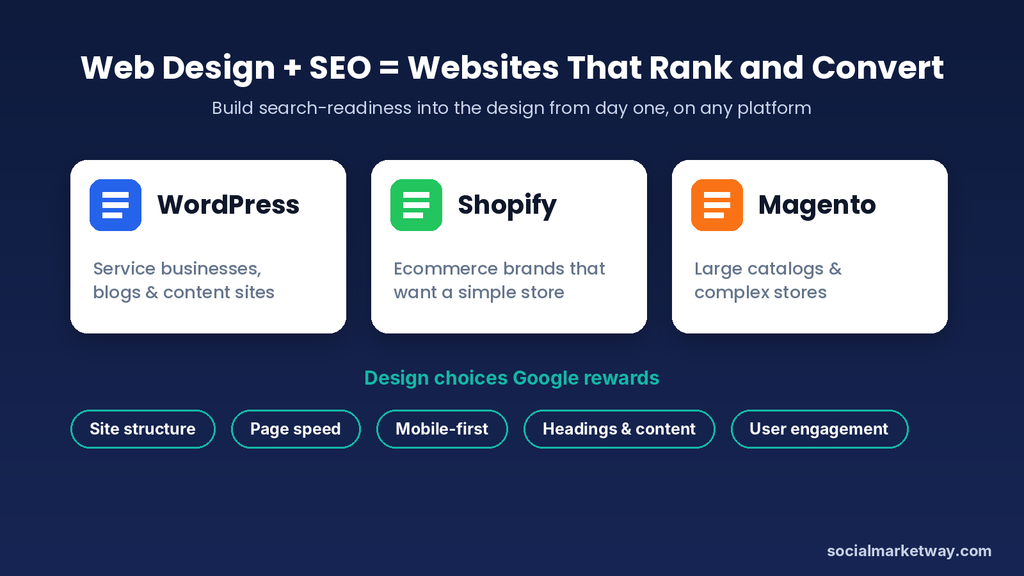
Design choices that directly affect rankings
- Site structure: A clear hierarchy of pages and categories helps Google crawl your site and understand what each page is about.
- Page speed and Core Web Vitals: Google measures loading speed, visual stability and responsiveness. Design decisions about images, fonts and scripts drive these scores.
- Mobile-first indexing: Google ranks sites based on their mobile version, so a weak mobile design means weak rankings.
- Headings and content layout: Proper H1, H2 and H3 tags, scannable sections and internal links help both readers and search engines.
- User engagement: When visitors stay longer and explore more pages, it signals that your site deserves its spot.
This is where on-page SEO comes in. It fine-tunes titles, meta descriptions, headings, image alt text, internal links and content so every page you design is also built to rank. If you want ongoing growth after launch, our SEO packages bundle the right mix of technical, on-page and content work for your goals and budget.
Choosing the right platform for your website
The platform your site runs on shapes both its design flexibility and its SEO potential. Here are the three we work with most often.
WordPress powers a huge share of the web, and for good reason. It is flexible, easy to update and ideal for service businesses, blogs and content-rich sites. With the right theme and setup, WordPress sites can be fast, secure and very search-friendly. Our WordPress SEO services make sure your site’s structure, plugins and content are working to bring in organic traffic.
Shopify is a favorite for ecommerce brands that want a reliable, easy-to-manage store. Good Shopify design focuses on product photography, clear collections, trust signals and a smooth checkout. Pair it with Shopify SEO to optimize collection pages, product descriptions and site speed so your products show up when shoppers search.
Magento (Adobe Commerce) is built for larger stores with big catalogs, complex filtering and advanced customization. Its power comes with SEO challenges such as duplicate URLs and crawl issues from filtered pages. Our Magento SEO services handle those technical details so large stores can rank at scale.
No matter which platform you choose, the lesson is the same: design your website with search in mind from day one, and you will save time, money and lost rankings later.
9 Signs Your Website Needs a Redesign
Not sure whether your current site is helping or hurting? Run through this checklist. If you tick three or more, your website is very likely costing you customers.
- It has not been redesigned in three years or more.
- It looks or works poorly on a smartphone.
- Pages take longer than three seconds to load.
- Your traffic is steady, but calls and form submissions are low.
- You are embarrassed to send people to it.
- Competitors’ websites look noticeably more modern than yours.
- You cannot easily update text, photos or services yourself.
- It does not appear on page one of Google for your main services.
- Your branding, services or prices have changed, but the site has not.
A redesign is not about chasing trends. It is about removing the friction that stops interested people from becoming customers. Often, the jump from an outdated site to a strategic, modern one produces the single biggest lift in leads a business sees all year.
What to Expect From a Professional Web Design Service
Hiring a web design agency should feel clear and organized, not mysterious. Here is the process a quality web design service typically follows, and the one we use with our own clients.
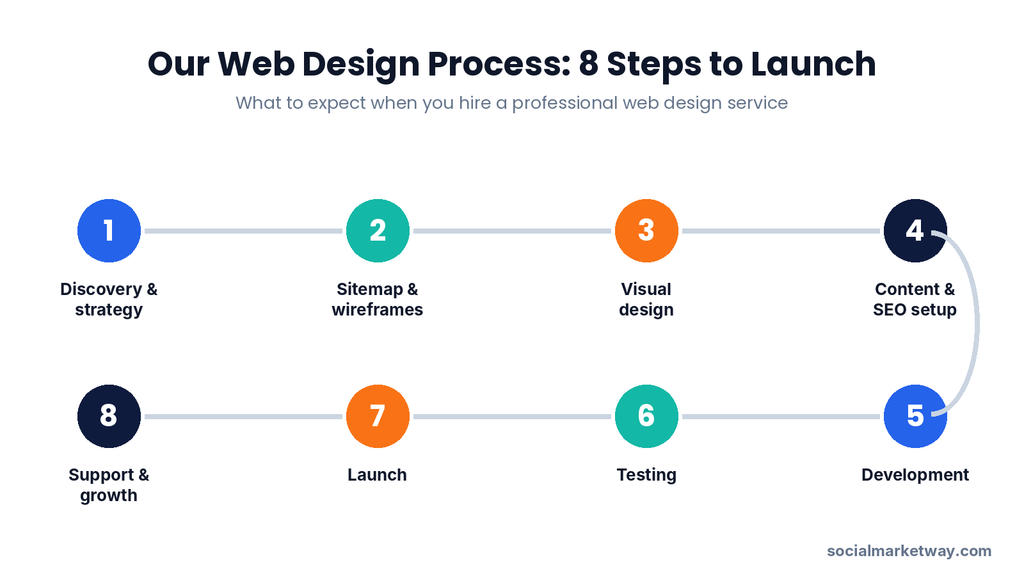
- Discovery and strategy. We learn about your business, goals, ideal customers and competitors. This step defines what success looks like, whether that is more calls, more bookings or more online sales.
- Sitemap and wireframes. We map out every page and sketch the layout of key screens so the structure and user journey are solid before any visual design begins.
- Visual design. Our designers create mockups that reflect your brand, with colors, fonts, imagery and calls to action. You review them and share feedback.
- Content and SEO setup. We organize your copy, images and headings, and build in on-page SEO so every page is search-ready.
- Development. The approved design is built on the right platform, fully responsive, fast and secure.
- Testing. We test across browsers and devices, check speed, fix broken links and make sure forms and tracking work.
- Launch. Your new site goes live, with redirects in place to protect any rankings you already have.
- Support and growth. After launch, we monitor performance, make improvements and help you keep growing with SEO and marketing.
The best web design projects are partnerships. You bring knowledge of your business and customers; your designer brings the strategy and skill to turn that knowledge into a website that sells.
Frequently Asked Questions About Web Design
Why is web design important for small businesses?
Small businesses compete with bigger brands that have larger budgets. A professional website levels the playing field. It makes a small company look established, answers customer questions around the clock and generates leads without a big sales team. For many small businesses, the website is the most important salesperson they have.
What are the main benefits of web design?
The main benefits of web design are stronger first impressions, higher trust, better search rankings, more leads and sales, a great mobile experience, faster load times, consistent branding and a long-term return on investment. Together, these turn your website from an online brochure into a growth engine.
Why use a professional web designer instead of a website builder?
Website builders give you a template; a professional web designer gives you a strategy. Designers plan your site around how your customers think and buy, build in SEO and speed from the start and avoid the common mistakes that make DIY sites underperform. You also get your time back and an expert to call when you need help.
How long does it take to design a website?
Most small business websites take four to eight weeks from discovery to launch. Larger ecommerce or custom projects can take longer. The timeline depends on the number of pages, the features you need and how quickly content and feedback are shared.
How much does professional web design cost?
Costs vary widely based on the size of the site, custom features, ecommerce needs and ongoing support. The better question is what the website will return. A site that brings in even a few extra customers each month usually pays for itself quickly. Contact us for a quote tailored to your goals.
Does web design affect SEO?
Yes, a great deal. Site speed, mobile friendliness, page structure, headings, internal links and user engagement are all shaped by design, and all of them influence rankings. That is why we build SEO into every website project rather than treating it as an afterthought.
How often should I redesign my website?
Most businesses benefit from a full redesign every three to four years, with smaller improvements made continuously. Technology, design standards and customer expectations change quickly, and a site that felt modern a few years ago can start to look dated and underperform.
Conclusion: Your Website Should Be Your Best Salesperson
So, why is web design important? Because your website shapes how customers see you, whether they trust you and whether they choose you. It affects your Google rankings, the return on every marketing dollar you spend and how many visitors turn into paying customers. The benefits of web design are not abstract. They show up as more calls, more bookings, more sales and a stronger brand.
A DIY template might get you online, but a professional web designer gets you results. The right partner builds a site that looks great, loads fast, ranks well and guides every visitor toward becoming a customer.
Why business owners choose Social Market Way
At Social Market Way, we do not just design websites. We build growth systems that combine strategic design, conversion-focused copy and proven SEO. Our clients have seen real, measurable results, such as an electrical contractor that grew organic traffic by 700% and a solar company that increased organic leads by 160%. Do not just take our word for it: read what our clients say about working with us.
Here is what you get when you work with us:
- A custom design built around your brand and your customers
- Mobile-first, fast-loading and secure development
- SEO built in from day one, on WordPress, Shopify or Magento
- Clear communication and a team that supports you after launch
Ready to turn your website into a customer magnet?
Your competitors are already investing in their websites. Every day your site underperforms is a day of leads you will never get back. Let’s change that.
Contact us today for a free consultation, and we will review your current site, show you exactly where you are losing customers and map out a plan to fix it. Explore our website design services to see how we can help, then reach out. Your next customer is searching for you right now. Let’s make sure they find you, and choose you.