


SEO for Architects: How Architecture Firms Win More Projects From Google

The best architecture firms are rarely the loudest. They let the work speak. The problem is that a beautiful portfolio does nothing if the people who need it can’t find it. Today, a homeowner planning a custom build, a developer scoping a mixed-use project, or a facilities director planning a renovation almost always starts in the same place: a Google search.
That is why SEO for architects has quietly become one of the most valuable investments a practice can make. When your firm shows up for the searches your ideal clients run, you stop depending on referrals alone, stop competing purely on fee in RFPs, and start getting inquiries from people who have already seen your work and want you.
This guide walks through exactly how architect SEO works, which keywords matter, how to turn your project portfolio into a search asset, and how to know whether to handle it in-house or bring in a specialist.
Why SEO for Architects Matters More Than Ever
Architecture is a high-trust, high-value purchase. A single residential commission can be worth tens of thousands of dollars in fees; a commercial project can be worth far more. Clients don’t hire an architect on impulse. They research, compare portfolios, read about process, and look for proof that a firm understands their type of project.
All of that research happens online, and most of it begins with search. A prospective client might type “modern home architect in Austin,” “architect for restaurant renovation,” or “how much does an architect cost for an addition.” Each of those searches is a moment of intent. The firm that appears in that moment gets considered. The firm that doesn’t, doesn’t.
Here is what makes SEO for architectural firms especially attractive compared to other marketing channels:
- It compounds. A well-built project page or guide can bring in qualified visitors for years, unlike an ad that stops the moment you stop paying.
- It pre-qualifies leads. Someone who finds you by searching “sustainable residential architect” already cares about what you do.
- It levels the playing field. A boutique studio with a well-optimized site can outrank much larger firms for local and niche searches.
- It supports every other channel. Referral clients still Google you before they call. A strong search presence reassures them they’re making the right choice.
The opportunity is also wide open. Many architecture websites are designed for visual impact first and discoverability second, with large image galleries, very little text, and slow load times. That creates a real gap for firms willing to do architectural SEO properly.
What Architect SEO Actually Is (and What It Isn’t)
At its core, architect SEO is the process of making your firm’s website the most useful, trustworthy, and relevant result for the searches your future clients run. It is not about stuffing keywords into a page or gaming an algorithm. Google’s systems have become very good at rewarding sites that genuinely help searchers.
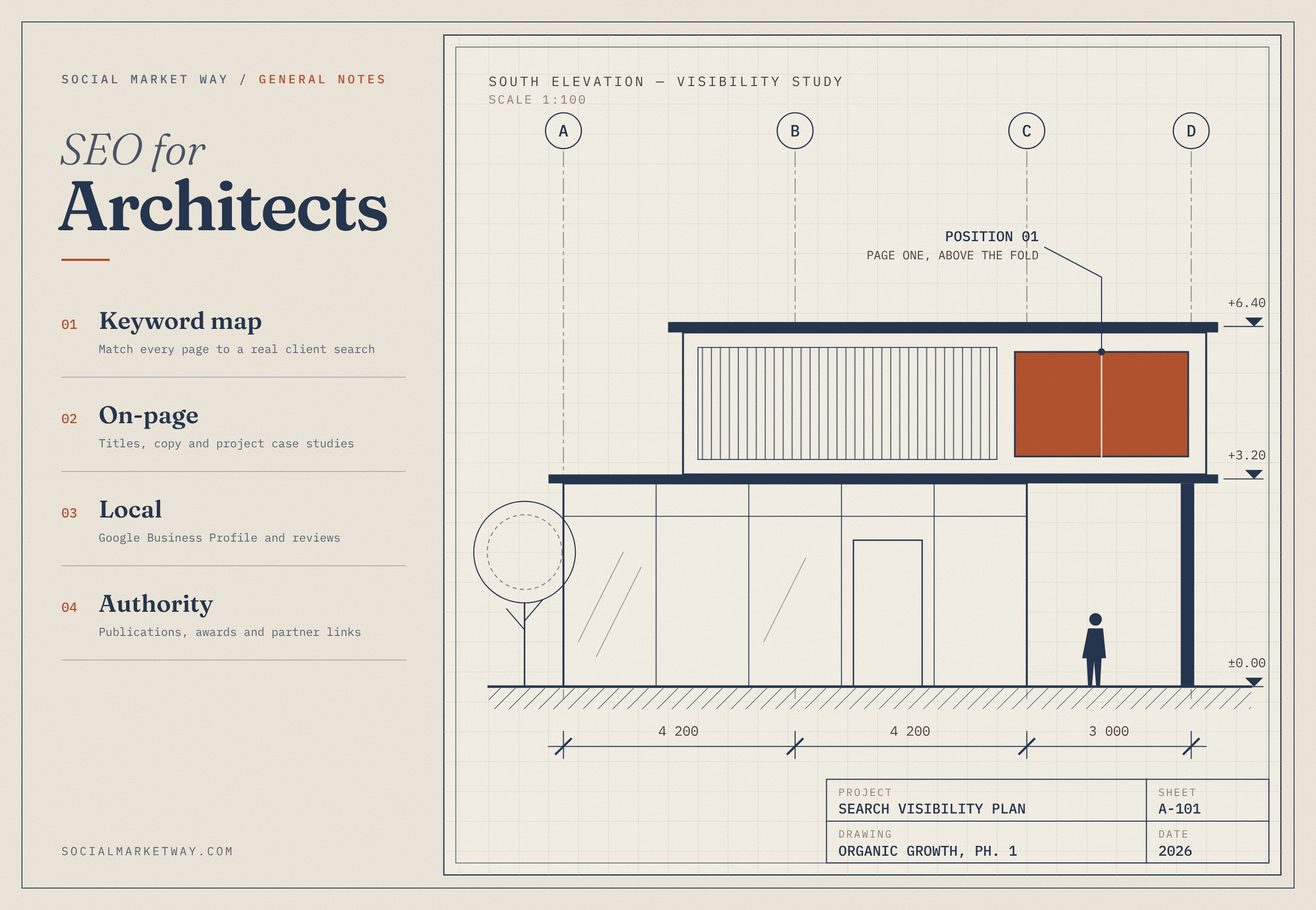
For an architecture practice, SEO breaks down into four connected pillars:
- On-page SEO: The words, structure, and signals on each page of your site, from service pages to project case studies.
- Technical SEO: How fast, crawlable, and mobile-friendly your site is, which is especially important for image-heavy portfolios.
- Local SEO: Your visibility in map results and “near me” searches, driven largely by your Google Business Profile and local citations.
- Off-page SEO: The authority your site earns through links, mentions, publications, awards, and partnerships.
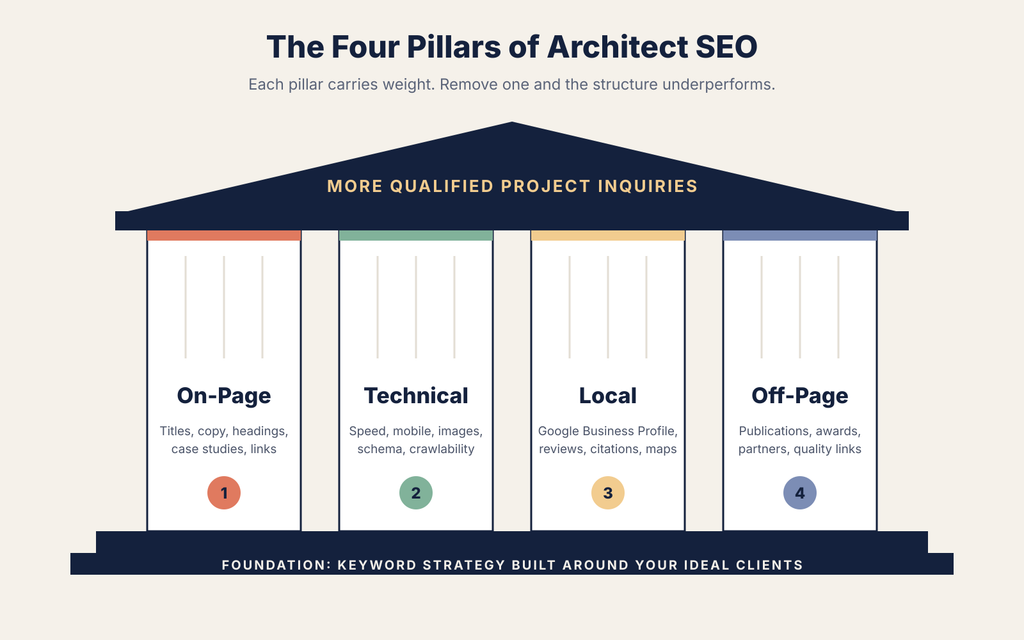
When all four work together, architects SEO becomes a steady pipeline instead of a guessing game. When one is missing, the others underperform. A beautifully written project page won’t rank if the site takes eight seconds to load. A fast site won’t rank if no other websites ever reference it.
How Clients Actually Search for an Architecture Firm
Before choosing keywords or rewriting pages, it helps to understand the path a client takes from first search to signed contract. Most architecture clients move through three broad stages.
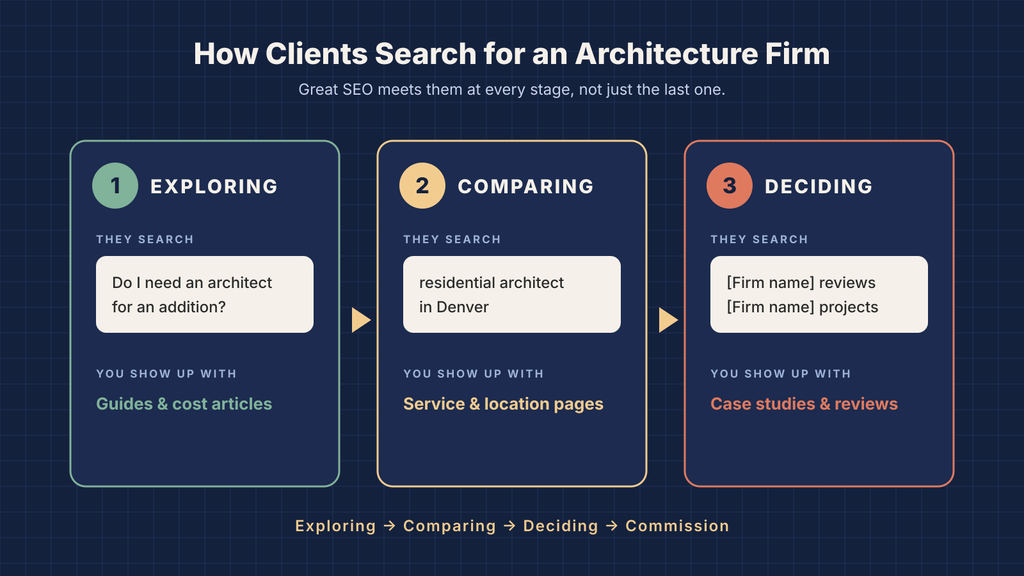
Stage 1: Exploring. The client has a problem or an idea but isn’t ready to hire. They search informational queries like “do I need an architect for a home addition,” “architect vs. designer,” or “cost to design a custom home.” Firms that answer these questions build early trust.
Stage 2: Comparing. The client knows they need an architect and starts evaluating options. Searches become more specific: “residential architect in Denver,” “healthcare architecture firm,” “passive house architect near me.” This is where your service and location pages need to show up.
Stage 3: Deciding. The client has a shortlist. They search your firm’s name, read reviews, look at completed projects, and check whether your process and fees fit. Strong case studies, clear process pages, and visible social proof seal the decision.
Good SEO for architecture firms creates content for all three stages. Most firms only build for Stage 3, a portfolio and a contact page, and wonder why the phone doesn’t ring.
SEO Keywords for Architects: Building Your Keyword Map
Choosing the right SEO keywords for architects is where strategy starts. The goal isn’t to rank for the biggest possible term. It’s to rank for the terms that signal your ideal client is looking for exactly what you do.
Think about keywords in four groups:
| Keyword type | Example searches | Where it belongs |
|---|---|---|
| Service + location | “residential architect Miami,” “commercial architect Charlotte” | Core service pages and location pages |
| Specialty / project type | “custom home architect,” “adaptive reuse architect,” “school architecture firm” | Dedicated specialty pages |
| Problem / question | “how much does an architect charge,” “permit drawings for addition” | Blog articles and guides |
| Brand + trust | “[Firm name] reviews,” “[Firm name] projects” | Homepage, about page, reviews, case studies |
A few practical rules for building your keyword map:
- One primary keyword per page. Your “Custom Homes” page targets custom home searches. Your “Healthcare” page targets healthcare searches. Splitting topics this way helps Google understand exactly what each page is for.
- Lead with what clients call it, not what architects call it. Clients search “home addition architect” far more often than “residential infill design services.” Use industry language in the body, but match the client’s words in headings and titles.
- Respect local intent. Most architecture searches have a location built in, whether typed or implied. If you serve multiple cities, each one deserves its own genuinely useful page, not a copy-and-paste with the city name swapped.
- Prioritize intent over volume. A search with 40 monthly visits from people ready to commission a home is worth more than one with 4,000 visits from architecture students.
Your keyword map becomes the blueprint for your entire site structure, which, fittingly, is something architects understand better than anyone.
On-Page SEO for Architecture Firms
Once you know which keywords belong on which pages, on-page optimization is how you make each page clearly relevant and genuinely useful. For architecture websites, this usually means adding substance to pages that are currently all imagery.
Every important page on your site should have:
- A descriptive title tag that includes the primary keyword and your location, such as “Custom Home Architect in Scottsdale | Firm Name.”
- A compelling meta description that reads like an invitation, not a list of keywords.
- One clear H1 heading that tells visitors and search engines what the page is about.
- Substantial, helpful copy. For a service page, explain who you serve, your approach, your process, typical timelines, and what makes your work distinct.
- Internal links that connect related services, projects, and articles so both visitors and Google can navigate your expertise.
- Clear calls to action that make the next step obvious, whether that’s a consultation, a call, or a project questionnaire.
If you’d like to see how these elements fit together in a structured process, our on-page SEO services page breaks down how we audit and optimize titles, content, headings, schema, and internal linking page by page.
One of the most common on-page problems in SEO for architects is the “beautiful but empty” page: a full-screen hero image, a two-word headline, and a contact button. Visitors may love it, but search engines have almost nothing to understand. The fix is not to clutter the design. It’s to add well-written sections below the fold that explain your work in plain language.
Turn Your Portfolio Into Your Strongest SEO Asset
Your project portfolio is the single most underused SEO opportunity on most architecture websites. Each completed project is a story that can attract searches from future clients with similar goals. Yet most portfolio pages contain a gallery, a project name, and maybe a single sentence.
Instead, treat every significant project as a case study. A strong project page includes:
- The challenge: What did the client need? What constraints existed: site, budget, zoning, sustainability goals, historic context?
- The approach: How did your team solve it? What design decisions mattered most and why?
- The outcome: What was built? Include square footage, location, completion date, certifications, awards, or client results.
- The client’s voice: A short testimonial adds credibility and natural, keyword-rich language.
- Optimized images: Descriptive file names (“modern-farmhouse-architect-nashville-exterior.jpg”), meaningful alt text, and compressed file sizes.
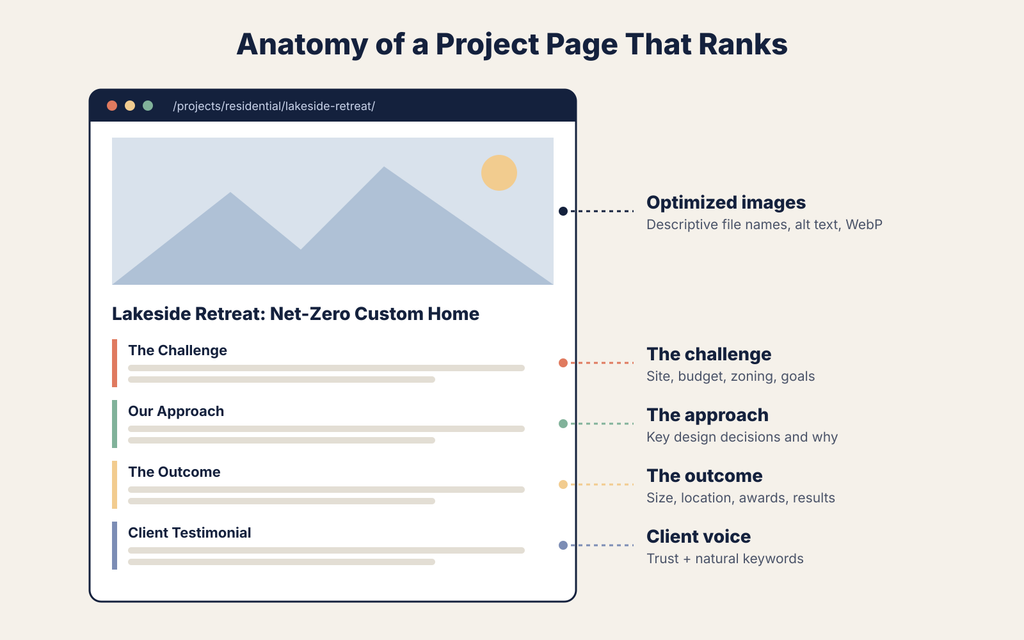
A detailed case study for a “net-zero home in Boulder” can rank for searches like “net zero home architect Colorado” for years. It also gives a prospective client exactly what they need to picture working with you. That combination of visibility and persuasion is what makes portfolio-driven architectural SEO so effective.
Group related projects into category pages too: residential, commercial, hospitality, education, interiors, and so on. Those category pages can target broader specialty keywords while linking to individual case studies below them.
Local SEO: Owning the Map in Your Market
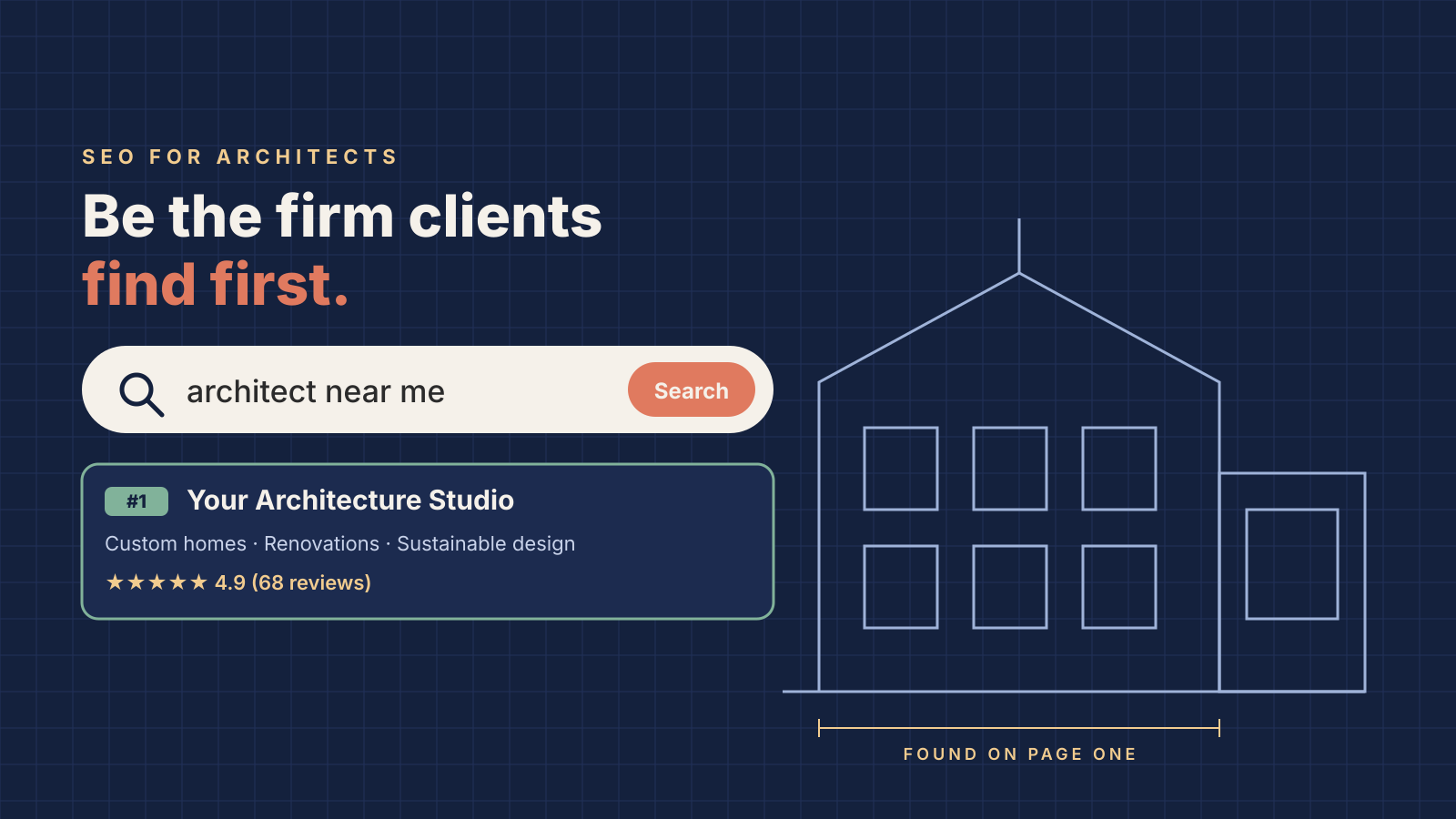
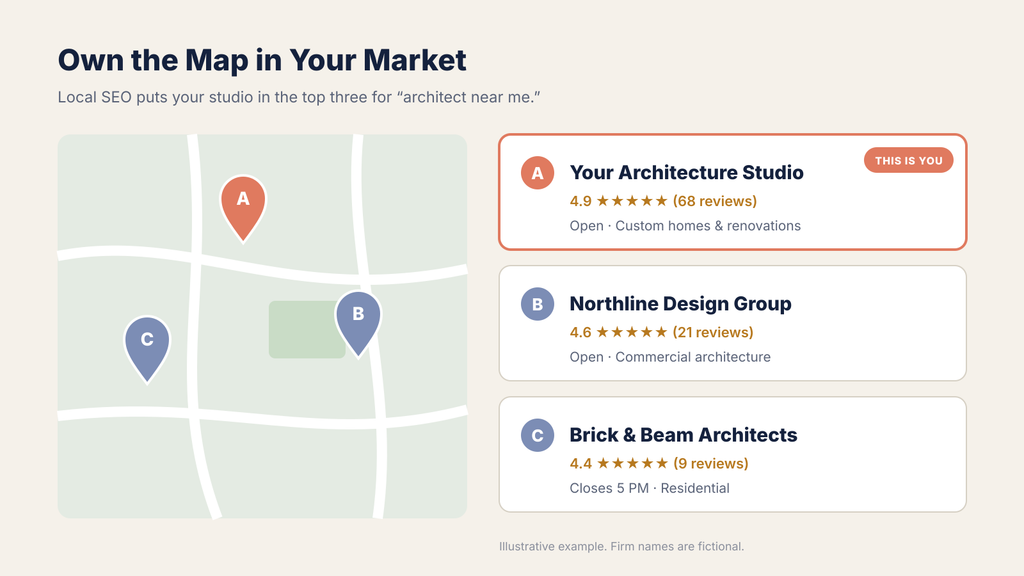
For most firms, the majority of projects come from a defined geographic area. That makes local search one of the highest-return parts of any architect SEO strategy. When someone searches “architect near me” or “architecture firm in [city],” Google typically shows a map with three businesses before the regular results. Being in that group is enormously valuable.
Alt text: SEO for architectural firms – appearing in Google’s local map pack for “architect near me”
To compete in local results:
- Fully complete your Google Business Profile. Choose accurate primary and secondary categories, write a real description, list your services, add your service area, and keep hours current.
- Post project photos regularly. Fresh, high-quality images of completed work signal activity and attract clicks.
- Ask every happy client for a review. Reviews influence both rankings and decisions. Make it easy with a direct link, and respond thoughtfully to every review you receive.
- Keep your name, address, and phone consistent everywhere your firm is listed: directories, professional associations, chambers of commerce, and industry listings.
- Build location pages for each city or region you actively serve, with local projects, local zoning or permitting insights, and local testimonials.
Local optimization is often where smaller studios outperform larger competitors. A five-person firm with 60 detailed reviews and an active profile can easily outrank a national practice with a neglected listing.
Off-Page Architectural SEO: Building Authority That Google Trusts
Google treats links from other websites as votes of confidence. For an architecture practice, the good news is that your industry is full of natural opportunities to earn those votes, and many firms leave them on the table.
High-value off-page opportunities for architects include:
- Design publications and blogs. Submitting completed projects to architecture and design outlets can earn powerful, relevant links and exposure.
- Awards and competitions. Award listings often link back to winning firms and add credibility on their own.
- Professional associations. Membership directories from local and national architecture organizations are trusted, relevant links.
- Collaborator websites. Builders, engineers, interior designers, landscape architects, and photographers you’ve worked with can credit and link to your firm on shared projects.
- Local press and community involvement. Feature stories on civic projects, sponsorships, and speaking engagements build local relevance.
- Guest expertise. Contributing insights to real estate, construction, or home publications positions your principals as authorities.
The key is relevance and quality, not volume. Ten links from respected design and local sources will do more for SEO for architectural firms than hundreds of links from low-quality directories. Our off-page SEO services focus on exactly this kind of authority building: earning genuine mentions and links that strengthen your rankings without putting your site at risk.
Technical SEO for Image-Heavy Architecture Websites
Architecture websites have a unique technical challenge: they need to showcase large, gorgeous images without slowing the site to a crawl. Speed matters for rankings, and it matters even more for visitors. A prospective client who waits too long for your homepage to load may simply go back to the search results and click a competitor.
The technical checklist for architect SEO includes:
- Image compression and modern formats. Serve WebP or AVIF images, sized correctly for each device, with lazy loading for galleries.
- Mobile-first design. Many clients first discover firms on their phones. Navigation, galleries, and contact forms must work flawlessly on small screens.
- Clean site structure. Logical URLs (/projects/residential/lakeside-retreat/) help both people and search engines understand your site.
- Indexing hygiene. Make sure important pages are indexable, remove duplicate or thin pages, and submit an XML sitemap.
- Structured data. Schema markup for your organization, local business details, reviews, and projects helps search engines interpret your content.
- Core Web Vitals. Monitor loading speed, responsiveness, and visual stability, and fix issues before they cost you rankings.
Many architecture sites are built on visually focused templates or portfolio platforms that look stunning but carry hidden technical problems. A technical audit is often the fastest way to unlock rankings your content already deserves. Whether you’re a solo practitioner or a 200-person studio, technical SEO for architecture firm websites starts here, because no amount of great content can rank on a site Google struggles to load.
Content That Attracts Your Ideal Clients
Beyond service pages and project case studies, a thoughtful content strategy lets you capture clients early in their journey, long before they’re comparing firms. The best content for SEO for architecture firms answers the real questions clients ask in first meetings.
Strong content ideas include:
- Cost and fee guides: “How much does an architect cost for a custom home in [city]?”
- Process explainers: “What happens during schematic design?” or “How long does it take to design a commercial building?”
- Permitting and zoning guides: Local insight that only a practicing architect can provide.
- Comparison articles: “Architect vs. design-build firm: which is right for your project?”
- Trend and material guides: Sustainable design, passive house standards, adaptive reuse, or biophilic design, tailored to your specialty.
Each article should link naturally to related services and projects, guiding readers toward the point where they’re ready to talk. Over time, this library of genuinely useful content positions your firm as the obvious expert in your market and your niche.
How to Measure Whether Your SEO Is Working
SEO is a long-term investment, so it’s important to track the right signals. Rankings alone don’t pay the bills. Inquiries and commissions do.
The metrics that matter most for an architecture practice:
- Organic traffic to service, location, and project pages, not just the homepage.
- Keyword visibility for your priority service + location and specialty terms.
- Google Business Profile actions: calls, website clicks, and direction requests.
- Form submissions and consultation requests attributed to organic search.
- Lead quality: project type, budget range, and fit with your ideal client profile.
- Closed projects that began with an organic search.
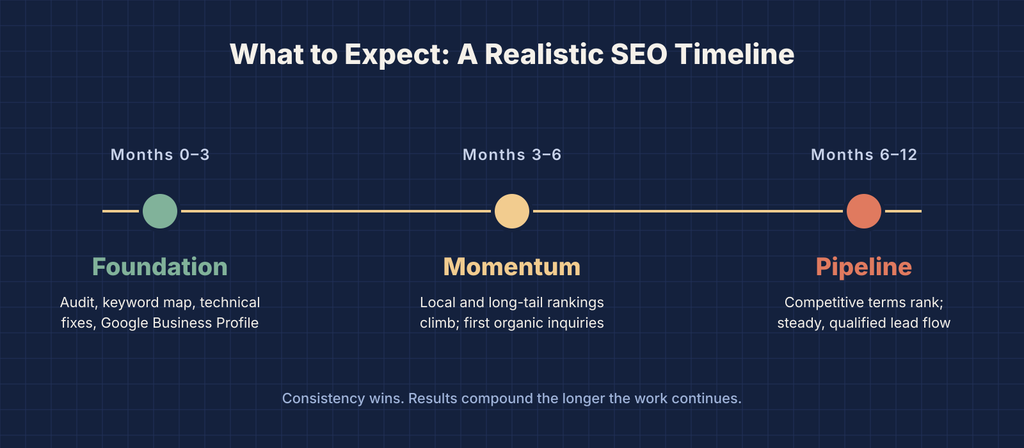
Most firms see early movement in local visibility and long-tail keywords within the first few months, with more competitive rankings and steady lead flow building over six to twelve months. The firms that win are the ones that stay consistent.
Common SEO Mistakes Architecture Firms Make
Even talented firms with beautiful websites often make the same mistakes. Avoiding them puts you ahead of most of your competition:
- Relying entirely on images. Search engines can’t rank what they can’t read.
- One generic “Services” page. Lumping residential, commercial, and interiors onto one page means none of them rank well.
- Ignoring the Google Business Profile. For local searches, it’s often more visible than your website.
- Never asking for reviews. Clients are often happy to write one, but only if asked.
- Thin project pages. A gallery with no story wastes your strongest asset.
- Unoptimized image files. Huge, unnamed images slow the site and miss search opportunities.
- Inconsistent effort. A burst of activity followed by months of silence rarely produces lasting results.
Should You Do SEO Yourself or Hire a Specialist?
Some firms handle the basics in-house, and that’s a reasonable starting point. If someone on your team has time to write case studies, manage your Google Business Profile, and request reviews consistently, you can make real progress.
But most architects quickly discover the challenge: billable work always wins. Project deadlines, client meetings, and site visits push marketing to the bottom of the list. Meanwhile, technical issues, keyword research, link building, and performance tracking require specialized skills and ongoing attention.
Working with a partner who understands architect SEO gives you:
- A strategy built around your ideal projects, not generic traffic.
- Consistent execution that doesn’t stop when your studio gets busy.
- Technical expertise to keep an image-heavy site fast and healthy.
- Authority building through relationships and outreach your team doesn’t have time for.
- Clear reporting that connects SEO activity to inquiries and revenue.
At Social Market Way, our SEO services are built for businesses like architecture firms that sell high-value, trust-based services. We combine keyword strategy, content, technical improvements, and authority building into one plan focused on the outcome you actually care about: more of the right projects.
What Working With an Architect SEO Partner Looks Like
If you’re considering outside help, here’s what a well-run engagement typically includes:
- Discovery. We learn about your firm, your ideal clients, the project types you want more of, and the markets you serve.
- Audit. We review your website, technical health, current rankings, competitors, and Google Business Profile to find the biggest opportunities.
- Keyword and content map. We build a keyword strategy that matches each page on your site to the searches your best prospects run.
- Optimization. We improve service pages, project case studies, location pages, and technical performance.
- Authority building. We pursue relevant links, citations, and mentions that strengthen your credibility.
- Reporting and refinement. We track rankings, traffic, and inquiries, then adjust the plan based on what’s working.
Every firm is at a different stage. A new studio may need foundational work and local visibility, while an established practice may be ready for a multi-city content and authority campaign. You can compare options on our SEO packages page to find the level of support that fits your goals and budget.
Frequently Asked Questions About SEO for Architects
How long does SEO for architects take to show results?
Most firms see early improvements in local visibility and niche keywords within three to four months. More competitive rankings and consistent lead flow typically build over six to twelve months, depending on your market and starting point.
Is SEO worth it for a small architecture firm?
Yes. Small and boutique firms often benefit the most because local and specialty searches are less competitive than broad national terms. A focused strategy can put a small studio in front of exactly the right clients.
What are the best SEO keywords for architects?
The best keywords combine your service or specialty with your location, such as “custom home architect in [city]” or “commercial architecture firm [region].” Question-based keywords about cost, process, and permitting are also valuable for attracting clients earlier in their research.
Do architects need a blog for SEO?
A blog isn’t mandatory, but helpful content is. Articles that answer real client questions about costs, timelines, and process attract visitors before they choose a firm and build trust that makes them more likely to contact you.
How is SEO for architecture firms different from other industries?
Architecture websites are typically image-heavy and text-light, which creates technical and content challenges. The sales cycle is longer and trust matters more, so detailed case studies, reviews, and authority signals carry extra weight.
Can I do architect SEO without redesigning my website?
In most cases, yes. Many improvements, such as adding content, optimizing images, improving metadata, fixing technical issues, and building authority, can be made to an existing site. A redesign is only necessary if the platform itself is holding you back.
Ready to Be the Firm Clients Find First?
Your work deserves to be seen by the people who need it most. SEO for architects isn’t about chasing algorithms. It’s about making sure that when a future client searches for the kind of project you love to design, your firm is the one they discover, trust, and call.
If you’d like a clear picture of where your website stands today and what it would take to attract more of your ideal projects, Social Market Way can help. We’ll review your site, identify your biggest opportunities, and map out a practical plan to turn search into a steady source of new commissions.
Let’s build your firm’s search presence on a solid foundation. Reach out to Social Market Way today to start the conversation.