
When 97% of patients search online for local dental services, understanding SEO isn’t optional—it’s essential for practice survival. Yet many dental practice owners feel overwhelmed by SEO terminology, struggling to communicate effectively with marketing professionals or make informed decisions about their online presence.
This comprehensive guide breaks down the top 10 SEO terms every dentist should know, providing practical definitions, real-world examples, and actionable insights. Whether you’re evaluating SEO agencies, planning your dental practice’s digital strategy, or simply want to understand how patients find your services online, mastering these fundamental concepts will position your practice for sustained growth and new patient acquisition.

Key Takeaways
- Understanding SEO terminology is essential for dental practice success in 2024
- Keywords, SERP, and local SEO are fundamental concepts every dentist must grasp
- Technical SEO terms like crawling and indexing directly impact website visibility
- Google Business Profile optimization is crucial for local dental practice discovery
- Backlinks and domain authority determine your website’s credibility and ranking
- Mobile-first indexing means your mobile site performance affects all rankings
- Schema markup helps search engines understand your dental practice information
- Understanding these terms enables better communication with SEO professionals
1. Keywords – The Foundation of Dental SEO
Keywords are the specific words and phrases potential patients type into search engines when looking for dental services. These terms form the foundation of your entire dental SEO strategy, connecting patient searches directly to your practice’s online content.
Understanding keywords for dentists requires recognizing three distinct categories. Short-tail keywords like “dentist” or “dental implants” have massive search volume but face intense competition from thousands of dental practices. Long-tail keywords such as “pediatric dentist accepting new patients in Austin” demonstrate specific intent and convert significantly better, with studies showing conversion rates consistently outperforming broad terms.
Local dental keywords represent the most valuable category for most practices. When patients search “emergency dentist near me” or “teeth whitening services downtown,” they’re ready to book appointments. These location-based searches capture high-intent patients actively seeking dental care in your area.
Effective keyword strategy involves strategic placement throughout your dental website. Your target keywords should appear naturally in page titles, headings, and content descriptions. For example, a cosmetic dentist might incorporate keywords naturally into service pages: “Our downtown practice specializes in teeth whitening services and smile makeovers for busy professionals.”
Keyword research tools like Google Keyword Planner reveal what potential patients actually search for, often differing dramatically from industry terminology. Patients search for “tooth pain relief” rather than “endodontic treatment,” highlighting the importance of using patient language in your content strategy.
2. SERP (Search Engine Results Page)
A SERP is the page displaying search results after someone enters a query into Google or other search engines. For dental practices, understanding SERP layout determines where and how your practice appears when potential patients search for dental services.
Modern SERPs contain multiple elements beyond traditional organic listings. Paid advertisements occupy top positions, followed by the local pack—a map showing three dental practices for location-based searches. Featured snippets provide direct answers to common questions, while “People Also Ask” sections expand related queries.
The local pack dominates dental searches, appearing for queries like “dentist near me” or “dental clinic downtown.” These three highlighted practices receive the majority of clicks, making local pack placement crucial for patient acquisition. Research consistently shows the first page of Google search results captures 71-92% of all clicks, with top three positions receiving the lion’s share.
Featured snippets represent prime SERP real estate for dental practices. Well-structured content answering common questions like “How much do dental implants cost?” or “What causes gum disease?” can capture these prominent positions, driving significant traffic and establishing authority.
Understanding SERP features helps dental practices optimize content for maximum visibility. Creating FAQ pages, maintaining detailed service descriptions, and structuring content clearly increases chances of capturing featured snippet positions and improving overall search engine rankings.
3. Local SEO – Attracting Nearby Patients
Local SEO represents the most critical optimization strategy for dental practices, focusing specifically on attracting patients within your geographic service area. This specialized approach targets the 97% of consumers who search online for local businesses, including dental services.
Local SEO strategies center on several key components. Google Business Profile optimization ensures accurate practice information appears across Google’s ecosystem. NAP consistency—maintaining identical Name, Address, and Phone number across all online platforms—signals legitimacy to search engines and builds trust with potential patients.
Local citations from relevant directories amplify your practice’s authority. Listings in the American Dental Association directory, local chamber of commerce, and healthcare-specific platforms strengthen your local search presence. These citations act as digital references, confirming your practice’s legitimacy and location.
Patient reviews fundamentally impact local search rankings and patient decision-making. Practices with consistently high ratings see dramatically higher inquiry rates, with five-star averages nearly doubling patient contact compared to three-star competitors. Actively soliciting reviews and responding professionally to all feedback builds both search authority and patient trust.
Location-based keywords form the backbone of effective local dental SEO. Incorporating city names, neighborhood references, and regional landmarks into your website content helps search engines understand your service area and match you with nearby patients searching for dental care.
4. Google Business Profile (Formerly Google My Business)
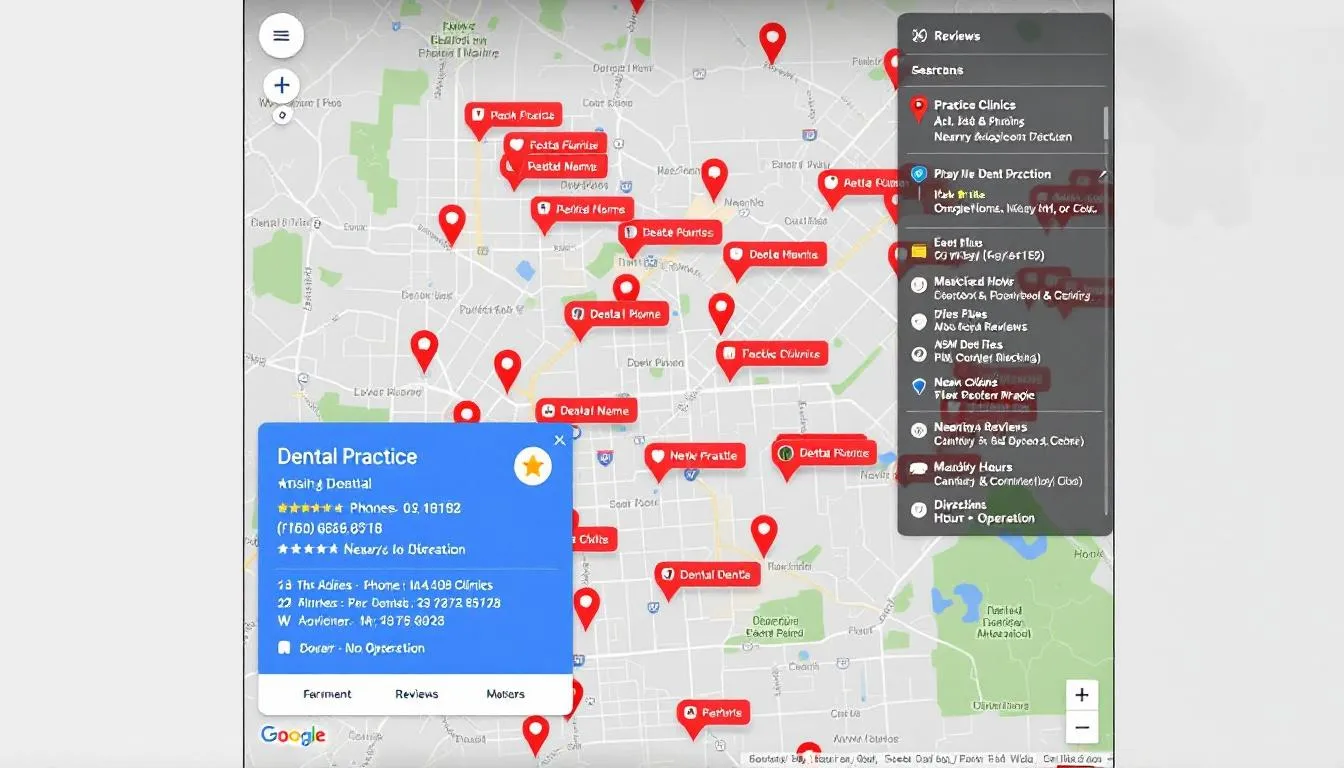
Google Business Profile serves as your dental practice’s official listing within Google’s ecosystem, controlling how your clinic appears in Google Maps, local searches, and knowledge panels. This free tool directly influences patient discovery and conversion rates for location-based searches.
Essential GBP elements include comprehensive practice information: accurate hours, contact details, services offered, and website links. High-quality photos showcasing your office, team, and treatment areas significantly boost engagement, with businesses featuring photos receiving 42% more direction requests and 35% more website clicks.
Regular posting capabilities allow practices to share updates, promotions, and educational content directly through your GBP listing. Dental practices posting weekly updates about new services, seasonal promotions, or oral health tips see measurable increases in patient engagement and appointment requests.
Patient reviews integration makes GBP crucial for reputation management. Google explicitly recommends responding to all reviews, both positive and negative, as engagement signals practice attentiveness and professionalism. Review responses appear publicly, offering opportunities to demonstrate excellent patient care and address concerns professionally.
Accurate business categories and attributes help patients find relevant services quickly. Selecting appropriate specialties like “cosmetic dentist,” “pediatric dentist,” or “oral surgeon” ensures your practice appears for specific service searches, connecting you with patients seeking your exact expertise.
5. Crawling and Indexing
Crawling and indexing represent fundamental processes determining whether your dental website appears in search results. Search engine bots, called crawlers or spiders, systematically discover and evaluate website content, while indexing stores this information in searchable databases.
The crawling process involves bots following links throughout the internet, discovering new pages and content updates. For dental websites, proper internal linking ensures crawlers find all important pages, from service descriptions to location information. Broken links or poor site structure can prevent crawlers from accessing crucial content, effectively making pages invisible to potential patients.
Indexing occurs after successful crawling, with search engines storing and categorizing page content for future search queries. Pages that aren’t indexed cannot appear in search results, regardless of content quality or relevance. Common indexing issues include slow loading speeds, server errors, or improper robots.txt configurations.
XML sitemaps submitted through Google Search Console improve crawling efficiency by providing search engines with comprehensive page lists. Dental practices should regularly monitor Search Console for crawl errors, ensuring all service pages, location information, and important content remains accessible to search engines.
Technical factors significantly impact crawling and indexing success. Fast-loading pages, clean URL structures, and proper heading hierarchies facilitate efficient crawling. Regular technical audits identify and resolve issues preventing proper indexing, ensuring your dental practice’s website remains fully discoverable by search engines and potential patients.
6. Backlinks and Domain Authority
Backlinks are links from external websites pointing to your dental practice’s website, serving as digital votes of confidence that significantly influence search engine rankings. Domain authority, measured on a 1-100 scale, reflects your website’s overall credibility based primarily on backlink quality and quantity.
High-quality backlinks from authoritative sources carry substantial ranking weight. Links from dental associations, medical organizations, local news outlets, or educational institutions provide more value than hundreds of low-quality directory listings. Search engines view these authoritative links as endorsements of your practice’s credibility and expertise.
Building legitimate backlinks for dental practices involves several strategic approaches. Guest posting on dental health blogs, participating in community events covered by local media, and partnering with other healthcare providers create natural link-building opportunities. Press releases announcing new technologies, practice expansions, or community involvement often generate valuable media coverage and backlinks.
Local business partnerships offer excellent backlinking opportunities. Collaborating with orthodontists, oral surgeons, or medical practices creates referral networks that benefit both SEO and patient care. Chamber of commerce memberships, local business associations, and community organization involvement frequently result in quality local backlinks.
Avoiding harmful link practices protects your dental practice from search engine penalties. Link farms, paid link schemes, and irrelevant directory spam can severely damage rankings. Focus on earning links through valuable content, community involvement, and professional relationships rather than purchasing questionable backlinks that risk long-term SEO success.
7. On-Page SEO Optimization
On-page SEO encompasses all optimization techniques applied directly to individual pages of your dental practice’s website. These elements help search engines understand your content while improving user experience and conversion rates for potential patients.
Title tags represent the most critical on-page element, appearing as clickable headlines in search results. Effective dental practice titles include primary keywords while remaining under 60 characters: “Family Dentist in Austin | Comprehensive Dental Care | ABC Dental.” Well-crafted titles improve both search rankings and click-through rates from search engine results pages.
Meta descriptions provide 160-character summaries appearing beneath title tags in search results. While not direct ranking factors, compelling meta descriptions significantly influence click-through rates. Dental practices should craft descriptions that include relevant keywords while encouraging patients to visit: “Schedule your dental cleaning today. Our experienced team provides gentle, comprehensive care for the whole family.”
Header tags (H1, H2, H3) structure content hierarchically, helping both search engines and readers understand page organization. Service pages should use logical header structures: H1 for main service names, H2 for procedure details, and H3 for specific treatment options or benefits.
Image optimization involves adding descriptive alt text to all photos and graphics. This supports accessibility requirements while providing additional keyword opportunities. Instead of generic descriptions, use specific dental terminology: “Digital X-ray equipment at Downtown Dental Clinic” rather than simply “dental equipment.”
Internal linking connects related pages within your dental website, distributing SEO value while helping patients find relevant information. Service pages should link to related procedures, location pages, and educational content, creating a comprehensive user experience that encourages deeper engagement.
8. Mobile-First Indexing
Mobile-first indexing means Google primarily uses your website’s mobile version for indexing and ranking decisions, making mobile optimization essential for dental practice success. With over 60% of dental patient searches occurring on mobile devices, poor mobile performance directly impacts patient acquisition.
Responsive design ensures your dental website adapts seamlessly to all screen sizes, from smartphones to desktop computers. Pages should load quickly, display clearly, and provide easy navigation regardless of device. Mobile users expect immediate access to contact information, appointment booking, and emergency dental services.
Page loading speed becomes critical on mobile networks where connection speeds vary significantly. Research demonstrates that one-second delays in mobile loading times can reduce conversions by 7%. Dental practices must optimize images, minimize code, and use content delivery networks to ensure fast mobile performance.
Mobile navigation requires simplified menus and easily accessible contact buttons. Patients searching for emergency dental services on mobile devices need immediate access to phone numbers and location information. Thumb-friendly button sizes and clear call-to-action placement improve mobile user experience and conversion rates.
Google’s Mobile-Friendly Test tool provides actionable feedback on mobile optimization opportunities. Regular testing ensures your dental practice website meets mobile standards and provides excellent user experience across all devices. Poor mobile performance can harm rankings even for desktop searches, making mobile optimization universally important.

9. Schema Markup
Schema markup involves structured data code that helps search engines understand your dental practice information more precisely. This specialized coding can enhance your search appearance with rich results, star ratings, and detailed business information that attracts more patient clicks.
LocalBusiness schema provides comprehensive practice information to search engines, including location, hours, services, and contact details. Dental practices can implement specialized Dentist schema that identifies specific services like dental implants, teeth whitening, or emergency dental care, helping search engines match your practice with relevant patient searches.
Review schema displays star ratings directly in search results, significantly improving click-through rates. Dental practices with visible star ratings in search results see substantially higher engagement than competitors without schema markup. These enhanced listings build immediate trust and credibility with potential patients.
FAQ schema enables your frequently asked questions to appear in Google’s “People Also Ask” sections and featured snippets. Common dental questions about insurance acceptance, appointment availability, or procedure costs can capture prominent SERP positions when properly marked up with schema code.
Implementation requires adding structured data to your website’s HTML code, though Google’s Structured Data Markup Helper simplifies the process for non-technical users. Many dental website platforms now include built-in schema options, making implementation accessible for practices without extensive technical resources.
Regular schema validation ensures your markup remains error-free and effective. Google’s Rich Results Test tool identifies markup issues and confirms proper implementation, helping maintain enhanced search appearances that attract more potential patients to your dental practice.
10. Search Intent and User Experience
Search intent refers to the underlying purpose behind a patient’s search query, while user experience encompasses how easily and effectively patients can navigate and use your dental website. Understanding and optimizing for both factors significantly impacts your SEO success and patient conversion rates.
Four primary search intent categories define patient behavior. Informational intent seeks knowledge about dental health, procedures, or conditions. Navigational intent looks for specific dental practices or websites. Commercial intent compares treatment options or providers. Transactional intent focuses on booking appointments or contacting dental services immediately.
Aligning content with search intent improves both rankings and patient satisfaction. Educational blog posts serve informational searches about gum disease or oral health tips. Service pages address commercial intent by comparing treatment options and benefits. Contact and appointment pages satisfy transactional intent with clear calls-to-action and booking information.
User experience factors increasingly influence search engine rankings through behavioral metrics like bounce rate, time on site, and conversion rates. Google monitors how patients interact with dental websites, using positive engagement signals as ranking factors. Poor user experience can harm SEO performance regardless of other optimization efforts.
Effective dental website UX includes intuitive navigation, fast loading speeds, and clear appointment booking pathways. Patients should easily find service information, contact details, and scheduling options within seconds of arriving. Mobile-friendly design, accessible forms, and transparent pricing information all contribute to positive user experience.
Regular UX auditing identifies improvement opportunities through patient feedback, analytics data, and usability testing. Dental practices that prioritize user experience see improved search rankings, higher conversion rates, and better patient satisfaction scores, creating sustainable competitive advantages in their local markets.

FAQ
What’s the most important SEO term for dentists to understand? Keywords are fundamental since they connect patient searches to your dental services and determine content strategy. Understanding how patients search for dental care—using terms like “dentist near me” rather than clinical terminology—forms the foundation for all other SEO efforts.
How does local SEO differ from regular SEO? Local SEO specifically targets patients in your geographic area using location-based keywords and Google Business Profile optimization. While regular SEO focuses on broad visibility, local SEO ensures your dental practice appears when nearby patients search for dental services.
Why is mobile-first indexing important for dental websites? Since Google primarily uses mobile sites for ranking, poor mobile performance can hurt your visibility even for desktop users. With most patients searching for dental services on mobile devices, mobile optimization directly impacts patient acquisition and search engine rankings.
What’s the difference between crawling and indexing? Crawling discovers your website pages, while indexing stores that content in search engines for potential display in results. Pages that aren’t properly crawled and indexed remain invisible to potential patients, regardless of content quality.
How do backlinks help dental practice SEO? Quality backlinks from reputable sites signal authority to search engines, improving your website’s credibility and rankings. Links from dental associations, local news, or medical organizations carry more weight than generic directory listings.
What schema markup should dental practices use? LocalBusiness, Dentist, Review, and FAQ schema types help search engines understand and display your practice information better. These markups can enhance search appearances with star ratings, business details, and featured snippet opportunities.
How does search intent affect dental SEO strategy? Understanding patient intent helps create content that matches what searchers want, improving engagement and conversion rates. Informational content serves patients researching procedures, while transactional pages focus on appointment booking and contact information.
Why is Google Business Profile crucial for dentists? It controls how your practice appears in local searches and Google Maps, where most patients discover dental services. Optimized profiles with accurate information, photos, and reviews significantly impact local search visibility and patient acquisition.
Conclusion
Mastering these top 10 SEO terms every dentist should know provides the foundation for effective digital marketing and sustainable patient acquisition. From understanding how keywords connect patient searches to your dental services, to optimizing Google Business Profile for local discovery, each concept plays a crucial role in your online success.
The dental industry’s digital landscape continues evolving rapidly, with search engines becoming increasingly sophisticated and patient expectations rising consistently. Dental practices that understand fundamental SEO terminology can make informed decisions about their online presence, communicate effectively with marketing professionals, and implement strategies that attract local patients consistently.
Remember that SEO success for dental practices is an ongoing process requiring continuous attention and adaptation. Regular monitoring of search engine rankings, patient feedback, and website performance ensures your practice maintains competitive advantages in local markets where new patient acquisition drives sustainable growth.
Whether you’re evaluating SEO agencies, planning internal marketing efforts, or simply wanting to understand how patients find your dental practice online, these essential terms provide the knowledge foundation necessary for informed decision-making and successful digital marketing investments that generate measurable returns through increased patient acquisition and practice growth.

0 Comments