



How to Get MSP Clients: The Complete Growth Playbook

If you’ve ever typed “how to get MSP clients” into Google at 11pm after a slow sales month, you already know the problem isn’t a lack of effort. It’s that most of the advice out there is generic, recycled, and doesn’t account for how buyers actually evaluate managed service providers today.
The truth is blunt: you can be the best technician in your market and still starve for clients. Technical skill and client acquisition are two completely different disciplines, and most MSP owners were trained in exactly one of them.
This guide breaks down the seven strategies that are actually moving the needle for MSPs growing right now — niche positioning, website conversion, networking, partnerships, marketing, referrals, and the operational scaling that lets you say yes to new clients without breaking what already works.
Show Image
Why “Being Great at IT” Isn’t a Growth Strategy
Here’s the uncomfortable pattern we see across the MSP industry: technicians-turned-owners assume that great service will naturally generate a pipeline of new business. Sometimes it does — slowly, unpredictably, and never fast enough to hit real growth targets.
Client acquisition is a system, not a hope. It requires a defined audience, a website that pre-sells your value before a call ever happens, consistent visibility in the right rooms (physical and digital), and a referral engine that runs without you having to remember to ask. MSPs that treat growth as deliberately as they treat uptime SLAs are the ones pulling ahead in 2026.
1. Pick a Niche and Own It
Positioning yourself as “the IT company for everyone” puts you in a price war with every generalist MSP in your metro area. Vertical specialization flips the script: instead of competing on cost, you compete on expertise — and expertise commands premium pricing.
Start with what you already know. If you’re currently supporting three law firms, two dental practices, and a manufacturer, look at where the overlap is. Chances are you already understand the compliance requirements, software stack, and operational rhythms of one of those industries better than you realize. That’s your starting niche.
Common high-value MSP niches in 2026:
- Healthcare — HIPAA, HITRUST, EHR integrations, medical device networking
- Legal — document management systems, e-discovery, client confidentiality requirements
- Financial services — SOC 2, PCI-DSS, regulatory audit support
- Manufacturing — OT/IT convergence, industrial IoT, PLC networking
- Nonprofits — grant compliance, budget-constrained tech stacks, donor data protection
Once you niche down, every part of your marketing gets sharper — your website copy, your case studies, your ad targeting, even your sales conversations. Prospects in a specialized vertical aren’t asking “why should I trust an IT company?” They’re asking “does this IT company understand my industry?” A clear yes closes deals faster than any discount ever will.
2. Build a Website That Sells Before You Do
Most MSP websites are digital brochures nobody reads. In 2026, your website has to function as your best salesperson — because it’s doing the qualifying long before a prospect picks up the phone.
The non-negotiables:
- Sub-3-second load times. Slow sites lose prospects before they see a single word of copy.
- Clear, niche-specific service language. “HIPAA-compliant IT support for medical practices” converts better than “managed IT services” — because it’s what your actual buyer is searching for.
- Multiple visible contact paths. A phone number in the header, a ticket-style contact form, and live chat cover the three different ways buyers prefer to reach out. Missing one means losing leads who won’t use the others.
- Mobile-first design. Over half of your prospects are evaluating you from a phone. If the site breaks on mobile, they bounce.
- Proof, not just claims. Case studies with real numbers, testimonials tied to specific outcomes, and logos of the industries you serve build trust faster than any tagline.
If your site currently reads like a list of services instead of a resource that answers a buyer’s actual questions, that’s the highest-leverage fix available to you this quarter.
3. Network With Intent, Not Just Attendance
Showing up to a Chamber of Commerce mixer with a stack of business cards isn’t a strategy — it’s a hope. Networking that actually generates MSP clients requires the same deliberateness as everything else on this list.
Show Image
Where it actually works:
- LinkedIn, done properly. Don’t just have a profile — participate. Join the groups where your niche’s decision-makers post. Answer questions with real expertise instead of a pitch. Use Sales Navigator to find companies matching your ideal client profile, then reach out referencing something specific about their business, not a template.
- Local chambers and business associations. These rooms are full of accountants, attorneys, and financial advisors — professionals who refer IT services constantly once they trust you. Expect three months of consistent attendance before referrals start flowing. Most MSPs quit at month two.
- Vertical-specific conferences. A healthcare IT conference puts you directly in front of decision-makers in your niche, alongside complementary vendors worth partnering with. One qualified lead often covers the entire cost of attending.
Networking is a compounding asset. It rarely pays off in the first meeting, but the MSPs who show up consistently for a year build a referral network that competitors can’t replicate with an ad budget.
4. Build Partnerships That Feed You Clients on Autopilot
Partnerships are the most underused lever in MSP growth, mostly because they require upfront relationship-building instead of a quick campaign. But they pay dividends long after the initial handshake.
Three partnership structures worth building:
- The overflow partnership. Larger MSPs routinely turn away accounts below their minimum monthly revenue threshold. Position your agency as their official referral partner for those smaller accounts. They keep goodwill with the client (via a warm handoff and maybe a finder’s fee), you get pre-qualified leads without any ad spend.
- The complementary-service partnership. Web developers, software vendors, and managed print providers all serve clients who eventually need IT support. Formalize the relationship so that when their client asks “who handles your IT?”, your name comes up before Google does.
- The specialty partnership. If you don’t offer a service in-house — say, advanced cybersecurity auditing — partner with a specialist who does. You refer clients who need it, they refer clients who need general MSP support.
The partnerships that actually produce leads have one thing in common: a clear, explicit value exchange and a scheduled check-in (quarterly, at minimum) to keep the relationship active instead of letting it go dormant after the first referral.
5. Market to the Audience You Actually Want
Generic “best practices” marketing wastes budget. Effective MSP marketing starts with a defined audience and a defined outcome for every dollar spent.
Show Image
Where to focus:
- Content that answers real questions. Write for the specific problems your niche faces — not generic “5 signs you need an MSP” content that every provider has already published. Become the resource a buyer bookmarks while building the internal case to switch providers.
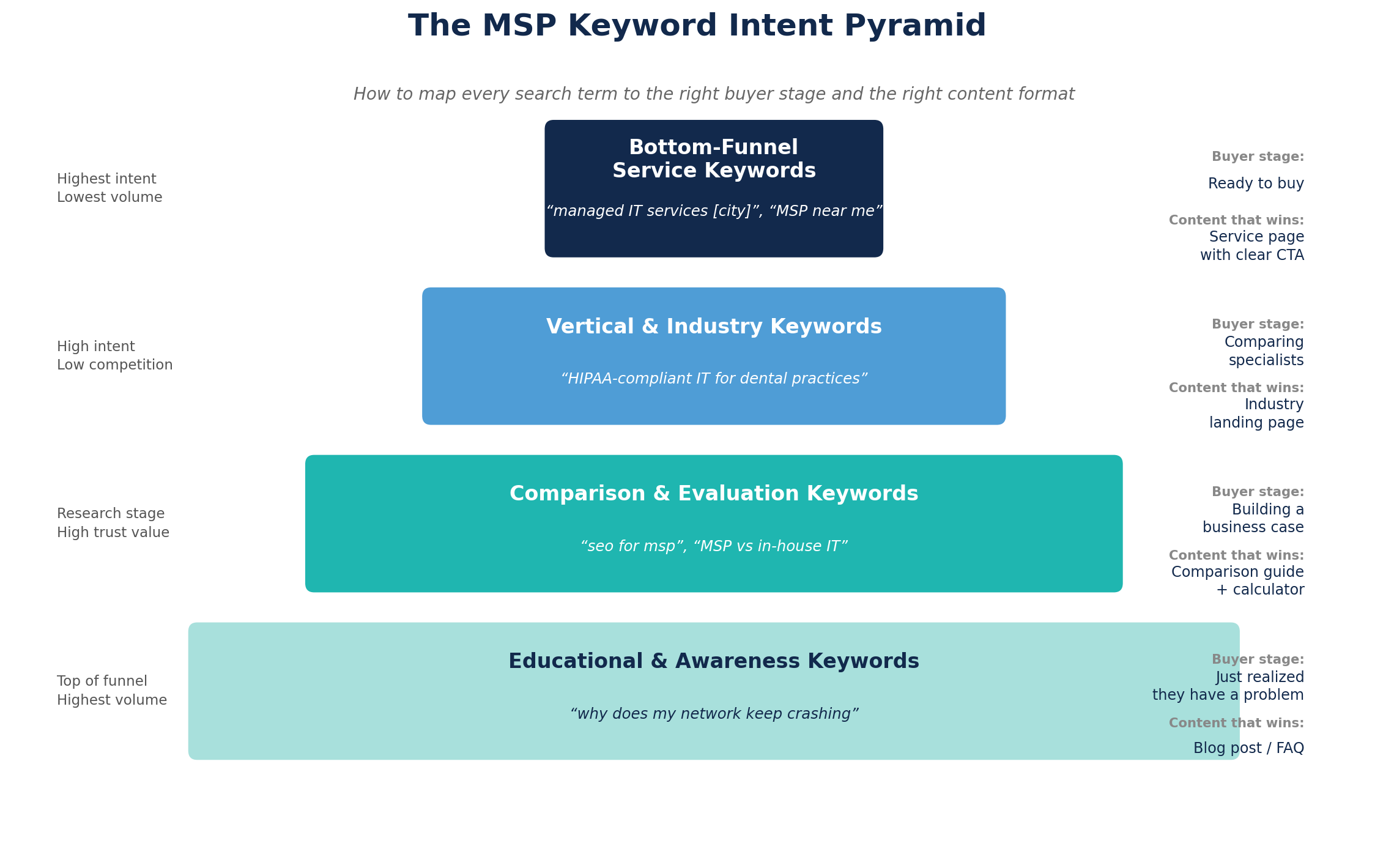
- SEO built around buyer language. A healthcare-focused MSP should target “HIPAA-compliant IT support,” not “managed IT services.” Long-tail, high-intent keywords convert at a fraction of the cost of broad, competitive terms.
- Paid ads as an accelerant, not a foundation. Google Ads capture buyers who are already searching. LinkedIn Ads let you target specific job titles at specific company sizes. Start with a modest test budget, measure cost per qualified lead, then scale what’s actually working.
- Track what matters. Cost per lead, lead-to-opportunity conversion rate, customer acquisition cost, and lifetime value to CAC ratio tell you whether marketing is working. Impressions and likes don’t.
6. Turn Happy Clients Into a Referral Engine
Referrals close at three to five times the rate of cold outreach, because trust is transferred along with the recommendation. And yet most MSPs treat referrals as something that might happen, rather than something they systematically generate.
Show Image
Build referrals into your existing touchpoints:
- Ask directly during quarterly business reviews — most satisfied clients are happy to refer you but simply never think to unless prompted.
- Offer simple, automatic incentives (service credits work well) rather than complicated tiered programs that clients find confusing and ignore.
- Use video testimonials tied to a specific problem you solved. They carry more weight than a generic written quote.
- Lean on your professional network — former colleagues and industry contacts who already trust your capability are often your fastest early referral source.
A referral program isn’t a nice-to-have side project. For established MSPs, it’s usually the single highest-ROI growth channel available — and it costs almost nothing to run once it’s built.
7. Make Sure You Can Actually Handle the Growth
Here’s the part most “how to get clients” articles skip entirely: winning new clients is only half the equation. If your operations can’t scale with your sales, growth turns into churn — and churn quietly kills every other strategy on this list.
What separates MSPs that scale profitably:
- A unified platform instead of a patchwork of disconnected tools, so client count doesn’t create proportional administrative overhead.
- Automation for routine work — patch deployment, alert triage, ticket routing — so technician hours scale with complexity, not headcount.
- Predictable, automated billing tied directly to delivered work, so revenue doesn’t leak through missed billable hours as you grow.
The MSPs winning market share in 2026 aren’t just better at marketing. They’re running operations that can absorb 20 new clients without the service quality that won those clients in the first place starting to slip.
Bringing It All Together
Getting MSP clients consistently isn’t about finding one silver-bullet tactic — it’s about running several of these systems in parallel: a niche that sharpens everything else, a website that qualifies leads before you talk to them, relationships built deliberately over time, and an operational backbone that lets you grow without breaking.
That’s a lot for any MSP owner to build alone while also running day-to-day operations. This is exactly the gap our agency exists to close. We work exclusively with MSPs to build the niche positioning, conversion-focused websites, content and SEO systems, and referral programs outlined above — so you can spend your time delivering great service instead of guessing at marketing.
If you’re ready to stop hoping for referrals and start generating a predictable pipeline of qualified MSP clients, we’d love to talk about what that looks like for your business.
Ready to build a client acquisition system that actually works for your MSP? Reach out for a free growth audit — we’ll show you exactly where your current pipeline is leaking and what to fix first.