


MSP Marketing Agency: The Complete Guide to Choosing a Partner That Actually Gets You Clients

If you’ve typed “msp marketing agency” into Google more than once this quarter, you’re not alone. MSPs across North America are waking up to the same reality: cold outreach is dying, referrals have plateaued, and the MSPs winning new logos in 2026 are the ones showing up in search results, on LinkedIn, and in the inboxes of IT decision-makers at exactly the right moment.
The problem is that most marketing agencies don’t understand managed services. They don’t know the difference between a break-fix client and a fully managed one. They don’t know what “co-managed IT” means to a mid-market prospect, or why your sales cycle looks nothing like a SaaS company’s. Hiring the wrong msp marketing company doesn’t just waste budget — it can set your pipeline back a full year.
This guide breaks down exactly what a specialized msp marketing firm does, how to evaluate one, what services actually move the needle, and how to avoid the mistakes that send most MSPs back to square one.
What Does an MSP Marketing Agency Actually Do?
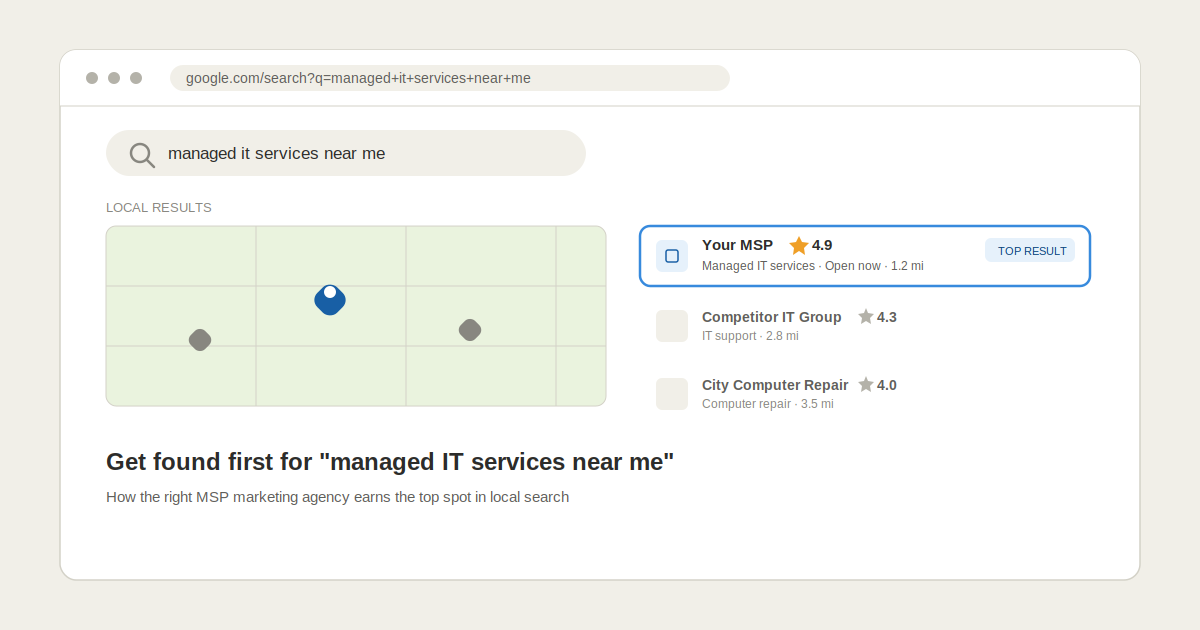
The entire job of an msp marketing agency comes down to one question: when a business owner in your territory searches for help, does your company show up first — and does what they find make them want to call?
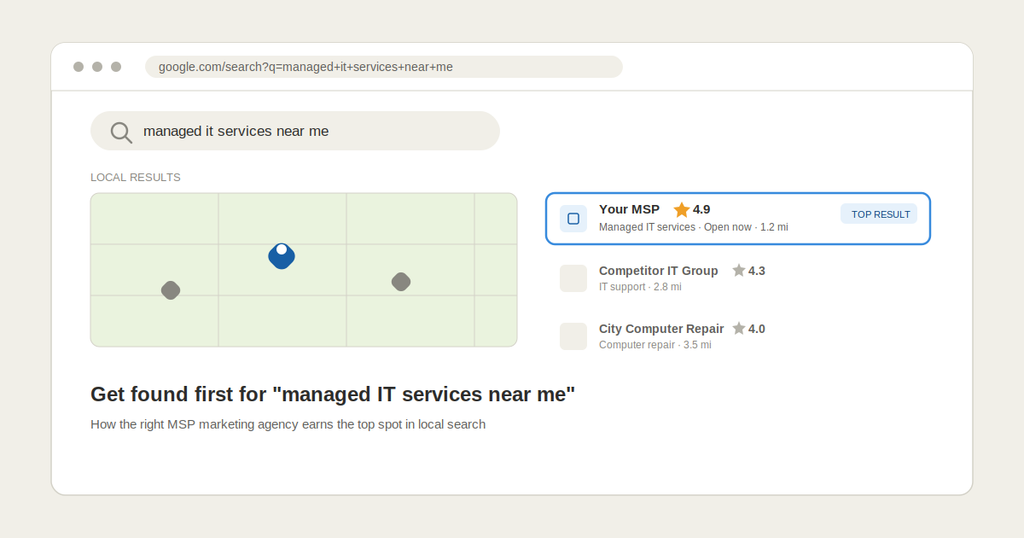
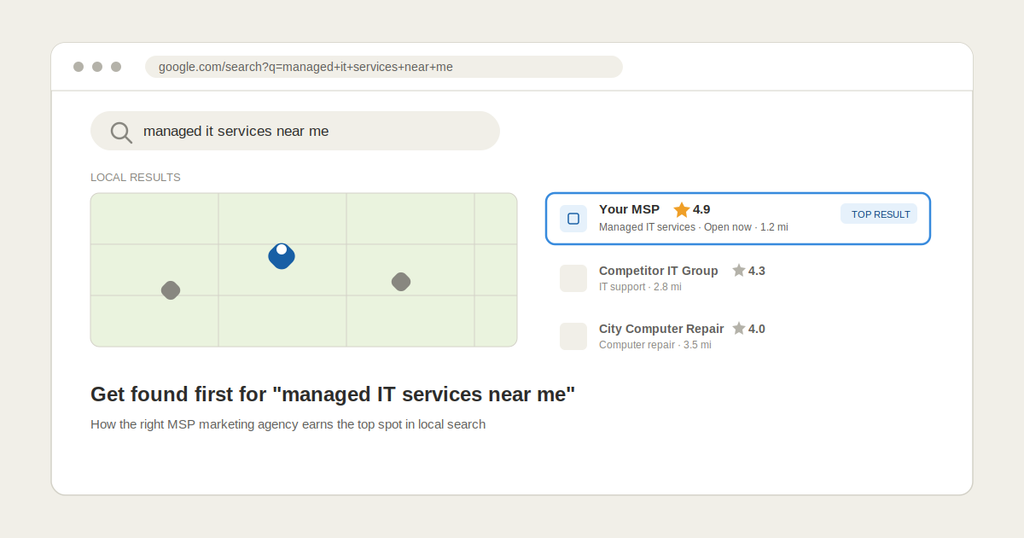
That screenshot is the whole game. A prospect types a service plus a location, Google surfaces a handful of local results and a map pack, and the businesses that show up first capture the overwhelming majority of the clicks — most local searches never make it past the first three map pack listings. A true msp marketing agency builds every part of its strategy around earning that top spot and then converting the click once it happens. That typically includes:
- SEO and content built around the searches your prospects actually run (think “IT support near me,” “outsourced IT for law firms,” or “cybersecurity compliance for healthcare”)
- Website conversion optimization so visitors turn into booked calls, not bounces
- Paid search and paid social to fill pipeline gaps while organic rankings build
- Email nurture sequences for the long, considered B2B sales cycle MSPs deal with
- Reputation and review management, since the star rating sitting right next to your listing directly affects click-through rate
- Reporting tied to MRR and net-new clients, not vanity metrics like impressions
The best msp marketing services don’t operate as siloed tactics — they’re built as a single system where SEO earns the visibility shown above, content and reviews build the trust that turns a click into a call, and nurture turns that call into a signed contract. If you want the full breakdown of how each channel fits together, our complete guide to SEO for MSP providers who want more clients walks through the exact framework we use with MSP clients.
Why Generic Marketing Agencies Fail MSPs
Here’s what typically happens when an MSP hires a general digital marketing shop: the agency runs a keyword tool, sees “IT support” has decent volume, writes a handful of generic blog posts, and calls it a strategy. Six months later, traffic might tick up slightly, but the search results above never change — the MSP still isn’t the one showing up when it matters, because the content never addressed the actual buying triggers for managed IT services.
MSP buyers aren’t searching the way e-commerce or SaaS buyers search. They’re often triggered by a specific event: a ransomware scare, a failed compliance audit, a departing IT employee, or frustration with an existing provider. A marketing firm for msps that understands this builds content and campaigns around those trigger moments — not just broad keyword volume.
Generic agencies also tend to underinvest in the local side of search entirely, which is the exact mechanism behind that map pack screenshot above. A digital marketing services for msp package that skips local SEO is skipping the highest-intent, highest-converting piece of the whole system.
How to Rank in the Map Pack: A Closer Look at Local SEO
Since your MSP almost certainly serves a defined metro area or region rather than walk-in foot traffic, local search visibility deserves its own conversation — and its own way of measuring it.
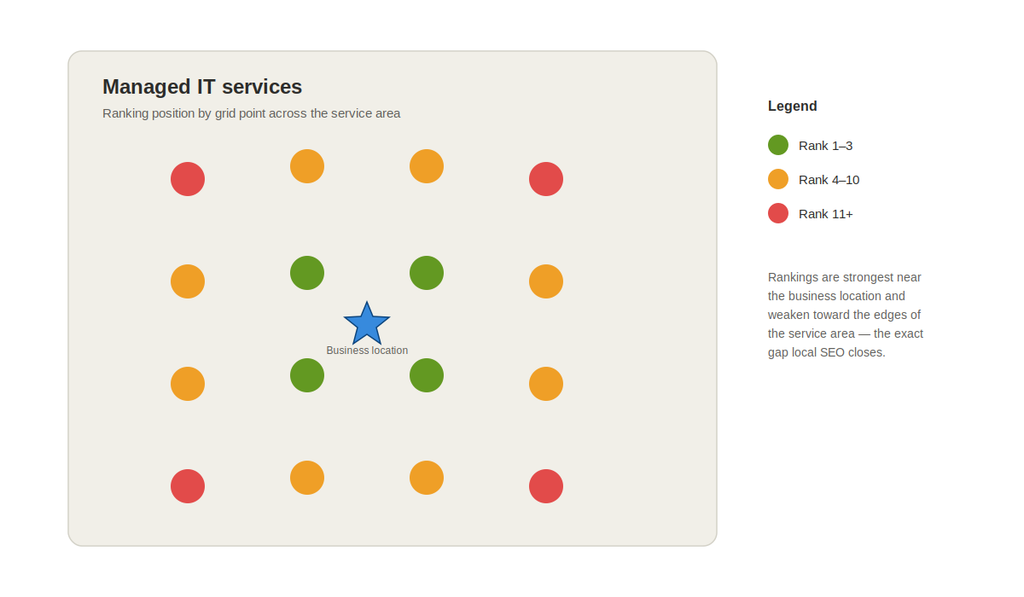
That grid is how a serious marketing company for msps actually measures local SEO progress — not a single “are we ranking” checkbox, but a map showing exactly where in your territory you’re winning and where you’re invisible. Notice the pattern: rankings are strongest near the business’s actual location and weaken toward the edges of the service area. That’s the natural shape of local search, and it points directly to the work involved in closing those gaps:
- Google Business Profile optimization — categories, services, photos, and consistent posting
- Location pages for every city or county you actively serve, not just your headquarters
- Review generation at scale, since review count and rating both factor into map pack ranking
- Citation consistency — your business name, address, and phone number matching exactly across every directory that lists you
The goal isn’t just to turn one or two grid points green — it’s to push that green zone outward until it covers your entire service area. Our local SEO services are built specifically to help service-area businesses like MSPs expand that footprint, city by city.
Core Services to Look For in an MSP Marketing Firm
Local rankings are one piece of a larger system. The strongest msp marketing services stacks also include:
Search Engine Optimization (SEO)
Beyond the local layer, SEO covers your core service pages (managed IT, cybersecurity, cloud, compliance) and the educational content that ranks for the questions your prospects are asking before they ever fill out a form. On-page work — title tags, header structure, internal linking, page speed, and content depth — determines whether those pages can compete once they’re built. Our on-page SEO services focus specifically on turning existing website pages into ranking, converting assets without a full rebuild.
For the complete technical breakdown of how SEO works specifically for managed service providers — keyword strategy, site architecture, content planning — see our complete guide to SEO for MSP providers.
Content Marketing Built Around Buyer Intent
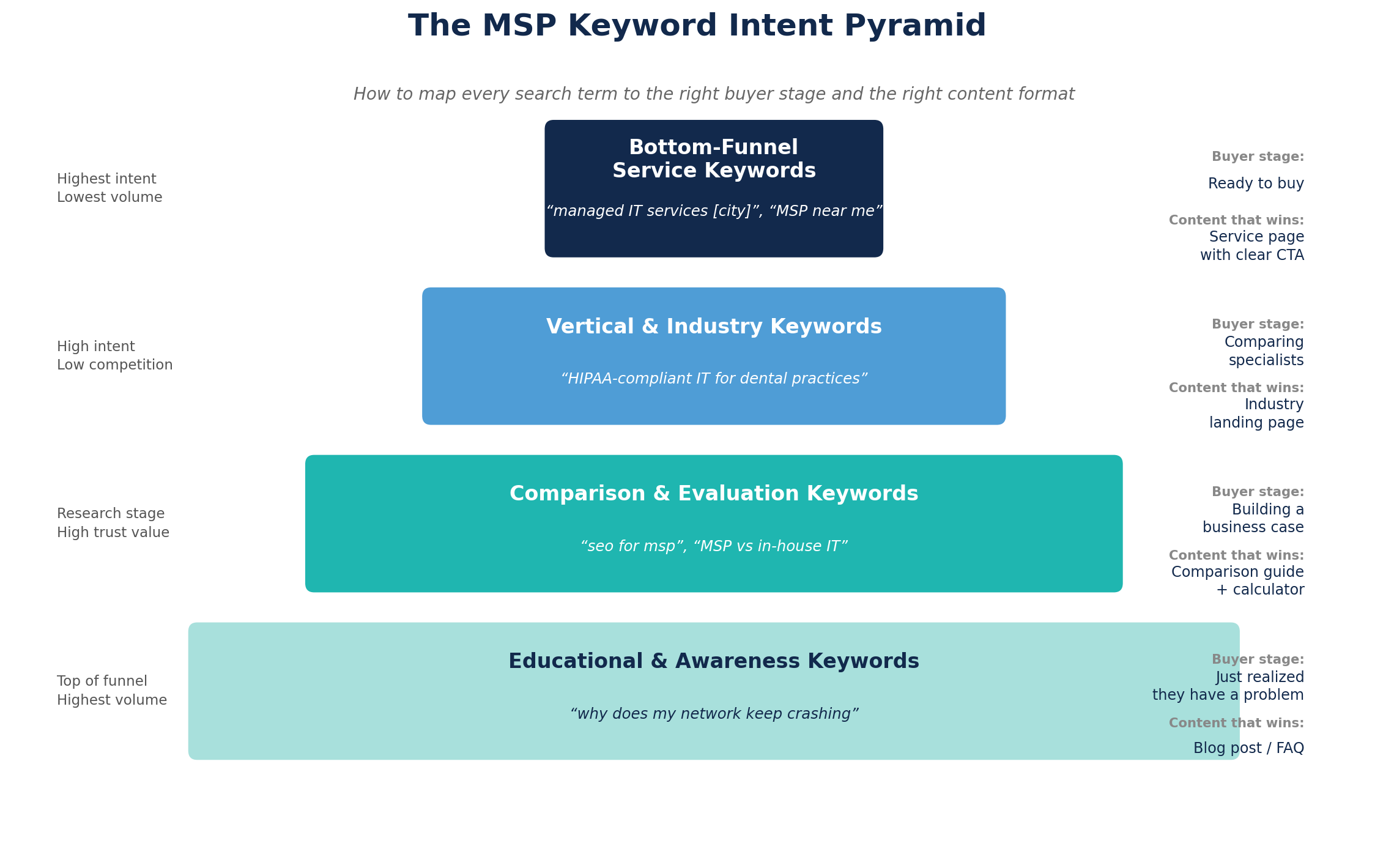
Blog posts that answer real prospect questions — “how much does managed IT cost,” “signs you’ve outgrown break-fix IT,” “what is co-managed IT” — build trust and capture search traffic simultaneously. This content should map directly to each stage of the buyer journey, from early education to bottom-of-funnel comparison content.
Paid Search and Paid Social
Organic SEO takes months to compound. Paid search and LinkedIn ads fill that gap and let you target specific industries, company sizes, and job titles (IT director, office manager, CFO) with precision — especially useful when entering a new vertical or geography where organic authority hasn’t been built yet.
Website Conversion Optimization
Traffic and rankings without conversion are wasted spend. Clear calls-to-action, trust signals (certifications, client logos, reviews), and a frictionless contact process all directly affect how many of those searchers you win actually become booked calls.
Sales and Marketing Alignment
The strongest digital marketing services for msp businesses connect every channel above directly to the sales pipeline — lead scoring, CRM integration, and follow-up sequences that don’t let a warm lead go cold. For the full playbook on turning marketing activity into closed-won clients, our complete growth playbook for getting MSP clients covers the entire process from first touch to signed contract.
MSP Marketing Agencies vs. In-House Marketing
Many MSPs debate whether to hire an in-house marketer or work with an outside msp marketing company. Both can work, but they solve different problems.
In-house marketing makes sense once you have consistent budget for a full team — SEO, content, design, paid media, and analytics rarely live in one person’s skill set. A single in-house hire often becomes a generalist stretched too thin, running low-impact tactics across too many channels.
An outside agency gives you access to a full team of specialists — strategists, SEO specialists, content writers, and paid media managers — for a fraction of what several in-house salaries would cost. For most MSPs under $10M in revenue, an agency delivers more consistent output and faster results per dollar spent.
Some MSPs land on a hybrid: an in-house marketing coordinator managing day-to-day tasks and client-facing content, paired with an agency handling SEO strategy, technical execution, and paid media. This structure tends to scale well as the MSP grows.
How to Tell If It’s Actually Working: Reading an MSP Marketing Report
Rankings and traffic are inputs. The output that matters is whether marketing is turning into pipeline — and that requires reporting built around business outcomes, not vanity metrics.
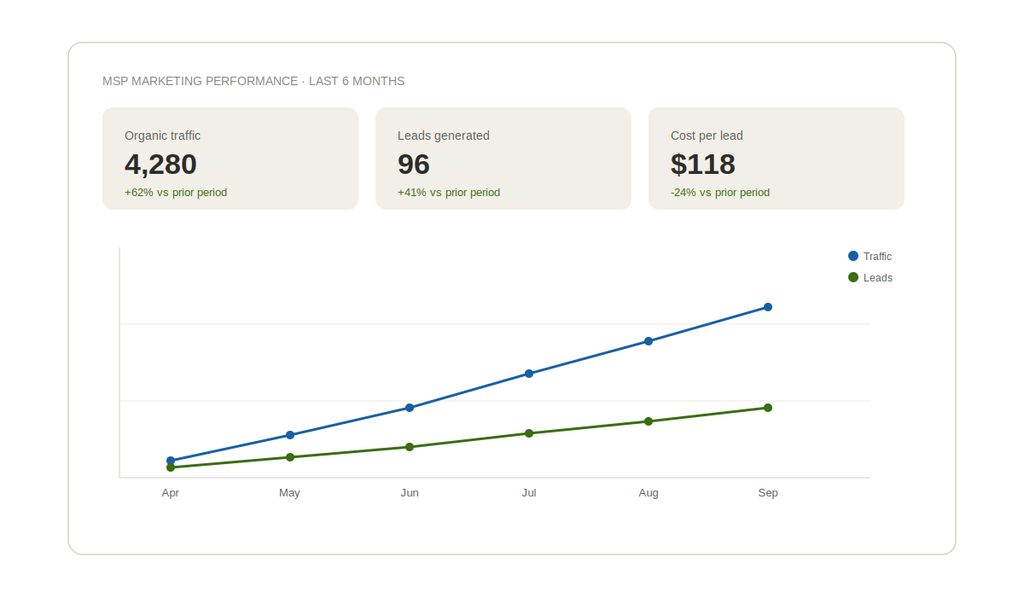
Three things about that report format matter more than the specific numbers:
- Traffic and leads are tracked together, not traffic alone. A dashboard that only shows visitor counts climbing tells you nothing about whether those visitors are turning into anything. Leads need their own line on the chart.
- Cost per lead is a headline metric, not a footnote. As SEO compounds, cost per lead should trend down over time even while overall marketing spend holds steady — because organic traffic is doing more of the work that paid channels used to carry alone.
- The trend line matters more than any single month. SEO is a compounding channel. A single flat or slightly down month isn’t a red flag; a flat trend across two full quarters is.
If your current — or prospective — msp marketing firm can’t produce something close to this every month, tied to actual leads and pipeline rather than impressions or “engagement,” that’s a real gap in the partnership.
Red Flags When Vetting MSP Marketing Companies
Watch for these warning signs before signing a contract with any marketing services for msp provider:
- Guaranteed rankings or lead counts. No legitimate SEO or marketing firm can guarantee specific rankings — search algorithms simply don’t allow that kind of certainty.
- Vague reporting. If the monthly report doesn’t resemble the dashboard format above — leads and cost per lead alongside traffic — push back.
- One-size-fits-all packages. MSPs vary wildly by vertical focus, geography, and target company size. A cookie-cutter package rarely fits.
- No understanding of your ideal client profile. If the agency can’t articulate who your best clients are within the first month, they’re not going to market to them effectively either.
- Long-term lock-in contracts with no visibility. Month-to-month or quarterly reviews with transparent reporting protect you if the partnership isn’t working.
How Much Do MSP Marketing Services Cost?
Pricing varies significantly based on scope, but most MSPs working with a specialized msp marketing agency should expect to invest somewhere between $2,500 and $10,000+ per month, depending on:
- Number of channels active (SEO only vs. SEO + paid + content + email)
- Competitiveness of your target keywords and geography
- Number of locations or service territories covered on the geogrid
- Whether website redesign or rebuild work is included
- Content volume and depth required
SEO-focused retainers tend to sit on the lower end initially, with cost scaling as content and technical scope grow. The right way to evaluate cost isn’t “what’s the monthly fee” — it’s “what’s the cost per qualified lead,” using a report that looks like the dashboard above, and how that compares to what you’re paying for referrals, trade shows, or cold outreach today.
Choosing the Right MSP Marketing Agency for Your Growth Stage
Not every MSP needs the same approach. Here’s a rough guide based on where your business sits today:
Early-stage MSPs (under $1M revenue): Focus budget on local SEO and a handful of high-intent service pages. You don’t need a 50-post content library yet — you need to turn your own geogrid green in the neighborhoods closest to your office and convert the traffic that finds you there.
Growth-stage MSPs ($1M–$10M revenue): This is where a full-funnel approach pays off — SEO, content marketing, and paid media working together, with clear sales handoff and a reporting rhythm like the dashboard above. This is also the stage where most MSPs benefit most from a dedicated msp digital marketing partner rather than piecing together freelancers.
Established MSPs ($10M+ revenue): Expanding into new verticals or geographies often means running the geogrid exercise in parallel across new territories, alongside vertical-specific content (healthcare IT, legal IT, manufacturing IT) and more sophisticated paid media targeting.
Regardless of stage, IT and technology companies broadly face similar trust and credibility hurdles in search — buyers want proof before they’ll hand over their infrastructure to a new provider. Our guide to SEO for IT and technology companies covers how to build that trust signal by signal, from technical credibility content to review strategy.
Bringing It All Together
Choosing an msp marketing agency isn’t about finding the cheapest option or the one with the flashiest pitch deck — it’s about finding a partner that can put your business in that top map pack listing, show its work with reporting that ties directly to leads and pipeline, and keep expanding both as your business grows. SEO earns you visibility when prospects are actively searching. Local SEO turns that visibility into coverage across your whole service area. And a tight connection between marketing and sales turns all of that activity into closed-won revenue.
If you’re evaluating options, start by asking any prospective msp marketing firm to show you real MSP results, walk you through how they’d approach your local search footprint, and share an example of the kind of report you’d actually receive. Anything less, and you’re just buying activity — not growth.
Ready to Turn Search Traffic Into Signed Clients?
At Social Marketway, MSP marketing isn’t a side offering — it’s our specialty. We build SEO, content, and demand generation systems specifically for managed service providers who want more qualified leads, not just more traffic.
Get in touch with our team to talk through where your marketing stands today and what a focused MSP growth strategy could look like for your business.