

MSP Marketing Strategy: The Complete Playbook to Win More Managed IT Clients

Most managed service providers don’t have a marketing problem. They have a system problem. They post on LinkedIn when things are slow, run a Google Ads campaign for a month, send a newsletter twice a year, and then go quiet the moment a big onboarding lands. Referrals keep the lights on, but referrals don’t scale, and they don’t show up on schedule.
A real MSP marketing strategy replaces that feast-or-famine cycle with a predictable pipeline: prospects who find you on Google, click your ads when they’re actively shopping, remember you because of your retargeting, and stay warm in your inbox until the day their current provider drops the ball.
This guide is the exact playbook we use at Social Market Way to grow managed IT firms. You’ll learn:
- How to position your MSP so the right clients self-select
- What an MSP marketing website needs to actually convert visitors into booked calls
- The SEO steps that get you into Google’s top results for “managed IT services in [your city]”
- How to run Google Ads and Facebook Ads without burning your budget
- Why email marketing is the most underrated channel in MSP digital marketing, and how to turn today’s “not a fit” prospects into next year’s best clients
- A 90-day marketing plan for MSP firms that you can start this week
Let’s build a pipeline that doesn’t depend on luck.
Why MSP Marketing Is Different (and Why Generic Agencies Get It Wrong)
Selling managed IT isn’t like selling shoes. Your buyer is a business owner, office manager, or CFO who is about to hand you the keys to their entire operation: their data, their email, their security, their uptime. That’s a high-trust, high-consideration purchase, and it usually happens on the buyer’s timeline, not yours.
Three things make MSP marketing unique:
- Long, trigger-based buying cycles. Most businesses don’t switch providers on a whim. They switch after a trigger: a ransomware scare, a failed audit, a new office, a key IT person quitting, or one too many unanswered tickets.
- Local trust matters. Even in a remote-first world, most small and mid-sized businesses want an MSP that knows their market and can send someone on-site.
- Your ideal client is narrow. A 10-seat law firm, a 150-seat manufacturer, and a solo consultant need completely different things. Marketing to “everyone with computers” attracts tire-kickers.
That’s why the best MSP marketing strategies don’t rely on a single channel. They combine search visibility, paid ads, social retargeting, content, and email into one connected system, where every lead is captured, and nobody is wasted.
[embed: node/2ef376da-0016]
Every channel feeds the same pipeline. Good-fit prospects go straight to a discovery call; everyone else joins your monthly nurture list, so that when their trigger event hits, you’re the first MSP they call.
Step 1: Build the Foundation Before You Spend a Dollar on Ads
The biggest mistake we see? MSPs pouring money into ads that send traffic to a website that can’t convert it. Before any channel, get these three pieces right.
Define your ideal client profile (ICP)
Write down, in plain language, who you serve best. For example: “Professional services firms in Dallas–Fort Worth with 20–150 employees, compliance requirements (HIPAA, SOC 2, or cyber insurance questionnaires), and no full-time IT leader.”
A sharp ICP makes every other decision easier: which keywords to target, which ad audiences to build, what your blog should cover, and who should be politely routed to your nurture list instead of your sales calendar.
Pick a position you can own
“We provide managed IT services” is what every competitor says. Stronger positions sound like:
- “Co-managed IT for growing manufacturers”
- “Cybersecurity-first IT for healthcare practices”
- “The MSP for law firms that bill by the hour and can’t afford downtime”
You can still serve other clients. But leading with a niche makes you the obvious choice for someone, instead of an interchangeable option for everyone.
Turn your MSP marketing website into a sales rep
Your MSP marketing website is the hub every channel points to. If it’s slow, vague, or buried in jargon, your SEO, ads, and emails all underperform. A high-converting MSP site includes:
- A clear headline above the fold that says who you help, where, and the outcome (“Proactive IT and cybersecurity for Dallas law firms: fewer tickets, zero surprises”)
- Separate service pages for managed IT, cybersecurity, cloud/Microsoft 365, co-managed IT, backup and disaster recovery, and compliance
- Location pages for every city or metro you actually serve
- Industry pages that speak to each vertical’s specific pain points
- Proof everywhere: client logos, reviews, case studies with numbers, certifications, and response-time guarantees
- One primary call to action (“Book a 15-minute IT assessment”) repeated on every page, plus a softer offer for people who aren’t ready (“Get our monthly IT tips for business owners”)
- Fast load times, mobile-first design, and clean technical structure
Every page also needs proper titles, headers, internal links, and schema markup. That’s the job of on-page SEO services, and it’s where most MSP websites quietly lose rankings they should be winning.
Step 2: SEO for MSPs, or How to Get Found on Google in Your City
When a Dallas business owner’s server crashes or their cyber-insurance renewal asks questions they can’t answer, they don’t post on social media. They open Google and type something like “managed IT services Dallas” or “IT support near me.” Whoever shows up in the first few results gets the call.
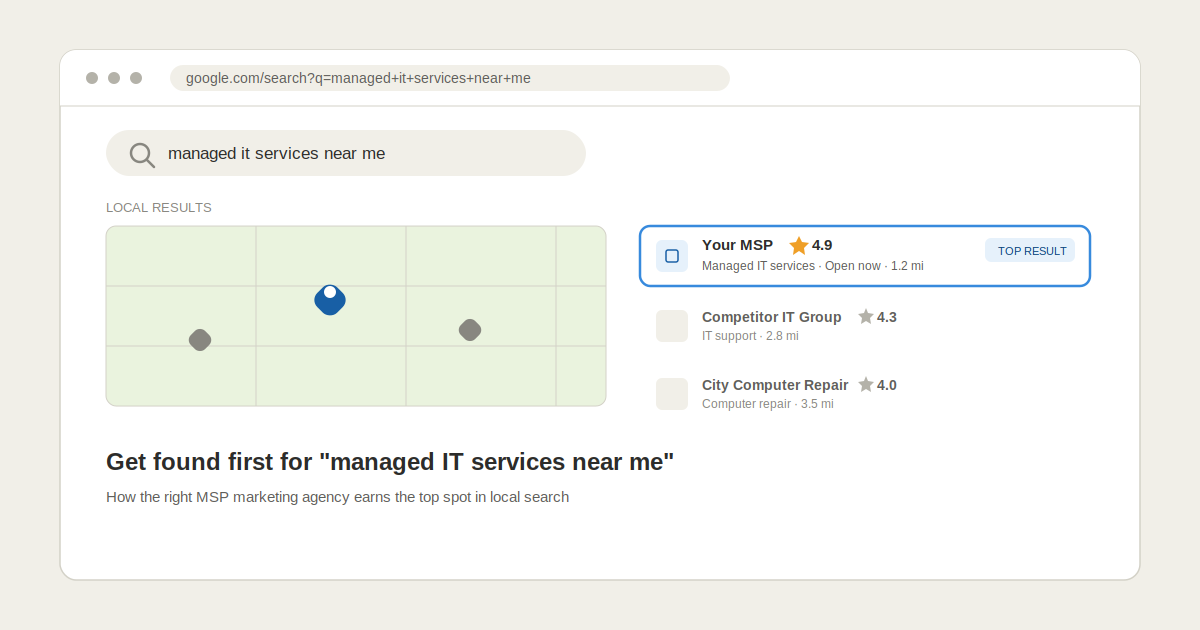
Here’s what that search results page looks like, and the three places your MSP needs to own:
[embed: node/e946885d-600d]
Notice that the page has three distinct zones, and each one is won differently. Paid ads are rented. The map pack and organic rankings are earned, and once you earn them, they keep producing leads every month without a per-click fee. That’s why SEO is the backbone of any serious online marketing for MSP firms.
The 7-step SEO process we use for MSPs
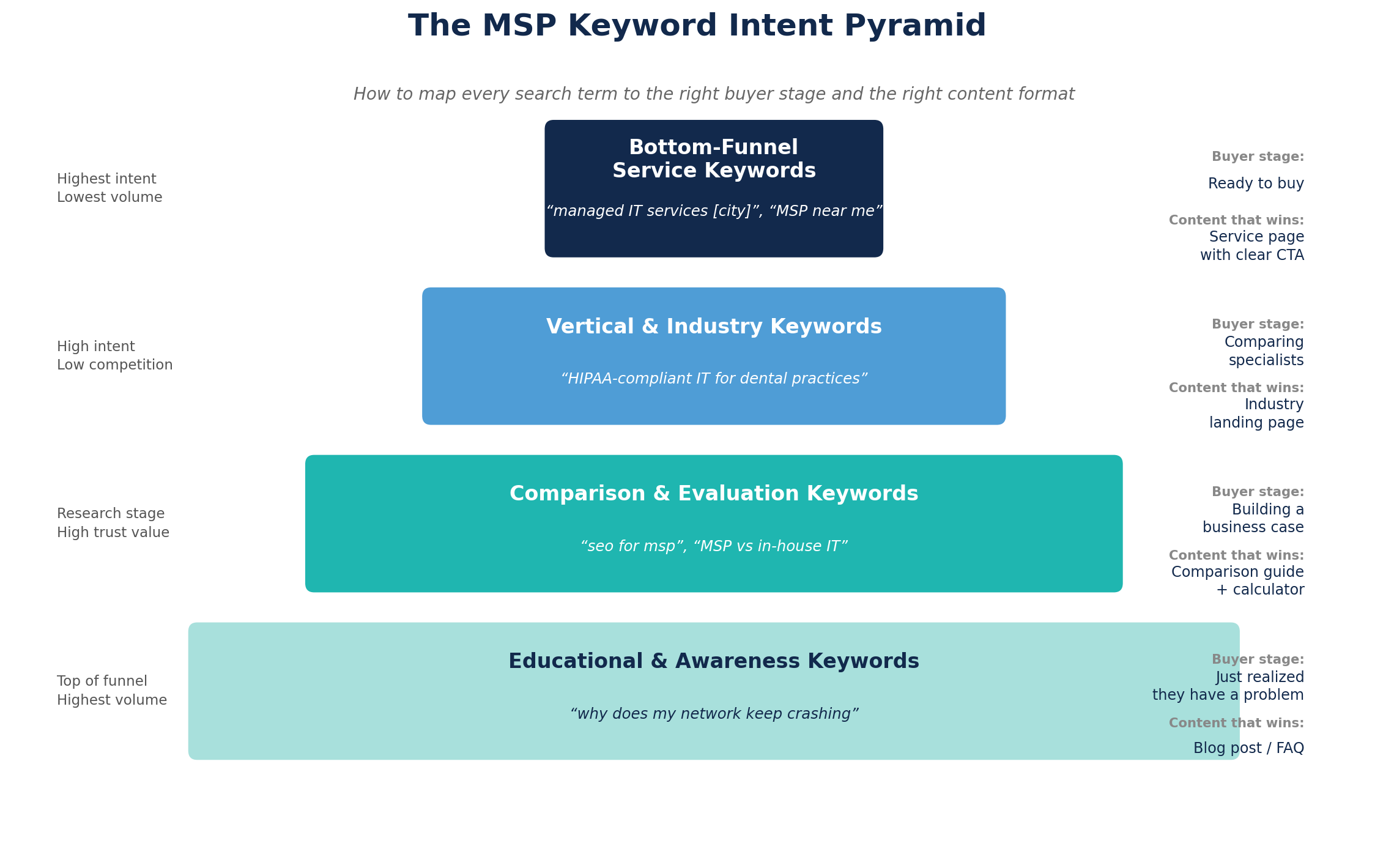
- Keyword and intent research. We map the exact phrases your buyers use, from high-intent terms like “managed IT services [city]” and “outsourced IT support [city]” to research terms like “what does an MSP cost” and “co-managed IT vs. in-house.”
- Technical audit. Site speed, mobile usability, crawl errors, indexing, and Core Web Vitals. If Google can’t crawl it cleanly, nothing else matters.
- On-page optimization. Every service, industry, and location page gets a clear target keyword, optimized title tag and meta description, logical H1–H3 structure, FAQ sections, schema markup, and internal links.
- Google Business Profile optimization. Correct categories, service areas, services list, photos, weekly posts, and Q&A. This is the single biggest lever for the map pack.
- Review generation. A simple, automated ask after every resolved ticket or quarterly business review. Consistent, recent reviews are a powerful local ranking and trust signal.
- Local citations and authority links. Consistent name, address, and phone across directories, plus links from local chambers, vendor partner pages, sponsorships, and industry publications.
- Content that answers buyer questions. Monthly blogs and guides that target long-tail searches, build topical authority, and give you something valuable to send your email list (more on that below).
If you serve several cities, don’t try to rank one home page for all of them. Build a dedicated, genuinely useful page for each market, and support it with local SEO services that keep your Google Business Profile, reviews, and citations working together.
For a deeper look at how search works for tech firms specifically, read our guide to SEO for IT and technology companies. And if you want the full MSP-specific breakdown, including timelines and what to expect month by month, see why an MSP SEO agency approach outperforms generic SEO.
MSP marketing tip: SEO compounds, but it takes time. Most MSPs start seeing meaningful movement in three to six months, depending on competition and where the site starts. That’s exactly why we pair it with paid search in the early months.
Step 3: Google Ads, or Capturing Buyers Who Are Shopping Right Now
SEO is a long game. Google Ads is how you get in front of high-intent buyers this month. When someone searches “IT support company Dallas” at 4:45 p.m. on a Friday after their file server went down, they’re not researching. They’re hiring.
The problem is that IT services clicks are expensive, and most MSPs who “tried Google Ads” wasted their budget on broad keywords, generic ads, and a home page instead of a landing page. Here’s how we structure digital marketing for MSPs on Google Ads so every dollar has a job:
| Campaign | Example keywords | Where it sends traffic |
|---|---|---|
| Core managed IT | “managed IT services [city]”, “outsourced IT support [city]” | Dedicated city landing page with a 15-minute assessment offer |
| Cybersecurity | “cybersecurity company [city]”, “ransomware protection for business” | Security landing page with a free risk assessment |
| Compliance and verticals | “HIPAA IT support”, “IT for law firms [city]” | Industry page with relevant case study |
| Switching intent | “change IT provider”, “IT company not responding” | “Switching made easy” page with an onboarding timeline |
| Branded | Your company name | Home page (cheap clicks that protect your brand from competitors) |
Google Ads best practices for MSPs
- Use exact and phrase match first. Broad match without tight controls will happily spend your budget on “IT jobs,” “free computer repair,” and “MSP certification.”
- Build a negative keyword list from day one. Exclude jobs, careers, salary, training, free, DIY, residential, and home computer repair.
- Send every campaign to a matching landing page. One offer, one form, proof above the fold, and no navigation menu to wander off through.
- Track real conversions. Form fills and calls are a start, but connect your CRM so you optimize for booked assessments and signed deals, not just clicks.
- Geo-target tightly. Only show ads in the areas you can actually serve on-site.
- Schedule wisely. Many MSPs see better lead quality during business hours, when decision-makers are at their desks.
Done right, Google Ads fills your pipeline while SEO builds. As organic rankings climb, you can shift budget away from the keywords you now rank for and toward new markets or services.
Step 4: Facebook Ads, or Staying Top of Mind Until the Trigger Hits
“Do business owners really pick an MSP from Facebook?” Rarely on the first scroll. But that’s not the job Facebook and Instagram ads do in a smart MSP marketing strategy. Their job is to make sure that when a trigger event happens, your name is the one they already recognize.
Business owners are on Facebook every day, off the clock, in a scrolling mindset. That’s the perfect moment to teach, reassure, and remind, rather than hard-sell. We run a three-stage funnel:
[embed: node/63b76102-ca7c]
Facebook Ads tips that work for MSPs
- Retargeting is the highest-return play. Someone who visited your cybersecurity page last week and saw your client testimonial today is far more likely to book than a stranger.
- Lead with value, not features. “5 signs your business has outgrown its IT guy” beats “We offer 24/7 monitoring and patch management” every time.
- Use video featuring real people. A 30-second clip of your owner or lead engineer explaining a common security mistake builds more trust than any stock photo.
- Upload your email list as a custom audience. Your nurture subscribers see your ads too, which reinforces every email you send.
- Use Meta lead forms for your lead magnets. Checklist downloads captured inside the platform reduce friction, and every download feeds your email list automatically.
This is where paid social and email start working together, which brings us to the most underrated channel in MSP digital marketing.
Step 5: Email Marketing, or Turning “Not a Fit Yet” Into Future Clients
Here’s a question most MSPs never ask: what happens to the prospects you say no to?
Every month, you talk to business owners who aren’t the right fit right now. Maybe they have eight employees and you work best with twenty-five or more. Maybe they’re 14 months into a 36-month contract with another provider. Maybe the budget just isn’t there this year. Most MSPs thank them for their time and never speak to them again.
That’s leaving money on the table. Businesses grow. Contracts expire. Providers disappoint. The eight-person accounting firm you passed on today could be a thirty-person firm in two years, and the question is whether they’ll remember you when it happens.
The nurture list strategy
The fix is simple and powerful: every prospect who isn’t a fit today goes onto your email list (with their permission), and they hear from you every single month.
[embed: node/abe5aacb-93ca]
Here’s how to run it:
- Capture everyone. Add a line to your discovery-call close: “We’re probably not the right fit today, but I’d love to send you our monthly IT tips for business owners. Would that be helpful?” Almost nobody says no to free, useful advice.
- Tag them by reason. “Too small,” “under contract until [date],” “budget,” “industry.” Tags let you send the right message at the right time, like a check-in email 90 days before their contract renews.
- Send one valuable email every month. Built around your latest blog post, plus one quick security tip and one short client story. No hard pitch, just proof that you know what you’re doing.
- Watch for buying signals. Clicks on pricing, switching, or cybersecurity content are signals. When someone engages repeatedly, a personal note from your owner or account manager converts beautifully.
- Keep the door open. Every email ends with a soft invitation: “When you’re ready for a second opinion on your IT, reply to this email.”
Why email works so well for MSPs
- You own the list. Rankings shift and ad costs rise, but your list is an asset no algorithm can take away.
- It’s the lowest-cost channel you have. Once content is written, sending it to 50 or 5,000 people costs about the same.
- It compounds your content. The monthly blog you publish for SEO does double duty as your nurture email, which is why consistent blogging is one of the smartest MSP marketing ideas you can act on.
- It shortens sales cycles. By the time a nurtured prospect calls, they’ve read a year of your advice. They’re not comparing you on price; they’re asking when you can start.
- It boosts every other channel. Email subscribers can be retargeted on Facebook, and past clicks tell you which topics to turn into ads and new blog posts.
The same list also serves your current clients. A monthly email that explains new threats and shows the value you delivered is one of the best retention and upsell tools an MSP has.
Step 6: MSP Marketing Ideas and Content That Builds Trust
Content is the fuel for every channel above. One strong monthly blog post can rank on Google, become your nurture email, get cut into a Facebook video, and hand your sales team something to send after a call. Here are proven MSP marketing ideas to fill your calendar:
Blog topics your buyers actually search for
- “How much do managed IT services cost in [city]?” (pricing content is some of the most-read content on any MSP site)
- “Managed IT vs. in-house IT: which is right for a 30-person business?”
- “What to do in the first hour after a ransomware attack”
- “How to answer your cyber insurance security questionnaire”
- “Signs it’s time to switch IT providers”
- “Microsoft 365 security settings every small business should turn on”
- Industry guides: “HIPAA IT checklist for dental practices,” “IT for law firms: protecting client confidentiality”
Lead magnets that grow your email list
- A downloadable cybersecurity checklist or self-assessment
- A “switching IT providers” guide with an onboarding timeline
- A short IT budget planning template for next year
- A recorded webinar on a timely threat
Trust builders
- Case studies with real outcomes (response times, downtime avoided, compliance passed)
- Short videos of your team answering common questions
- Co-hosted lunch-and-learns with local chambers, CPA firms, or law firms
- Partner spotlights with the vendors you already work with
Quick MSP marketing tips we give every client
- Publish consistently, not occasionally. Two strong posts a month beats ten in January and none until June.
- Write for the business owner, not the technician. Translate “EDR and SIEM” into “we spot attacks before they shut you down.”
- Put a price range on your site. Buyers want a ballpark, and transparency filters out poor-fit leads before they reach your calendar.
- Ask for reviews every month. Make it a process, not a one-time push.
- Repurpose everything. Blog to email, email to social post, social post to video.
Step 7: Your 90-Day Marketing Plan for MSP Growth
Strategy is only useful if it turns into action. Here’s the marketing plan for MSP firms we roll out with new clients, broken into three 30-day phases:
[embed: node/860f8c01-f5ed]
The order matters. Fixing the website and tracking first means every ad dollar in month two is measured. Launching paid campaigns in month two gives you leads while SEO ramps up. And by month three, you have real data to cut what isn’t working and double down on what is.
How to Measure Whether Your MSP Marketing Is Working
Vanity metrics like impressions and likes feel good but don’t pay salaries. Track these instead:
| Metric | What it tells you |
|---|---|
| Booked discovery calls or assessments | Whether marketing is creating real sales conversations |
| Cost per booked call, by channel | Which channels deserve more budget |
| Close rate by lead source | Which channels bring the best-fit buyers |
| Keyword rankings for “[service] + [city]” terms | Whether SEO is gaining ground in your market |
| Map pack position and review count | Your local visibility and social proof |
| Email list growth and click rate | Whether your nurture engine is healthy |
| New monthly recurring revenue (MRR) from marketing | The number that matters most |
DIY vs. Hiring an MSP Marketing Agency
You can do all of this in-house. But be honest about the cost: SEO, Google Ads, Facebook Ads, content, email, and web optimization are six different skill sets, and your team’s best hours should be spent serving clients.
The right MSP marketing agency should:
- Understand managed services. They should know the difference between co-managed and fully managed IT, and why a cyber-insurance questionnaire is a buying trigger.
- Report on pipeline, not just traffic. Ask how they’ll tie results to booked calls and new MRR.
- Run channels as one system. Your SEO, ads, and email should share data and messaging, not operate as disconnected vendors.
- Build assets you own. Your content, your list, your ad accounts, your website.
Ready to Build a Pipeline That Doesn’t Depend on Referrals?
At Social Market Way, we provide end-to-end MSP marketing solutions built around exactly what you’ve read here: local SEO that gets you into the map pack and top organic results, Google Ads that capture buyers who are ready now, Facebook campaigns that keep you top of mind, and an email nurture engine that turns today’s “not a fit” into tomorrow’s signed agreement.
Our marketing services for MSP firms are built for owners who want predictable growth, clear reporting, and a partner that actually speaks IT.
Book a free MSP marketing strategy session. We’ll review your website, show you where you rank for “managed IT services [your city]” today, point out where competitors are winning, and map out the exact 90-day plan to get you there.
And if now isn’t the right time? No problem. Join our monthly newsletter for MSP owners. We’ll send one genuinely useful marketing idea every month, and we’ll be here when you’re ready.
Frequently Asked Questions About MSP Marketing
What is the best MSP marketing strategy? The most effective strategy combines local SEO for long-term visibility, Google Ads for immediate high-intent leads, Facebook retargeting for brand recall, and email marketing to nurture prospects who aren’t ready to buy yet.
How long does SEO take for an MSP? Most MSPs see meaningful ranking movement within three to six months, with stronger results building over six to twelve months, depending on competition and your website’s starting point.
Should MSPs use Facebook ads? Yes, mainly for retargeting and lead-magnet campaigns. Facebook keeps your brand visible to business owners between trigger events, and it works best alongside search and email.
What should I do with prospects who aren’t a good fit? Add them to your email list with permission, tag them by reason, and send monthly value-driven content. When their business grows or their contract ends, you’ll be the MSP they already trust.