

SEO vs PPC: What’s the Difference and Which Is Right for Your Business?

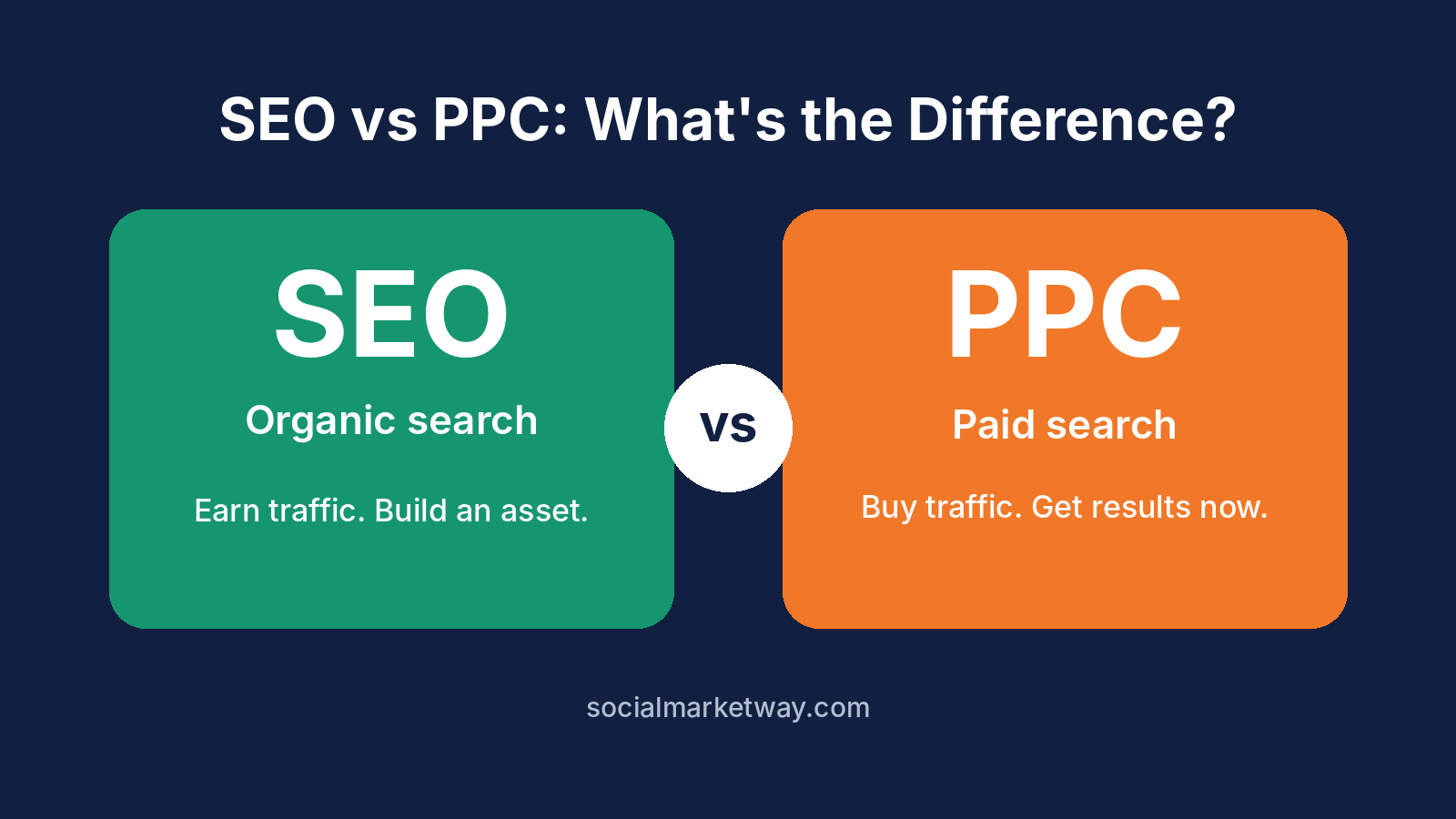
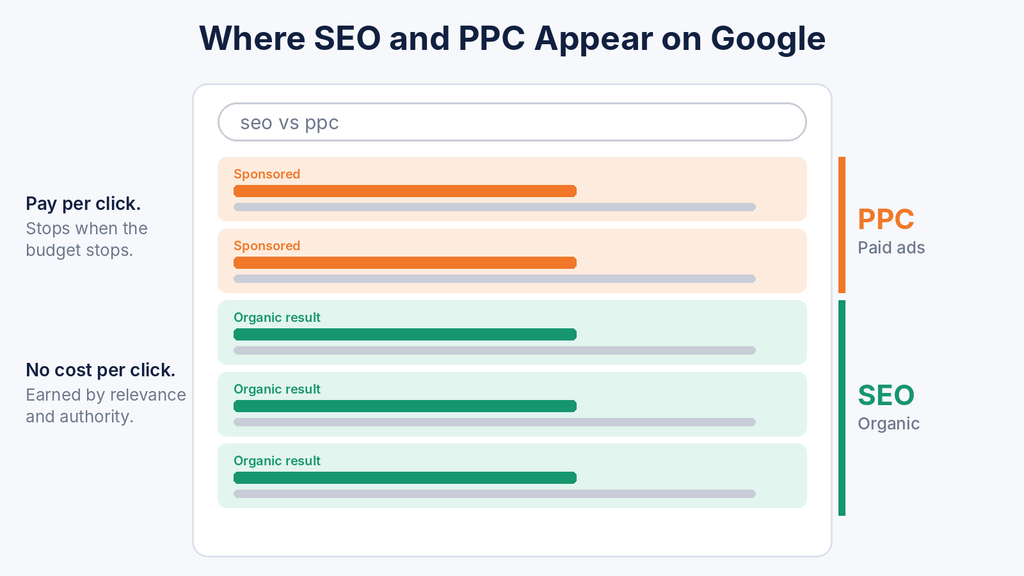
Every time someone types a question into Google, two kinds of results compete for their click. At the top, marked with a small “Sponsored” label, are paid ads. Below them are the organic listings that earned their place by being the most relevant, trustworthy answer. Those two kinds of results are the whole story of SEO vs PPC.
If you run a business, you have probably been told you need both, or that one is a waste of money, or that the other takes forever. The truth is more useful than any of those slogans. SEO and PPC are two different tools that solve two different problems, and the businesses that grow fastest know exactly when to use each one.
In this guide you will learn:
- What SEO and PPC actually mean, in plain English
- How each one works behind the scenes
- The 10 key differences between SEO and paid search, side by side
- The real pros and cons of each channel
- Which one to prioritise for your business type, budget and timeline
- How to combine SEO and PPC so each makes the other stronger
- How to budget for both and measure the return
Whether you are a founder spending your first marketing dollar or a marketing manager deciding where next quarter’s budget goes, by the end you will know whether you need SEO services, paid ads, or a mix of both.
What Is SEO? (Search Engine Optimization Explained)
SEO, short for search engine optimization, is the practice of improving your website so it ranks higher in the unpaid, organic results of search engines like Google and Bing. You do not pay Google for each visitor. Instead, you earn visibility by proving your page is the best answer to the searcher’s question.
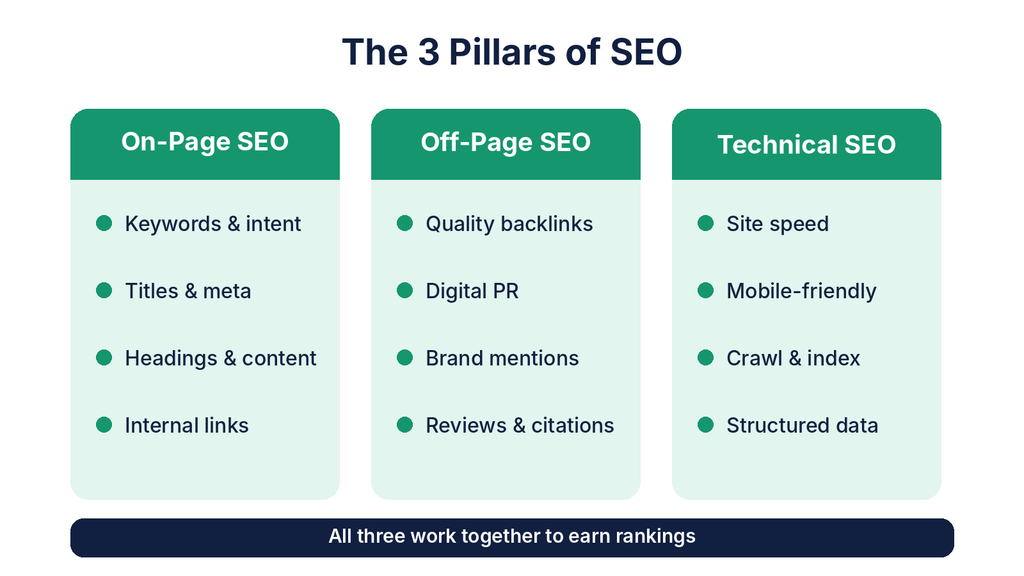
Google decides rankings with an algorithm that weighs hundreds of signals. Most of them fall into three pillars, and a complete SEO strategy works on all three at once.
1. On-page SEO: making each page the best answer
On-page SEO covers everything you control on the page itself. That includes the content, the title tag, the meta description, headings, image alt text, internal links and how well the page matches what the searcher actually wants (search intent).
A page that targets “seo vs ppc” but only talks about PPC will struggle, no matter how many links point to it. Professional on-page SEO aligns every element of the page with a clear keyword and a clear intent, so both Google and the reader understand it instantly.
Key on-page elements include:
- Keyword targeting – one primary topic per page, supported by related terms
- Title tags and meta descriptions – your “ad copy” in the organic results
- Header structure (H1–H3) – helps readers scan and helps Google understand topics
- Content depth and quality – answers the question better than competing pages
- Internal linking – passes authority between your pages and guides visitors
- Image optimisation – compressed files and descriptive alt text
2. Off-page SEO: earning trust from the rest of the web
Off-page SEO is about your reputation outside your own website. The biggest factor is backlinks, links from other websites pointing to yours. Google treats each quality link as a vote of confidence. A link from a respected industry publication carries far more weight than dozens from low-quality directories.
Off-page work also includes digital PR, brand mentions, guest contributions, local citations and reviews. Because links are hard to earn and easy to get wrong, a structured off-page SEO strategy focuses on relevance and quality instead of volume.
3. Technical SEO: making sure Google can read your site
Technical SEO is the foundation. If search engines cannot crawl, render and index your pages, great content will never rank. Technical work covers site speed, Core Web Vitals, mobile-friendliness, HTTPS security, XML sitemaps, robots.txt, canonical tags, structured data and fixing broken links or redirect chains.
How SEO results build over time
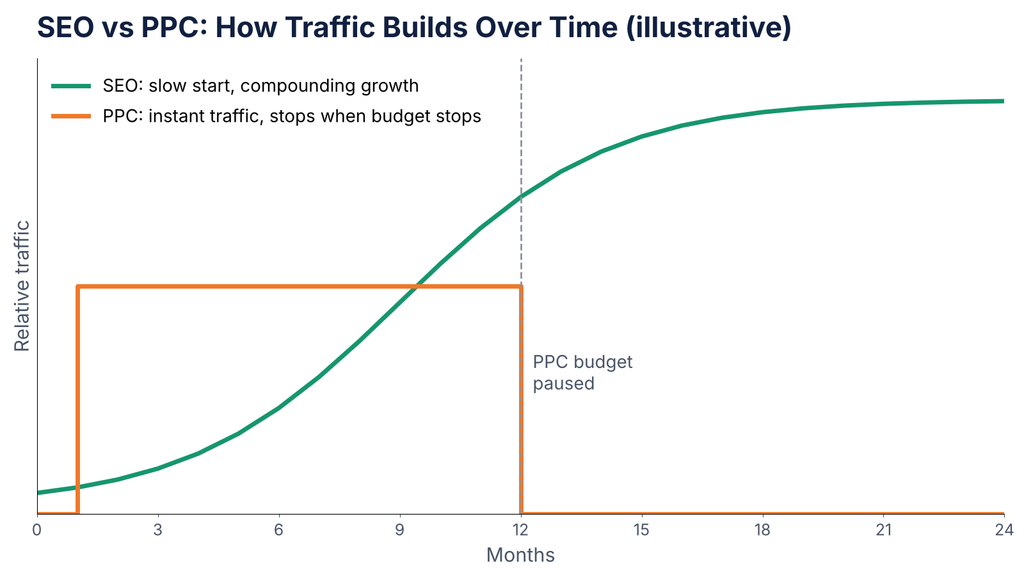
SEO is a compounding investment. In the first few months you are mostly fixing foundations, publishing content and earning early links. Rankings usually start moving within three to six months for less competitive terms, and keep climbing for a year or more. Once a page ranks, it can keep sending traffic for years with only light maintenance, which is why SEO often delivers the lowest cost per lead over the long run.
What Is PPC? (Pay-Per-Click Advertising Explained)
PPC stands for pay-per-click. It is a form of paid advertising where you pay a fee only when someone clicks your ad. When people talk about search engine PPC, they usually mean ads on Google or Bing that appear above and below the organic results, labelled “Sponsored”. That is why SEO vs PPC is often described as SEO vs paid search.
PPC is not limited to search engines, though. The same pay-for-performance model powers ads on Facebook, Instagram, LinkedIn, YouTube, TikTok and shopping platforms. A well-run PPC management programme picks the platforms where your buyers actually spend their time.
How a search ad auction works
Every time someone searches, Google runs a split-second auction among all the advertisers bidding on that keyword. The winner is not simply whoever bids the most. Google calculates an Ad Rank for each advertiser, based mainly on:
- Your maximum bid – the most you are willing to pay for a click
- Quality Score – Google’s rating of your ad’s relevance, expected click-through rate and landing page experience
- Ad assets and context – extensions like sitelinks and callouts, the searcher’s device, location and time
This is the most important thing to understand about PPC. A highly relevant ad with a strong landing page can outrank a competitor who bids more, and pay less per click. That is why expert Google Ads management focuses as much on relevance and conversion as on bids.
The main types of PPC campaigns
- Search ads – text ads triggered by keywords; the classic search engine PPC format and the highest-intent traffic
- Shopping ads – product images, prices and store names, ideal for ecommerce
- Display ads – banner and image ads across millions of websites, best for awareness and remarketing
- Video ads – YouTube placements for storytelling and reach
- Performance Max – Google’s automated campaigns that run across all its channels from one budget
- Social ads – audience-targeted ads on platforms like Facebook and Instagram, where you target people by interests, demographics and behaviour instead of keywords
How fast PPC works
PPC is the fastest way to get traffic. A campaign can be approved and showing within a day, and you can see clicks, leads and sales the same week. The flip side is just as important: the moment you stop paying, the traffic stops too. PPC rents attention, while SEO builds an asset you own.
SEO vs PPC: 10 Key Differences at a Glance
The simplest way to remember the difference: SEO earns traffic, PPC buys it. Here is how that plays out across the factors that matter most when you are deciding between SEO or PPC.
| Factor | SEO (organic search) | PPC (paid search) |
|---|---|---|
| How you pay | Time, content and expertise; no fee per click | A fee every time someone clicks your ad |
| Speed to results | Slow: typically 3–6+ months | Fast: often within 24–48 hours |
| How long results last | Compound and persist after work slows | Stop the moment the budget stops |
| Position on Google | Organic listings below the ads | Top and bottom of the page, marked “Sponsored” |
| Cost over time | Cost per lead falls as rankings mature | Cost per click stays flat or rises with competition |
| Targeting control | Limited; you rank for what Google decides is relevant | Precise: keywords, location, device, time, audience |
| Testing speed | Slow; changes take weeks to show | Fast; A/B test headlines and offers in days |
| Trust and click behaviour | Many users trust and prefer organic results | Strong for high-intent, ready-to-buy searches |
| Data and insights | Indirect, delayed keyword data | Full keyword, conversion and cost data in real time |
| Ownership | You build a lasting asset | You rent visibility |
Notice that neither column wins outright. SEO wins on long-term cost and trust. PPC wins on speed, control and data. That is exactly why the smartest question is rarely “SEO or PPC?” and more often “how much of each, and when?”
The Pros and Cons of SEO
Advantages of SEO
1. Traffic without a per-click cost. Once you rank, every visit is free at the point of the click. A single page ranking well for a valuable keyword can bring in leads every day for years.
2. Compounding returns. Each new piece of content, each new backlink and each technical fix adds to the authority of your whole domain. Month 12 is usually far more productive than month 3 for the same effort.
3. Credibility and trust. Many searchers skip the ads and click the first organic result because they see it as earned, not bought. Ranking organically positions your brand as an authority.
4. Covers the whole buyer journey. SEO lets you answer early questions (“what is ppc and seo”), comparison questions (“ppc vs seo”) and buying questions (“seo agency near me”). PPC is usually too expensive to target every informational query.
5. A durable, sellable asset. Rankings and content add real value to your business. If you sold the company tomorrow, organic traffic would be part of what the buyer pays for.
Disadvantages of SEO
1. It takes time. New sites and competitive keywords can take six to twelve months to deliver meaningful traffic. SEO rarely suits a business that needs revenue next week.
2. No guaranteed positions. You influence rankings, but Google controls them. Algorithm updates can move results, which is why sustainable, guideline-friendly tactics matter.
3. It needs ongoing, skilled work. Content, links and technical health all need attention. Doing it yourself is possible, but mistakes, especially with low-quality links, can set you back.
4. Results are harder to attribute. Organic visitors often research several times before buying, so connecting a specific ranking to a specific sale takes good analytics.
The Pros and Cons of PPC
Advantages of PPC
1. Immediate visibility. You can appear at the top of Google for your most valuable keywords today, even if your website is brand new.
2. Precise targeting. Choose exactly which keywords trigger your ads, which cities or postcodes see them, which devices, which hours of the day, and which audiences. Social platforms add targeting by interests, job titles and life events.
3. Measurable to the cent. PPC shows you what every click costs, which keywords convert and your exact return on ad spend. Few marketing channels are this transparent.
4. Full budget control. Set daily caps, pause campaigns in seconds and scale up what works. That makes PPC ideal for seasonal offers, launches and promotions.
5. A testing laboratory. Because results arrive fast, PPC is the quickest way to test headlines, offers and landing pages. The winners can then shape your SEO titles and on-page copy.
Disadvantages of PPC
1. Costs never stop. You pay for every click, forever. In competitive industries like legal, finance and insurance, single clicks can cost tens of dollars.
2. It can burn money fast. Broad match keywords, missing negative keywords and weak landing pages can drain a budget in days with nothing to show for it.
3. Ad fatigue and ad blindness. Some users skip anything labelled “Sponsored”, and social audiences tire of seeing the same creative.
4. Rising competition. As more competitors bid on the same terms, cost per click tends to rise. Your margin depends on out-optimising them, not just out-spending them.
SEO or PPC: Which Should You Choose?
The right answer depends on four things: how fast you need results, how much you can invest, how competitive your market is, and how long your customers take to decide. Use the scenarios below as a starting point.
Choose PPC first if…
- You are launching a new business, product or website. A new domain has no authority, so organic rankings will take months. PPC brings in customers while SEO matures.
- You run time-sensitive offers. Black Friday sales, event registrations and seasonal services need traffic now, not in six months.
- You sell a high-value product with clear buying intent. If a single customer is worth hundreds or thousands of dollars, paying for a high-intent click can be very profitable from day one.
- You need to validate demand. Before investing months in content, PPC tells you which keywords and offers actually convert.
- Your audience is easier to find by who they are than what they search. If people do not yet know your product exists, Facebook advertising can put it in front of the right demographic and interest groups before they ever search.
Choose SEO first if…
- You want sustainable, lower-cost growth. If you can wait three to six months, SEO usually delivers the lowest cost per lead over time.
- Your industry has very expensive clicks. When competitors bid up keywords, ranking organically is the way to compete without matching their ad budget.
- Your customers research before buying. B2B services, healthcare, home improvement and high-ticket purchases involve lots of informational searches that content answers well.
- You serve a local area. Local SEO and a strong Google Business Profile can win the map pack, one of the most valuable spots in local search.
- You are building a brand and authority. Being the trusted answer across dozens of related questions makes you the obvious choice when buyers are ready.
Quick decision guide
| Your situation | Recommended focus |
|---|---|
| New website, need sales this month | PPC now, start SEO in parallel |
| Established site, limited budget | SEO first, small PPC test on best keywords |
| Highly competitive, expensive keywords | SEO for long-tail terms, PPC on top converters |
| Seasonal or promotional business | PPC for peaks, SEO for year-round baseline |
| Local service business | Local SEO plus Google search ads |
| Ecommerce store | Shopping ads plus SEO for category and product pages |
| B2B with a long sales cycle | SEO content plus PPC and social remarketing |
Why SEO and PPC Work Best Together
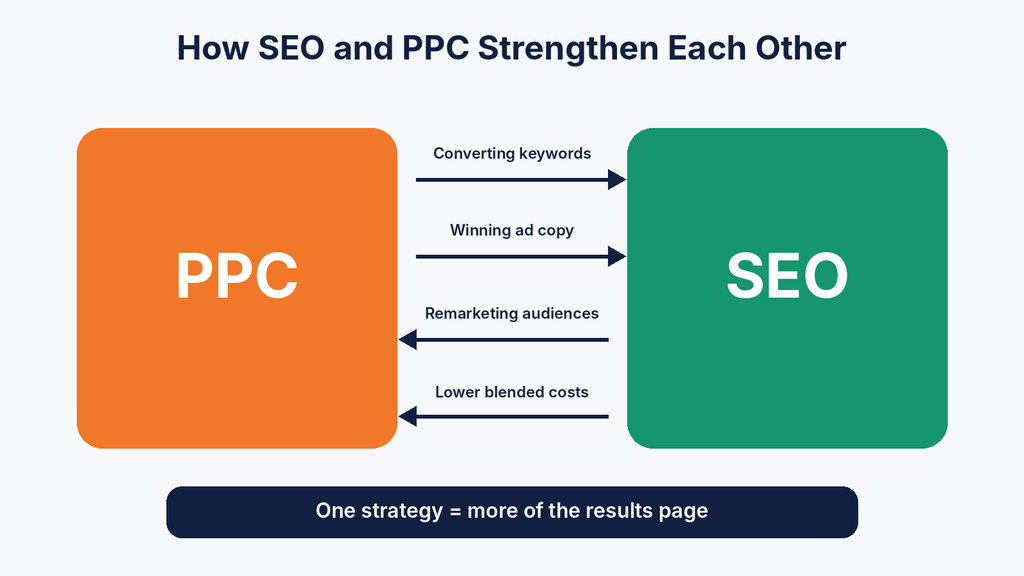
Framing it as PPC vs SEO misses the bigger opportunity. The two channels share the same search results page, the same customers and much of the same data. When they are run as one strategy, each makes the other cheaper and more effective. This is what people mean by “PPC in SEO” or integrated PPC and SEO marketing.
1. Use PPC data to choose SEO keywords
PPC tells you within weeks which keywords convert into customers. SEO takes months to rank. So test keywords with paid search first, then invest your SEO effort in the terms that have proven they make money.
2. Use winning ad copy to improve organic click-through
The headline that wins your ad A/B test is a strong candidate for your page’s title tag and meta description. Better organic click-through means more traffic from the same ranking.
3. Dominate the whole results page
When you appear in both the ads and the organic results for the same search, you take up more space, look like the market leader and push competitors further down. Many marketers see higher total clicks when both listings show together.
4. Retarget organic visitors with paid ads
Most first-time visitors from a blog post will not buy. Remarketing lists let you show Google Display, YouTube or social ads to the people who read your SEO content, bringing them back when they are ready.
5. Cover gaps while SEO matures
Use PPC on the valuable keywords you do not rank for yet. As organic rankings climb, shift budget away from terms you now own and toward new opportunities. Over time your blended cost per lead falls.
6. Protect your brand
Competitors can bid on your brand name. A low-cost brand campaign keeps your own ad at the top, while strong organic listings and reviews reinforce your credibility directly below it.
The businesses that win in search rarely treat SEO and PPC as rivals. They run them as two halves of one search strategy, guided by shared goals and shared reporting.
How to Budget for SEO and PPC (and Measure ROI)
There is no universal split, but a practical starting framework looks like this:
| Business stage | PPC share | SEO share | Why |
|---|---|---|---|
| Launch (months 0–6) | 60–70% | 30–40% | PPC drives early revenue while SEO foundations are built |
| Growth (months 6–18) | 40–50% | 50–60% | Organic traffic starts compounding; PPC focuses on proven winners |
| Mature (18+ months) | 20–40% | 60–80% | SEO carries the baseline; PPC handles launches, promotions and remarketing |
Treat these as ranges to test, not rules. Your margins, competition and sales cycle should shape the final mix.
Setting a PPC budget
Work backwards from your goals. If you need 20 leads a month, your landing page converts at 5% and an average click costs $3, you need around 400 clicks, or roughly $1,200 a month in ad spend. Add management and creative costs, then compare the cost per lead with what a customer is worth.
Setting an SEO budget
SEO is usually priced as a monthly retainer covering technical fixes, content and link building. Because effort compounds, consistency matters more than size; six months of steady work beats one expensive burst. Fixed-scope SEO packages make it easier to plan spend and know exactly what is delivered each month.
The metrics that matter
For PPC, track:
- Click-through rate (CTR)
- Cost per click (CPC)
- Conversion rate
- Cost per acquisition (CPA)
- Return on ad spend (ROAS)
- Quality Score
For SEO, track:
- Organic sessions and new users
- Keyword rankings for target terms
- Organic conversions and assisted conversions
- Backlinks and referring domains
- Core Web Vitals and indexation health
- Organic cost per lead (total SEO spend ÷ organic leads)
The fairest comparison is cost per lead or cost per customer over a 12-month window. Judging SEO after six weeks or PPC on clicks alone will mislead you every time.
8 Common SEO and PPC Mistakes to Avoid
- Giving up on SEO too early. Most SEO campaigns are abandoned just before they start paying off. Commit to at least six months before judging results.
- Running PPC without negative keywords. Without them, your ads show for irrelevant searches such as “free”, “jobs” or “DIY”, and you pay for every wasted click.
- Sending ad traffic to the homepage. Every ad group deserves a focused landing page that matches the ad’s promise. Relevance lifts conversion rate and Quality Score at the same time.
- Chasing rankings instead of revenue. Ranking first for a keyword nobody buys from is a vanity metric. Prioritise keywords with commercial intent.
- Buying cheap backlinks. Low-quality link schemes can trigger penalties that take months to recover from. Earn links through genuinely useful content and outreach.
- Ignoring mobile users. Most searches happen on phones. Slow, clunky mobile pages hurt both organic rankings and ad performance.
- Running SEO and PPC in silos. Separate teams with separate reports miss the shared insights described above. One strategy, one dashboard.
- Not tracking conversions properly. Without accurate conversion tracking in Google Analytics and your ad platforms, you are guessing which channel works.
Frequently Asked Questions About SEO and PPC
What is PPC and SEO, in simple terms?
SEO (search engine optimization) is improving your website so it appears in Google’s free, organic results. PPC (pay-per-click) is paying for ads that appear in search results or on social media, with a fee charged each time someone clicks. SEO earns traffic over time; PPC buys traffic instantly.
What is the meaning of SEO and PPC in digital marketing?
Together, SEO and PPC make up search engine marketing (SEM): the two ways a business can get visible on search engines. SEO is the organic side and PPC is the paid side.
Is PPC part of SEO?
No. PPC and SEO are separate disciplines. Running Google Ads does not directly improve your organic rankings. However, “PPC in SEO” is a common way of describing how paid search data and testing can inform and speed up your SEO strategy.
Which is better, SEO or PPC?
Neither is universally better. PPC is better for speed, testing and short-term campaigns. SEO is better for long-term, lower-cost traffic and authority. Most growing businesses get the best results by combining both.
What is the difference between SEO and paid search?
Paid search means ads you pay for on search engines, usually through Google Ads or Microsoft Ads. SEO targets the unpaid results. Paid search delivers instant, controllable visibility; SEO delivers slower but lasting visibility you do not pay for per click.
Is SEO cheaper than PPC?
Over the long term, usually yes, because organic traffic does not cost you per click. In the short term SEO can seem more expensive because you invest for months before results arrive. PPC costs less to start but never stops costing.
How long does SEO take compared with PPC?
PPC can drive traffic within a day or two of launch. SEO typically takes three to six months to show meaningful movement, and six to twelve months for competitive terms.
Does running Google Ads help SEO rankings?
Not directly. Google states that advertising does not influence organic rankings. Indirectly, ads can increase brand searches and awareness, and their data helps you choose better SEO keywords.
Can a small business afford both SEO and PPC?
Yes. Start with a modest PPC budget on your highest-intent keywords and a focused SEO plan for a handful of priority pages. Scale whichever channel delivers the lower cost per customer.
The Bottom Line: SEO vs PPC Is a Strategy, Not a Rivalry
SEO and PPC answer different questions. PPC answers “how do I get customers this week?” SEO answers “how do I keep getting customers for years without paying for every click?” A business that only asks one of those questions is leaving growth on the table.
If you need results fast, start with paid search and use the data to guide your organic strategy. If you can invest for the long term, build your SEO foundations and use PPC to fill the gaps. And if you want to win the whole results page, run both as one coordinated plan.
Ready to Grow With the Right Mix of SEO and PPC?
At Social Market Way, we build search strategies around your goals, not around a single channel. Our team handles everything from technical audits, on-page and off-page SEO to Google Ads, PPC and paid social campaigns, all measured against the metric that matters most: revenue.
Not sure whether you need SEO, PPC or both? Book a free strategy call and we will review your website, your competitors and your current campaigns, then show you exactly where your next dollar should go.
👉 Contact Social Market Way today for your free consultation