

Plastic Surgery Marketing: 14 Proven Strategies to Attract More Patients

Plastic surgery marketing is the mix of online and offline tactics a practice uses to attract, convert, and keep aesthetic patients. The practices that grow fastest do not rely on a single channel. They combine search, paid ads, social media, reviews, and patient follow-up into one system that keeps the consultation calendar full.
Competition has never been tougher. Board-certified surgeons now compete with medspas, dermatology groups, and med-tourism clinics for the same patients. Those patients research for weeks, compare before-and-after galleries, read dozens of reviews, and increasingly ask AI assistants for recommendations before they book.
The good news is that smart plastic surgeon marketing can level the playing field. A single-surgeon practice with a clear plan can outperform a larger group that spends more but markets without focus.
This guide covers 14 proven plastic surgery marketing strategies, from search and paid ads to referrals and email. You will also learn how to build a cosmetic surgery marketing plan, how much to budget, and which mistakes waste the most money.
Who This Guide Is For
- Plastic and cosmetic surgeons who want a steady flow of qualified consultations
- Practice managers and marketing coordinators at aesthetic practices and medspas
- Multi-location surgical groups looking to improve return on their marketing spend
- Any practice that feels stuck relying on word of mouth alone
Know Your Patients Before You Market
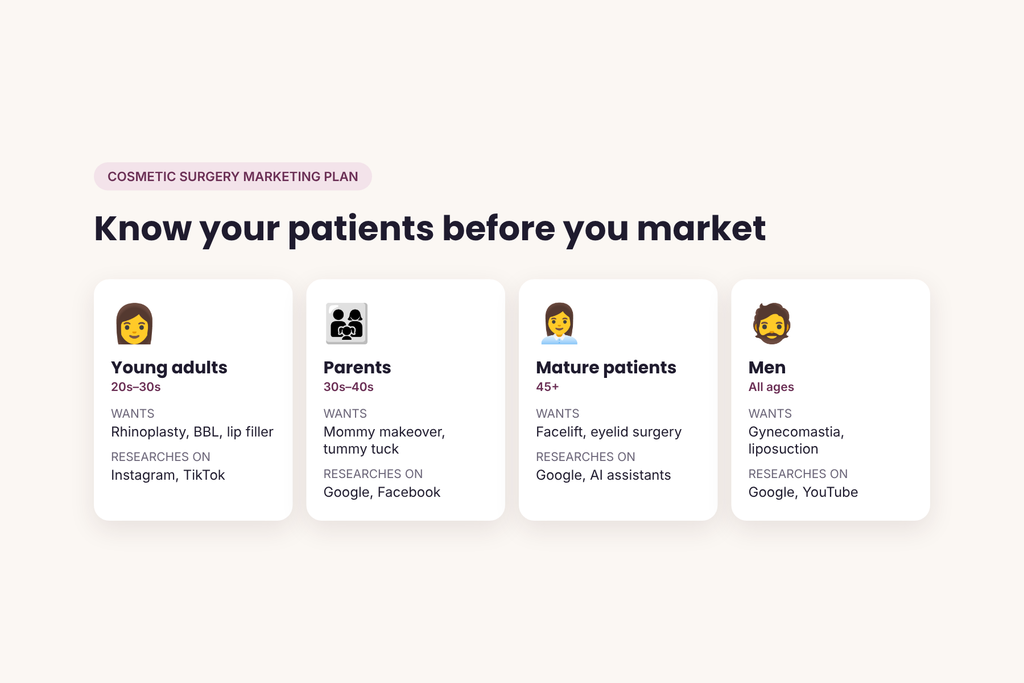
Every effective campaign starts with a clear picture of who you want to reach. Aesthetic patients are not one audience. A 28-year-old considering a BBL, a 45-year-old mother researching a mommy makeover, and a 60-year-old executive weighing a facelift search differently, trust different proof, and respond to different messages.
Build a simple profile for each core patient type:
| Patient type | Common procedures | What they care about | Where they research |
|---|---|---|---|
| Young adults (20s–30s) | Rhinoplasty, BBL, breast augmentation, lip filler | Natural results, price, social proof | Instagram, TikTok, Google, RealSelf |
| Parents (30s–40s) | Mommy makeover, tummy tuck, liposuction | Recovery time, financing, safety | Google, Facebook, friend referrals |
| Mature patients (45+) | Facelift, eyelid surgery, neck lift | Surgeon experience, discretion, results | Google, AI assistants, doctor referrals |
| Men | Gynecomastia, liposuction, eyelid surgery | Privacy, subtle results, fast recovery | Google, YouTube, forums |
How to Build a Cosmetic Surgery Marketing Plan
A cosmetic surgery marketing plan turns scattered tactics into a system you can measure. It does not need to be long, but it should answer five questions:
- Which procedures matter most? Focus on high-value, high-margin procedures you want to grow, not everything you offer.
- Who are you targeting? Use the patient profiles above.
- Which channels will you use? Most practices need search, paid ads, social, and reviews working together.
- What is the budget? Set a monthly amount and split it by channel.
- How will you measure success? Track cost per lead, cost per consultation, and revenue per channel.
Review the plan every quarter. Shift budget toward the channels that book consultations, and cut what only produces clicks.
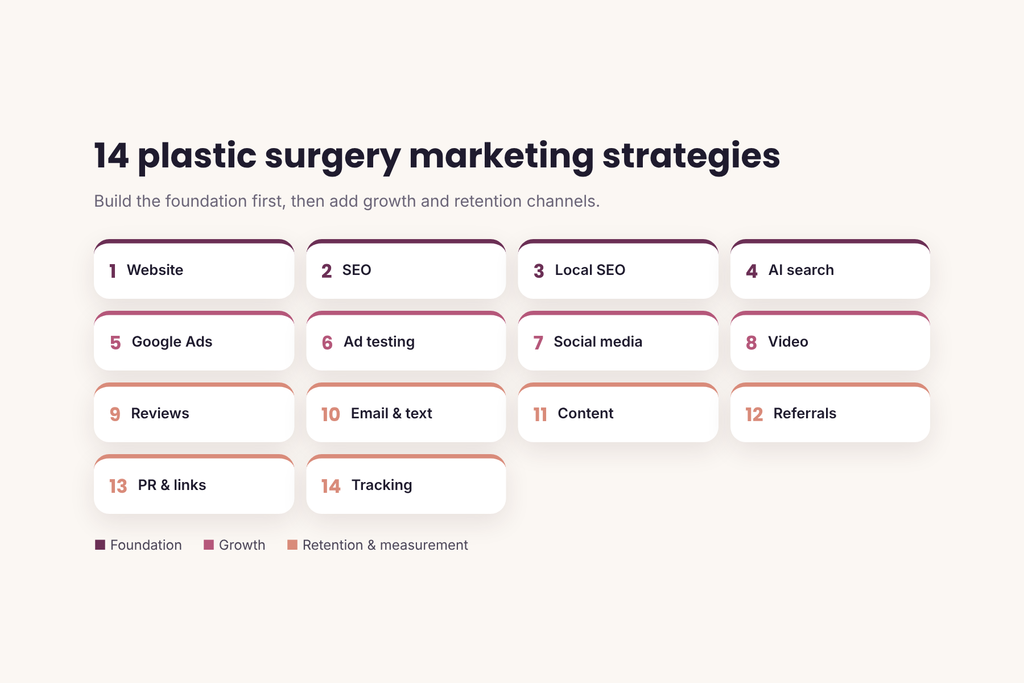
14 Plastic Surgery Marketing Strategies That Work
The strategies below are grouped from foundation to growth. Start with the first four, because every paid ad, social post, and email sends patients back to your website and search presence.
1. Turn Your Website Into a Consultation Engine
Your website is the hub of all plastic surgery internet marketing. Patients judge your skill by its design, so an outdated site quietly sends them to competitors. A modern site should load fast on phones, showcase a large before-and-after gallery, and make booking possible in two taps.
Every high-value procedure needs its own page covering candidates, recovery, results, cost, and risks. Add surgeon bios with board certifications, patient testimonials, financing details, and a clear call to action on every page. Strong on-page SEO makes sure each of those pages is structured to rank, with optimized titles, headings, image alt text, and internal links.
2. Invest in SEO for Long-Term Patient Flow
Search engine optimization is the backbone of plastic surgery digital marketing. Paid ads stop the moment you stop paying, but strong organic rankings keep producing consultations month after month. Patients also tend to trust organic results more than ads.
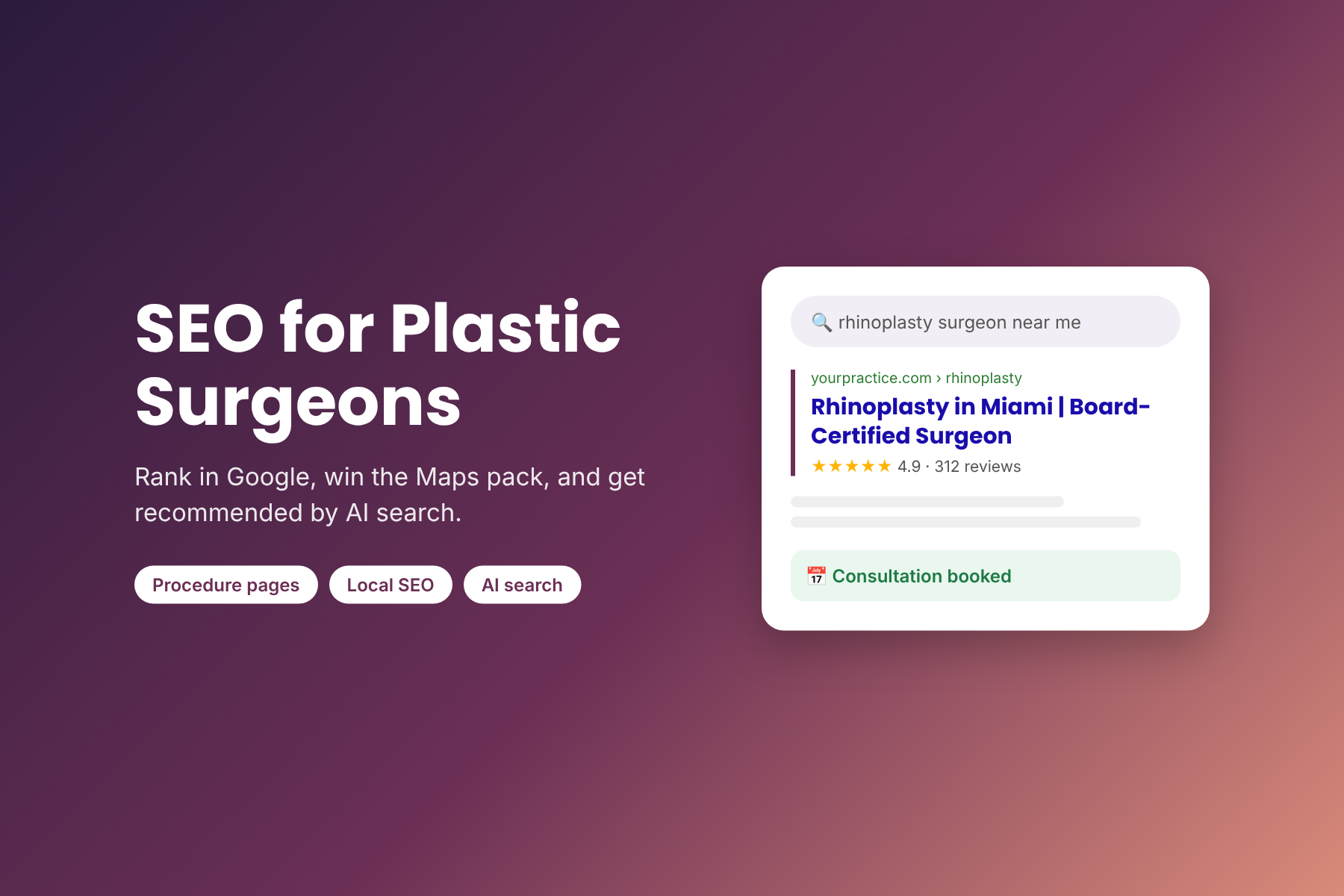
Focus on procedure and location keywords such as “rhinoplasty surgeon in Miami” or “tummy tuck Dallas.” For a full walkthrough of keyword strategy, procedure pages, and technical fixes, read our guide to SEO for plastic surgeons.
3. Dominate Local Search and Google Maps
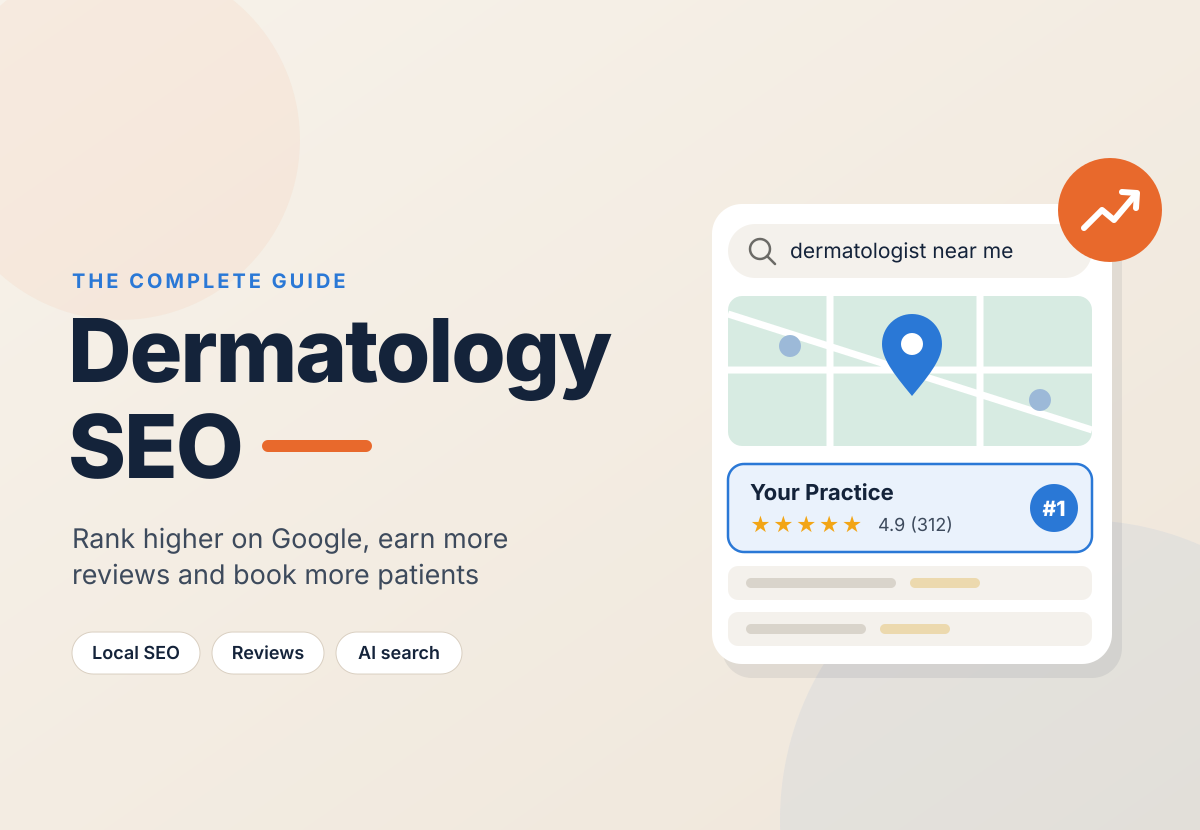
Most aesthetic patients search with local intent, like “plastic surgeon near me.” Google answers with the map pack, the three listings above the regular results, and those spots earn a large share of calls and direction requests. A focused local SEO strategy helps you earn one of them.
Your Google Business Profile drives most of that visibility. Choose “Plastic surgeon” as your primary category, list every procedure as a service, upload new photos monthly, and post updates weekly. Our Google Business Profile SEO guide covers every setting in detail.
Keep your name, address, and phone number identical across Google, Apple Maps, Yelp, Healthgrades, RealSelf, and other medical directories. Inconsistent listings confuse search engines and weaken rankings.
4. Get Recommended by AI Search
Patients now ask ChatGPT, Gemini, and Google AI Overviews questions like “Who is the best facelift surgeon in Atlanta?” These tools respond with a short list of names. If your practice is not on that list, you miss patients who are already close to booking.
AI tools favor practices with clear answers, consistent information across the web, structured data, and strong third-party reviews. Start each procedure page with a short, direct summary, add FAQ schema, and keep surgeon and practice details identical everywhere. Our AI SEO services are built to help practices earn these citations.
5. Run Targeted Google Ads
Pay-per-click ads put your practice at the top of Google the same day you launch. For high-value procedures like breast augmentation or a mommy makeover, one booked surgery can cover months of ad spend. The catch is cost: cosmetic terms are among the most expensive keywords in healthcare, often $10 to $30 or more per click.
That makes campaign structure critical. Separate campaigns by procedure, use tight location targeting, write ads that mention financing or free consultations, and send each ad to a matching procedure page rather than your homepage. Expert Google Ads management keeps budgets focused on searches that turn into consultations.
6. Test and Refine Your Plastic Surgery Advertising Campaigns
The best plastic surgery advertising campaigns are built through testing, not guessing. Digital platforms let you change a headline, offer, or image in minutes, so there is no reason to run one version forever.
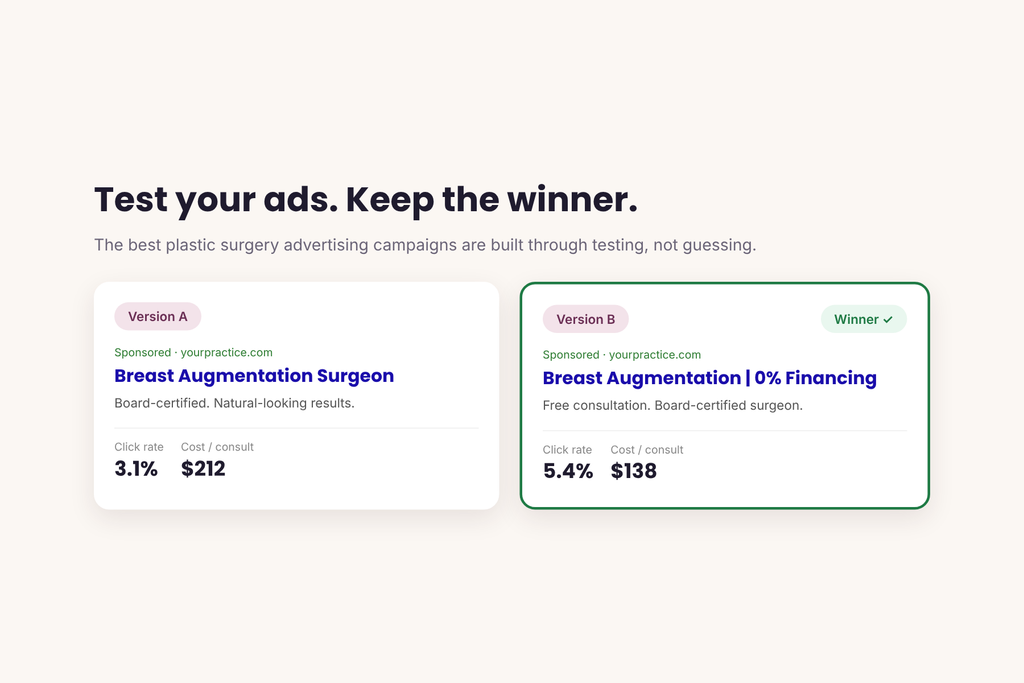
Test one variable at a time:
- Offer: free consultation versus a seasonal financing promotion
- Creative: real before-and-after photos versus surgeon video
- Message: confidence and lifestyle versus safety and expertise
- Landing page: long procedure page versus short booking page
Add remarketing to every campaign. Most patients visit several times before booking, so showing ads to past visitors on Google, Facebook, and Instagram keeps your practice top of mind during their research.
7. Build Trust on Social Media
Instagram, TikTok, Facebook, and YouTube are where many aesthetic patients first discover a surgeon. Social media works best when it shows the people and the results behind the practice, not just promotions.
Strong content ideas include patient journeys shared with written consent, behind-the-scenes clips of the office, surgeon Q&A videos, myth-busting posts, and recovery tips. Post consistently, reply to comments and messages quickly, and always follow platform rules and patient privacy laws. Partnering with local lifestyle creators can also introduce your practice to new audiences.
8. Use Video to Show Expertise
Video lets patients meet the surgeon before they ever walk in. That familiarity lowers anxiety, which is one of the biggest barriers to booking cosmetic surgery.
Create short videos that explain each procedure, walk through recovery, answer common questions, and feature patient testimonials. Use them on procedure pages, YouTube, social media, and in video ads. Videos also increase time on page, which supports your search performance.
9. Make Reviews a System
Reviews may be the most powerful trust signal in cosmetic surgery. Most patients read several before contacting a surgeon, and review count, rating, and recency also influence your Google Maps rankings.
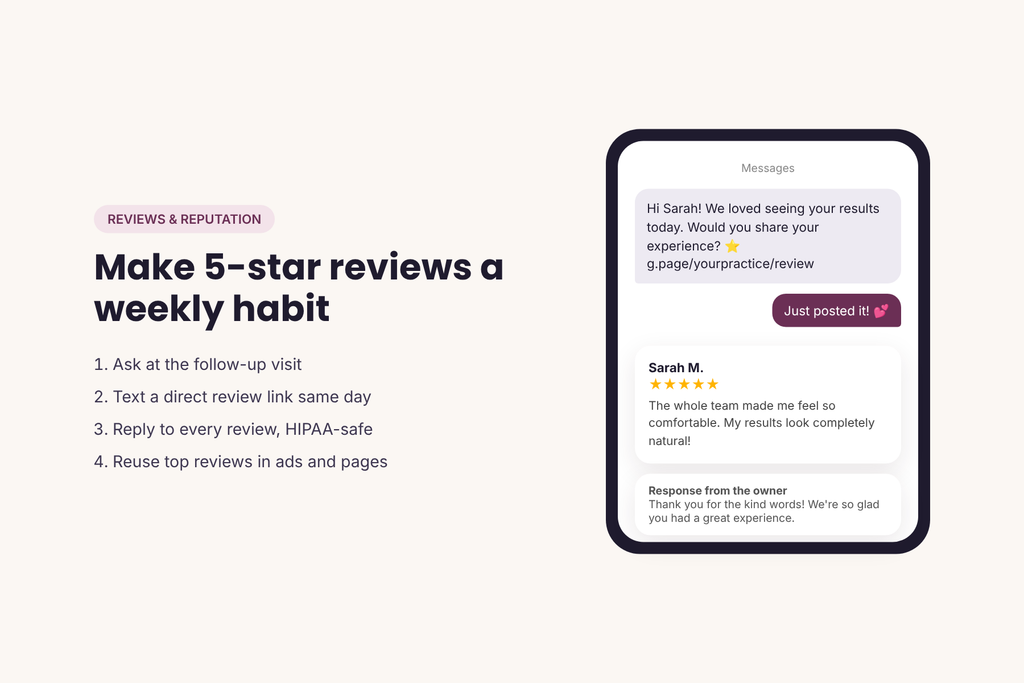
Build a simple routine. Ask happy patients for a review at a follow-up visit, once they can see their results, and send a text with a direct link the same day. Respond to every review, positive or negative, without confirming the reviewer is a patient or mentioning treatment details. Then reuse your best reviews on procedure pages, in emails, and in ads.
10. Nurture Leads With Email and Text
Many patients who contact your practice are not ready to book yet. Email and text follow-up keeps the conversation going until they are, and it remains one of the highest-return channels in marketing for plastic surgery.
Set up automated sequences for:
- New inquiries: a welcome message, surgeon introduction, and consultation reminder
- Consultation no-shows and undecided patients: success stories, financing options, and FAQs
- Past patients: post-op check-ins, review requests, and complementary non-surgical treatments
- Your full list: monthly newsletters with seasonal offers and practice news
Keep every message HIPAA-compliant, and never include treatment details in a subject line.
11. Publish Content That Answers Patient Questions
Helpful content builds authority with patients and search engines at the same time. Each blog post or guide is another chance to rank and another reason for patients to trust your expertise.
Write about the questions you hear in consultations every week. Good plastic surgery marketing ideas for content include cost guides by procedure, recovery timelines, “procedure A vs. procedure B” comparisons, and candidate checklists. Have the surgeon review every article, and link each post to the matching procedure page.
12. Turn Happy Patients Into Referrals
Word of mouth remains one of the strongest sources of new cosmetic patients. People trust a friend’s results more than any ad.
Make referring easy. Give patients referral cards, mention the program during post-op visits, and thank referrers with a handwritten note or a credit toward a non-surgical treatment. Check state medical board rules and anti-kickback regulations before offering any incentive. You can also build professional referral networks with dermatologists, OB-GYNs, and dentists.
13. Earn Press and High-Quality Links
Media coverage builds credibility and search authority at the same time. Offer your surgeon as an expert source on trending topics like GLP-1 weight loss and skin laxity, or non-surgical alternatives to surgery. Local magazines, health publications, and podcasts are always looking for qualified voices.
Each mention earns trust with patients and, when it includes a link, strengthens your rankings. Our off-page SEO services focus on earning these kinds of relevant, reputable links rather than risky shortcuts.
14. Track What Turns Into Booked Surgeries
You cannot improve what you do not measure. Many practices know their website traffic but not which channel produced their last ten surgeries.
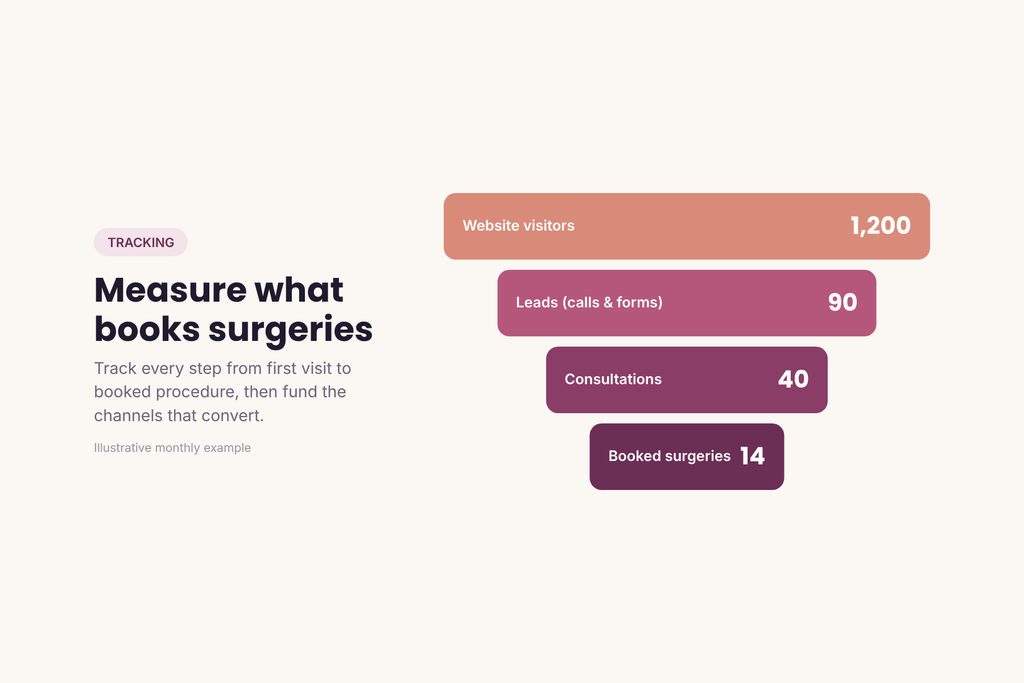
Install call tracking, connect forms to your CRM, and tag every campaign. Then review these numbers monthly:
| Metric | What it tells you |
|---|---|
| Cost per lead | How efficiently each channel generates inquiries |
| Lead-to-consultation rate | How well your front desk converts inquiries |
| Consultation-to-surgery rate | How well consultations close |
| Revenue per channel | Where your next marketing dollar should go |
Strong surgeon marketing is not about doing everything. It is about doubling down on the channels that book patients.
How Much Should You Spend on Plastic Surgery Marketing?
Most aesthetic practices invest between 7% and 12% of revenue in marketing, and practices in aggressive growth mode or new markets often spend more. The right number depends on your local competition, your procedure mix, and how quickly you want to grow.
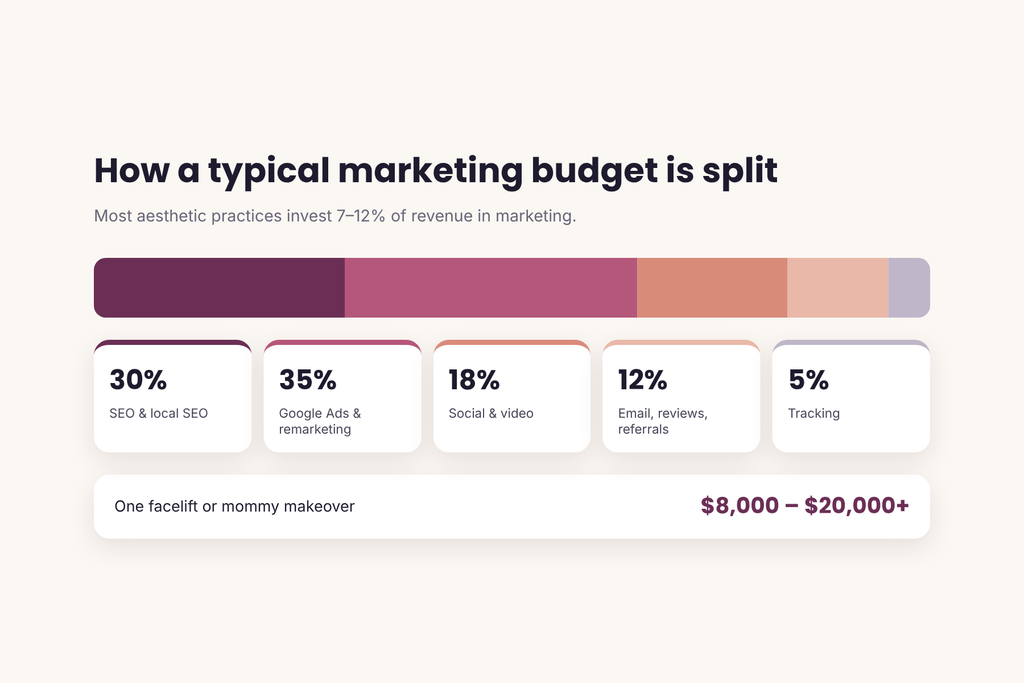
Here is how a typical monthly budget is often divided:
| Channel | Share of budget | Why it matters |
|---|---|---|
| SEO and local SEO | 25–35% | Builds long-term, low-cost patient flow |
| Google Ads and remarketing | 30–40% | Delivers consultations quickly |
| Social media and video | 15–20% | Builds awareness and trust |
| Email, reviews, and referrals | 5–10% | Converts and retains existing leads |
| Tracking and reporting | 5% | Shows what is actually working |
To understand what agencies charge for search work specifically, read our breakdown of how much SEO costs and how pricing packages work.
When you are ready to compare options, our SEO packages show what is included at each level, from local visibility for a single surgeon to full programs for multi-location groups.
Keep the return in perspective. One rhinoplasty, facelift, or mommy makeover can bring $8,000 to $20,000 or more in revenue. If your marketing books four extra procedures a month, even a substantial budget pays for itself several times over.
How to Choose a Plastic Surgeon Digital Marketing Agency
The right partner can transform a practice. The wrong one can waste a year of budget. Ask every agency these questions before you sign:
- Do you specialize in cosmetic surgeon marketing, and can you share results from similar practices?
- Will you report on booked consultations and revenue, not just clicks and impressions?
- How do you handle HIPAA in forms, tracking, reviews, and ads?
- Who will actually manage our account, and how often will we meet?
- Do you cover search, AI search, paid ads, and social together, or will we need several vendors?
- What is the contract length, and who owns the website, content, and ad accounts?
A trustworthy agency answers plainly and shows you a sample report before you commit. Be cautious of anyone who guarantees first-page rankings or a specific number of patients.
Common Marketing Mistakes Plastic Surgeons Make
Even well-funded practices fall into these traps:
- Marketing every procedure equally. Concentrate on the high-value procedures you most want to grow.
- Sending ads to the homepage. Each campaign needs a matching procedure page.
- Ignoring the phone. Slow callbacks and missed calls lose patients who are ready to book.
- Using stock photos. Real results and real staff convert far better.
- Chasing trends without a plan. A viral video means little if it does not bring consultations.
- Skipping follow-up. Most leads need several touches before they schedule.
Avoiding these mistakes is often the fastest way to improve results without spending another dollar.
Frequently Asked Questions
What is plastic surgery marketing?
Plastic surgery marketing is the combination of strategies a practice uses to attract and book aesthetic patients. It typically includes a conversion-focused website, SEO, local search, paid advertising, social media, video, review management, email follow-up, and referral programs, all measured by consultations and revenue.
What are the best marketing ideas for plastic surgeons?
The most effective ideas are the ones that build trust and capture patients who are already searching. Start with a fast website and strong procedure pages, then add SEO, Google Business Profile optimization, Google Ads, a consistent review process, and email follow-up. Social media and video work best once that foundation is in place.
How long does it take to see results?
Paid ads can generate consultations within days of launch. SEO and local search usually show early movement in about three months, with meaningful growth between months four and nine. Social media and referral programs build steadily over time, so the strongest practices run fast and slow channels together.
Is social media enough to grow a plastic surgery practice?
Social media is valuable for awareness and trust, but it rarely works alone. Many patients discover a surgeon on Instagram or TikTok, then search on Google, read reviews, and check the website before booking. If those touchpoints are weak, social followers rarely become patients.
How is marketing for plastic surgeons different from other surgery marketing?
Cosmetic procedures are elective and paid out of pocket, so patients compare surgeons much more carefully than they would for a covered procedure. That means marketing for surgeons in the aesthetic space must lean heavily on visual proof, reviews, surgeon credentials, and financing. General surgery marketing focuses more on physician referrals, insurance acceptance, and hospital affiliation.
How can a practice get more cosmetic surgery patients online?
Focus on being visible and trustworthy wherever patients research. Rank your procedure pages for local searches, keep your Google Business Profile complete and active, collect reviews every week, and answer common questions clearly on your website. Then use Google Ads and remarketing to reach patients who are actively comparing surgeons. Finally, respond to every inquiry within minutes, because speed often decides who books the consultation.
Should I hire an agency or handle marketing in-house?
Many practices use a hybrid model. Your team can manage social posts, review requests, and patient follow-up, while an agency handles specialized work like SEO, AI search optimization, paid ads, and tracking. Whatever you choose, assign one person to own the results and review them every month.
What makes plastic surgery marketing compliant?
Compliant marketing protects patient privacy and avoids misleading claims. Get written consent before sharing any patient photos or stories, keep patient information out of public review replies, use HIPAA-compliant forms and tracking tools, and avoid promising specific outcomes. Check your state medical board’s advertising rules, especially for referral incentives and testimonials.
Start Growing Your Practice
The practices that win in aesthetic medicine treat marketing as a system rather than a series of one-off campaigns. They know their ideal patients, build a strong website and search presence, use paid ads to fill gaps, earn trust through reviews and content, and measure every channel by booked surgeries.
You do not need to launch all 14 plastic surgery marketing strategies at once. Pick the three that address your biggest gaps right now, execute them well for 90 days, and then add the next layer. Small, steady improvements across each channel add up to a fuller consultation calendar every month. For most practices, that means fixing the website, strengthening local search, and putting a review process in place before scaling paid ads.
Social Marketway helps plastic surgeons and aesthetic practices turn online visibility into booked consultations. Our team combines SEO, local search, AI search optimization, and paid media into one plan built around your procedures and your market. Contact us today for a free marketing audit, and find out exactly where your next patients are coming from and what is holding them back from booking.