



Website Maintenance Cost: Pricing, Packages & What to Budget

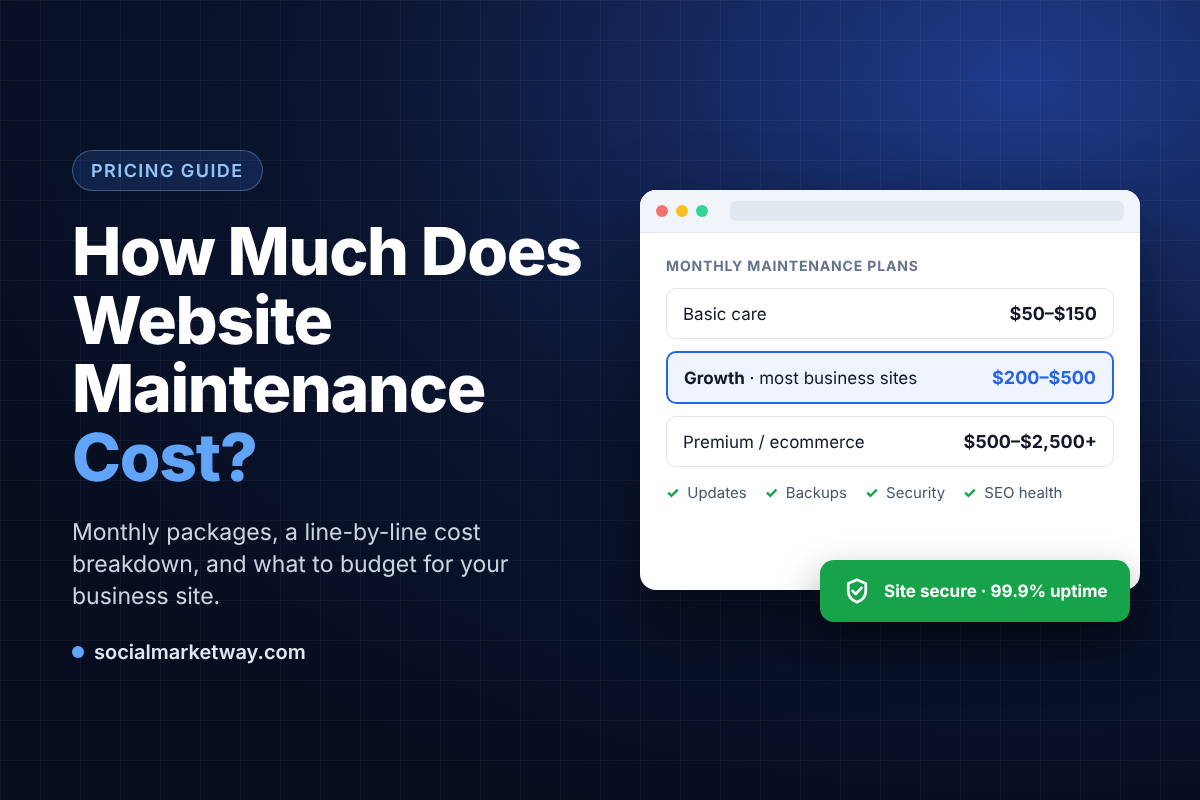
Tthe typical website maintenance cost for a small business runs $30 to $250 per month if you handle much of the work yourself, and $200 to $500 per month with a professional plan. Ecommerce stores usually spend $500 to $2,500 per month, and enterprise sites can pass $5,000 per month. Where you land depends on your site’s complexity, traffic, platform, and who does the work.
Most business owners budget carefully for the website build and then forget about everything that comes after launch. But a website is not a one-time purchase. It behaves more like a car or a storefront: it needs regular servicing, security checks, and updates to keep performing. Skip that work and the site slowly gets slower, less secure, and less visible on Google, until something breaks at the worst possible moment.
This guide answers the question we hear most from clients: how much does it cost to maintain a website? We break down every cost line, compare monthly website maintenance packages, explain what freelancers and agencies charge, and show you how to build a realistic budget for 2026 and beyond.
Key takeaways
- Website maintenance costs range from about $5 a month for a DIY personal blog to $5,000+ a month for large enterprise sites.
- Hosting, domain, and SSL are the fixed basics; security, updates, content, and developer time are where costs grow.
- A common rule of thumb is to budget 15–20% of your original build cost each year for maintenance.
- Agencies usually sell maintenance as tiered monthly packages, while freelancers often bill $35–$150 per hour.
- Skipping maintenance is almost always more expensive than paying for it, especially after a hack or a long outage.
What is website maintenance (and what does it include)?
Website maintenance is the ongoing work of keeping a live website secure, fast, accurate, and working as intended. It covers everything that happens after launch, from routine software updates to fixing a broken checkout at 2 a.m.
Think of it as preventive care. A well-built site from a team offering professional web development services starts strong, but every website is built on software that keeps changing. WordPress releases core updates, plugins patch security holes, browsers change how they render pages, and Google updates how it ranks content. Maintenance keeps your site in step with all of it.
A complete maintenance program usually includes:
- Software updates: CMS core, themes, and plugins, tested so updates don’t break the layout.
- Security: malware scanning, firewalls, login protection, and fast cleanup if something gets through.
- Backups: automated daily or weekly backups stored off-site, plus tested restores.
- Uptime and performance monitoring: alerts when the site goes down and regular speed tuning.
- Content updates: new pages, price changes, staff bios, blog posts, and promotional banners.
- SEO health: fixing broken links, keeping metadata current, and maintaining your on-page SEO so rankings don’t slip.
- Technical support: a developer on call for bugs, form failures, and integration problems.
- Renewals: keeping the domain, hosting, SSL certificate, and premium licenses active.
Not every plan includes all of these. That is the single biggest reason two quotes for “website maintenance” can differ by hundreds of dollars a month, so always compare what is included, not just the price.
How much does it cost to maintain a website in 2026?
The honest answer is that the cost to maintain a website depends mostly on what kind of website it is. A five-page brochure site and a 3,000-product online store are both “websites,” but they carry very different risks and workloads.
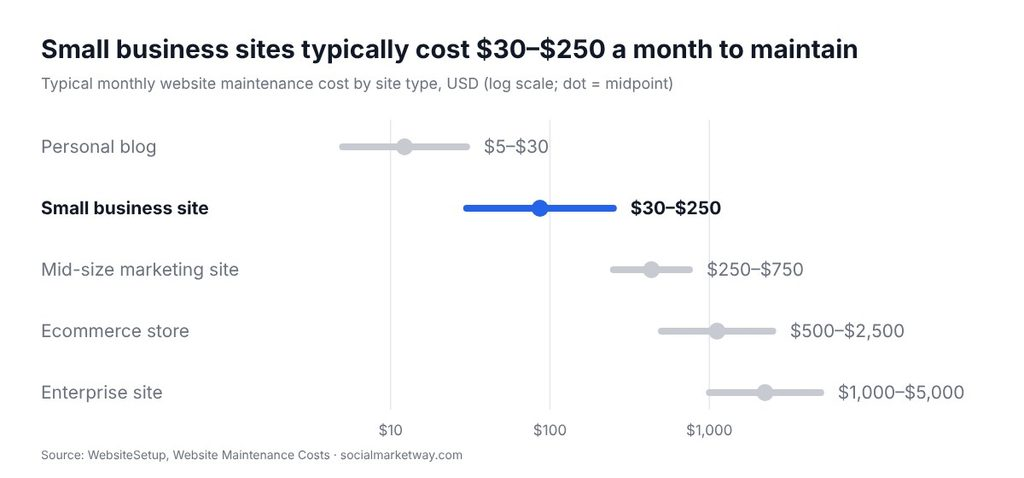
The ranges above include hosting, domain renewal, basic security, and routine upkeep, but not paid marketing. Here’s what sits behind each band:
- Personal blog ($5–$30/month): cheap shared hosting, free SSL, free plugins, and the owner’s own time. Annual cost: roughly $60–$360.
- Small business website ($30–$250/month): better hosting, a few premium plugins, and either DIY updates or a basic care plan. Annual cost: $360–$3,000.
- Mid-size business or marketing site ($250–$750/month): more pages, lead forms, CRM integrations, and regular content updates. Annual cost: $3,000–$9,000.
- Ecommerce website ($500–$2,500/month): payment security, inventory and plugin conflicts, faster hosting, and much less tolerance for downtime. Annual cost: $6,000–$30,000.
- Enterprise site ($1,000–$5,000+/month): dedicated infrastructure, compliance requirements, multiple integrations, and a team on call. Annual cost: $12,000–$60,000+.
Another quick way to estimate your cost for website maintenance is the 15–20% rule. Many developers suggest budgeting 15–20% of the original build cost per year. So a $10,000 business website should expect roughly $1,500–$2,000 a year in maintenance, before marketing and content.
Website maintenance costs: a line-by-line breakdown
Your total bill is the sum of a handful of recurring expenses. Some are fixed and predictable; others scale with the size and ambition of your site. Here is what each line typically costs in 2026.
| Cost item | Typical 2026 cost | Who usually needs it |
|---|---|---|
| Domain renewal | $10–$25 per year (+$2–$15 for privacy) | Every website |
| Web hosting | $5–$75 per month for most sites; $60–$500 for large stores | Every website |
| SSL certificate | Free with most hosts; $10–$200 per year for EV or wildcard | Every website (free is fine for most) |
| Premium plugins and extensions | $30–$200 each per year; $100–$500 total | WordPress and other CMS sites |
| Security and backups | $0–$300 per month | Every business site |
| Developer / tech support | $50–$150 per hour | Sites with custom features or integrations |
| Design updates | $40–$90 per hour | Brands that refresh banners, graphics, landing pages |
| Content creation | $0.10–$1.00 per word | Sites that publish blogs or resources |
| SEO tools | $99–$500+ per month | Sites that compete for organic traffic |
Domain name
A standard .com or .net domain costs $10–$25 a year to renew. Premium or specialty extensions such as .io can cost more. It is a small bill, but an expired domain takes your entire site and email offline, so set it to auto-renew.
Hosting
Hosting is the largest fixed cost for most sites. Shared hosting suits small, low-traffic sites. VPS and cloud plans typically run $30–$150 a month and give growing businesses more speed and stability. Managed WordPress hosting starts around $25 a month and handles updates, caching, and backups for you.
SSL certificate
The padlock in the browser bar is non-negotiable in 2026. Browsers warn visitors away from sites without it, and Google treats HTTPS as a ranking signal. Most hosts include a free certificate, which is enough for nearly every small business.
Plugins, themes, and licenses
Premium plugins for forms, SEO, page building, and security usually cost $30–$200 each per year. They add up quickly, and every unused plugin is also a potential security hole. Audit them every quarter.
Security and backups
Keeping software updated is free and stops most attacks. Premium firewalls, malware scanners, and monitoring range from $5 to $300 a month depending on coverage. Off-site backups are your insurance policy: when everything else fails, a clean backup is what gets you back online.
People: developers, designers, and writers
This is where costs vary most. US-based freelance developers commonly charge $45–$80 an hour, with specialists going well past $150. Designers run $40–$90 an hour for polished work, and capable content writers start around $0.10–$0.15 per word.
Monthly website maintenance packages: what each tier includes
Most agencies and care-plan providers sell monthly website maintenance packages in three tiers. The names change from company to company, but the structure is remarkably consistent.
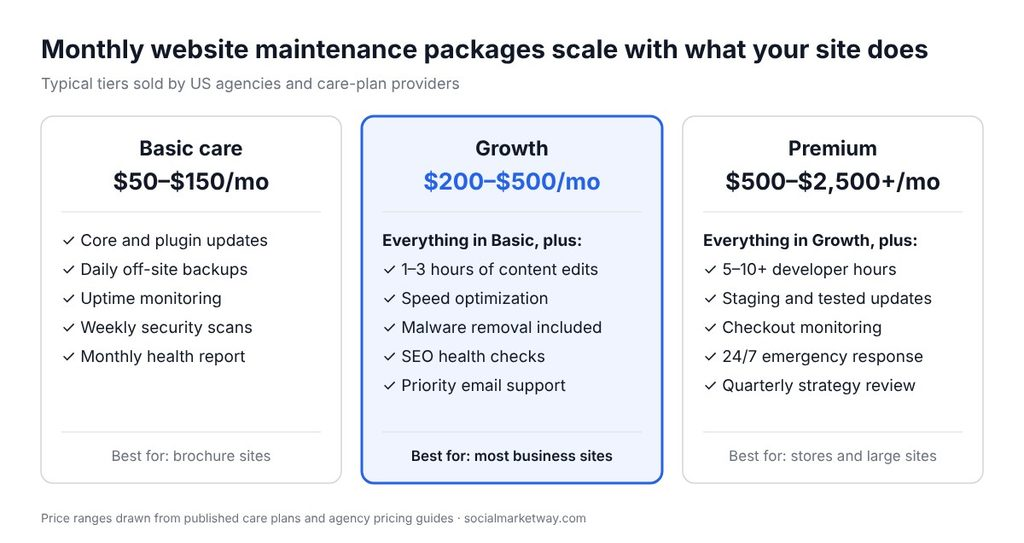
Basic care ($50–$150/month) covers the essentials that keep a site safe: updates, backups, uptime alerts, and security scans. It suits simple brochure sites that rarely change. The catch is that content edits and malware cleanup are usually billed extra, often at $75–$150 an hour.
Growth ($200–$500/month) is where most small and mid-size businesses belong. On top of the basics, you get a block of hours for content changes, speed tuning, malware removal, and routine SEO checks. For a site that generates leads, this tier usually pays for itself the first time something goes wrong.
Premium ($500–$2,500+/month) is built for ecommerce and high-traffic sites where downtime costs real money. Expect dedicated developer hours, a staging environment where updates are tested before going live, checkout monitoring, and 24/7 emergency response.
When comparing packages, look past the headline price and check four details:
- Included hours. How many hours of edits or development are included, and what is the overage rate?
- Response time. Is there a guaranteed response window for emergencies, or just “best effort”?
- Malware cleanup. Is it included, or a surprise $200–$500 invoice?
- Contract terms. Month-to-month plans are more flexible than 12-month lock-ins, especially for small sites.
7 factors that drive your website maintenance cost
Two businesses in the same industry can pay very different amounts to maintain their sites. These seven factors explain most of the gap.
1. Size and number of pages. A 10-page site has far fewer links to check, images to optimize, and pages to update than a 500-page resource library. More pages mean more time on every routine task.
2. Platform and build quality. A clean, well-coded site is cheaper to maintain than one stitched together from dozens of plugins and a heavy page builder. Custom code needs a developer who understands it. This is one reason professional website design pays off long after launch: good architecture lowers every future bill.
3. Number of plugins and integrations. Each plugin, payment gateway, CRM connection, or booking tool is another component that can conflict with an update. Sites with 40 plugins routinely cost more to maintain than sites with 10, and the cheapest fix is often removing the ones you don’t use.
4. Ecommerce functionality. Online stores handle payments and customer data, so security standards are higher and downtime is expensive. Inventory sync, shipping rules, and checkout testing all add hours.
5. Traffic and performance needs. High-traffic sites need stronger hosting, a content delivery network (CDN), caching, and more frequent speed tuning to stay fast under load.
6. Content frequency. A site that publishes weekly blog posts, changes promotions monthly, or updates menus and prices often needs more hands-on time than one that rarely changes.
7. Compliance and security requirements. Healthcare, finance, legal, and any site collecting personal data may need accessibility (ADA/WCAG) work, privacy updates, and stricter security controls. These add cost but also reduce legal risk.
Website management cost: DIY vs. freelancer vs. agency
The biggest lever on your website management cost is who does the work. Each option trades money for time, reliability, and risk.
| Option | Typical 2026 cost | Best for | Main risk |
|---|---|---|---|
| DIY | $50–$100 per year plus your time | Personal blogs and very simple sites | One bad update or hack can cost more than years of care |
| Freelancer | $35–$150 per hour, or $100–$1,000 per month on retainer | Small sites with occasional changes | Availability: one person, no backup |
| Agency | $200–$2,500+ per month | Business-critical sites, ecommerce, growing brands | Higher cost; check what is actually included |
Doing it yourself
If you are comfortable with WordPress, you can handle updates, backups, and simple content changes on your own. Your cash cost drops to hosting, a domain, and any premium tools, which can be under $100 a year for a small site. But DIY maintenance typically takes two to five hours a month, and your time has a price. An hour a week spent fixing plugins adds up to roughly a full work week every year.
Hiring a freelancer
A good freelancer is often the best value for a small site. Rates in 2026 commonly run $50–$150 an hour depending on skill and location. The trade-off is resilience: if your freelancer is sick, on vacation, or takes a bigger client, your urgent fix waits.
Partnering with an agency
An agency costs more but gives you a team, documented processes, guaranteed response times, and the ability to grow into SEO, content, and redesign work without switching providers. Full agency retainers commonly run $500–$3,000+ a month. For any site that generates leads or sales, that redundancy is usually worth paying for. Our website maintenance services are built around exactly this model: predictable monthly pricing, proactive updates, and a real team on call.
Website hosting and maintenance cost: are they the same thing?
No, and confusing the two is one of the most common budgeting mistakes. Hosting is the server space that keeps your site online. Maintenance is the work that keeps it secure, updated, and useful. A $10-a-month hosting bill is not a maintenance plan.
That said, many providers bundle them, so it helps to know what a combined website hosting and maintenance cost looks like:
- Shared hosting + DIY maintenance: about $5–$20 a month. Fine for hobby sites, risky for businesses.
- Managed WordPress hosting: $25–$300+ a month. The host handles server-level updates, caching, and backups, but usually not plugin conflicts, design changes, or content.
- Agency hosting + maintenance bundle: often $100–$500 a month for small and mid-size business sites. You get one invoice, one point of contact, and someone accountable when anything breaks.
- Cloud or dedicated hosting + full support: $500 to several thousand a month for high-traffic and ecommerce sites.
When a quote bundles hosting and maintenance, ask for the two numbers separately. It makes comparing providers far easier and shows you exactly what the maintenance portion buys.
How much to charge for website maintenance (for agencies and freelancers)
If you build websites for clients, recurring maintenance is the most stable revenue you can create. But many web professionals underprice it and end up doing unlimited work for a flat $50. Here is how to price it sustainably.
Step 1: Calculate your real hourly cost
Start with what an hour of your time must earn to cover salary, software, insurance, and overhead, plus profit. For most US freelancers this lands between $50 and $150 an hour; agencies typically bill $100–$175.
Step 2: Estimate the monthly workload per site
Time the routine tasks for a typical client site: updates and testing, backup checks, security scans, uptime reviews, and a monthly report. For a simple WordPress site, that is often 1–2 hours a month. Add the content-edit hours you plan to include.
Step 3: Price in the tools
List the software you pay for on the client’s behalf: premium plugin licenses, a security service, backup storage, uptime monitoring, and reporting tools. Divide shared tools across clients and include each client’s share in the plan price.
Step 4: Build tiers, not a single price
Tiered packages let clients choose their level of risk and help you upsell as their needs grow. A simple structure that works for many agencies:
- Essential: $75–$150/month. Updates, backups, monitoring, and a monthly report. No content hours.
- Business: $200–$400/month. Everything above plus 1–3 hours of edits, speed tuning, and malware removal.
- Ecommerce/Pro: $500–$1,500+/month. Dedicated developer hours, staging, checkout testing, and priority support.
Step 5: Protect your margins
Set clear limits in writing. Define what counts as “maintenance” versus a new project, cap included hours, and publish your overage rate. Unused hours should expire monthly rather than roll over indefinitely. Finally, review pricing every year: plugin licenses and hosting rarely get cheaper.
Quick formula: (monthly hours × hourly rate) + tool costs + 20–30% risk buffer = monthly plan price. For example, 2 hours × $85 + $25 in tools = $195, plus a 25% buffer for emergencies ≈ $245 a month.
The real cost of skipping website maintenance
The most expensive maintenance plan is the one you never bought. Neglect rarely causes one dramatic failure on day one; instead, small problems stack up until they become an emergency.
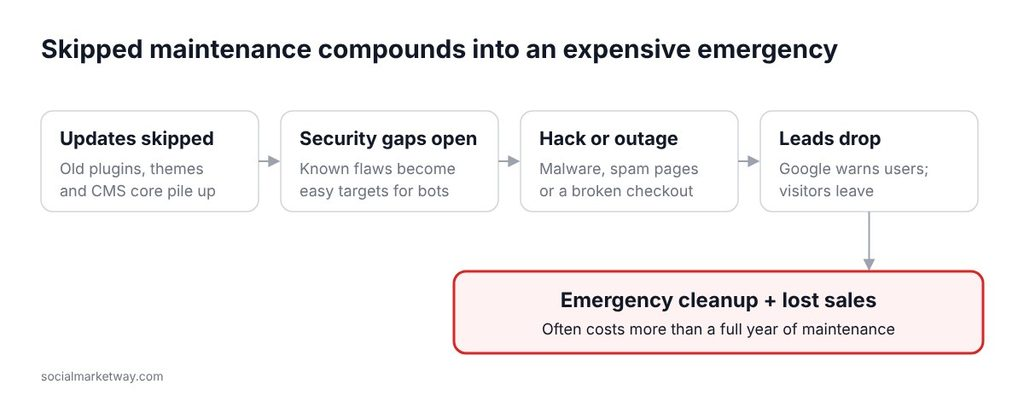
Here is what that emergency can look like in practice:
- Security breaches. Outdated plugins are one of the most common ways small sites get hacked. At the extreme end, IBM’s 2025 Cost of a Data Breach Report found the average US breach now costs a record $10.22 million. Small businesses face far smaller numbers, but even a basic malware cleanup, blacklist removal, and lost week of sales can wipe out a year’s maintenance budget.
- Downtime. Every hour your site is down, leads and orders go to a competitor. For an online store, a broken checkout over a weekend can cost more than a premium care plan.
- Lost rankings. Slow pages, broken links, and security warnings all hurt visibility in search. Rebuilding lost organic traffic usually takes months of SEO work.
- Expensive rebuilds. Sites left untouched for years often become impossible to update safely. At that point, a full redesign may be cheaper than repairing the old site.
- Lost trust. A browser warning or a defaced homepage tells customers you aren’t paying attention. That damage is hard to measure and harder to undo.
Regular maintenance is not a cost center. It is insurance for one of your most important sales assets.
How to choose website maintenance services in the USA
The market for website maintenance services in the USA ranges from $20-a-month plugin-update bots to full-service agencies. Price alone won’t tell you which is right. Use these questions to separate real partners from resellers:
- What exactly is included each month? Ask for a written list of tasks, not a vague promise of “ongoing support.”
- How are updates tested? Good providers update on a staging copy first, then push to the live site. Bad ones click “update all” and hope.
- What is the emergency response time? Look for a guaranteed window, such as four hours for critical issues, ideally during US business hours and on weekends.
- Is malware removal included? If not, find out the cost before you need it.
- Where are backups stored, and have restores been tested? A backup you have never restored is a guess, not a safety net.
- Will you get reports? Monthly reports showing updates, uptime, speed, and security scans prove the work is happening.
- Can they grow with you? A provider who also handles SEO, content, and redesigns saves you from switching vendors later.
- Who owns the site and logins? You should always keep admin access, your domain, and your hosting account in your name.
Red flags include long contracts for small sites, “unlimited” edits with no definition, no references, and providers who can’t explain their security process in plain language.
Your website maintenance checklist
Whether you maintain your site yourself or hire help, these are the tasks that should happen on a schedule. Use this checklist to audit any maintenance plan you are paying for.
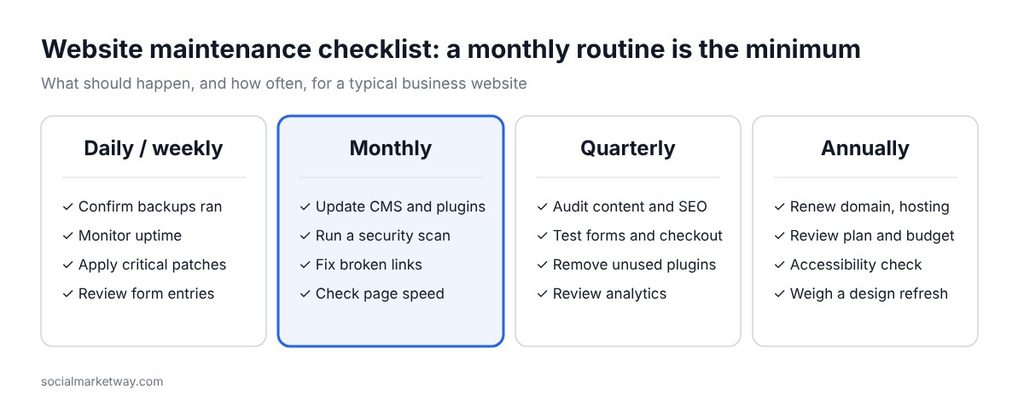
The more traffic and revenue your site brings in, the more often you should check it. Ecommerce stores should monitor uptime and checkout daily, while a simple brochure site can usually rely on a solid monthly routine plus automated backups.
Frequently asked questions about website maintenance costs
What is the average website maintenance cost per month?
For most small businesses, website maintenance costs $30–$250 per month with a DIY approach and $200–$500 per month with a professional plan. Ecommerce sites typically spend $500–$2,500 per month.
How much does it cost to maintain a website per year?
A small business website usually costs $360–$3,000 a year to maintain, a mid-size site $3,000–$9,000, and an online store $6,000–$30,000. A simple rule is to budget 15–20% of the original build cost each year.
What is the minimum cost to maintain a website?
If you do everything yourself on cheap shared hosting with free plugins, a basic site can cost as little as $50–$100 a year for the domain and hosting. That minimum leaves no budget for professional help when something breaks.
Is website maintenance included in hosting?
Usually not. Basic hosting keeps the server running, but plugin updates, design fixes, content changes, and malware cleanup are separate. Managed hosting covers more of the technical side, but still not content or custom development.
How often should a website be maintained?
Backups and uptime monitoring should run daily, software updates and security scans monthly, content and SEO audits quarterly, and plan and budget reviews yearly.
Can I maintain my website myself?
Yes, especially for small WordPress or website-builder sites. Expect to spend two to five hours a month. For business-critical sites, ecommerce, or custom builds, professional maintenance is usually the safer and cheaper long-term choice.
Does website maintenance help SEO?
Yes. Fast load times, working links, secure HTTPS, fresh content, and accurate metadata all support rankings. Maintenance protects the results of your on-page SEO work instead of letting them decay.
Conclusion: budget for maintenance like the business asset it is
Website maintenance cost is not a mystery once you break it into parts. Domain, hosting, and SSL are your fixed basics. Security, updates, content, and developer time are where the budget grows, and where good planning saves the most money. For most businesses, a realistic number is $200–$500 a month for professional care, or roughly 15–20% of the build cost each year.
The businesses that spend the least over time are rarely the ones with the cheapest plan. They are the ones that never face an emergency because someone is quietly keeping their site updated, backed up, fast, and secure.
If you’d rather spend your time running your business than updating plugins, Social Market Way can help. Explore our website maintenance services for predictable monthly care, or talk to our team about web development if your current site is costing more to keep alive than it’s worth. Pair either with our on-page SEO services to make sure a healthy site also ranks.