


Google Local Services Ads: The Complete Guide to LSA Lead Generation for Local Customers

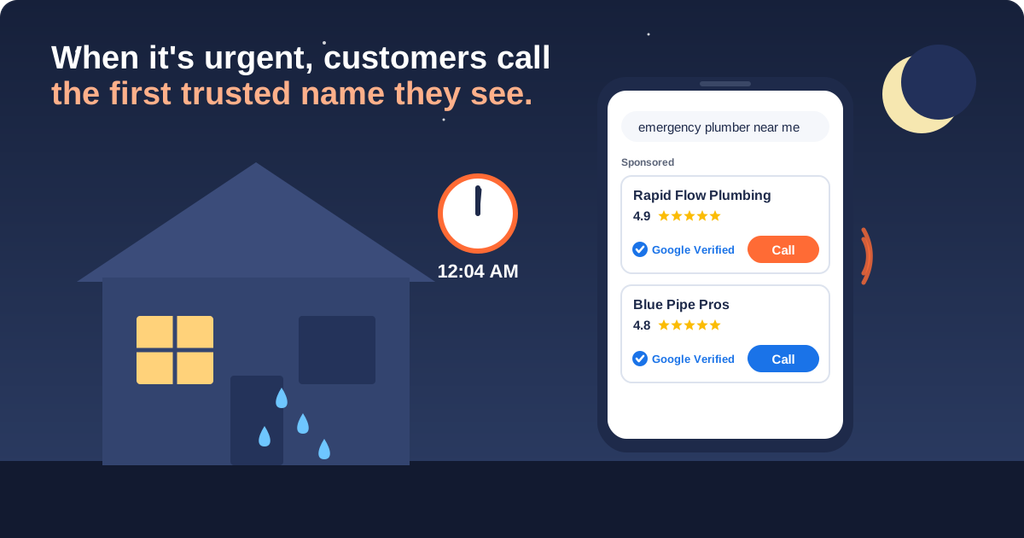
When a pipe bursts at midnight or the air conditioning dies in the middle of a heat wave, homeowners do not scroll through pages of search results. They pick up their phone, search for help, and call one of the first businesses they see. For local service providers, being that business can be the difference between a fully booked week and an empty calendar. That is exactly the moment Google Local Services Ads were built for.
Google describes the product as Local Services Ads: lead generation for local customers, and that summary is accurate. Instead of paying for clicks that may or may not turn into business, you pay for real leads, such as phone calls, messages, and booking requests, from people in your service area who need what you offer. In this guide, we will explain what Google LSA is, how it works, which Google local services categories qualify, how ads are ranked, and how to optimize Google local service ads so you get more of the right leads for less money.
What Is Google LSA?
Google LSA is short for Google Local Services Ads, a pay-per-lead advertising format designed specifically for service-based businesses that serve customers in a defined geographic area. Plumbers, electricians, roofers, HVAC technicians, cleaners, lawyers, real estate agents, and dozens of other professionals use LSAs to appear at the very top of Google search results when nearby customers search for their services.
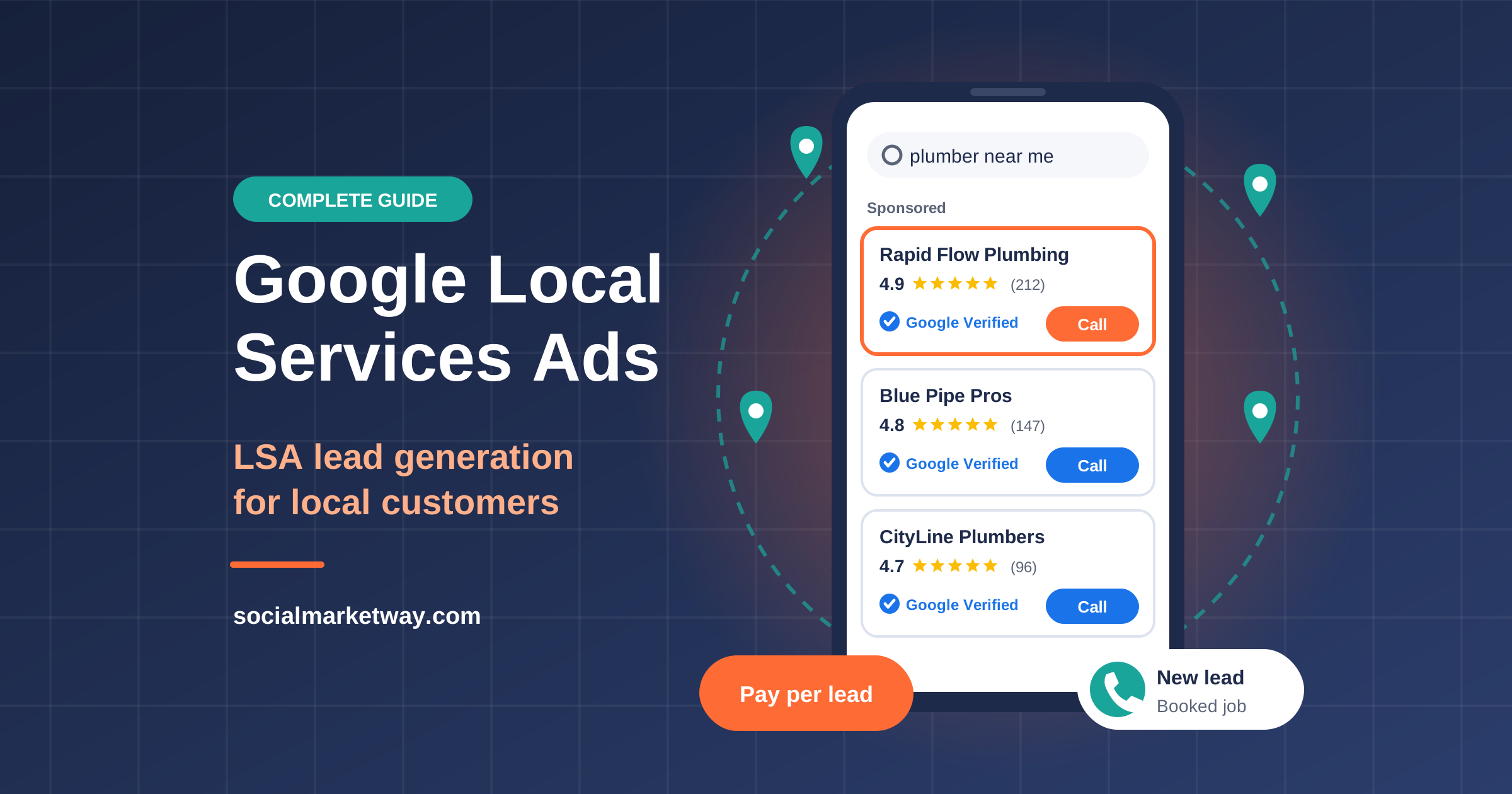
Unlike a standard text ad, a Local Services Ad looks more like a business card. It typically shows your business name, star rating, number of reviews, years in business, service area, hours, and a direct call or message button. Businesses that pass Google’s screening process also display the blue Google Verified checkmark, which tells searchers that Google has checked the company’s licensing, insurance, or background details, depending on the category.
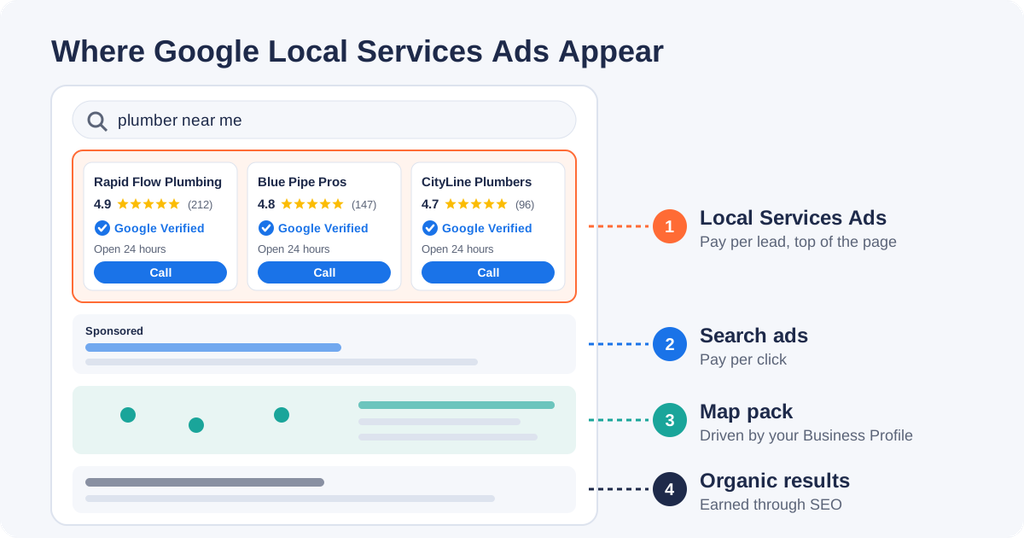
What Are Google Local Service Ads Used For?
So, what are Google local service ads actually good at? In short, they are built for high-intent, ready-to-hire searches. Someone typing “emergency plumber near me” or “divorce lawyer in Miami” is not casually browsing. They have a problem and want to speak with someone now. LSAs put your phone number in front of that person before any other ad or organic listing.
Because the format is lead-based, LSAs are especially valuable for businesses where a single phone call can be worth hundreds or thousands of dollars. A roofing replacement, a personal injury case, or an HVAC installation can more than justify the cost of a lead, as long as your team answers the phone and converts the opportunity. That is why LSAs tend to deliver the strongest return for businesses with a fast, organized intake process.
How Google Local Services Ads Work
The mechanics of LSAs are refreshingly simple compared with traditional search campaigns. You do not choose keywords, write ad copy, or set bids for individual searches. Instead, you tell Google which services you offer, which areas you cover, when you are open, and how much you want to spend each week. Google then decides when and where to show your ad based on how relevant and trustworthy your business appears.
Here is how the process typically works from start to finish:
- A customer searches for a local service, such as “electrician near me,” on Google Search or Maps.
- Google shows a small set of Local Services Ads at the top of the page, often with a “more” option to view additional providers.
- The customer reviews ratings, badges, and business details, then calls, messages, or requests a booking directly from the ad.
- That interaction becomes a lead in your LSA dashboard, where you can listen to call recordings, read messages, and track status.
- You are charged only for valid leads that relate to your listed services and service area.
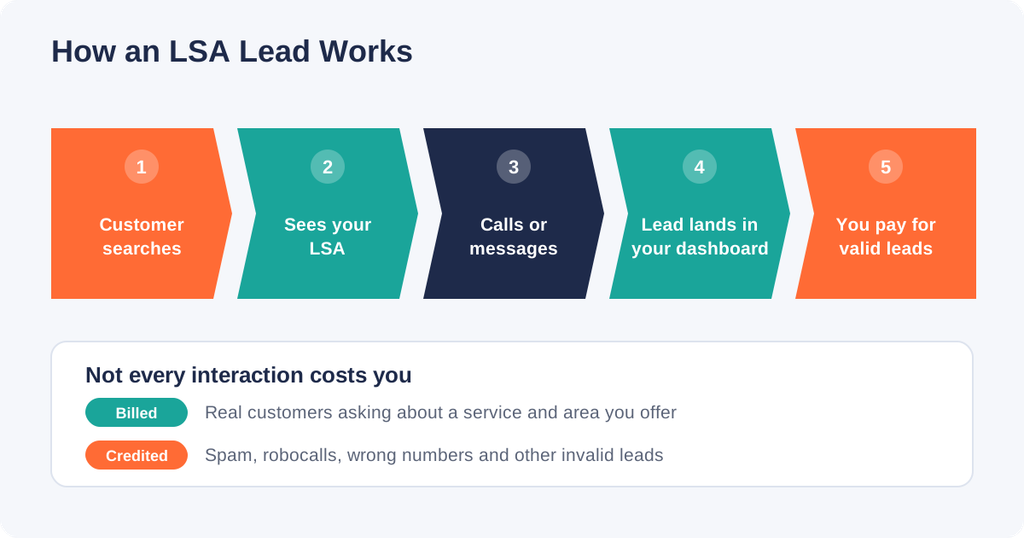
The cost of each lead varies by industry, location, and competition. A lead for a locksmith in a small town will cost far less than a lead for a personal injury attorney in a major city. You control total spend through a weekly budget, and Google aims to deliver as many leads as that budget allows.
If a lead is clearly invalid, such as spam, a wrong number, or a job outside your service area, Google uses an automated review system to credit many of these charges. For leads the system misses, you can rate the lead and explain why it was not a fit. Keeping your service areas and job types accurate is essential, because Google expects your settings to reflect the work you actually want.
LSAs vs. Traditional Google Search Ads
Many business owners wonder whether they should run LSAs, regular search ads, or both. They are different tools that complement each other. Search ads are part of broader PPC advertising, where you pay each time someone clicks through to your website, choose your own keywords, and control your messaging and landing pages. LSAs trade that control for simplicity, top placement, and a pay-per-lead model.
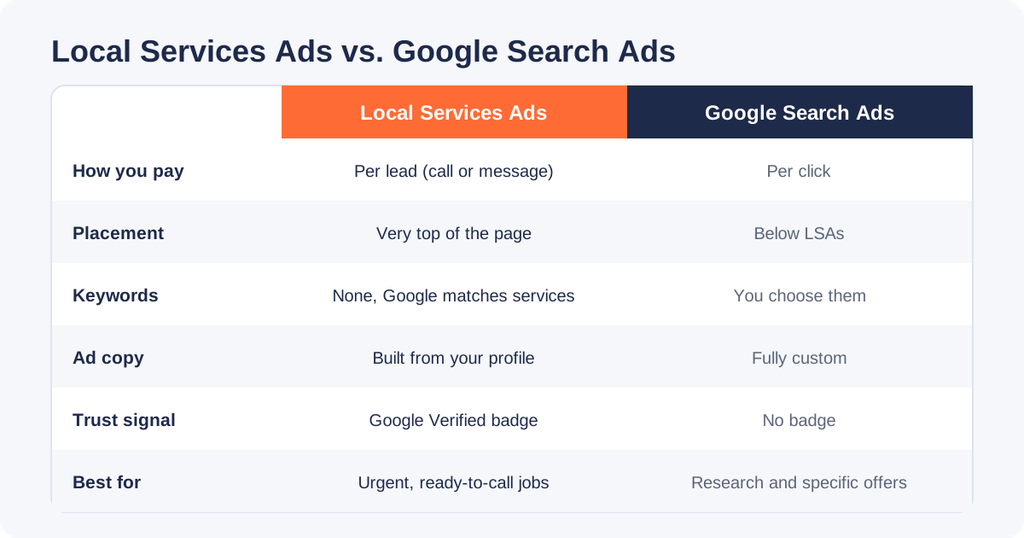
In practice, the strongest local accounts use both. LSAs capture the most urgent, ready-to-call customers at the top of the page, while search ads reach people researching options, comparing prices, or looking for services that LSAs do not cover. Running both also gives you more real estate on the results page, which makes it harder for competitors to win the customer.
Google Local Service Ads Categories
Not every business can run LSAs. Google limits the program to specific service types, and availability depends on both your category and your location. In the United States, Google supports more than 70 business types, and the list continues to expand into new countries and industries. Google local service ads categories generally fall into a few major groups.
Home Services
This is the largest and most established group. It includes plumbers, electricians, HVAC contractors, roofers, locksmiths, pest control companies, house cleaners, carpet cleaners, garage door technicians, appliance repair services, landscapers, movers, painters, window cleaners, and general contractors.
Professional Services
Lawyers across many practice areas, including personal injury, family, immigration, criminal defense, and estate planning, can use LSAs. Real estate agents, financial planners, and tax specialists also qualify in many markets.
Health, Wellness, and Care Services
Depending on location, categories may include providers such as chiropractors, physical therapists, counselors, childcare providers, and senior care services.
Pet and Lifestyle Services
Pet groomers, pet sitters, dog trainers, and other lifestyle businesses are available in some regions.
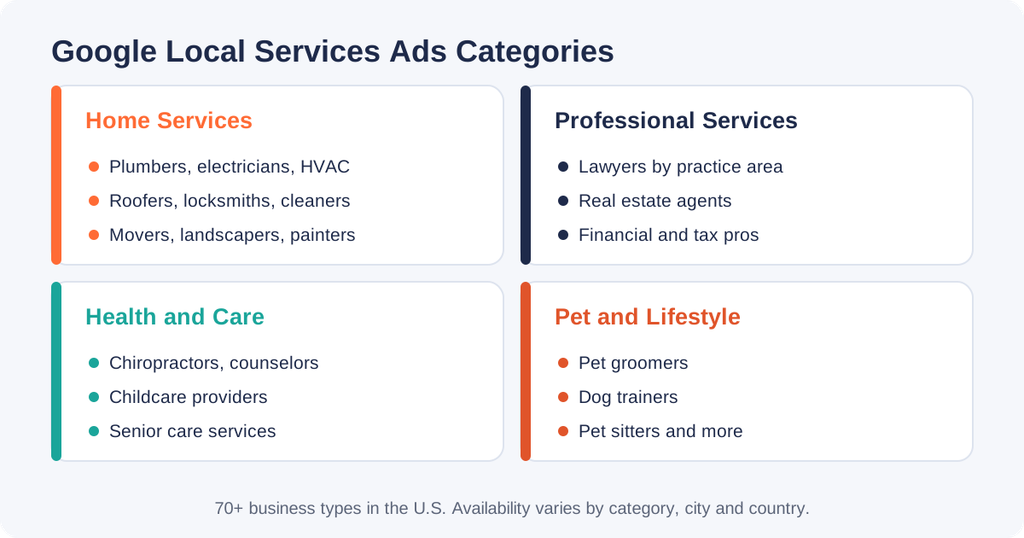
Because local services ads categories vary by country and even by city, the safest step is to check Google’s official eligibility tool before you build your profile. If your category is not available yet, standard search ads and local SEO remain excellent ways to reach local customers in the meantime.
Why Local Service Businesses Love LSAs
LSAs have become a core lead source for many local companies, and for good reason. The biggest benefits include:
- Top-of-page visibility. LSAs generally appear above traditional search ads and organic results, so you are the first option customers see.
- Built-in trust. The Google Verified badge, star ratings, and review counts help customers feel confident choosing you.
- Pay only for leads. You are not paying for curious clicks that bounce from your website.
- Less management. There are no keywords, bids, or ad copy to maintain, which saves time for busy owners.
- Direct contact. Customers call or message you straight from the ad, so you do not need a perfect landing page to win the job.
That said, the simplicity comes with tradeoffs. You have less control over when your ad shows, you cannot fine-tune messaging, and performance depends heavily on reviews and responsiveness, which we will cover next.
How to Set Up Google Local Services Ads
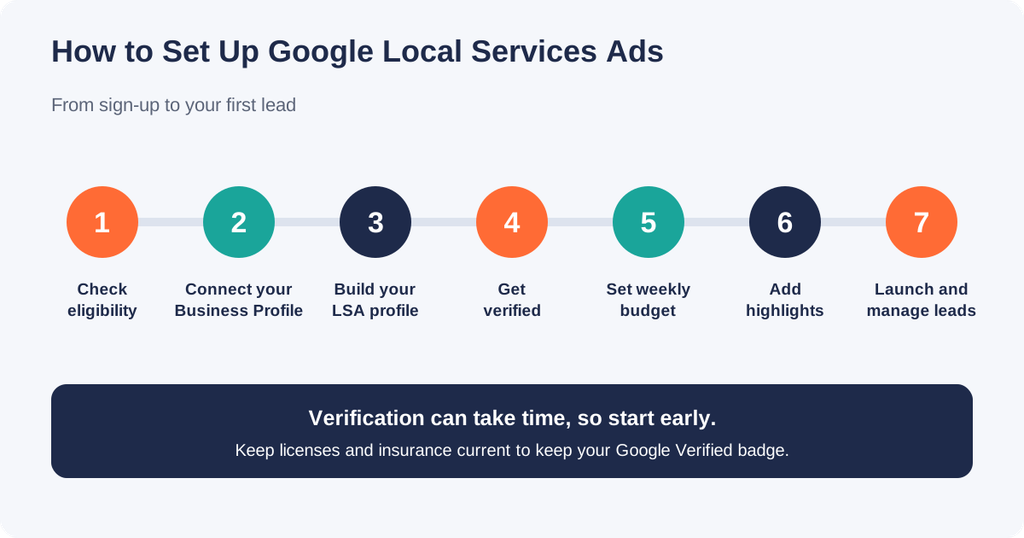
Getting started is straightforward, but approval can take time, so plan ahead. Follow these steps:
- Check eligibility. Confirm that your business type and service area are supported.
- Connect your Google Business Profile. A verified, complete profile is now required to run LSAs, and its reviews feed directly into your ads.
- Create your LSA profile. Add your services, job types, service areas, hours, and business details.
- Complete verification. Upload license and insurance documents and complete any required background checks for owners or technicians.
- Set your weekly budget. Base it on how many leads you want and how many you can realistically handle.
- Add business highlights. Features such as “family owned,” “free estimates,” or “24/7 availability” help you stand out.
- Launch and manage leads. Once approved, respond to every call and message quickly and update lead statuses in your dashboard.
What Determines Your LSA Ranking?
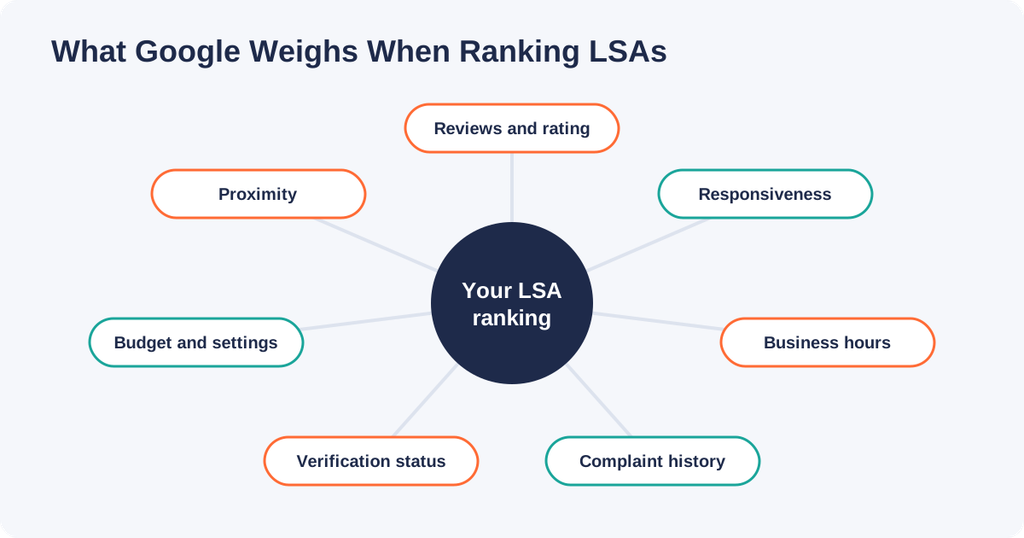
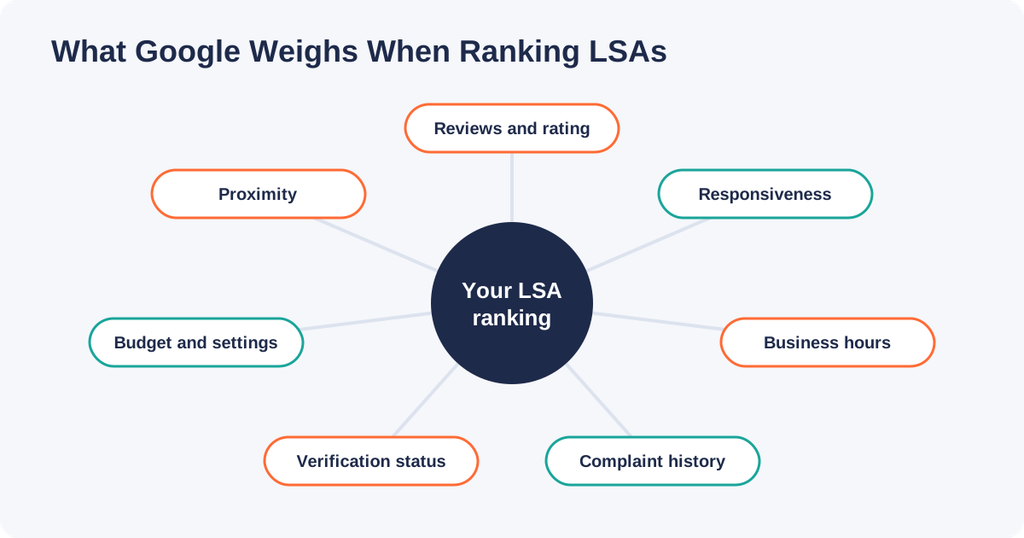
Because LSAs do not use keyword bids, Google ranks advertisers using signals that reflect quality and reliability. While Google does not publish an exact formula, the most important factors include:
- Proximity to the customer’s location.
- Review score and review volume on your Google Business Profile.
- Responsiveness to calls and messages, including how often you miss leads.
- Business hours, since ads are more likely to show while you are open and able to answer.
- Complaint history and whether there are serious or repeated customer issues.
- Verification status, including current licenses and insurance.
- Budget and settings, including whether your budget and service areas allow Google to send leads.
How to Optimize Google Local Service Ads
Once your ads are live, the real work begins. Knowing how to optimize Google local service ads is what separates businesses that get a steady stream of profitable leads from those that burn through budget. These are the strategies that make the biggest difference.
1. Build a Steady Flow of Reviews
Reviews are one of the strongest ranking signals and one of the biggest factors in whether customers call. Ask every satisfied customer for a review, make the process easy with a direct link, and respond to every review, positive or negative, in a professional tone. A steady flow of recent reviews matters more than a large batch collected years ago.
2. Answer Every Lead, Fast
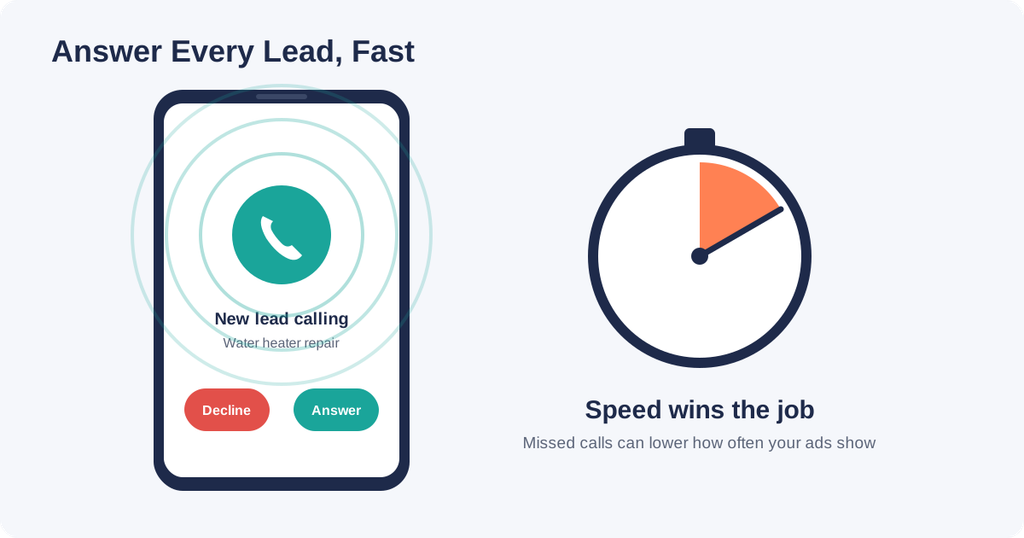
Google tracks how often you answer calls and how quickly you respond to messages. Missed calls can reduce how often your ads appear. Route calls to someone who can answer during business hours, set your hours accurately, and pause ads when nobody is available.
3. Keep Job Types and Service Areas Precise
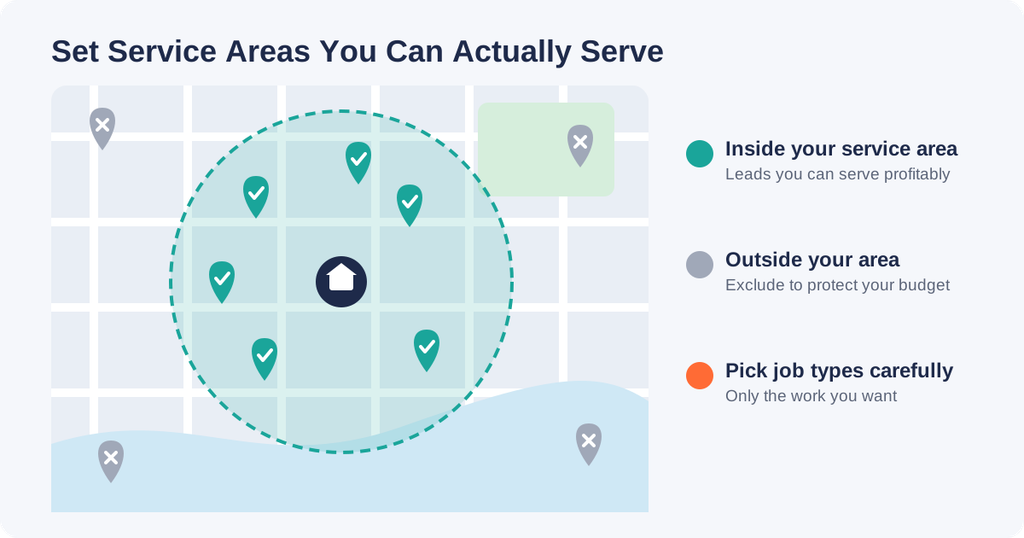
Only select services you actually want and only include areas you can serve profitably. Accurate settings reduce irrelevant leads and protect your budget, especially now that many credit decisions are automated.
4. Complete Your Google Business Profile
Fill in every field, upload recent photos of your team and work, add services, and post updates regularly. A complete, active profile reinforces trust and supports your ad ranking.
5. Manage and Rate Your Leads
Listen to call recordings, mark booked jobs, and rate leads that were not a fit. This feedback helps Google understand which leads are valuable and keeps your reporting accurate.
6. Adjust Budgets Strategically
Increase budgets during peak seasons when demand and close rates are high, and scale back when your schedule is full. Track cost per lead against your close rate and average job value to understand true return.
Pairing LSAs With Your Broader Marketing Strategy
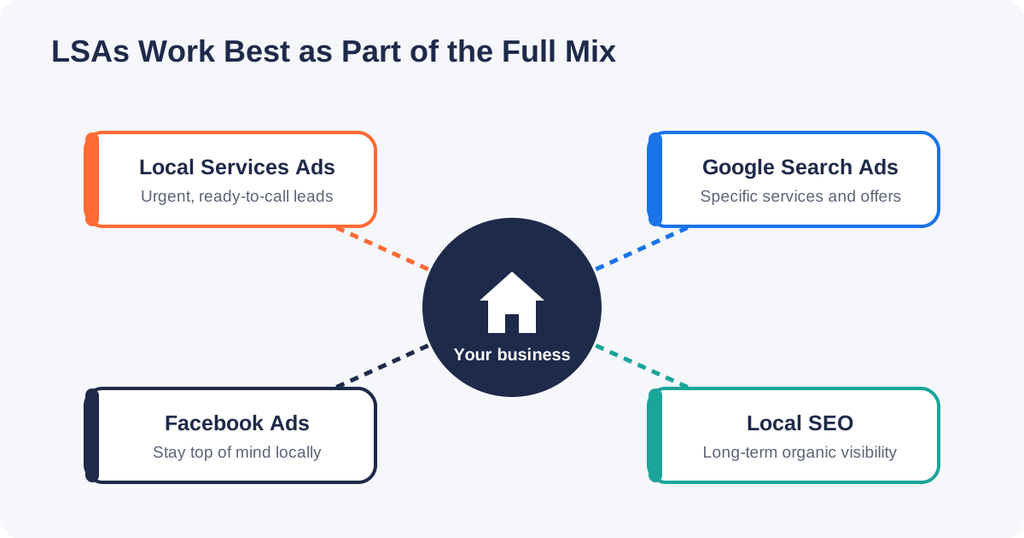
LSAs work best as one piece of a bigger plan. Standard search campaigns let you target specific high-value services, run promotions, and send traffic to your website. At Social Market Way, our Google Ads management team coordinates LSAs and search ads so both campaigns support each other instead of competing for the same budget.
Social advertising can also play a valuable role. While LSAs capture people who need help right now, Facebook advertising helps you stay top of mind with homeowners and local customers before they need you, so your name is familiar when they finally search.
Finally, do not overlook organic search. Strong local SEO improves your Google Business Profile, earns more reviews, and helps your website rank in the map pack and organic results, which all reinforce your LSA performance. If you are weighing where to invest first, our guide on SEO vs. PPC and which is right for your business breaks down the strengths of each approach.
Common LSA Mistakes to Avoid
- Ignoring missed calls. Every unanswered lead can hurt your visibility and waste money.
- Selecting every job type. Broad settings attract leads you do not want or cannot serve profitably.
- Letting documents expire. Lapsed licenses or insurance can remove your badge or pause your ads.
- Neglecting reviews. Without fresh reviews, competitors will steadily outrank you.
- Setting inaccurate business hours. If your ads run while nobody can answer, you pay for leads you cannot convert and risk lower rankings.
- Not tracking results. Without measuring booked jobs and revenue, you cannot tell if LSAs are profitable.
Frequently Asked Questions About Google LSAs
What is Google LSA in simple terms?
Google LSA is an ad format that puts eligible local service businesses at the top of Google search results and charges them for leads, such as calls and messages, instead of clicks. It is designed to connect nearby customers with trusted local providers as quickly as possible.
How much do Local Services Ads cost?
There is no fixed price. The cost per lead depends on your industry, your location, and how many competitors are advertising in your area. Home service leads in smaller markets are often far cheaper than legal leads in large cities. You control your total spend by setting a weekly budget.
Do I need a website to run LSAs?
No. Customers contact you directly from the ad, so a website is not required. However, a strong website still helps, because many customers will look you up before calling, and it supports your other marketing channels.
Are Google local services categories the same everywhere?
No. The available Google local services categories differ by country and sometimes by city. A category that is live in one market may not be available in another, so always confirm eligibility for your exact service area.
How long does it take to get approved?
Approval timelines vary. Simple profiles with documents ready can be approved fairly quickly, while categories that require background checks for owners and technicians can take longer. Having your licenses, insurance, and Business Profile in order before you apply speeds things up.
Can I run LSAs and regular Google Ads at the same time?
Yes, and for most local businesses it is the smartest approach. LSAs capture urgent, ready-to-call customers, while search ads let you promote specific services, offers, and seasonal campaigns with full control over your message.
Is Google LSA Right for Your Business?
If you run a local service business in an eligible category, Google LSA is one of the most direct ways to turn search demand into real phone calls and booked jobs. The format rewards businesses that do the fundamentals well: earning great reviews, answering every lead, keeping profiles accurate, and delivering excellent service. Combine LSAs with search ads, social campaigns, and local SEO, and you create a lead generation system that captures customers at every stage of their search. Start with a realistic budget, monitor your leads closely, and keep optimizing, and Local Services Ads can become one of the most profitable channels in your marketing mix. If you want expert help launching or improving your Local Services Ads, the Social Market Way team is ready to help you turn more local searches into booked jobs.