


How Google Ads Auction Works: Ad Rank, Bids, and Quality Explained

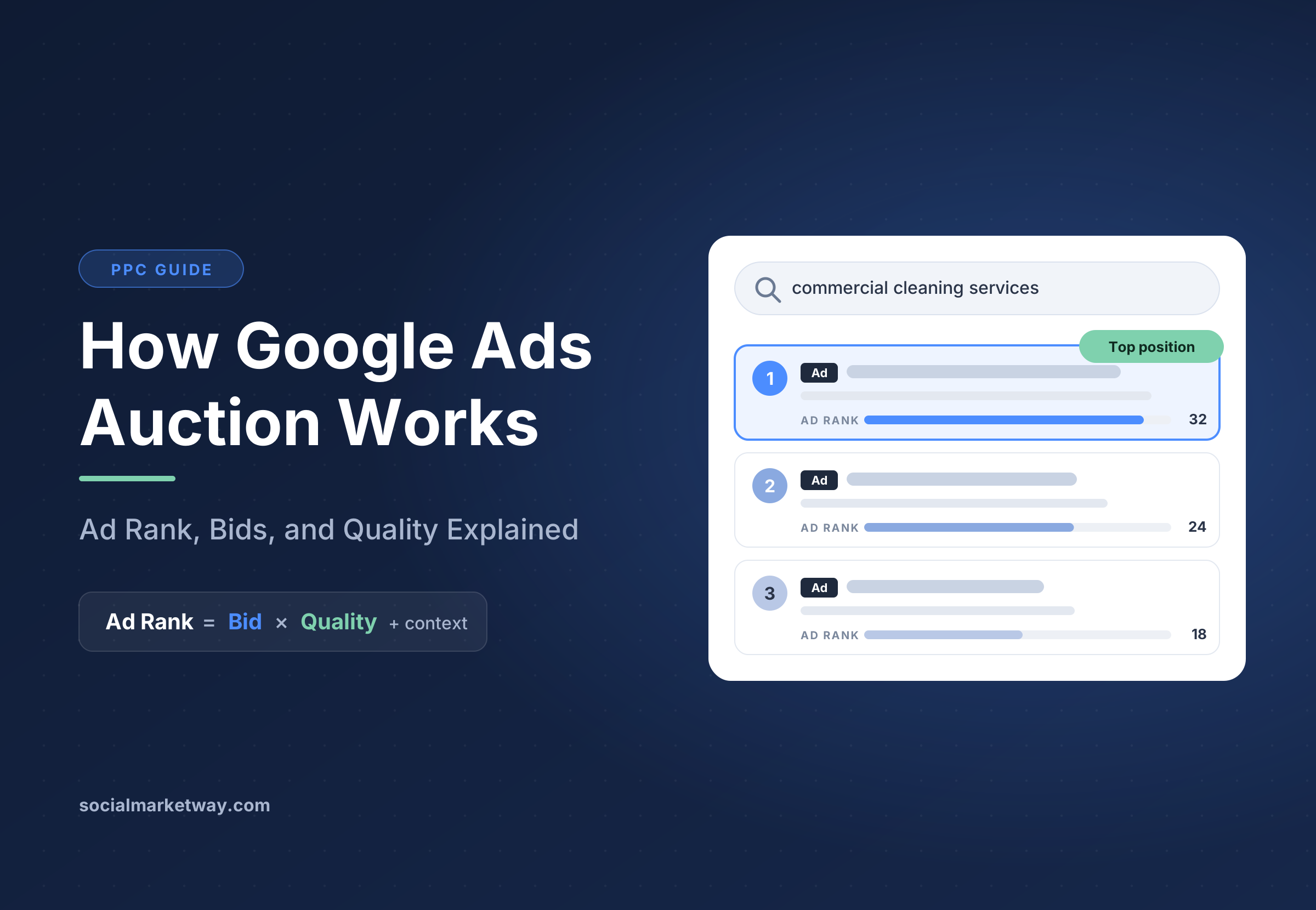
Every time someone types a query into Google, an auction takes place in a fraction of a second. It decides which ads appear, in what order, and how much each advertiser pays for a click. Most advertisers never see this auction, yet it shapes every dollar they spend.
Many businesses assume the highest bidder always wins. That is not how Google Ads works. An advertiser with a smaller bid can outrank a bigger spender, and often pays less per click while doing it. The difference comes down to a score called Ad Rank, which blends your bid with the quality and relevance of your ad.
This guide explains how the Google Ads auction works from start to finish. You will learn what Ad Rank is, how bids and bidding strategies feed into it, what Quality Score really measures, and how Google calculates what you pay. Most importantly, you will learn practical ways to win more auctions without simply raising your budget.
If you would rather have specialists handle this for you, our Google Ads management services are built around exactly these principles. But whether you manage campaigns in-house or with an agency, understanding the auction is the foundation of profitable paid search.
What Is the Google Ads Auction?
The Google Ads auction is the automated process Google runs every time an ad could appear on a search results page. It is not a single event held once a day or once a week. A fresh auction runs for each individual search, so the same keyword can produce different results from one minute to the next.
This matters because conditions constantly change. The person searching is in a different location, on a different device, at a different time of day. Competitors adjust bids, pause campaigns, or launch new ads. Each of these variables is weighed again in every auction.
There are three outcomes the auction decides:
- Eligibility: whether your ad is allowed to show at all.
- Position: where your ad appears relative to other ads, including whether it reaches the top of the page.
- Price: how much you pay if someone clicks.
It also helps to understand what the auction is not. Google Ads is a pay-per-click system, so you are not paying to enter the auction or for your ad to be seen on Search. You pay only when a user clicks. That makes paid search very different from organic search, where rankings are earned over months and clicks cost nothing directly. If you are still weighing the two channels, our guide to SEO vs PPC and which is right for your business breaks down the trade-offs.
The key takeaway is simple. Google wants to show ads that are useful to searchers, because useful ads get clicked and keep people coming back. The auction is designed to reward advertisers who deliver that usefulness, not just those with the deepest pockets.
How a Google Ads Auction Plays Out, Step by Step
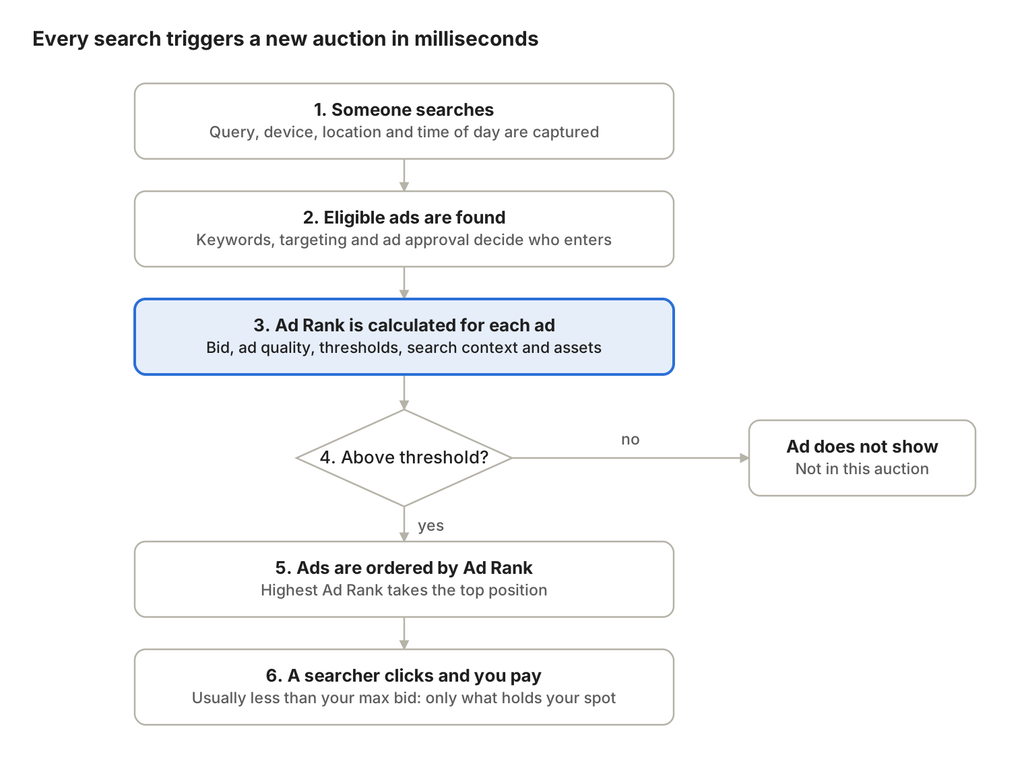
Although the whole process takes milliseconds, every auction follows the same sequence. Understanding each step shows you where your campaigns can win or lose.
- A user searches. Someone types a query such as “emergency plumber near me.” Google records the context around that search, including the device, location, time of day, and the wording of the query.
- Google finds eligible ads. The system looks for every ad whose keywords match the search and whose targeting settings include this user. Ads that are disapproved, paused, out of budget, or targeting another location are excluded before the auction begins.
- Ad Rank is calculated. For each remaining ad, Google calculates an Ad Rank score. This blends your bid with the quality of your ad and landing page, plus several contextual factors covered in detail below.
- Thresholds are checked. Each ad must reach a minimum Ad Rank to show at all, and a higher minimum to appear above the organic results. Ads that miss the threshold sit out this auction, even if few competitors are present.
- Ads are ordered and shown. The ad with the highest Ad Rank earns the top position, followed by the next highest, and so on. A limited number of ads can appear at the top of the page, while others may show at the bottom.
- The searcher clicks, and you pay. If someone clicks your ad, you are charged an actual cost per click. In most cases this is lower than your maximum bid, because you only pay what is needed to keep your position.
The critical insight is step three. Ad Rank, not your bid alone, decides where you land and what you pay.
Ad Rank Explained: What Decides Your Position
Ad Rank is the score Google uses to decide whether your ad shows, where it appears, and how much you pay. It is recalculated in every auction, so your Ad Rank for the same keyword can rise or fall depending on who is searching and who else is competing.
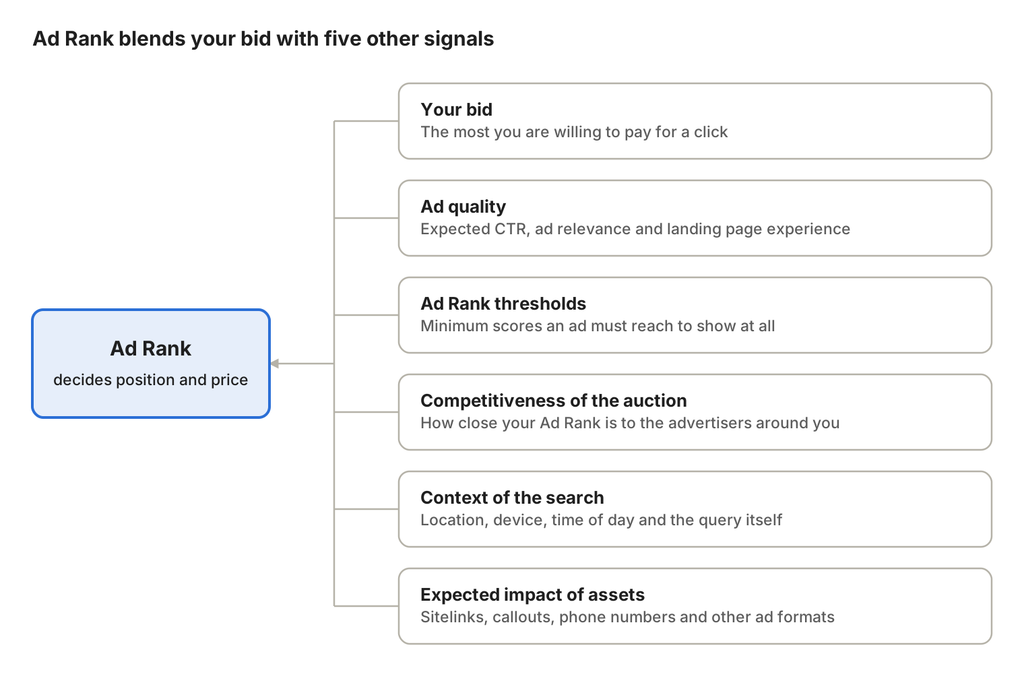
Google describes Ad Rank as being built from six main factors:
- Your bid. The maximum amount you are willing to pay for a click. Bids still matter, but they are only one input.
- Ad quality. Google’s estimate of how useful your ad and landing page will be to this searcher. This is assessed through expected click-through rate, ad relevance, and landing page experience.
- Ad Rank thresholds. Minimum standards an ad must meet to show at all. These vary by auction and are higher for the top positions on the page.
- Competitiveness of the auction. When two advertisers have very similar Ad Ranks, they compete more closely for a position, which can raise the price for both.
- Context of the search. The search terms, the user’s location and device, the time of day, and the other ads and results on the page all influence the outcome.
- Expected impact of assets. Sitelinks, callouts, call buttons, images, and other assets make ads more useful. Google estimates how much they will help and factors that into Ad Rank.
You may have seen Ad Rank described with a simple formula: bid multiplied by Quality Score. That shorthand is a useful way to understand the relationship between money and quality, and we use it in the worked example later in this article. But the real calculation is more nuanced. Google weighs live, auction-time signals rather than a single fixed number, which is why two advertisers with identical bids can land in very different positions.
The practical lesson is that you have several levers to pull, not just one. Raising your bid is the most expensive way to improve Ad Rank. Improving relevance, landing pages, and assets often achieves the same result for far less money.
Bids: How Much You Are Willing to Pay
Your bid is the maximum amount you are prepared to pay for a single click. It is the factor most advertisers focus on, and for good reason: all else being equal, a higher bid raises your Ad Rank. But a bid is a ceiling, not a price tag. You will rarely pay your full maximum, as the section on actual cost per click explains.
How you set that bid depends on your bidding strategy. Google Ads offers two broad approaches.
Manual bidding. With manual CPC bidding, you set a maximum bid for each keyword or ad group yourself. This gives you direct control and transparency, which can be useful for small accounts, tightly budgeted campaigns, or when you are testing new keywords. The downside is that a fixed bid cannot react to the signals that change in each auction.
Automated (Smart) bidding. Smart Bidding uses machine learning to set a bid for each individual auction, a practice known as auction-time bidding. It considers signals such as device, location, time of day, browser, language, and remarketing lists to predict how likely a click is to convert. Common strategies include:
- Maximize conversions: gets as many conversions as possible within your budget.
- Target CPA: aims for a set average cost per acquisition.
- Maximize conversion value: focuses on revenue or value rather than conversion count.
- Target ROAS: aims for a set return on ad spend.
- Maximize clicks: drives as much traffic as possible within budget, useful for awareness.
Smart Bidding is powerful, but only when it has accurate data. If conversion tracking is broken, incomplete, or counting the wrong actions, the algorithm will optimize toward the wrong goal and spend confidently in the wrong places. Clean tracking is the first thing to audit before switching strategies.
Regardless of strategy, remember that your bid interacts with quality. A strong, relevant ad can win a top spot with a modest bid, while a weak ad may need a very high bid just to clear the threshold. Choosing the right strategy is a core part of any well-run PPC management program, because the wrong one can quietly drain budget for months.
Quality Score: Google’s Measure of Ad Quality
Quality Score is a rating from 1 to 10 that Google assigns to each of your keywords. It summarizes how relevant and useful your ads and landing pages are likely to be for people searching that keyword, compared with other advertisers. A higher score generally means lower costs and better positions.
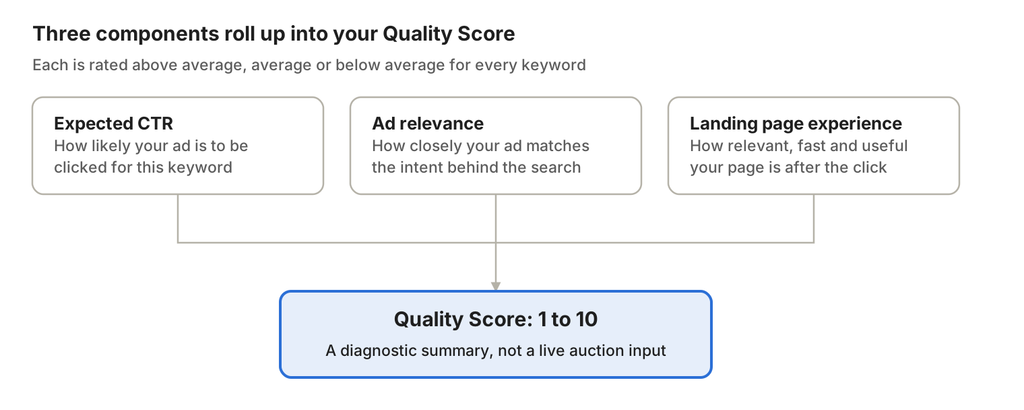
Quality Score is built from three components, each rated as above average, average, or below average.
1. Expected click-through rate
This is Google’s prediction of how likely your ad is to be clicked when it appears for a given keyword. It is based on past performance, adjusted for factors like ad position and extensions so that a top-placed ad is not unfairly favored. A below-average rating often means your ad copy does not speak to what searchers want, or the keyword is too broad.
2. Ad relevance
Ad relevance measures how closely your ad matches the intent behind the search. If someone searches for “waterproof hiking boots” and your ad talks generically about “outdoor footwear,” your relevance will suffer. Tightly themed ad groups, where keywords and ads share the same topic, are the most reliable way to improve this rating.
3. Landing page experience
This assesses how useful and relevant your landing page is to the people who click your ad. Google looks at whether the page delivers what the ad promised, loads quickly, works well on mobile, and is easy to navigate. Sending every click to your homepage is one of the most common reasons for a poor rating.
Quality Score is a diagnostic tool
One point causes confusion. Quality Score itself is not fed directly into the auction. Google calls it a diagnostic tool: a helpful summary you can check in your account. The auction uses real-time quality signals that are calculated for each individual search.
In practice, though, the two move together. The behaviors that raise your Quality Score are the same ones that improve auction-time quality. Treat Quality Score as a health check that points you toward the weakest component, then fix that component first.
What You Actually Pay: Actual Cost Per Click
Your maximum bid is the most you will pay, but it is rarely what you are charged. Google uses a pricing model where you pay only the minimum required to keep your ad position and clear the relevant Ad Rank thresholds. That figure is called your actual cost per click, or actual CPC.
A widely used simplified model shows the logic clearly:
\text{Actual CPC} = \frac{\text{Ad Rank of the advertiser below you}}{\text{Your Quality Score}} + \$0.01Google’s real calculation includes more signals than this, so treat the formula as an illustration rather than a precise calculator. It still captures the most important idea: the better your quality, the less you pay to beat the same competitor.
A worked example
Imagine three advertisers bidding on the keyword “commercial cleaning services.” Using the simplified formula of bid multiplied by Quality Score:
| Advertiser | Max bid | Quality Score | Ad Rank (bid x QS) | Position | Actual CPC |
|---|---|---|---|---|---|
| Advertiser A | $4.00 | 8 | 32 | 1 | $3.01 (24 / 8 + $0.01) |
| Advertiser B | $6.00 | 4 | 24 | 2 | $4.51 (18 / 4 + $0.01) |
| Advertiser C | $3.00 | 6 | 18 | 3 | Minimum to clear the threshold |
The results are striking. Advertiser B bids 50 percent more than Advertiser A, yet finishes second. Worse, B pays $4.51 per click for the lower spot, while A pays just $3.01 for the top position. Advertiser A wins the better placement and saves $1.50 on every click, purely because its ads and landing pages are more relevant.
Multiply that gap across thousands of clicks a month and the difference becomes enormous. This is why experienced advertisers spend so much effort on quality. It is the only lever that improves your position and lowers your costs at the same time.
Figures in this example are illustrative and use a simplified model of Google’s pricing.
Ad Rank Thresholds, Search Context, and Assets
Bids and quality get most of the attention, but three other factors quietly shape every auction.
Ad Rank thresholds
Thresholds are the minimum Ad Rank an ad needs to appear. They exist to protect the user experience: Google would rather show no ad than a poor one. Thresholds are not fixed. They depend on the ad’s quality, the user’s location and device, the nature of the search terms, and the position in question. Showing above the organic results requires clearing a higher bar than showing at the bottom of the page.
Thresholds explain a frustrating situation many advertisers face. You may be the only bidder on a niche keyword and still not show, or pay more than you expected. In a low-competition auction, the threshold, rather than a rival, sets the floor on your price. Improving quality lowers the threshold you need to clear.
Context of the search
The same keyword can behave very differently depending on who is searching. Someone looking for “accountant” on a mobile phone at 8 p.m. may have very different intent from someone searching on a desktop at 10 a.m. Google considers the search terms, location, device, time, and the nature of other ads and results on the page. This is one reason Smart Bidding can outperform manual bids: it adjusts for context in every auction.
Expected impact of assets
Assets, formerly called ad extensions, add extra information to your ad. Examples include sitelinks to specific pages, callouts that highlight benefits, structured snippets, call buttons, location details, prices, and images. Google estimates how much each asset will improve your ad’s performance and factors that into Ad Rank.
Assets also make your ad physically larger on the page, which tends to increase click-through rate. Adding relevant assets is one of the cheapest and fastest ways to improve Ad Rank without raising your bid. Note that Google decides which assets to show in each auction, so providing a full set gives the system more options to work with.
How to Win More Auctions Without Overspending
Now that you understand how the auction works, here are the most effective ways to improve your Ad Rank and lower your costs.
- Build tightly themed ad groups. Group keywords around a single topic so your ads can speak directly to each search. An ad group for “emergency plumbing” should not also contain “bathroom remodeling.” Tight themes lift ad relevance and expected CTR together.
- Write ads that mirror search intent. Include the core keyword naturally in your headlines, address the searcher’s problem, and give a clear reason to click. Use responsive search ads with a variety of distinct headlines and descriptions so Google can test combinations.
- Send clicks to the most relevant page. Every ad should lead to a landing page that matches its promise. If the ad mentions a free quote, the page should make requesting one obvious. Avoid sending paid traffic to a generic homepage.
- Make landing pages fast and mobile-friendly. Slow pages lose visitors and drag down landing page experience. Compress images, reduce scripts, and test pages on real phones.
- Use every relevant asset. Add sitelinks, callouts, structured snippets, call and location assets, and images where they fit. They increase your ad’s size and expected impact at no extra cost per click.
- Add negative keywords regularly. Review your search terms report and exclude irrelevant queries. Fewer wasted clicks mean better CTR, stronger quality signals, and more budget for searches that convert.
- Fix conversion tracking before automating. Smart Bidding is only as good as the data it receives. Confirm that you are tracking the right actions, with accurate values, before trusting an automated strategy.
- Monitor Auction Insights. This report shows who you compete against, how often you outrank them, and your share of impressions. It helps you spot new competitors and judge whether lost impressions come from budget or from rank.
- Bid where it pays. Use device, location, and schedule data to focus spend on the times and places that convert. Raising bids should be a deliberate decision backed by profit data, not a reflex.
None of these steps is a one-time fix. Auctions change daily, so the advertisers who win consistently are the ones who test, measure, and refine continuously. That ongoing optimization is the heart of professional PPC services.
Common Myths About the Google Ads Auction
Myth 1: The highest bidder always wins. As the worked example shows, a lower bid paired with stronger quality can take the top spot. Bids matter, but they are only one part of Ad Rank.
Myth 2: You pay your maximum bid. In most auctions you pay less than your maximum, because you are charged only what you need to hold your position and clear thresholds.
Myth 3: Spending more with Google improves your rankings. Google does not reward large budgets with better quality ratings. Your Ad Rank is calculated fresh in every auction based on your bid, quality, and context. Organic rankings are entirely separate from paid ads, and buying ads does not boost them.
Myth 4: Quality Score is a direct input to the auction. Quality Score is a diagnostic summary. The auction uses real-time quality signals, though improving one usually improves the other.
Myth 5: Position one is always the goal. The top spot is not always the most profitable. Sometimes the second or third position delivers conversions at a much lower cost. The right target depends on your margins, your conversion rate, and your goals.
Myth 6: Once a campaign is set up, the work is done. Competitors, search behavior, and Google’s own systems change constantly. Campaigns that are left alone usually drift toward higher costs and weaker results.
Conclusion: Quality Is Your Biggest Advantage
The Google Ads auction is not a simple bidding war. It is a real-time evaluation of how useful each ad is likely to be, run every time someone searches. Ad Rank decides who shows and in what order, and it blends your bid with ad quality, thresholds, search context, and the expected impact of your assets.
The most important lesson is that quality is a multiplier. Relevant keywords, compelling ads, strong landing pages, and a full set of assets let you win better positions while paying less per click. Advertisers who understand this consistently outperform competitors who simply raise their bids.
If you want to put these principles to work without the trial and error, the team at Social Market Way can help. Our Google Ads management services focus on improving Ad Rank, lowering cost per click, and turning more of your budget into revenue. Not sure whether paid search is the right fit yet? Start with our breakdown of SEO vs PPC, or explore our wider PPC services to see how we approach paid media from strategy to reporting.