


Broad Match vs. Phrase Match vs. Exact Match: Which Should You Use?

Choosing the right keyword match type is one of the most important decisions you make in Google Ads. It controls which searches can trigger your ads, how much traffic you get, and how much of your budget goes to clicks that never had a chance of converting.
Get it right and your ads reach people who are ready to buy. Get it wrong and you either miss valuable searches entirely or pay for thousands of irrelevant ones. Many accounts that struggle with high costs and low conversion rates have the same root problem: the wrong match types on the wrong keywords.
This guide compares broad match, phrase match, and exact match in plain language. You will learn how each one works today, the strengths and risks of each, and a practical framework for deciding which to use. By the end, you will know how to build a match type strategy that balances reach with control.
If you would rather leave keyword strategy to specialists, our Google Ads management services handle match type selection, negative keyword management, and ongoing optimization for you.
What Are Keyword Match Types and Why Do They Matter?
When you add a keyword to a Google Ads campaign, you are not telling Google to show your ad only when someone types those exact words. You are giving Google a signal about the searches you want to compete for. The match type tells Google how loosely or strictly to interpret that signal.
Google Ads currently offers three keyword match types:
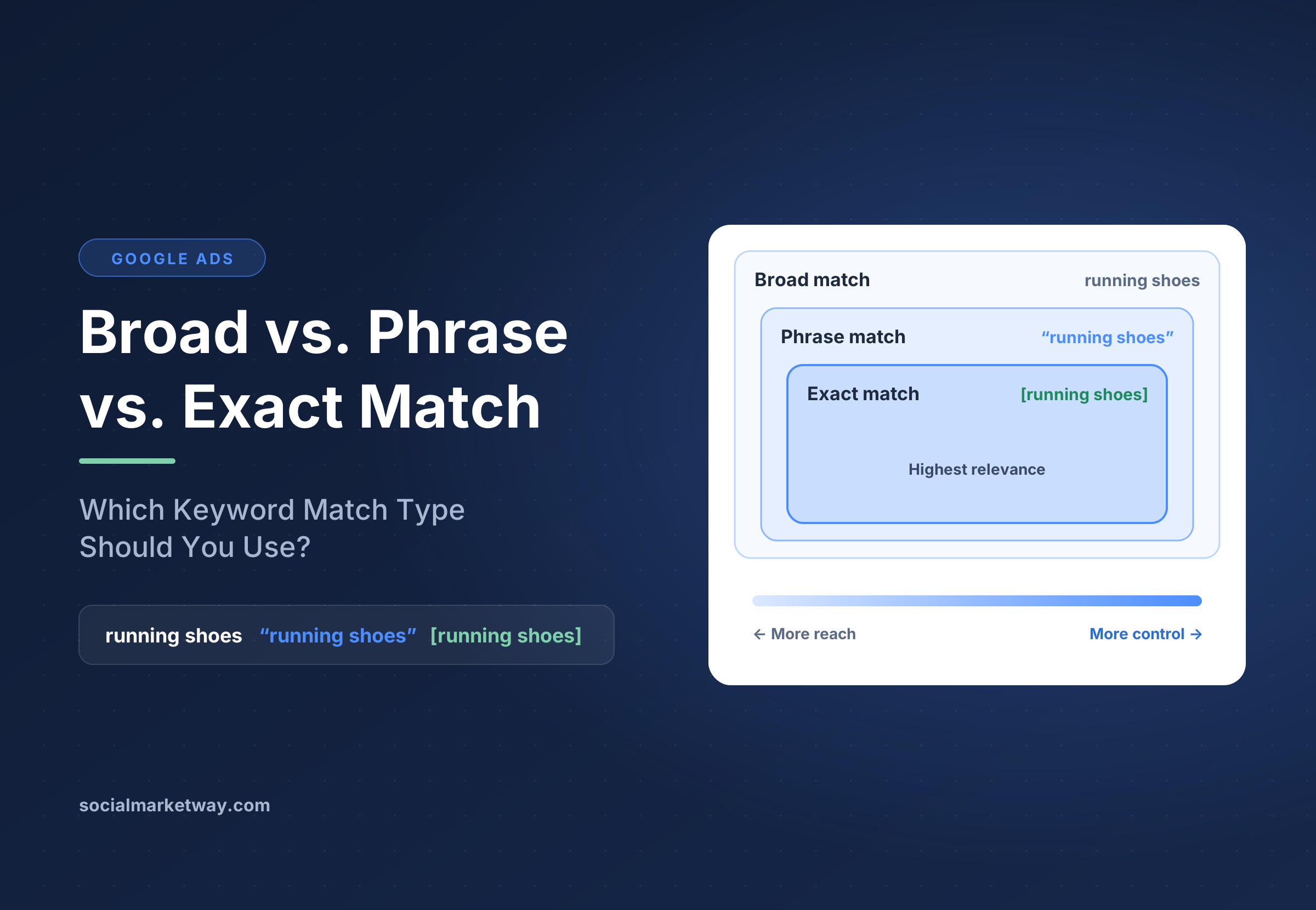
- Broad match: the widest reach. Ads can show on searches related to your keyword, even if they do not contain its words.
- Phrase match: a middle ground. Ads can show on searches that include the meaning of your keyword, often with extra words before or after.
- Exact match: the tightest control. Ads can show on searches with the same meaning or intent as your keyword.
You set the match type with simple punctuation when entering keywords:
| Match type | How to enter it | Example |
|---|---|---|
| Broad match | No symbols | running shoes |
| Phrase match | Quotation marks | “running shoes” |
| Exact match | Square brackets | [running shoes] |
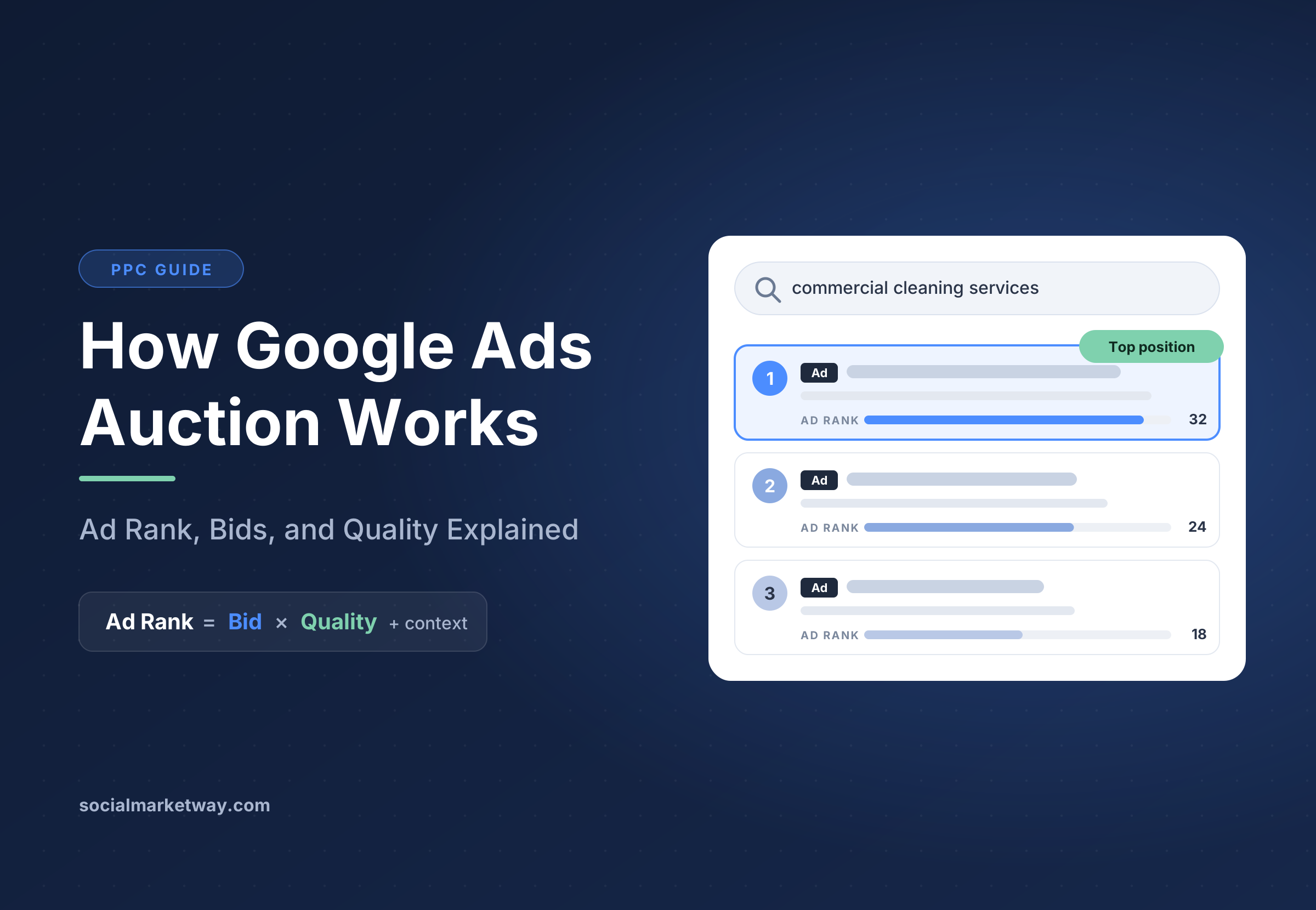
Match types matter because they decide which auctions you enter. Every eligible search triggers an auction where your ad competes on Ad Rank, a blend of your bid, ad quality, and context. If you want a refresher on how that works, read our guide on how the Google Ads auction works. A looser match type enters you into far more auctions, while a stricter one keeps you in fewer, more targeted ones.
Match types also affect quality. Ads shown on loosely related searches tend to earn lower click-through rates and weaker relevance, which can raise your costs over time. That is why match type choices ripple through your entire account.
One more point of history: older guides mention “broad match modifier,” written with plus signs. Google retired that option in 2021 and folded its behavior into phrase match. If you see plus-sign keywords in an old account, they now behave like phrase match.
Broad Match: Maximum Reach
Broad match is the default match type in Google Ads. It lets your ads show on searches that are related to your keyword, including searches that do not contain any of its words. Google uses its understanding of language and intent to decide what counts as related.
For the broad match keyword running shoes, your ad could appear for searches such as:
- running shoes
- best sneakers for jogging
- marathon training gear
- shoes for a 5k race
Modern broad match is far smarter than it used to be. Google now looks beyond the keyword itself, using signals such as the user’s recent searches, the content of your landing page, and the other keywords in your ad group to judge relevance. When paired with Smart Bidding, it can also set a bid for each search based on how likely it is to convert.
Advantages of broad match
- Finds searches you did not think of. People phrase queries in endless ways, and many searches Google sees every day are brand new. Broad match can capture these without you having to predict them.
- Less keyword management. One broad keyword can cover what used to take dozens of exact and phrase keywords.
- Works well with automation. Smart Bidding strategies such as Target CPA and Target ROAS can bid down on weak searches and bid up on strong ones, which helps offset broad match’s looser targeting.
Disadvantages of broad match
- Less control. You may appear for searches that are only loosely connected to what you sell.
- Higher risk of wasted spend. Without strong negative keywords and accurate conversion data, broad match can drain a budget quickly.
- Harder to read results. Because one keyword triggers so many different searches, it can be harder to tell which intent is actually driving your conversions.
When to use broad match
Broad match works best when you have reliable conversion tracking, enough conversion volume for Smart Bidding to learn from, and a budget that can absorb some testing. It is also useful for discovering new keyword ideas: run broad match carefully, then mine the search terms report for winners to add as phrase or exact keywords.
Avoid broad match with manual bidding and no conversion data. In that setup, Google has the freedom to match loosely but no information about which searches are valuable.
Phrase Match: The Balanced Middle Ground
Phrase match shows your ads on searches that include the meaning of your keyword. The search can contain extra words before or after it, and Google will also match close variations such as plurals, misspellings, and synonyms. Word order matters when changing it would change the meaning.
For the phrase match keyword “running shoes”, your ad could appear for:
- best running shoes for women
- running shoes on sale
- buy running shoes near me
- running shoe store
It would not appear for searches like “shoes for running a business,” where the meaning is different, or “marathon training gear,” which does not include the core idea of running shoes.
Advantages of phrase match
- Good balance of reach and control. You capture many longer, more specific searches while staying close to your core topic.
- Catches high-intent long-tail queries. Searches with extra words, such as “best,” “buy,” or a location, often signal someone close to a decision.
- Easier to manage than broad. The searches you trigger are more predictable, which makes the search terms report easier to review.
Disadvantages of phrase match
- Still some irrelevant traffic. Added words can change intent. “Free running shoes” or “running shoes repair” might not suit a store selling new shoes.
- Less discovery than broad. You will miss related searches that use completely different wording.
When to use phrase match
Phrase match is a strong default for many advertisers, especially small and mid-sized accounts. It works well with both manual and automated bidding, and it is a sensible choice when you have a modest budget but still want to reach searches you have not listed. Pair it with a solid negative keyword list to filter out added words that change the meaning.
Exact Match: Maximum Control
Exact match gives you the tightest control over which searches trigger your ads. Despite the name, it no longer means the search must match your keyword word for word. Exact match now covers searches with the same meaning or the same intent as your keyword, including plurals, misspellings, reordered words, and close synonyms.
For the exact match keyword [running shoes], your ad could appear for:
- running shoes
- running shoe
- shoes for running
- runing shoes
It would not appear for “best running shoes for women,” because the added words narrow the intent to something more specific.
Advantages of exact match
- Highest relevance. Your ad shows to people searching for precisely what you offer, which usually means stronger click-through rates and better Quality Scores.
- Predictable spend. Traffic is easier to forecast, and very little budget goes to off-topic searches.
- Precise bidding. You can set specific bids for your most valuable terms, such as branded searches or high-margin products.
Disadvantages of exact match
- Limited reach. You will miss many relevant longer searches unless you list them individually.
- Higher management effort. Covering a market with exact match alone means building and maintaining large keyword lists.
- Lower volume can starve automation. If exact match keywords generate few conversions, Smart Bidding has less data to learn from.
When to use exact match
Use exact match for your proven, high-converting keywords, for brand terms, and for expensive keywords where every click needs to count. It is also the safest choice when budgets are tight or when you are just starting out and want to learn which searches convert before expanding.
Broad vs. Phrase vs. Exact Match: Side by Side
The easiest way to picture the three match types is as nested circles. Exact match sits at the center, phrase match wraps around it, and broad match covers the widest area.
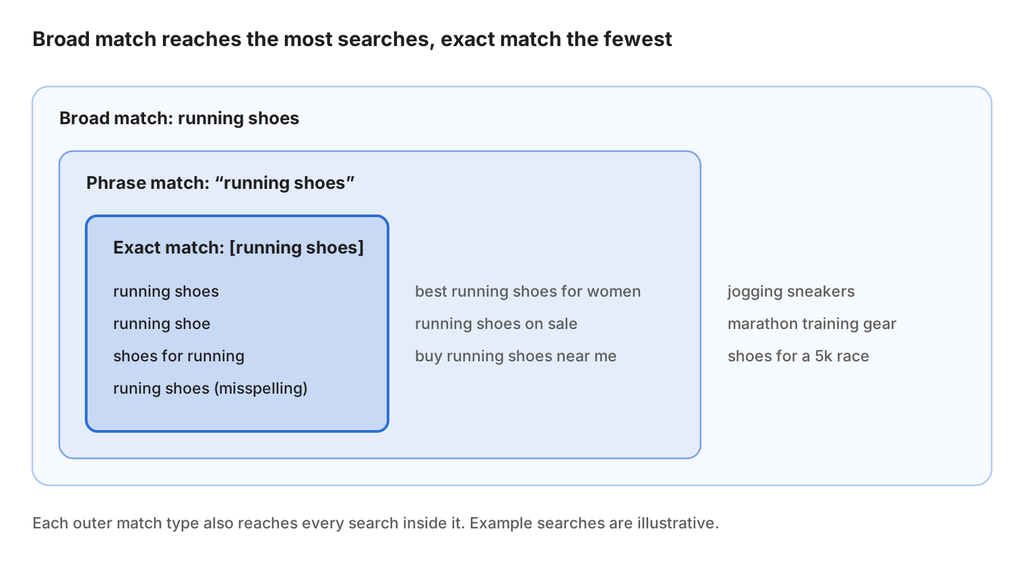
Here is how they compare across the factors that matter most:
| Factor | Broad match | Phrase match | Exact match |
|---|---|---|---|
| Syntax | running shoes | “running shoes” | [running shoes] |
| Reach | Widest | Medium | Narrowest |
| Control | Lowest | Medium | Highest |
| Typical relevance | Variable | Good | Highest |
| Risk of wasted spend | High without negatives and data | Moderate | Low |
| Keyword management effort | Low | Moderate | High |
| Best bidding pairing | Smart Bidding | Manual or Smart Bidding | Manual or Smart Bidding |
| Best for | Discovery and scale | Balanced growth | Proven, high-value terms |
Notice the trade-off running through every row. As reach goes up, control goes down. The right choice depends on how much data you have, how big your budget is, and how much risk you can accept.
Which Match Type Should You Use?
The right match type depends less on preference and more on your data, budget, and goals. Use this decision guide as a starting point.
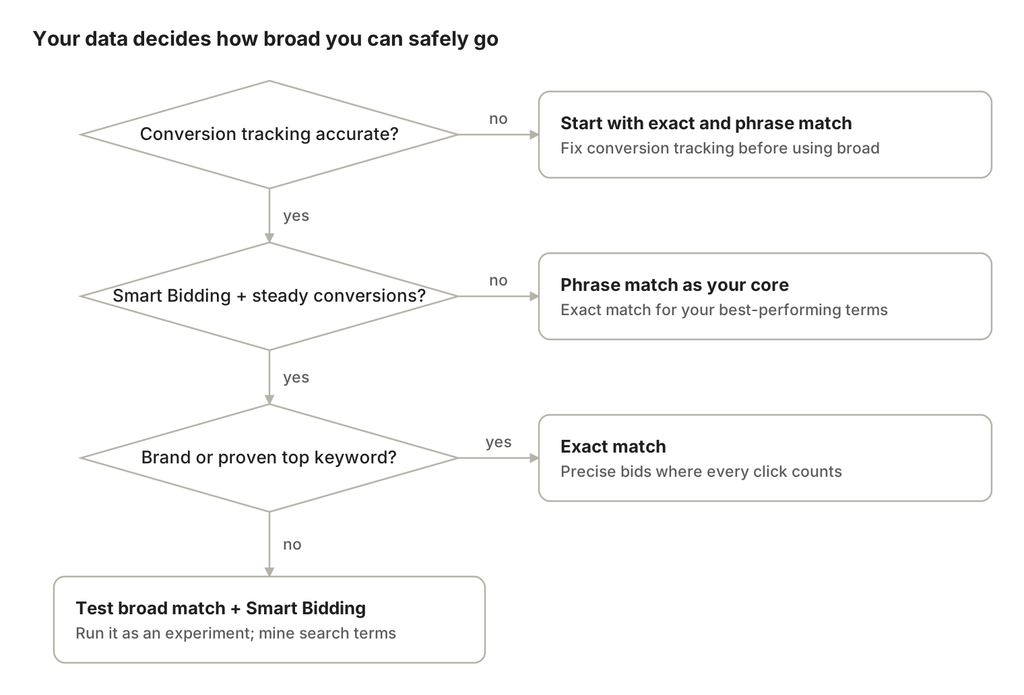
Choose exact match when:
- You are bidding on brand terms or proven, high-converting keywords.
- Clicks are expensive and every one needs to count.
- Your budget is small and you need tight control over spend.
- You are launching a new account and want clean data first.
Choose phrase match when:
- You want more reach than exact match without the risk of broad match.
- You use manual bidding or have modest conversion volume.
- You want to capture high-intent long-tail searches, such as those with “best,” “buy,” or a location.
Choose broad match when:
- Your conversion tracking is accurate and complete.
- You use Smart Bidding and have steady conversion volume, ideally dozens of conversions a month per campaign.
- You want to scale beyond your current keyword list or discover new search themes.
- You can review search terms and add negatives regularly.
The direction of travel at Google is clear. Its systems increasingly favor broad matching paired with automated bidding, and newer AI-driven campaign features push further in that direction. That does not mean broad match is right for every account today. It means the foundations it depends on, clean conversion data and strong negatives, are worth building now.
Negative Keywords: The Other Half of Match Types
No match type strategy is complete without negative keywords. Negatives tell Google which searches you do not want your ads to appear for. They are the main safety net that makes broad and phrase match workable.
Negative keywords use the same three match types, but they behave differently in one important way: negative keywords do not match close variants. A negative for “free” will not automatically block “freebie” or a misspelling. You need to add those variations yourself.
- Negative broad match blocks searches that contain all of the negative words, in any order. A negative broad cheap shoes blocks “shoes that are cheap” but not “cheap sneakers.”
- Negative phrase match blocks searches that contain the exact phrase in the same order. A negative phrase “used shoes” blocks “buy used shoes online” but not “shoes used for hiking.”
- Negative exact match blocks only that exact search, with no extra words.
Good candidates for negative keywords include words like “free,” “jobs,” “careers,” “DIY,” “how to,” and competitor or product names you do not want to bid on. The best source of negatives is your own search terms report. Review it weekly when you launch broad or phrase match, and at least monthly once things are stable.
Shared negative keyword lists save time across campaigns. Build one master list for universally irrelevant terms, then add campaign-level negatives where the context differs.
A Practical Match Type Strategy That Works
The question is rarely which single match type to use. Most successful accounts use all three, each with a clear job. Here is a framework you can adapt.
- Start with exact and phrase match. Build your first campaigns around your core, high-intent keywords in exact and phrase match. This gives you clean data about which searches convert, at a cost you can control.
- Set up conversion tracking properly. Before you expand, confirm you are tracking the actions that matter, such as purchases, leads, or calls, with accurate values. Broad match and Smart Bidding both depend on this data.
- Build a negative keyword foundation. Add obvious negatives from day one, then grow the list from your search terms report.
- Introduce broad match deliberately. Once a campaign has steady conversion volume, test broad match on your best themes with a Smart Bidding strategy such as Target CPA or Target ROAS. Run it as a controlled experiment and compare cost per conversion against your existing setup.
- Harvest winners and block losers. Review search terms regularly. Add strong converting queries as exact or phrase keywords so you can bid on them precisely. Add irrelevant queries as negatives.
- Protect your brand terms. Keep branded keywords in exact match, often in a separate campaign, so their strong performance does not mask weaker results elsewhere.
- Let results guide the mix. If broad match brings profitable new conversions, give it more budget. If it mostly adds cost, scale it back. There is no permanent answer, only the right answer for your data right now.
This kind of ongoing testing and refinement is what separates profitable accounts from expensive ones. It is the day-to-day work behind effective PPC management.
Common Match Type Mistakes to Avoid
Leaving everything on broad match by default. Broad match is the default setting, so many new advertisers use it without realizing. Combined with manual bidding and no negatives, this is one of the fastest ways to waste budget.
Assuming exact match means exact words. Exact match now includes close variants and same-intent searches. Check your search terms report rather than assuming you only appear for the precise wording.
Never reviewing the search terms report. This report shows the real searches behind your clicks. Ignoring it means you cannot spot waste or discover new opportunities.
Using broad match without conversion tracking. Broad match relies on data to separate good searches from bad ones. Without accurate tracking, it is guessing.
Forgetting that negatives ignore close variants. If you want to block “free” and “freebies,” add both. Negatives will not catch variations for you.
Judging broad match too quickly. Smart Bidding needs time to learn. Give a broad match test a few weeks and enough conversions before deciding whether it works.
Mixing match types without a plan. Duplicating the same keyword across several match types and ad groups can make results confusing and split your data. Give each match type a defined role.
Conclusion: Use the Right Match Type for the Right Job
There is no single best match type. Broad match offers the most reach and works best with strong data and Smart Bidding. Phrase match balances reach with control and suits most growing accounts. Exact match delivers the most precision for your proven, high-value keywords.
The strongest accounts use all three, each with a clear purpose, backed by accurate conversion tracking and a disciplined negative keyword strategy. Match types decide which auctions you enter, while your bids and ad quality decide how well you compete once you are there. To understand that second half, read our guide on how the Google Ads auction works.
Paid search is also only one way to win customers from Google. If you are deciding where to invest, our comparison of SEO vs PPC explains when each channel makes sense.
Want an expert to audit your keywords and match types? The team at Social Market Way can help. Explore our PPC services or learn more about our Google Ads management services to start turning more of your ad spend into customers.