



Chiropractic SEO: The Complete Guide to Ranking Higher and Filling Your Schedule

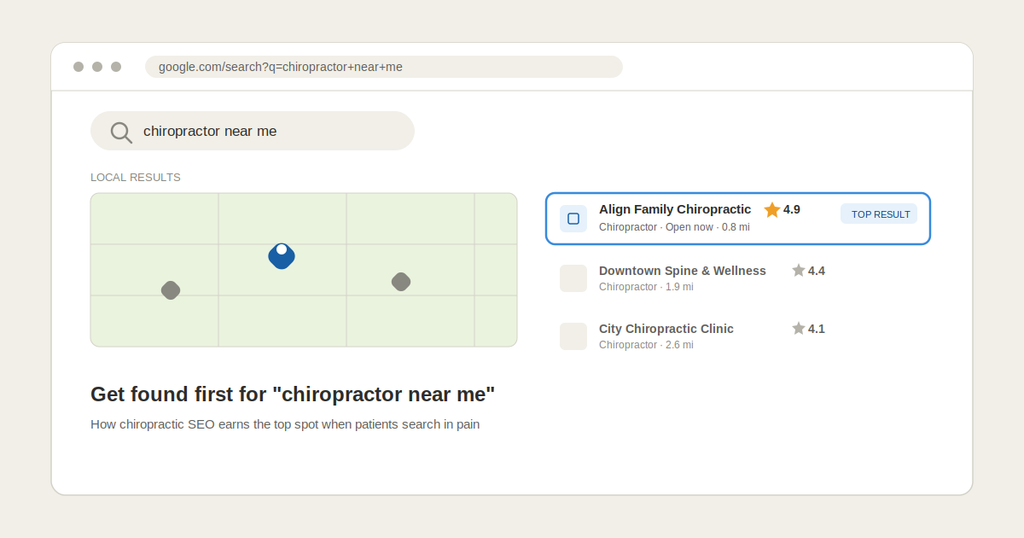
Somewhere in your city right now, someone woke up with a stiff neck, a shooting pain down their leg, or a nagging lower back ache they’ve been ignoring for weeks. They’re not calling a friend for a referral anymore — they’re pulling out their phone and typing “chiropractor near me.” What they see in the next ten seconds decides who gets that new patient.
That’s the entire premise behind chiropractic SEO: making sure that when local pain-driven searches happen, your practice is the one showing up first, backed by reviews and content that make the decision to book easy. Yet most chiropractic websites are still built the way they were a decade ago — a homepage, a services page, a bio, and little else — while competitors down the street quietly capture the search traffic that should be walking through your door.
This guide breaks down exactly how seo for chiropractor websites works in 2026: the local SEO tactics that win the map pack, the on-page structure that turns visits into booked appointments, the off-page authority that convinces Google (and patients) to trust you, and the content strategy that keeps your schedule full month after month.
What Is Chiropractic SEO, Exactly?
Chiropractic SEO is the practice of optimizing a chiropractic practice’s website and online presence so it ranks higher in search engines for the terms patients actually use — “chiropractor near me,” “back pain relief [city],” “chiropractor for sciatica,” or “pediatric chiropractor near me.” Done well, it also extends to how your practice shows up in AI-powered answers from tools like ChatGPT, Perplexity, and Google’s AI Overviews, since more patients now research providers conversationally before ever visiting a website.
Unlike SEO for a typical local business, chiropractor search engine optimization has to account for a few realities specific to healthcare-adjacent practices:
- Pain is the trigger. Most searches happen in a moment of discomfort, which means speed and clarity matter — patients want to know quickly whether you treat their specific issue.
- Trust is non-negotiable. Patients are handing over their health history and physical wellbeing to someone new. Reviews, credentials, and clear expertise carry enormous weight.
- Most practices serve a defined geographic area. You’re not competing nationally — you’re competing against the five or six practices within a reasonable drive of your office.
- Search intent varies by symptom and audience. “Chiropractor for lower back pain,” “prenatal chiropractor,” and “chiropractor after car accident” all represent different searchers with different urgency levels.
Getting all of this right is what separates practices quietly filling their schedule from search traffic and practices still relying entirely on referrals and repeat visits.
Why Local SEO Matters More for Chiropractors Than Almost Any Other Industry
Because chiropractic care is inherently local — nobody drives across the state for an adjustment — local seo for chiropractors deserves more attention than almost any other part of a marketing plan.
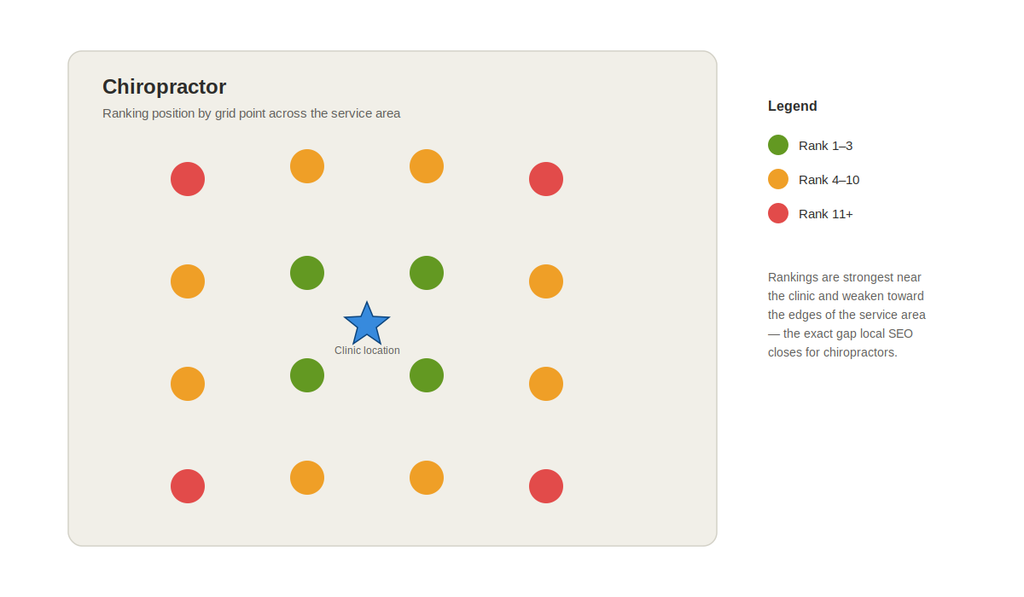
That grid is how local SEO progress actually gets measured — not a single “are we ranking” checkbox, but a map showing exactly where in your city you’re winning the map pack and where you’re invisible. Notice the pattern: rankings are strongest near the clinic’s actual location and weaken toward the edges of the service area, which is the natural shape of local search and exactly the gap a focused local SEO strategy is built to close. Turning that map from mostly amber and red to mostly green comes down to a specific set of tactics:
- Google Business Profile optimization — accurate categories (chiropractor, sports medicine clinic, physical therapist if applicable), complete service lists, regularly updated photos, and consistent posting
- Neighborhood and condition-specific landing pages — pages built around “chiropractor in [neighborhood]” or “chiropractic care for whiplash” rather than trying to make one homepage rank for everything
- Review generation at scale, since both review count and average rating factor directly into map pack ranking, and healthcare decisions lean especially hard on social proof
- Citation consistency — your practice name, address, and phone number matching exactly across every directory, insurance network listing, and health platform that lists you
Our local SEO services are built specifically to help service-area practices like chiropractic clinics expand that green zone outward, neighborhood by neighborhood, until it covers your entire patient base.
On-Page SEO: Turning Your Website Into a Patient-Converting Asset
Local visibility gets someone to click. On-page SEO is what happens next — whether the page they land on actually convinces them to book.
For chiropractic website seo, on-page work typically covers:
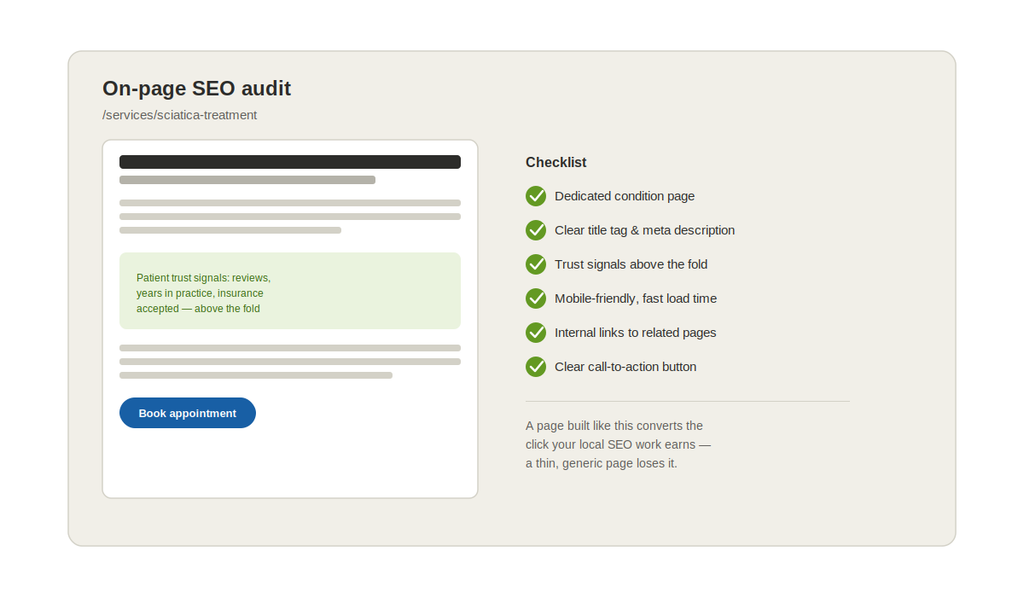
- Dedicated condition and service pages — back pain, neck pain, sciatica, headaches and migraines, sports injuries, auto accident recovery, prenatal care, pediatric chiropractic. Each condition deserves its own page addressing that patient’s specific concern, not a single paragraph buried on a general services page.
- Clear, empathetic copywriting that speaks to the patient’s actual experience — “if you’ve been living with lower back pain for months” resonates far more than a list of clinical techniques.
- Visible trust signals above the fold — years in practice, patient review scores, insurance accepted, and credentials, since patients decide whether to keep reading within seconds.
- Fast load times and mobile-friendly design, since the overwhelming majority of “chiropractor near me” searches happen on a phone, often while someone is in pain and impatient.
- Clean site architecture and internal linking so Google can easily understand which pages address which conditions and locations.
A practice with one thin, all-purpose services page is competing against practices with a dozen focused, well-structured pages — and losing every time a specific condition search happens. Our on-page SEO services focus specifically on turning existing website pages into ranking, converting assets without requiring a full site rebuild.
Off-Page SEO: Building the Authority Google (and Patients) Trust
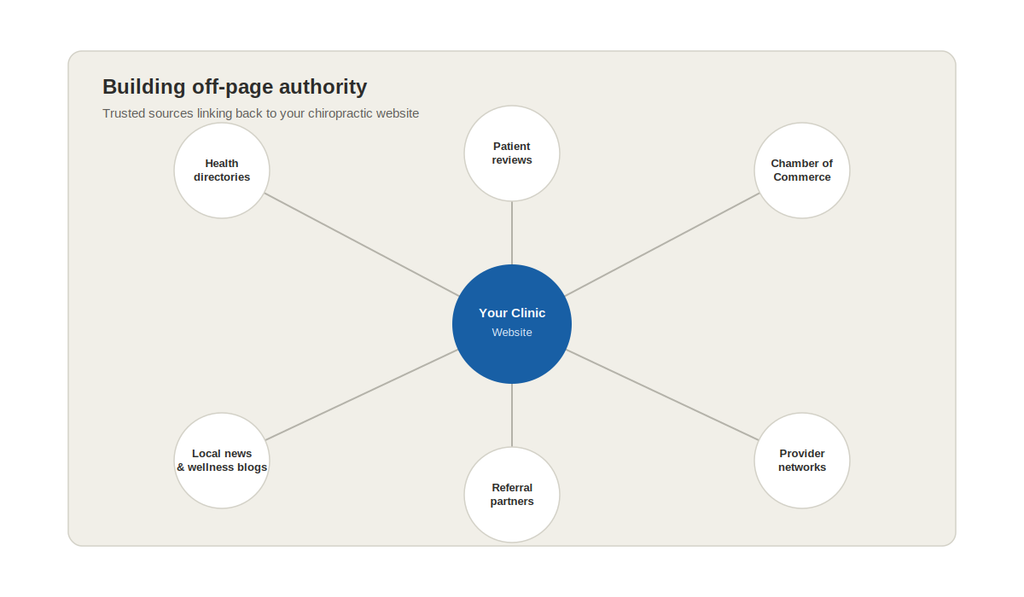
On-page work controls what happens on your website. Off-page SEO is about proving to search engines — and to skeptical new patients — that other credible sources vouch for you. For chiropractic practices, this typically comes from:
- Health and wellness directories — Healthgrades, Zocdoc, WebMD’s provider directory, and chiropractic-specific listings, which carry meaningful authority in Google’s eyes for healthcare-adjacent searches
- Local Chamber of Commerce and community listings, which are high-authority, highly relevant, and often an easy first link for an established practice
- Patient reviews across multiple platforms — Google, Healthgrades, and Facebook — since review volume and diversity function as their own kind of off-page signal
- Guest content or interviews on local news sites, wellness blogs, or podcasts, especially around topics like sports injury prevention or posture correction
- Referral partnerships with related providers — physical therapists, massage therapists, and primary care practices that link back to your site as a trusted referral
The goal isn’t link volume for its own sake — a single relevant link from a respected local health directory outweighs a dozen random, unrelated backlinks. Our off-page SEO services are built to grow exactly this kind of relevant authority for local healthcare and wellness practices.
Chiropractic Keyword Research: Finding What Patients Actually Type
Keyword research is the foundation everything else is built on. For chiropractic practices, the highest-converting keyword pattern almost always follows one of two formulas:
[Service or condition] + [Location]
- chiropractor + [city]
- back pain relief + [city]
- sports injury chiropractor + [city]
[Condition] + [Chiropractic]
- chiropractor for sciatica
- chiropractic care for migraines
- chiropractor after car accident
These condition-and-location combinations tend to carry lower competition and dramatically higher intent than broad terms like “chiropractor” alone, because the person searching is often actively in discomfort and looking for a same-week appointment. Beyond these, it’s worth building content around the long-tail, question-based searches your front desk hears every week — “how many chiropractic sessions do I need,” “does insurance cover chiropractic care,” “is chiropractic safe during pregnancy.” This kind of clear, structured content is also exactly what AI search tools favor when deciding which practices to cite as trustworthy sources.
Content Marketing: Building Trust Before the First Visit
Service and location pages capture people who already know what they want. Blog and educational content captures everyone else — the much larger group still researching or comparing before they’re ready to book.
Chiropractic practices that win at content consistently publish material answering real patient questions, such as:
- “What does a chiropractic adjustment actually feel like?”
- “How long does it take to recover from a herniated disc?”
- “Signs your headaches might be coming from your neck”
- “What to expect at your first chiropractic appointment”
This kind of content does three things simultaneously: it captures long-tail search traffic from people still deciding whether chiropractic care is right for them, it builds trust and reduces first-visit anxiety before the phone ever rings, and it gives AI search tools clean, well-structured answers to cite when someone asks a chatbot for a recommendation.
Reviews and Reputation: The Trust Signal That Decides Everything
For most local businesses, reviews matter. For chiropractic practices, they’re often the single deciding factor. A new patient is choosing to let someone manipulate their spine — the psychological bar for trust is simply higher than picking a restaurant or a retail store.
Practices with a strong, consistent flow of recent reviews — ideally mentioning specific conditions treated and outcomes achieved — tend to outperform practices with a higher raw star rating but few, outdated reviews. A simple, repeatable system (a text or email review request sent automatically after a positive visit) does more for long-term rankings and conversion than almost any other single tactic on this list.
Technical SEO Checklist for Chiropractic Websites
Even the best content and backlink strategy underperforms if the website itself has technical issues holding it back. Before investing heavily in content or links, confirm your site covers the basics:
- Site speed — slow-loading pages hurt both rankings and conversions, especially on mobile
- Mobile responsiveness — the majority of “chiropractor near me” searches happen on a phone
- HTTPS security, which patients increasingly notice and expect from any healthcare-adjacent website
- Clean URL structure, with condition and location pages organized logically rather than buried under generic navigation
- No broken links or crawl errors blocking Google from indexing key service pages
- Schema markup for local business, medical services, and reviews, which helps both traditional search engines and AI search tools understand exactly what your practice offers
How Long Does Chiropractic SEO Take to Show Results?
This is the question every practice owner asks, and the honest answer depends on your market’s competitiveness, your site’s current authority, and how consistently the strategy runs. A realistic timeline looks like this:
- Months 1–3: Technical fixes, keyword research, and foundational on-page and local SEO work go live
- Months 3–6: Early rankings begin moving for lower-competition, long-tail, and neighborhood-specific terms
- Months 6–12: Rankings for competitive city-wide terms climb, organic traffic compounds, and new patient inquiries become noticeably more consistent
Unlike paid ads, which stop producing the moment you stop paying, SEO builds a lasting asset. Content and rankings earned today keep generating new patient inquiries for years, which is exactly why chiropractic practices increasingly treat SEO as one of their highest-ROI marketing investments over time.
Choosing the Right Partner for Chiropractic SEO
Not every agency that claims to “do SEO” understands the chiropractic space. When evaluating a potential partner for best seo for chiropractors, look for:
- Proven experience with chiropractic or healthcare-adjacent clients specifically — ask for real examples, not generic case studies from unrelated industries
- Transparent reporting tied to rankings, traffic, and — most importantly — actual new patient inquiries, not vanity metrics like impressions
- A strategy covering all three pillars — on-page, local, and off-page — rather than a narrow focus on just one
- An understanding of healthcare marketing sensitivities, including patient privacy expectations and appropriate, non-clinical claims in marketing copy
- A clear plan for reviews and reputation, since this single factor influences both rankings and patient decision-making more than almost anything else
If a proposed strategy sounds identical to what a law firm, restaurant, or e-commerce store would receive, that’s a red flag. Chiropractors SEO requires a playbook built around pain-driven search behavior, trust-heavy decision-making, and a tightly defined local service area — not a generic template.
Common Chiropractic SEO Mistakes to Avoid
Even well-intentioned practices sabotage their own SEO efforts with a few recurring mistakes:
- Trying to rank one homepage for every condition and every neighborhood. A single page can’t compete for “chiropractor,” “sciatica treatment,” and five different city names simultaneously — dedicated pages win.
- Ignoring reviews. Skipping active review generation means missing one of the strongest local ranking and trust signals available in any healthcare-adjacent category.
- Publishing thin, generic content. A 200-word blog post that could apply to any medical practice provides little value to readers or search engines.
- Treating SEO as a one-time project. Search algorithms evolve constantly, and a “set it and forget it” mentality leads to rankings quietly eroding over time.
- Overlooking mobile experience. A slow, hard-to-navigate site on mobile loses exactly the patients who searched in a moment of pain and urgency.
Avoiding these pitfalls alone puts a practice ahead of a large share of local competitors still making them.
Bringing It All Together
Chiropractic SEO isn’t a single tactic — it’s a system. Strong local SEO wins the map pack when patients are searching in pain. On-page structure turns that click into a booked appointment. Off-page authority and reviews build the trust a new patient needs before they’ll let someone new adjust their spine. And consistent content keeps that trust building long before the phone ever rings.
The practices winning the most new patients online right now aren’t necessarily the biggest or most established — they’re the ones showing up, again and again, with genuinely helpful, trustworthy content exactly where and when a patient in pain is searching.
Ready to Fill Your Schedule With Search-Driven New Patients?
At Social Marketway, we build local SEO, on-page, and off-page strategies specifically for chiropractic and healthcare-adjacent practices that want more qualified new patients, not just more website traffic.
Get in touch with our team to talk through where your practice’s SEO stands today and what a focused chiropractic growth strategy could look like for your clinic.