

Dermatology SEO: The Complete Guide

Dermatology SEO, also called dermatologist SEO, is the search engine optimization work of making your practice the one patients find, trust and book when they search for skin care. That includes Google’s map pack, its regular results and, more and more, AI answers from Google, ChatGPT and other assistants.
The stakes have changed. Patients used to search, click a few websites and call. Now many read an AI summary first, scan reviews on several platforms, and visit your website only to confirm their choice. If you’re not visible at each of those steps, a med spa, a chain or a competing group practice takes the appointment.
The good news is that dermatology is a specialty where SEO pays off. Patients search by condition (“eczema flare that won’t go away”), by treatment (“Mohs surgery near me”) and by provider name. Each of those searches can lead to a dedicated page on your site. Healthcare is also the industry where ranking well still predicts AI visibility best. In BrightEdge’s February 2026 analysis, 24% of healthcare AI Overview citations also ranked in Google’s organic top 10, the highest of nine industries it tracked.
This guide walks through the full dermatology SEO playbook: how patients search, which keywords to target, local SEO, condition and treatment pages, E-E-A-T, technical fixes, content, reviews, links, AI search and how to measure results. If you’d rather have a team run it for you, see our healthcare SEO services.
How patients search for a dermatologist
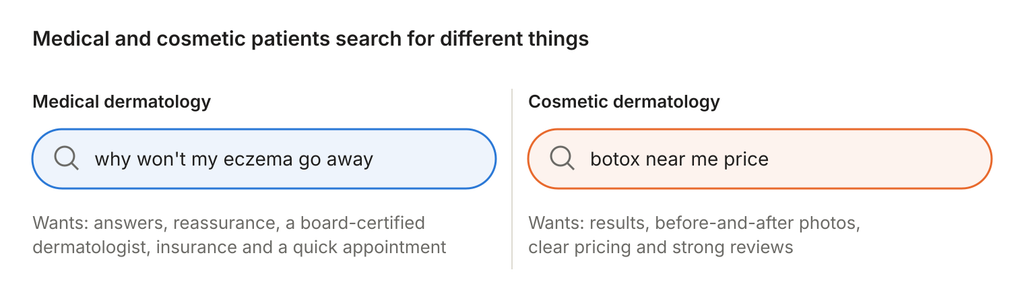
Dermatology serves two audiences that search in very different ways. Your SEO strategy has to serve both.
Medical dermatology patients search with a health concern. They type a symptom or condition, often with some worry: “itchy red patches on elbows,” “is this mole cancer,” “psoriasis treatment options.” They want clear answers, reassurance and proof that a board-certified dermatologist can help. Insurance acceptance and appointment availability matter a lot to them.
Cosmetic dermatology patients search with a goal. They type a treatment or result: “Botox cost,” “best laser for sun spots,” “microneedling before and after.” They compare providers on results, price, reviews and convenience. Many are also looking at med spas, so your pages must show why a dermatologist-led practice is worth choosing.
Both groups move through three stages:
- Learning. They research a symptom or treatment. These searches often trigger AI Overviews, so your content needs to be clear enough to be cited.
- Comparing. They look for options near them: “dermatologist near me,” “best Mohs surgeon in [city].” The map pack, reviews and your service pages decide who makes the shortlist.
- Booking. They search your practice or provider by name, check reviews one last time, and call or book online. A slow site or a hard-to-find booking button loses them here.
A strong dermatology SEO strategy builds pages for every stage and links them together. A patient who lands on your eczema article should be one click from your eczema treatment page, and one more click from booking.
Keyword research for dermatology practices
Good dermatology SEO starts with a keyword map: a list of the searches you want to win, grouped by intent, with one page assigned to each group. Without it, practices end up with several pages competing for the same term, or with high-value services that have no page at all.
Start with what your practice actually does and wants more of. List every condition you treat and every procedure you offer. Then mark the ones with the highest value: Mohs surgery, skin cancer screenings, laser treatments, injectables, acne and psoriasis programs.
Next, group keywords into four buckets:
| Keyword type | Examples | Best page type |
|---|---|---|
| Condition | eczema treatment, rosacea dermatologist, hair loss in women | Condition page |
| Treatment or procedure | Mohs surgery, chemical peel, CoolSculpting, Botox | Treatment page |
| Local and provider | dermatologist near me, dermatologist in [city], Dr. [Name] | Location page, provider bio, Google Business Profile |
| Questions | is microneedling safe for dark skin, how long does a mole biopsy take | Blog post or FAQ section |
A few tips that make the map more useful:
- Use patient language, not only clinical terms. Patients search “brown spots on face” far more than “solar lentigines.” Put the patient phrase in the title and heading, and explain the clinical term in the body.
- Add modifiers that signal intent to book. “Cost,” “near me,” “best,” “reviews” and “before and after” usually mean the patient is close to a decision.
- Check what already ranks. Search each target term in an incognito window. If the top results are condition explainers from big health sites, a blog post may fit better than a service page. If the map pack and practice pages dominate, build a service page.
- Don’t ignore low-volume terms. A keyword with 50 searches a month can still be worth thousands of dollars if it’s “Mohs surgeon [city].”
Once the map is done, every page on your site should have one clear target, and every high-value keyword should have one clear page.
Local SEO and your Google Business Profile
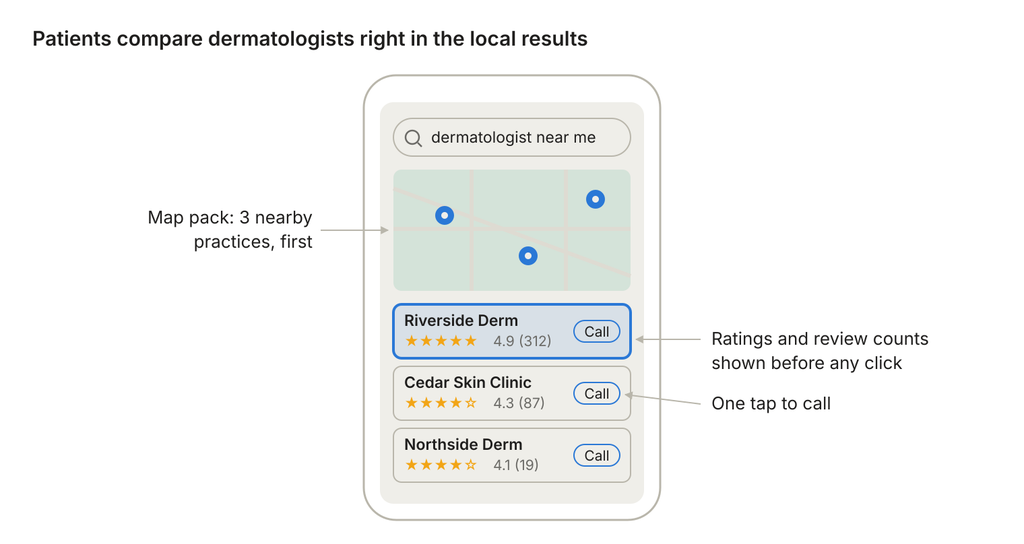
Most new dermatology patients come from local search. When someone types “dermatologist near me,” Google shows a map with three practices before any regular result. Getting into that map pack is the single biggest win for most practices.
Google ranks local results on three things: relevance (does your listing match the search), distance (how close you are) and prominence (how well known and trusted you are). You can’t move your office, but you can control relevance and prominence.
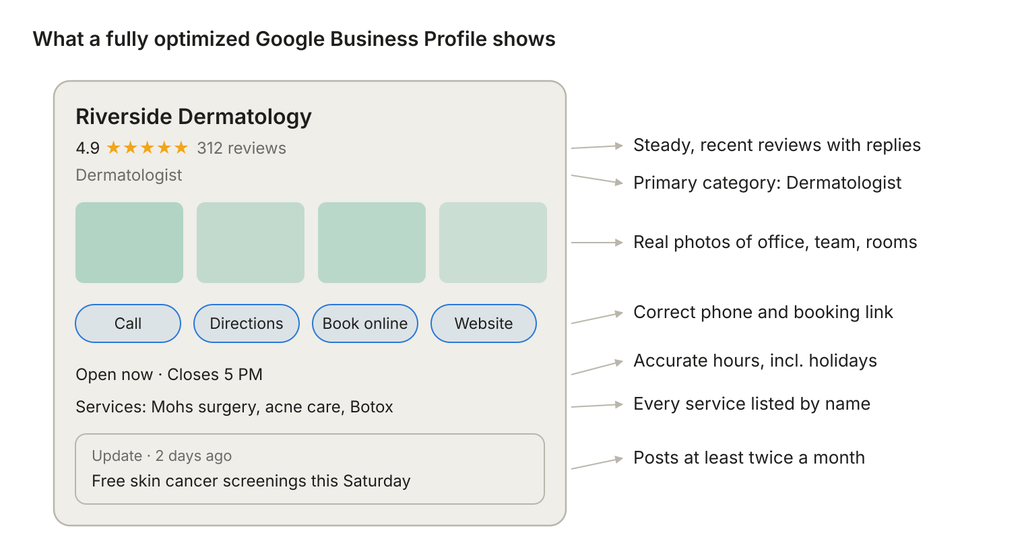
Optimize every Google Business Profile. Each office location needs its own verified profile. Then:
- Choose “Dermatologist” as your primary category. Add secondary categories that fit, such as “Skin care clinic” or “Medical spa” if you offer cosmetic services on site.
- List your services by name (Mohs surgery, acne treatment, Botox) with a short description of each.
- Add real photos often: the exterior so patients can find you, the waiting room, treatment rooms and your team. Skip stock photos.
- Keep hours, holiday hours, phone and booking link accurate. A wrong phone number costs appointments and trust.
- Post updates at least twice a month: new treatments, seasonal skin tips, provider news.
- Answer common questions in the Q&A section yourself before strangers do.
Consider individual provider profiles. Google allows profiles for individual practitioners in many cases. A well-reviewed provider profile can rank for searches on that provider’s name and specialty. Check Google’s current guidelines before creating them.
Keep your listings consistent. Your practice name, address and phone number (NAP) should match exactly across your website, Google, Apple Maps, Bing, Healthgrades, Zocdoc, Vitals, WebMD and insurance directories. Mismatches confuse both search engines and AI tools. A local SEO partner can audit and fix these in bulk.
Build a page for each location. If you have several offices, each one needs its own page with the address, a map, directions, parking notes, the providers who practice there, the services offered at that site and reviews from patients at that location. Avoid copying the same text across location pages with only the city swapped.
Growing beyond one city? Dermatology groups with many locations, or a telehealth service that reaches patients statewide, need a broader plan too. National SEO builds authority for your brand and core treatment pages, while each location page and profile wins its own local searches.
Condition and treatment pages that rank and convert
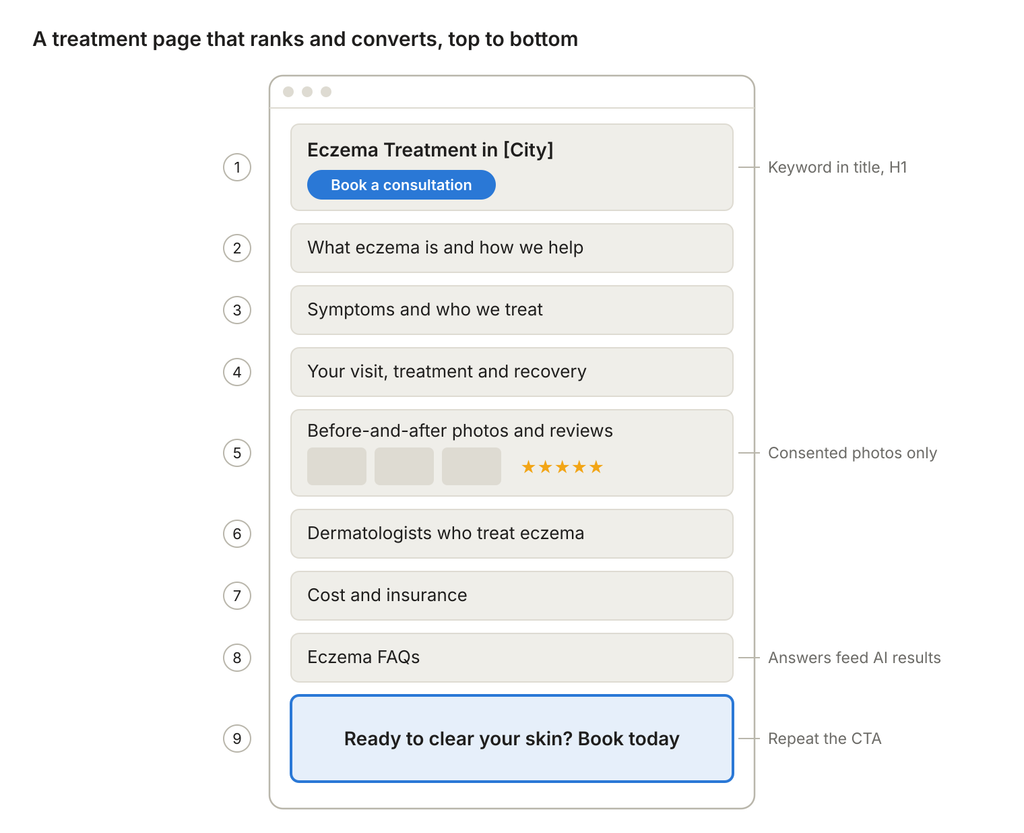
Your service pages do most of the heavy lifting in dermatology SEO. One page that lists 30 services in a few lines each can’t rank for any of them. Give each high-value condition and treatment its own page.
A strong dermatology service page includes:
- A clear, keyword-led title and H1. For example: “Eczema Treatment in Austin | Board-Certified Dermatologists.”
- A plain-language opening. In two or three sentences, say what the condition or treatment is, who it’s for and how your practice helps.
- Symptoms or candidacy. For conditions, describe the signs patients notice. For treatments, describe who is a good candidate and who isn’t.
- Treatment options and what to expect. Walk through the visit, the procedure, recovery time and number of sessions. Patients want to picture the experience before booking.
- Proof. Add consented before-and-after photos where appropriate, short patient reviews about that service, and the providers who perform it.
- Costs and insurance. Even a range or a note on what insurance usually covers reduces friction. Cosmetic patients especially look for price guidance.
- An FAQ section. Answer the five to eight questions patients actually ask about that service. These answers also feed AI Overviews and voice search.
- A clear call to action. Put a “Book a consultation” button near the top, in the middle and at the end. Make the phone number tappable on mobile.
Link pages together on purpose. Each condition page should link to the treatments for it, and each treatment page should link back to the conditions it treats. Link both to the providers who perform them. This helps Google understand your expertise and helps patients find the next step.
Write unique copy. Don’t paste manufacturer descriptions for lasers or injectables. Google tends to skip duplicate text, and patients can tell it wasn’t written by your team.
Our on-page SEO team builds and optimizes pages like these. If your current site makes them hard to add, it may be time for a website redesign.
E-E-A-T: why trust signals decide dermatology rankings
Google holds health content to a higher standard than most topics. Its search quality guidelines call these “Your Money or Your Life” (YMYL) topics, because bad information can hurt people. For YMYL pages, Google looks hard at E-E-A-T: experience, expertise, authoritativeness and trust.
For a dermatology practice, E-E-A-T is not abstract. It comes down to showing who wrote or reviewed each page, and why they’re qualified.
Build detailed provider bio pages. Each dermatologist, PA and nurse practitioner should have a page with:
- Full name, credentials and a professional photo
- Board certification (for example, American Board of Dermatology) and fellowships, such as Mohs surgery
- Medical school, residency and years in practice
- Areas of focus, languages spoken and offices where they see patients
- Publications, speaking, media mentions and professional memberships, such as the American Academy of Dermatology
- Reviews that mention them by name, and a link to book with them
Add bylines and medical review notes. Every condition page and blog post should show the author and a line such as “Medically reviewed by Dr. Jane Smith, MD, FAAD,” with the review date. Link the name to that provider’s bio.
Cite good sources. When you share statistics or treatment guidance, link to the American Academy of Dermatology, peer-reviewed studies or government health sites. It shows readers and search engines that your content is grounded.
Keep content current. Treatment options change. Review your top pages at least once a year and update the “last reviewed” date when you do.
Show your trust details. Your website should make it easy to find your address, phone number, insurance accepted, privacy policy and accessibility statement. Follow current web accessibility guidelines so every patient can use your site.
Technical SEO: speed, mobile and schema
Great content won’t rank if Google can’t crawl it or patients leave before it loads. Technical SEO is the foundation under everything else.
Speed. Dermatology sites are image-heavy, which makes them slow. Compress images, serve them in modern formats like WebP, lazy-load galleries and limit third-party scripts such as chat widgets. Aim to pass Google’s Core Web Vitals on mobile, which you can check free in Google Search Console and PageSpeed Insights.
Mobile first. Most patients search on their phones. Test every key page on a real phone. Buttons should be easy to tap, text readable without zooming, and the phone number and booking button always within reach.
Secure and accessible. Use HTTPS on every page. Forms that collect health details should use a HIPAA-compliant provider. Follow accessibility basics: alt text on images, enough color contrast, and forms that work with a screen reader.
Clean structure. Use a simple URL pattern such as /conditions/eczema/ and /treatments/mohs-surgery/. Keep important pages within three clicks of the homepage. Submit an XML sitemap and fix broken links and redirect chains.
Schema markup. Structured data tells search engines and AI tools exactly what each page is about. Useful types for dermatology include:
| Schema type | Use it on |
|---|---|
| MedicalClinic or Dermatology (a MedicalBusiness subtype) | Homepage and location pages |
| Physician | Provider bio pages |
| MedicalCondition | Condition pages |
| MedicalProcedure | Treatment pages |
| FAQPage | FAQ sections |
| Review and AggregateRating | Testimonials you host on your own site, following Google’s rules |
Validate your markup with Google’s Rich Results Test and the Schema.org validator after every change.
Content strategy: build topic clusters, not random posts
A dermatology blog works when every post has a job: answer a real patient question, then guide that reader to the service page where they can book. Posts written only to “publish something this month” rarely rank or convert.
The best structure is a topic cluster. Pick a high-value service, such as acne treatment. That service page is the hub. Around it, write several articles that answer the questions patients ask before booking. Each article links to the hub, and the hub links back to each article.
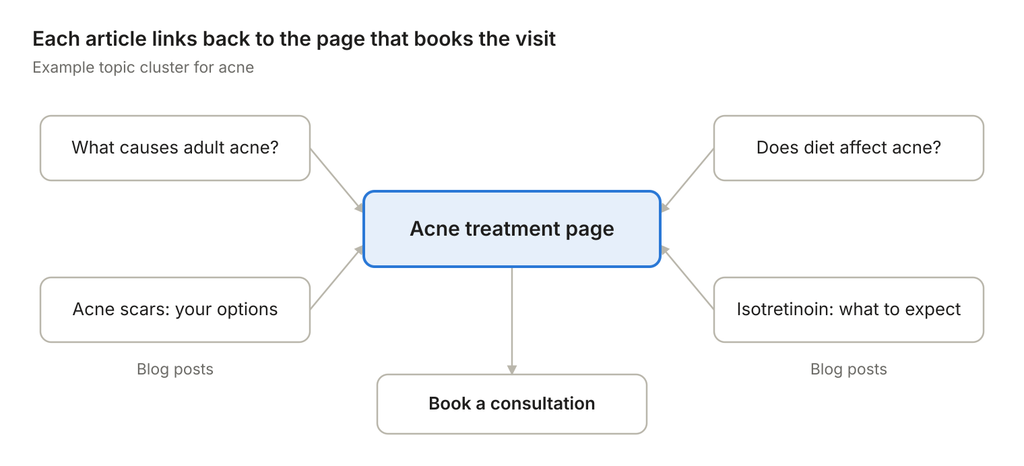
In this cluster, someone reading about acne scars sees a clear path to the acne treatment page, and from there to booking. Google also sees that your site covers acne in depth, which helps every page in the cluster rank.
To find topics for each cluster:
- Ask your front desk and providers which questions patients ask most often.
- Look at Google’s “People also ask” box and related searches for each service.
- Check Search Console for questions your site already shows up for but doesn’t answer well.
- Cover seasonal topics ahead of time: sunscreen and skin checks in spring, eczema and dry skin in fall.
Mix formats. Dermatology is visual, so short videos explaining a treatment, provider Q&A clips and step-by-step skincare routines perform well. Embed videos on the matching page and share them on your social channels. Our social media marketing services can help you produce and promote them.
Publish steadily. Two strong, reviewed articles a month beat eight thin ones. Our SEO services include content planning and writing for medical practices.
Reviews and online reputation
Reviews are both a local ranking factor and the main reason a patient picks one dermatologist over another. And patients’ standards are rising fast.
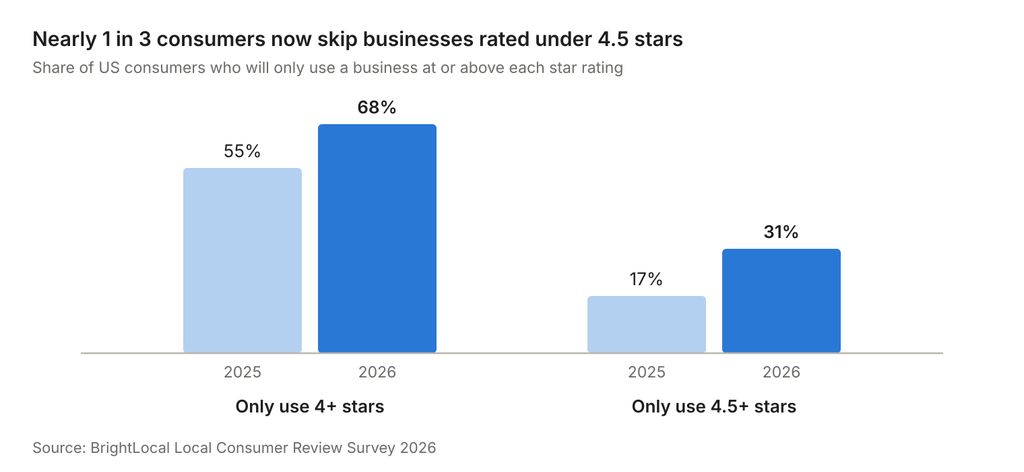
In BrightLocal’s Local Consumer Review Survey 2026, 97% of consumers said they read reviews for local businesses, and 41% said they always do, up from 29% a year earlier. The bar for star ratings also jumped:
The same survey found that patients care about more than the average rating:
- Volume: 47% of consumers won’t use a business with fewer than 20 reviews.
- Recency: 74% only care about reviews from the last three months.
- Responses: 89% expect owners to respond to reviews, and 50% are put off by generic, copy-paste replies.
- More platforms: the average consumer uses six review sites, and Healthgrades is one of the sites gaining use. AI tools like ChatGPT rose to third place as a source of local recommendations.
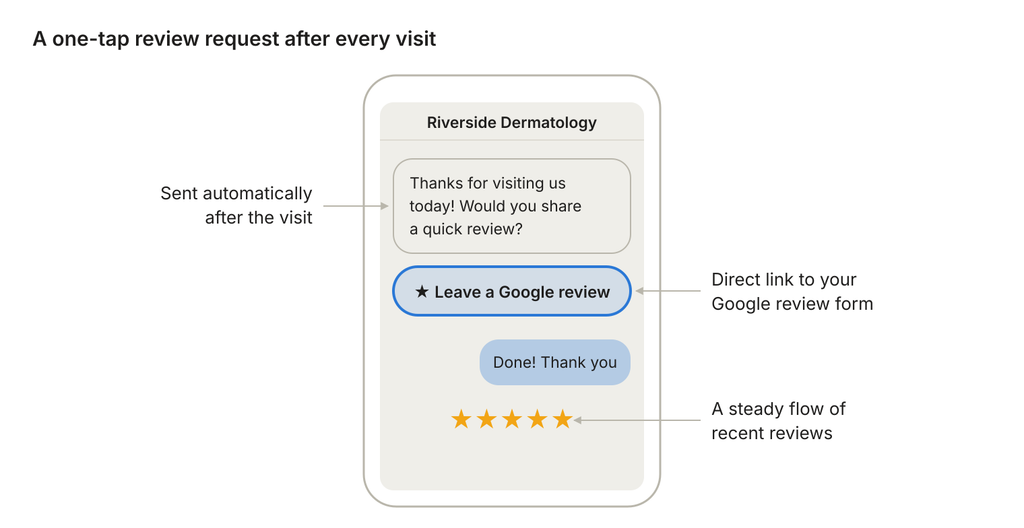
Make asking for reviews a habit. Send a short text or email after each visit with a direct link to your Google profile. Rotate in Healthgrades, Zocdoc and other sites your patients use. Train staff to mention it at checkout, and put a QR code at the front desk.
Respond carefully, with HIPAA in mind. Thank every reviewer, but never confirm that someone is a patient or mention their care. A safe reply to a negative review thanks them, says you take feedback seriously, and invites them to call the office manager directly.
Follow the rules. Never buy reviews, write fake ones or offer rewards in exchange for positive reviews. The FTC’s rule on fake reviews allows fines for these practices, and Google and Yelp ban incentives.
A reputation management tool can automate requests, alert you to new reviews and help you reply quickly.
Link building for dermatologists
Links from other trusted websites still tell Google that your practice is a real, respected authority. For dermatology, a handful of relevant local and medical links is worth far more than hundreds of random ones.
Good link sources for a dermatology practice include:
- Medical directories and associations. Make sure every provider is listed in the American Academy of Dermatology’s “Find a Dermatologist” directory, your state dermatology society, hospital affiliations and insurance directories.
- Local news and media. Offer your dermatologists as sources for stories on skin cancer awareness month, summer sun safety and winter skin care. Local TV and newspapers often link to the practice website.
- Community involvement. Free skin cancer screenings, school sun-safety talks, sponsorships of local races and partnerships with gyms or pools often earn links from event pages and partner sites.
- Universities and residency programs. If your providers teach, precept or publish research, ask the institution to link to their bio.
- Useful resources others want to cite. A clear guide such as “How to do a skin self-exam” with a printable body map can earn links from schools, gyms and health blogs.
Avoid paid link schemes, private blog networks and low-quality directories. They can trigger penalties and they don’t build the trust that health searches need. Our link building team handles safe, relevant outreach for practices that want help.
AI search and AI Overviews
AI is now part of how patients research skin concerns. A KFF poll fielded in early 2026 found that 32% of US adults used an AI chatbot for health information in the past year. And in BrightLocal’s 2026 survey, 45% of consumers said they used ChatGPT or other AI tools for local business recommendations, up from 6% a year earlier.
On Google, AI Overviews appear most often on question-style searches. Seer Interactive’s April 2026 study found they showed up on 85.9% of question-format queries, but only 5% of transactional queries. In practice, “what causes perioral dermatitis” will likely show an AI answer. “Book dermatologist [city]” mostly won’t.
That doesn’t make educational content pointless. What matters is whether your page is cited in the AI answer:
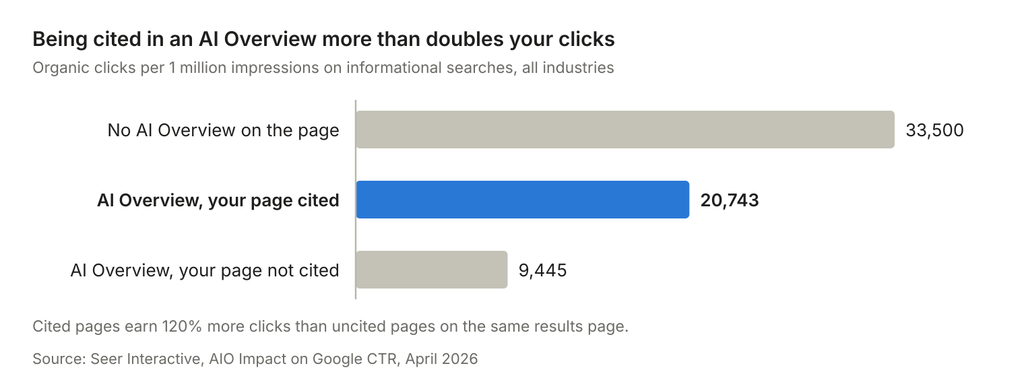
The good news for medical practices is that, in healthcare, AI tools lean on pages that already rank well. So everything earlier in this guide also improves your AI visibility. A few extra steps help:
- Answer questions directly. Start each FAQ answer and blog section with a one- or two-sentence answer, then add detail. AI tools quote clear, self-contained answers.
- Use structured data. Physician, MedicalCondition, MedicalProcedure and FAQPage schema help AI systems understand who you are and what you treat.
- Make credentials obvious. Bylines, medical review notes and detailed bios signal that a qualified dermatologist stands behind the content.
- Keep facts consistent everywhere. AI tools pull from your website, Google profile, directories and review sites. Conflicting hours, addresses or service lists make them less likely to recommend you.
- Check what AI says about you. Ask ChatGPT, Gemini, Perplexity and Google’s AI Mode questions like “best dermatologist for acne in [city].” Note who’s recommended and which sources they cite.
To get your practice cited and recommended by AI tools, see our AI SEO services.
Measuring dermatology SEO ROI
Rankings are a means, not the goal. The goal is booked appointments for the services you want to grow. Track SEO the same way you’d track any other investment.
| What to track | Where to find it | Why it matters |
|---|---|---|
| Map pack rankings by service and area | A local rank grid tool | Shows visibility where patients actually search |
| Organic traffic to service and condition pages | Google Analytics 4 | Shows whether the right pages are gaining visitors |
| Search impressions and clicks | Google Search Console | Separates more visibility from more clicks, which matters as AI answers grow |
| Calls, form fills and online bookings | Call tracking, GA4 conversions, booking software | The real measure of new patient demand |
| Google Business Profile actions | GBP Performance report | Calls, direction requests and website clicks from your listing |
| New patients by source and service | Practice management system | Ties SEO to revenue |
| AI visibility | Manual checks or an AI visibility tool | Shows whether AI tools mention and cite you |
A few practical tips:
- Use call tracking numbers on your website and Google profile, but keep your main number as the primary listing to protect NAP consistency.
- Ask every new patient how they found you, and record it in your practice software.
- Report by service line. Ten new Mohs consultations are worth more than 100 visits to a general blog post.
- Be patient. Local SEO changes can show results within weeks. New content and links usually take three to six months, and competitive cosmetic terms can take longer.
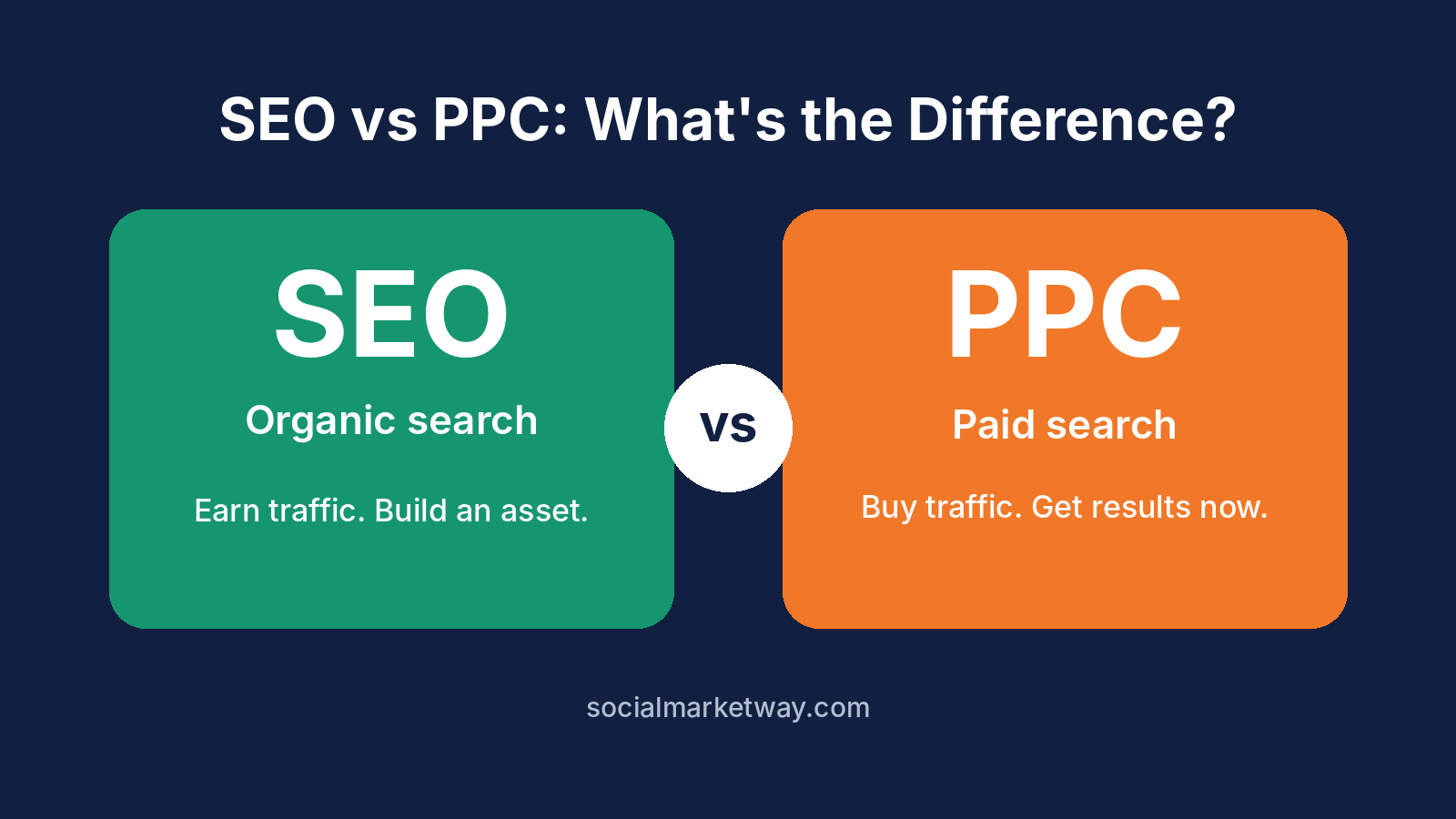
SEO also works best alongside other channels. Paid search can fill the gap while organic rankings grow, and its data shows which keywords convert.
9 dermatology SEO mistakes to avoid
- One page for all services. A single “Services” page can’t rank for Mohs surgery, acne and Botox at once.
- Copying text across location pages. Swapping only the city name creates thin, duplicate pages.
- No author or medical reviewer. Unsigned health content struggles to earn trust from Google, AI tools and patients.
- Stock photos everywhere. Patients want to see your real office and providers.
- Ignoring reviews after the first push. Recency matters. A burst of reviews two years ago won’t help much today.
- Responding to reviews in ways that break HIPAA. Never confirm someone is a patient or discuss their care.
- Slow, image-heavy pages. Large before-and-after galleries without compression drive mobile visitors away.
- Blogging without a plan. Posts that don’t link to a service page rarely lead to bookings.
- Measuring traffic instead of patients. Track calls, bookings and new patients by service, not just visits.
Dermatology SEO FAQ
What is dermatology SEO? Dermatology SEO is the process of improving a dermatology practice’s visibility in Google search, Google Maps and AI answers. It covers local SEO, service and condition pages, technical fixes, content, reviews and links, with the goal of turning searches into booked appointments.
How long does dermatology SEO take to work? Google Business Profile and local fixes can improve visibility within a few weeks. New pages, content and links usually show meaningful results in three to six months. Competitive cosmetic keywords in large cities can take longer.
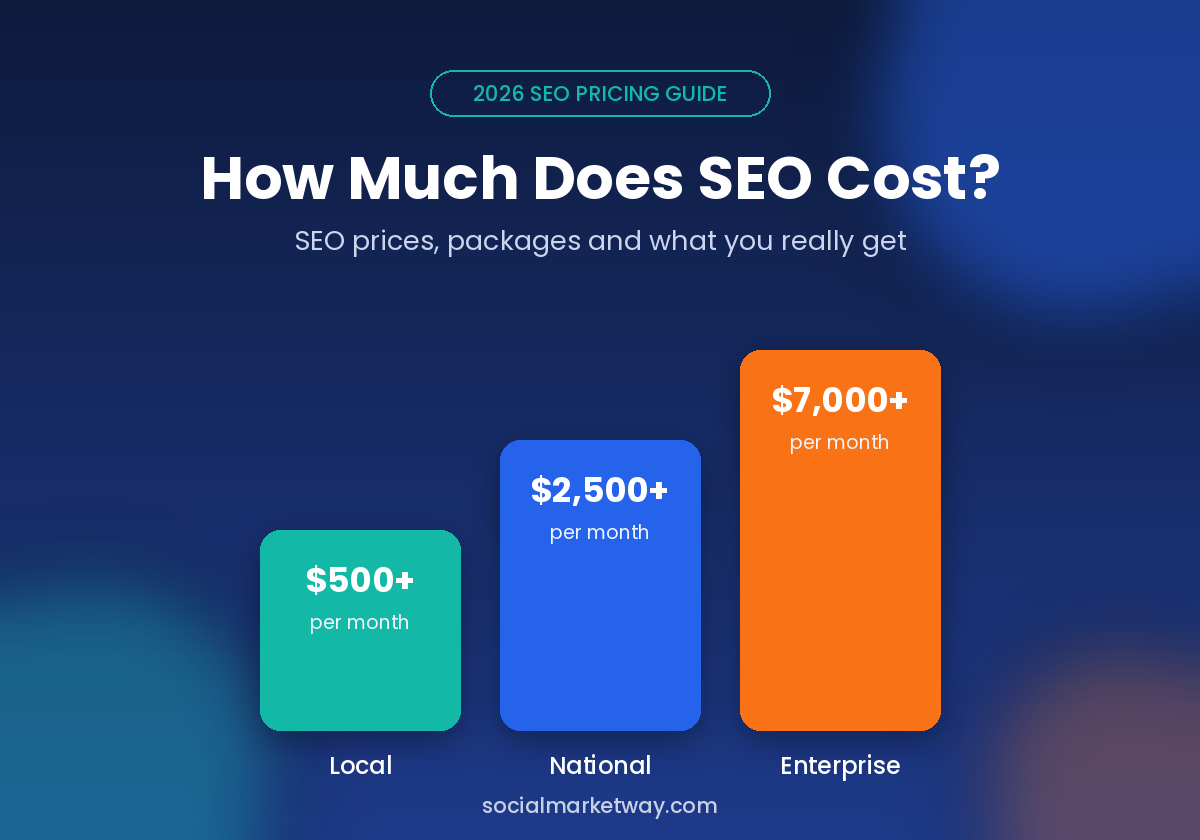
How much does dermatology SEO cost? Costs depend on your market, number of locations and how much content you need. Many practices invest a monthly retainer with an agency. Judge the cost by the new patients and revenue it brings in, not the price alone. For typical price ranges and what each tier includes, see how much SEO costs.
Is dermatology search engine optimization different from general SEO? Yes. Health content is held to higher standards for accuracy and expertise, so provider credentials and medical review matter more. Dermatology also mixes medical and cosmetic patients, who search and decide differently, and review responses must follow HIPAA.
Should medical and cosmetic dermatology have separate pages? Yes. Give each condition and each cosmetic treatment its own page. You can also group them into separate medical and cosmetic sections of your site so each audience finds what it needs quickly.
Can I do dermatology SEO myself? You can handle the basics: complete your Google Business Profile, ask for reviews and keep listings accurate. Technical SEO, schema, content at scale and link outreach usually need specialist time.
Do before-and-after photos help SEO? They help patients decide, which improves conversions. Use only photos with written patient consent, compress them for speed, and add descriptive alt text.
Get found, get chosen, get booked
Dermatology SEO is no longer just about ranking a homepage. Patients now check maps, reviews, AI answers and your website before they call. The practices that win show up at every step with clear, expert-reviewed pages for each condition and treatment, a strong Google profile, fresh reviews and a fast site that makes booking easy.
Start with the highest-impact work: your Google Business Profile, dedicated pages for your top three services, and a steady review process. Then build out topic clusters, strengthen provider bios and measure results by new patients, not traffic.
Want a team to handle it? Our healthcare SEO specialists build search programs for medical and cosmetic dermatology practices. Compare our SEO packages to find the right fit, or contact us for a free review of where you rank today.