

SEO for Plastic Surgeons: The Complete Guide to Ranking in Google, Maps, and AI Search

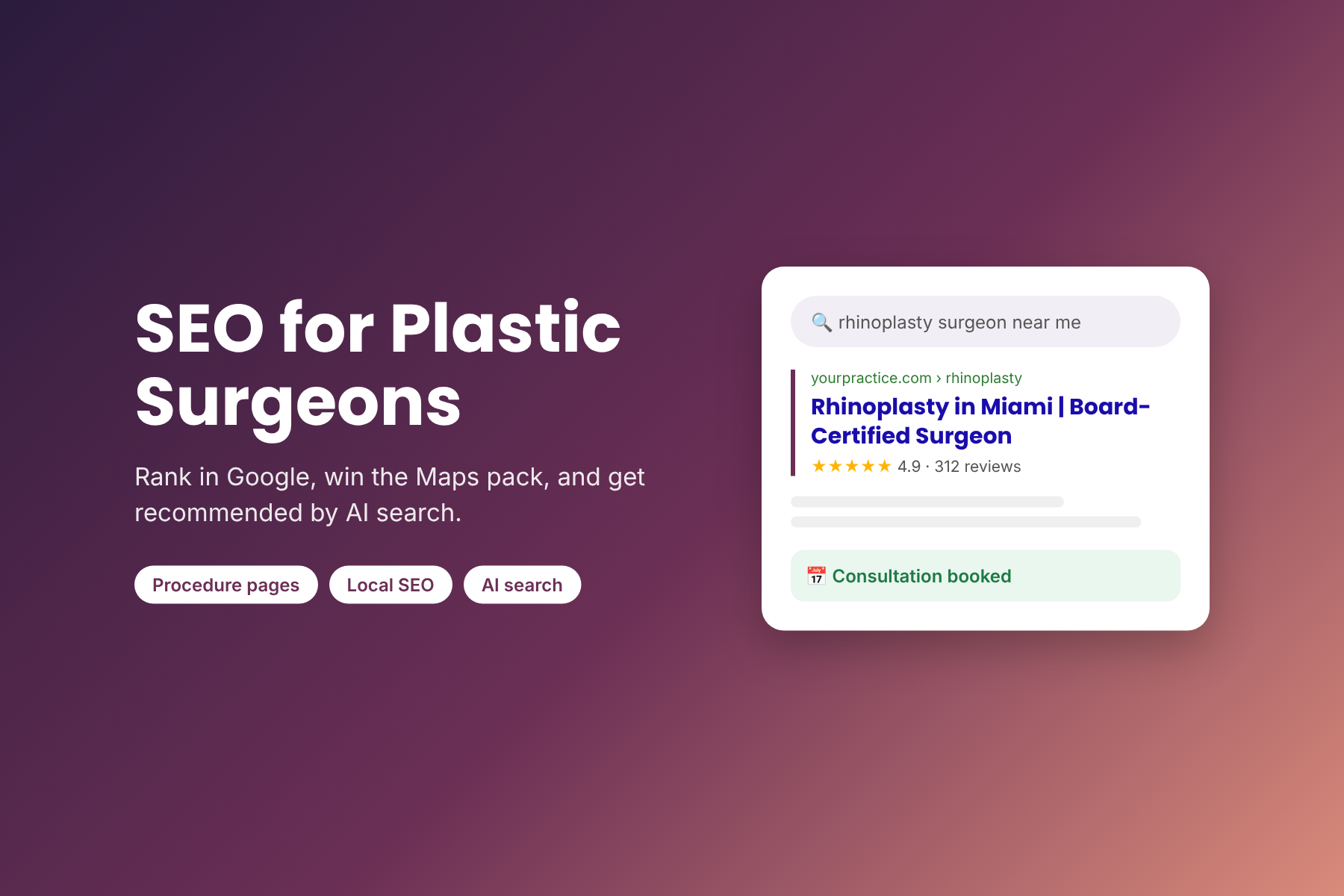
SEO for plastic surgeons is the work of getting a cosmetic or reconstructive practice found on Google, Google Maps, and AI assistants at the exact moment a patient is researching a procedure. Done well, it turns those searches into booked consultations, not just website visits.
Aesthetic surgery is one of the most competitive local markets online. Patients often spend weeks comparing surgeons, studying before-and-after galleries, and reading reviews before they ever pick up the phone. If your practice is not visible during that research window, the consultation goes to the surgeon who is.
This guide walks through how plastic surgeon SEO actually works in 2026: the keywords that matter, how to build procedure pages that rank, how to win the local map pack, how to get cited by ChatGPT and Google AI Overviews, what it costs, and how to judge an agency before you sign.
Who This Guide Is For
- Practice owners and board-certified surgeons who want more qualified consultation requests from search
- Marketing directors at medspas and multi-location cosmetic surgery groups
- Practice managers comparing in-house marketing with outside SEO services for plastic surgeons
- Anyone paying for SEO today who is not seeing new patient inquiries grow
If you have ever wondered why a competitor with fewer years in practice outranks you for “breast augmentation near me,” the answer is almost always in the sections below.
What Is SEO for Plastic Surgeons?
SEO plastic surgery work is the process of optimizing a practice’s website, Google Business Profile, reviews, and wider web presence so it ranks for procedure and location searches. It covers four connected layers: the pages on your site, your authority across the web, your local map presence, and your visibility inside AI-generated answers.
A complete program usually includes:
- Procedure page optimization for rhinoplasty, facelift, breast augmentation, tummy tuck, BBL, liposuction, and non-surgical treatments
- Local SEO and Google Business Profile management for every office location
- Technical SEO: page speed, mobile experience, crawlability, and schema markup
- Content that educates patients and demonstrates surgeon expertise
- Review generation and reputation management
- Authority building through links, PR, and directory citations
- AI search optimization so assistants recommend your practice by name
Why Plastic Surgeon SEO Is Different From General Medical SEO
Cosmetic surgery is an elective, high-ticket, emotionally driven purchase. That changes how patients search and what Google rewards. A patient looking for urgent care wants the closest open clinic. A patient considering a facelift wants proof that a specific surgeon is safe, skilled, and produces results they like.
That difference shows up in four ways:
- Longer research cycles. Patients compare multiple surgeons over weeks or months, so you need content for every stage, from “is a mini facelift worth it” to “best facelift surgeon in Miami.”
- Higher trust thresholds. Google treats cosmetic procedures as “Your Money or Your Life” topics. Board certifications, surgeon credentials, and real patient outcomes carry real ranking weight.
- Visual decision-making. Before-and-after galleries are often the most visited pages on a surgical site, and they need to be optimized like any other ranking asset.
- Brutal local competition. In most metros, dozens of surgeons, medspas, and dermatology groups compete for the same handful of map pack spots.
Generic healthcare marketing templates miss these nuances. Effective surgeon SEO is built around the way aesthetic patients actually decide.
Keyword Strategy: Targeting Patients Who Are Ready to Book
The best plastic surgeons SEO campaigns chase consultations, not raw traffic. Ranking for “what is a tummy tuck” can bring thousands of visitors, but ranking for “tummy tuck surgeon in Dallas” brings people with a budget and a timeline.
Group your keywords into three intent tiers:
| Intent tier | Example searches | Where it should rank |
|---|---|---|
| Ready to book | rhinoplasty surgeon Miami, plastic surgeon near me, mommy makeover cost Houston | Procedure + location pages, Google Business Profile |
| Comparing options | facelift vs mini facelift, best breast implant type, BBL recovery timeline | Procedure pages, in-depth blog guides |
| Early research | what is lipo 360, how long do fillers last | Educational blog content, FAQ sections |
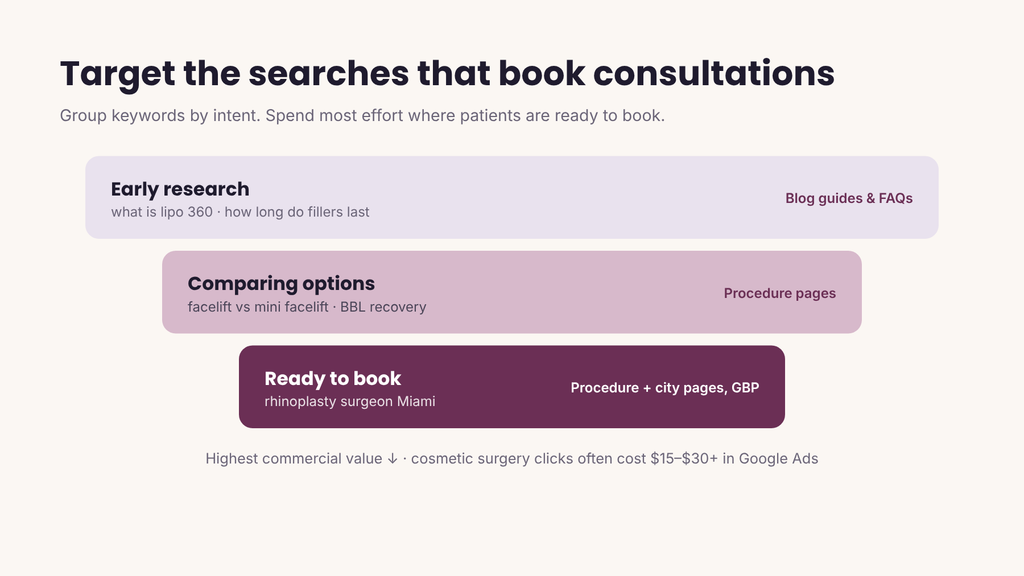
The ready-to-book tier deserves most of your budget, because those searches have the highest commercial value. You can see this in paid search data. In Google Ads, cosmetic surgery terms regularly cost $15 to $30 or more per click, which tells you exactly how much an organic ranking on the same term is worth every month.
A few practical rules for keyword selection:
- Map one primary keyword to one page. Two pages chasing “breast augmentation Austin” will cannibalize each other.
- Include neighborhoods and nearby suburbs, not just the main city name.
- Track procedure-level demand. Seasonal swings are real: body contouring searches spike in late winter and spring, while facial procedures rise ahead of the holidays.
- Mine your own consultation calls and contact forms for the exact language patients use.
The same discipline applies to SEO for cosmetic surgeons who focus on non-surgical treatments. Injectables, laser resurfacing, and body sculpting have their own keyword sets and should not be buried on a single “services” page.
On-Page SEO: Building Procedure Pages That Rank and Convert
Procedure pages are the highest-value pages on any plastic surgery website. A strong rhinoplasty page can rank for hundreds of related searches and generate a steady flow of consultations for years.
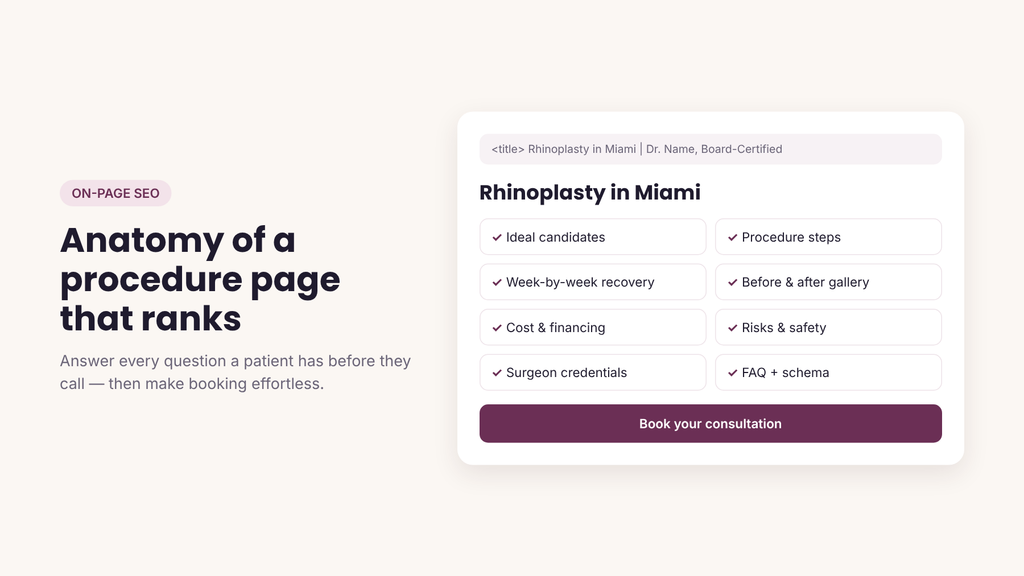
A high-performing procedure page answers every question a patient has before they call:
- Who is a good candidate, and who is not
- What the procedure involves and how long surgery takes
- Recovery timeline, week by week
- Realistic results, with a linked before-and-after gallery
- Cost range and financing options
- Risks, and how the surgeon minimizes them
- Why this surgeon: credentials, experience, and philosophy
- A clear call to action to book a consultation
On-page technical details matter just as much as the copy. Every page needs a unique title tag with the procedure and city, a compelling meta description, one clear H1, descriptive image alt text, and internal links to related procedures and the gallery. Professional on-page SEO services handle these elements systematically across every procedure, so nothing is left to chance.
Optimize Your Before-and-After Gallery
Galleries are often the most visited section of a surgical site, yet many are invisible to Google. Each case should have its own crawlable page or section with a short text description: the procedure, the patient’s goals, and the outcome. Compress images, use descriptive file names like rhinoplasty-before-after-miami-case-12.jpg, and write alt text a screen reader would find useful.
Show Real Expertise (E-E-A-T)
Google’s quality guidelines put heavy weight on Experience, Expertise, Authoritativeness, and Trustworthiness for medical topics. Strengthen these signals with detailed surgeon bios, board certification badges, hospital affiliations, published research, and a “medically reviewed by” byline on every educational article. Patients look for the same proof, so this work improves conversions and rankings at the same time.
Local SEO for Plastic Surgeons: Winning the Map Pack
Most aesthetic patients search with local intent, whether they type “plastic surgeon near me” or “liposuction in Scottsdale.” Google answers those searches with the local map pack, the three business listings shown above the regular results. Those three spots collect a large share of clicks, calls, and direction requests.
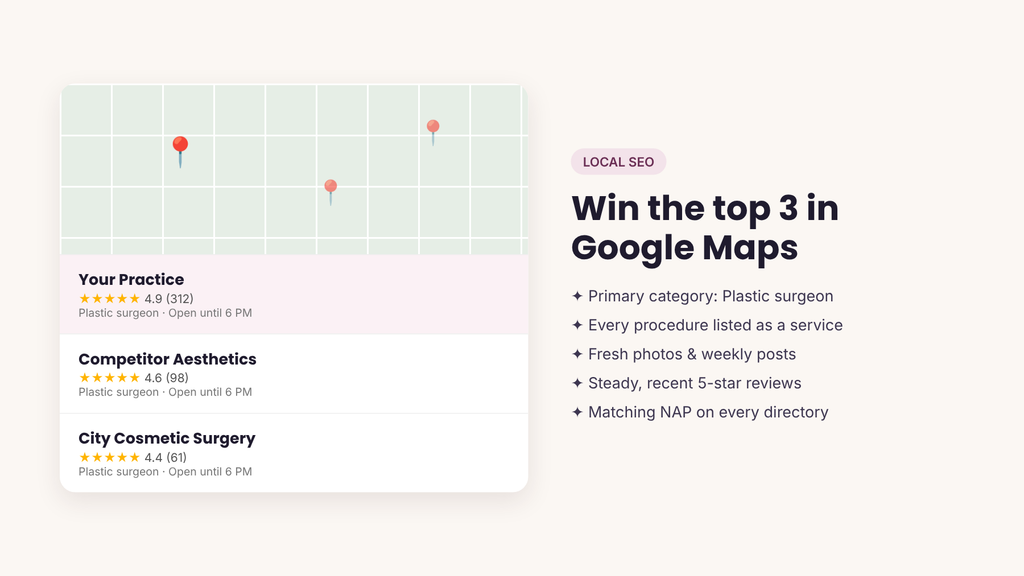
Local SEO for plastic surgeons focuses on the signals Google uses to rank that pack: relevance, distance, and prominence. You cannot move your office closer to every patient, but you can control relevance and prominence. A dedicated local SEO strategy builds those signals across your profile, your website, and the wider web.
Optimize Your Google Business Profile
Your Google Business Profile is often the first impression a patient has of your practice. Treat it like a second homepage:
- Choose “Plastic surgeon” as the primary category and add relevant secondary categories such as “Cosmetic surgeon” or “Medical spa”
- Add every procedure as a service, with a short description
- Upload fresh, high-quality photos of the office, the team, and the surgeon each month
- Publish Google posts about new treatments, events, and seasonal offers
- Answer common questions in the Q&A section before patients ask them
- Keep hours, phone number, and booking links accurate
For a deeper walkthrough of every setting, read our Google Business Profile SEO guide to ranking in Google Maps and the local pack.
Build Location Pages and Consistent Citations
Each office needs its own location page with the full address, embedded map, directions, parking details, local staff, and procedures offered there. Your name, address, and phone number must match exactly across Google, Apple Maps, Bing, Yelp, Healthgrades, RealSelf, and other medical directories. Inconsistent listings confuse Google and quietly weaken rankings.
Make Reviews a System, Not an Accident
Review count, rating, recency, and the words patients use all influence local rankings. Build a HIPAA-conscious process that asks every happy patient for a review at the right moment, typically at a follow-up visit once results are visible. Respond to every review professionally without confirming that the reviewer is a patient or sharing any treatment details.
Off-Page SEO: Building Authority Google Trusts
In competitive metros, great pages alone rarely reach the top three. Google also measures how much the rest of the web vouches for your practice. That trust comes mostly from links, mentions, and citations on other reputable sites.
The right links for a surgical practice are earned, relevant, and local. Think features in regional lifestyle magazines, expert quotes in health publications, profiles on medical association sites, and sponsorships of community events. Our off-page SEO services focus on exactly these kinds of placements rather than bulk links that can trigger penalties.
High-impact off-page tactics for plastic surgeons include:
- Digital PR: offering the surgeon as an expert source on trends like “Ozempic face” or non-surgical alternatives
- Medical directory profiles on RealSelf, Healthgrades, Vitals, and specialty society listings
- Local partnerships with medspas, dermatologists, fitness studios, and bridal businesses
- Guest articles and podcast appearances that showcase surgical expertise
- Unlinked mention reclaiming, where existing press coverage is updated to include a link
Avoid shortcuts. Purchased link packages, private blog networks, and spammy directories can do lasting damage to a medical site. One manual penalty can erase years of progress, so every link should be one you would be proud to show a patient.
AI Search: Getting Recommended by ChatGPT, Gemini, and Google AI Overviews
Patients now ask AI assistants questions like “Who is the best rhinoplasty surgeon in Chicago?” or “How much does a mommy makeover cost in Atlanta?” These tools answer with a short list of names and sources. If your practice is not one of them, you are invisible to a fast-growing group of high-intent patients.
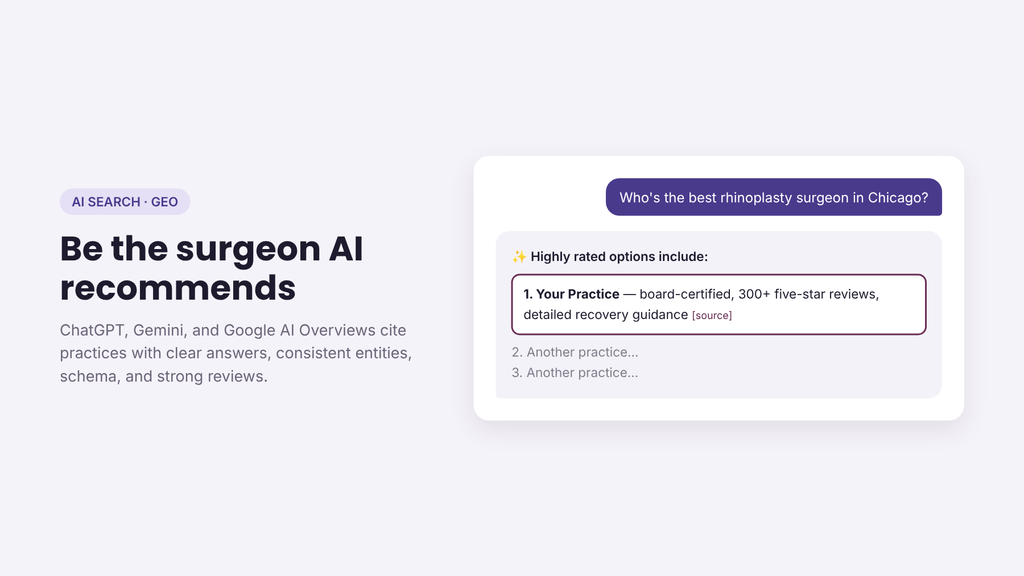
Generative engine optimization (GEO) is the practice of shaping your content and reputation so AI systems understand, trust, and cite you. Our AI SEO services are built around how these models pick their sources.
What helps a practice get cited:
- Clear, direct answers. Open each procedure page and FAQ with a 40 to 60 word summary that answers the question plainly.
- Entity clarity. Use consistent names for the practice, surgeons, procedures, and locations everywhere online.
- Structured data. Add schema for MedicalBusiness, Physician, MedicalProcedure, FAQ, and Review.
- Third-party validation. AI tools lean on reviews, directories, and press mentions, so off-page work feeds AI visibility too.
- Original, expert content. Surgeon-written insights, real cost data, and clear recovery timelines are more citation-worthy than generic copy.
Traditional SEO and GEO now reinforce each other. The same trust signals that lift your Google rankings also make AI systems more confident recommending you.
Technical SEO: The Foundation Under Everything Else
A beautiful website that loads slowly or blocks Google’s crawlers will never rank well. Plastic surgery sites are especially prone to technical problems because they carry heavy image galleries, video, chat widgets, and booking plugins.
Use this technical checklist:
- Pages load in under 2.5 seconds on mobile and pass Core Web Vitals
- Gallery images are compressed and served in modern formats like WebP
- The site is fully secure (HTTPS) and HIPAA-conscious forms are encrypted
- XML sitemap is submitted and free of broken or redirected URLs
- No duplicate procedure pages competing for the same keyword
- Schema markup is in place for the practice, physicians, procedures, and FAQs
- Internal links point from blog posts to the matching procedure pages
- Click-to-call buttons and booking forms work perfectly on mobile
Mobile performance deserves special attention. The majority of cosmetic surgery searches happen on phones, often late in the evening while a patient is browsing galleries. If a page jumps around while loading or the booking form is hard to tap, that patient goes back to the results and chooses another surgeon.
SEO and Google Ads: Better Together
SEO builds long-term, compounding visibility, but it takes months to mature. Paid search delivers consultations this week. The strongest practices run both and let each channel inform the other.
Paid campaigns are a fast testing lab. Within a few weeks you learn which procedures, offers, and ad messages produce the most booked consultations. Those insights guide which procedure pages to prioritize for organic growth. Expert Google Ads management also protects your budget from the wasted clicks that are common on expensive cosmetic surgery terms.
As your organic rankings climb, you can shift paid spend toward the terms where you do not yet rank, new locations, or seasonal promotions. Over time, the blended cost per consultation drops because more patients arrive through free organic listings.
How Much Does SEO for Plastic Surgeons Cost?
Pricing depends on your market, the number of locations and procedures, and how much ground you need to make up against competitors. These are typical monthly ranges in the US:
| Practice type | Typical monthly investment | What it usually covers |
|---|---|---|
| Single surgeon, smaller market | $1,500 – $3,500 | Local SEO, Google Business Profile, core procedure pages, reporting |
| Established practice, competitive metro | $3,500 – $7,500 | Full on-page and technical SEO, content, link building, review strategy |
| Multi-location group or aggressive growth | $7,500 – $15,000+ | Multi-location local SEO, digital PR, AI search optimization, CRO |
For a full breakdown of how agencies price their work, read how much SEO costs and how pricing packages work.
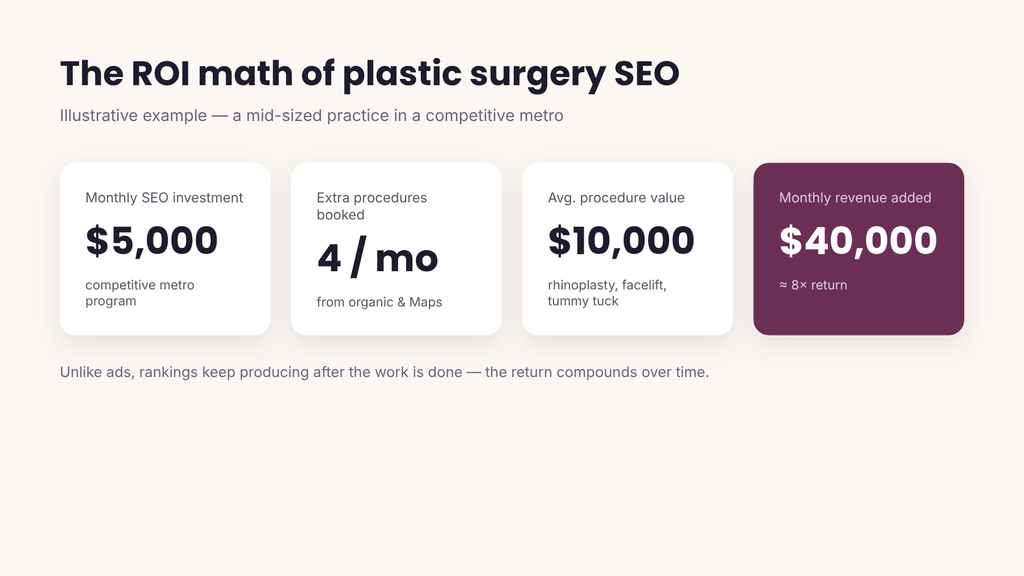
The ROI math is usually compelling. A single rhinoplasty, facelift, or mommy makeover can bring $8,000 to $20,000 or more in revenue. If SEO adds even three or four booked procedures per month, it covers its cost many times over, and unlike ads, those rankings keep producing after the work is done. You can compare options side by side on our SEO packages page.
How Long Does It Take?
Most practices see early movement in rankings and map visibility within three months. Meaningful growth in consultations typically appears between months four and nine. Highly competitive markets like Los Angeles, Miami, and New York can take longer. Be wary of anyone who promises page-one rankings in a few weeks.
How to Choose SEO Services for Plastic Surgeons
Ask every agency these questions before signing:
- Do you have experience with cosmetic surgery practices, and can you share examples?
- How will you track booked consultations, not just traffic and rankings?
- What is your link building approach, and can I see examples of links you earned?
- How do you handle HIPAA in reviews, forms, and tracking?
- Do you optimize for AI search as well as Google?
- Who will actually do the work, and how often will we meet?
- What is the contract length, and what happens to the content if we part ways?
A trustworthy partner will answer each one plainly and show you the reporting you will receive before you commit.
Common Plastic Surgery SEO Mistakes to Avoid
- One page for every procedure. A single “Services” page cannot rank for breast augmentation, facelift, and liposuction at once. Each procedure needs its own page.
- Thin or copied content. Manufacturer descriptions and recycled templates give Google no reason to rank you over the surgeon down the street.
- Neglecting the Google Business Profile. Wrong categories, old photos, and unanswered reviews quietly push you out of the map pack.
- Ignoring conversion tracking. Without call tracking and form attribution, you cannot tell which keywords produce patients.
- Unsafe review practices. Offering incentives for reviews or revealing patient details in replies can violate platform rules and privacy law.
- Hiring a generalist. Agencies that treat a cosmetic surgery practice like a plumbing company rarely understand trust signals, compliance, or the patient journey.
Frequently Asked Questions
What is SEO for plastic surgeons?
It is the process of improving a plastic surgery practice’s website, Google Business Profile, and online reputation so it ranks higher in Google search, Google Maps, and AI assistants for procedure and location searches. The goal is more qualified patients and more booked consultations.
Is SEO worth it for a plastic surgery practice?
For most practices, yes. Cosmetic procedures carry high revenue per patient, so even a few extra consultations per month can return several times the monthly investment. Organic rankings also keep delivering without a per-click cost.
How is SEO for cosmetic surgeons different from medspa SEO?
Surgical practices compete on credentials, safety, and surgical outcomes, and their procedures have longer research cycles. Medspas compete more on price, convenience, and promotions for non-surgical treatments. Many practices offer both and need distinct pages and keyword strategies for each.
Can I do plastic surgeon SEO myself?
You can handle basics like updating your Google Business Profile and requesting reviews. Technical fixes, content at scale, link building, and AI search optimization usually require specialist time and tools that most practices do not have in-house.
How do I know my SEO is working?
Track rankings for target procedure keywords, map pack visibility, organic traffic to procedure pages, phone calls, form submissions, and, most importantly, booked consultations. Your reporting should connect each of these to revenue.
Ready to Grow Your Practice With Search?
The practices that win in search treat it as a long-term growth engine, not a one-time project. Start with an honest audit of your procedure pages, your Google Business Profile, and your visibility in AI answers. Then fix the highest-impact gaps first.
Social Marketway builds SEO programs for plastic surgeons that focus on one outcome: more booked consultations from patients who are ready to move forward. Contact our team for a free practice visibility audit and a 90-day plan built around your procedures and your market.