

Higher Education SEO: The Complete Strategy Guide to Grow University Enrollment

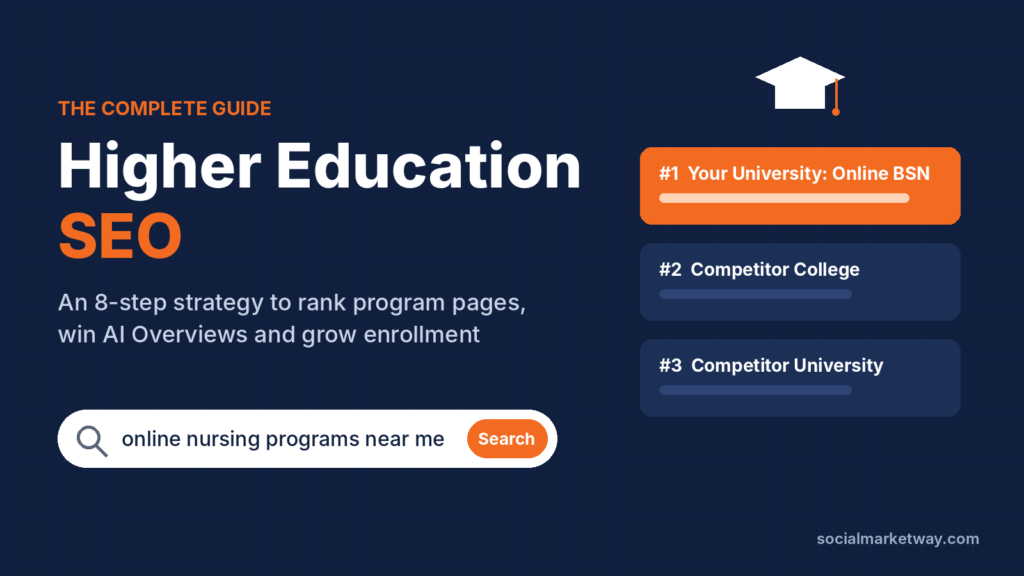
Higher education SEO is the work of getting a college or university’s program pages, admissions content and campus information to show up when prospective students search, and turning those searches into inquiries and applications. It is now the single most reliable way to reach students early in their decision.
Here is why that matters. In a 2026 survey of 1,057 prospective adult learners by UPCEA and Search Influence, 80% said search engines are where they start researching programs. Most of them also told researchers they seriously consider three or fewer programs before applying. If your school is not on page one, or in the AI summary above it, you are rarely on that short list.
This guide walks through what SEO in higher education actually involves, how it differs from paid search, and an 8-step SEO strategy for higher education that any admissions or marketing team can follow. It closes with a technical checklist and answers to the questions we hear most often from enrollment leaders.
Key takeaways
- Search is still the starting point for most prospective students, and AI Overviews now shape which schools make the short list.
- Program pages, not the homepage, are where higher ed SEO wins or loses enrollment.
- The best results come from combining keyword research by student intent, strong on-page work, technical health, local visibility and earned authority.
- SEO compounds over 6 to 12 months, which makes it one of the lowest cost-per-enrollment channels a school can build.
What Is SEO for Education?
SEO for education is the practice of improving a school’s website so it ranks higher in Google, Bing and AI search tools for the questions students and families ask. For colleges and universities, that means ranking for program searches (“online MBA programs”), career searches (“how to become a nurse practitioner”), cost searches (“cheapest accredited online degree”) and brand searches (“[your university] admissions deadline”).
It differs from SEO for a typical business in three ways:
- The buying cycle is long. A student may research for 6 to 18 months before applying, so content has to serve every stage, not just the final click.
- The website is huge. University sites often run to thousands of pages owned by dozens of departments, which creates duplicate content, broken links and competing pages.
- Trust signals carry extra weight. Google treats education content as high-stakes, so accreditation, faculty credentials, outcomes data and clear sourcing all influence rankings.
In practice, higher ed SEO works best as a structured search optimization program run like any other enrollment channel, with goals, owners and monthly reporting, rather than a one-off website cleanup.
What does an SEO specialist in higher education do?
An SEO specialist in higher education researches the terms prospective students use, rewrites and structures program pages to match them, fixes technical problems that stop pages from being indexed, earns links from credible sites, and reports how organic traffic turns into requests for information (RFIs), applications and enrolled students.
Why Higher Education SEO Matters More in 2026
Organic search is the largest traffic source for most university websites, and AI search has raised the stakes. The numbers below explain why enrollment teams are moving budget toward SEO.
| Finding | Figure | Source |
|---|---|---|
| Prospective students who start program research on a search engine | 80% | UPCEA and Search Influence, 2026 |
| Prospects who also use AI tools during their decision | 54% | UPCEA and Search Influence, 2026 |
| Programs most prospects seriously consider before applying | 3 or fewer | UPCEA and Search Influence, 2026 |
| Share of higher ed website traffic from organic search | 46% | The SEO Works, 2026 compilation |
| Universities without an established SEO plan | 51% | UPCEA, Higher Ed SEO Research Study |
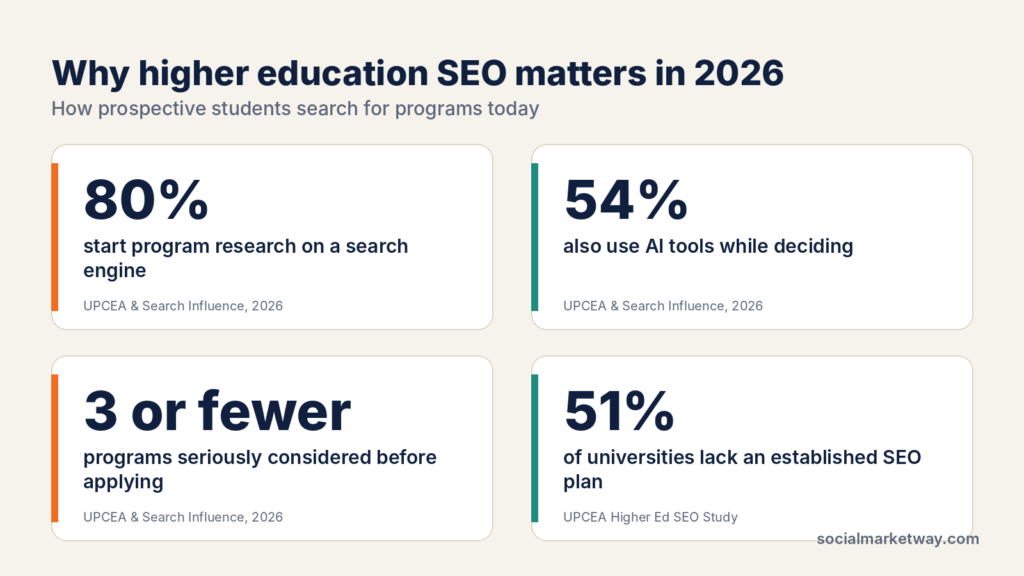
Two things stand out. First, the consideration set is tiny. A student who sees three schools in the search results and the AI summary often never looks further. Second, half of institutions still have no formal SEO plan, which means a disciplined school can overtake larger, better-known competitors on specific program keywords.
How AI Overviews change SEO in higher education
Google’s AI Overviews and tools like ChatGPT now answer many student questions directly. They pull from pages that already rank well, are clearly structured, and answer the question in the first few sentences. Pages with short, direct answers, FAQ sections, data tables and FAQ schema are the ones these tools cite. Every recommendation in this guide is written with that in mind.
SEO vs. Search Engine Marketing for Higher Education
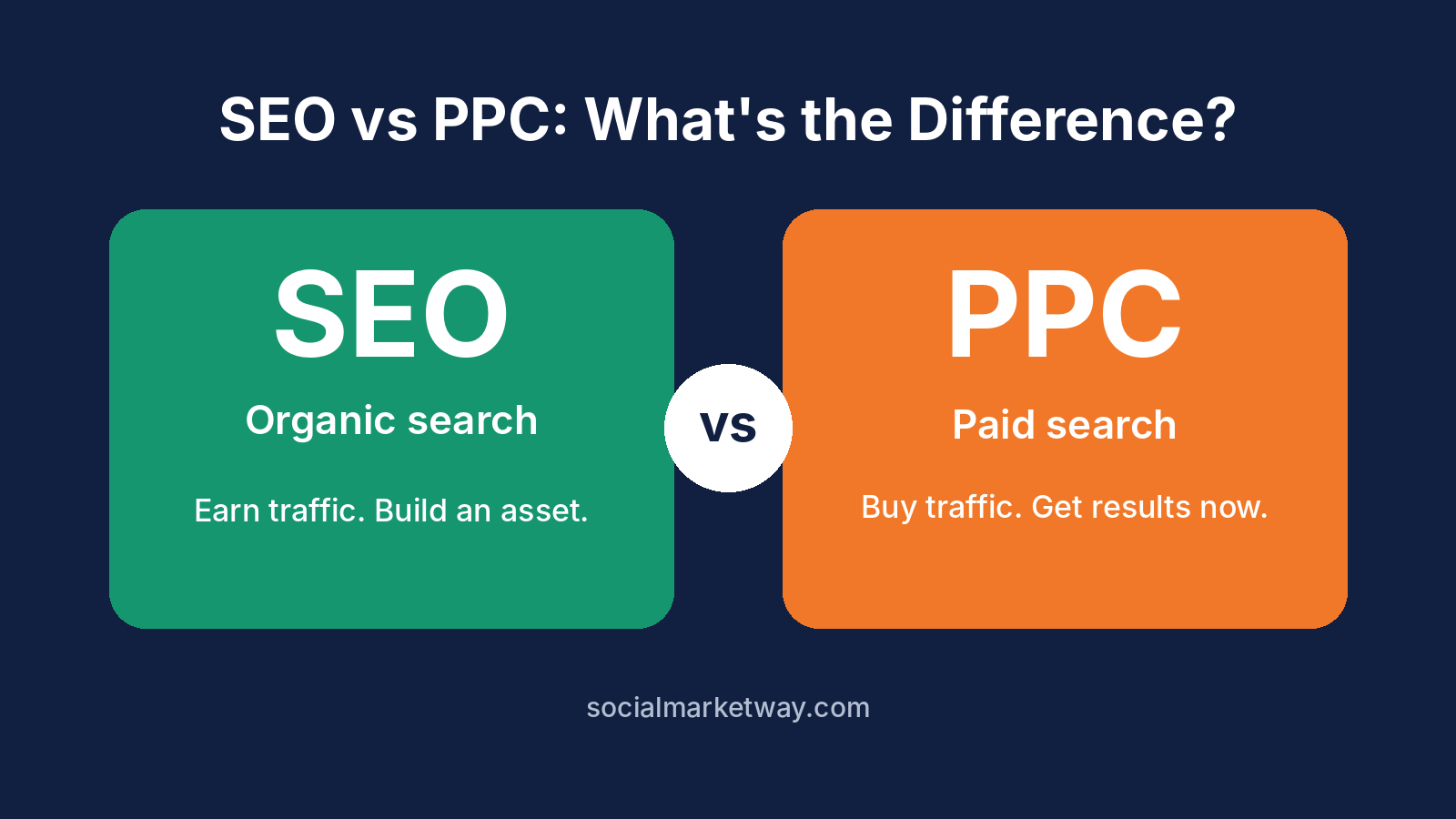
Search engine marketing for higher education usually means paid search: Google Ads and Microsoft Ads campaigns that place your programs at the top of results for a cost per click. SEO earns the unpaid positions below and around those ads. Most successful schools run both, but they do different jobs.
| SEO (organic) | Paid search (SEM) | |
|---|---|---|
| Cost model | Staff or agency time; no cost per click | Pay per click; education CPCs of $5 to $15+ are common |
| Speed | 3 to 6 months for early gains, 6 to 12 for strong results | Traffic the day a campaign launches |
| When you stop paying | Rankings and traffic largely remain | Traffic stops immediately |
| Trust | Organic results and AI citations are trusted more by many searchers | Clearly labeled as ads |
| Best for | Program pages, career and cost questions, brand protection, AI visibility | Application deadlines, new programs, competitive terms you can’t rank for yet |
How to use SEO and paid search together
- Launch with ads, sustain with SEO. Promote a new program with paid search while its program page builds organic rankings.
- Share keyword data. Paid search shows which terms convert to RFIs within weeks. Feed those terms into your SEO content plan.
- Cut spend where you rank. Once a program ranks in the top three organically, test reducing bids on that term and move the budget to harder ones.
Treated this way, search engine marketing for higher education becomes one connected system instead of two teams bidding against each other’s results.
How to Build an SEO Strategy for Higher Education in 8 Steps
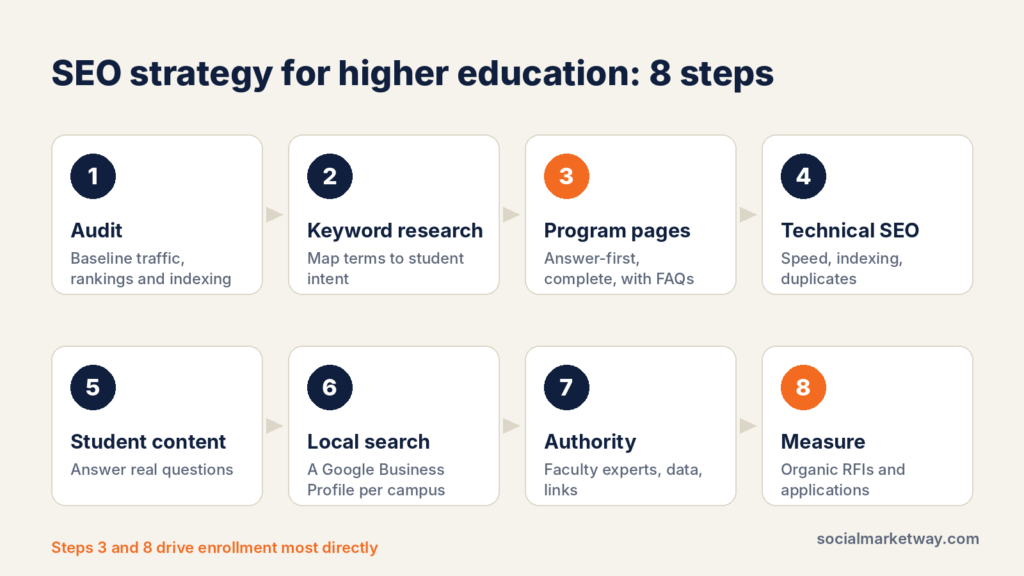
A strong SEO strategy for higher education follows eight steps: audit, research keywords by student intent, optimize program pages, fix technical issues, publish content that answers student questions, win local search, earn authority, and measure enrollment outcomes.
Step 1: Audit where you stand today
Start with a baseline. Pull 12 months of organic data from Google Search Console and GA4, then answer four questions:
- Which program pages get organic traffic, and which get almost none?
- Which keywords already rank in positions 4 to 20, close enough to push onto page one?
- How many pages are indexed, duplicated, orphaned or broken?
- Which competitors outrank you on your highest-value programs?
The answers tell you where quick wins are and which programs need the most work.
Step 2: Research keywords by student intent
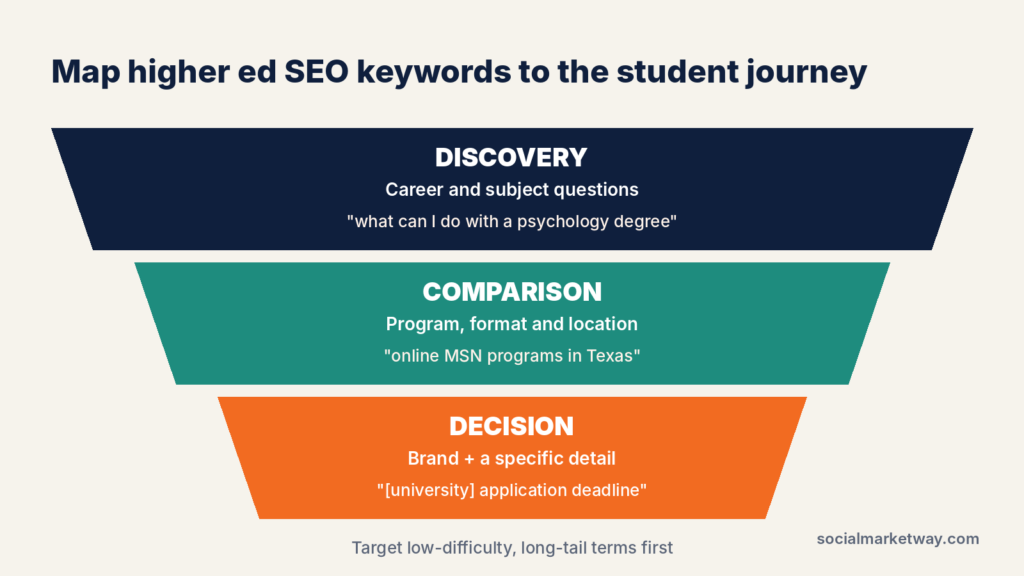
Students search differently at each stage of their decision. Map keywords to three stages:
- Discovery: career and subject questions, such as “what can I do with a psychology degree” or “highest paying healthcare jobs.”
- Comparison: program and format searches, such as “online MSN programs in Texas” or “part-time MBA near me.”
- Decision: your brand plus a detail, such as “[university] tuition,” “[university] application deadline” or “[program] admission requirements.”
Prioritize long-tail, low-difficulty terms first. Like the keywords this article targets, many high-intent education phrases have a keyword difficulty under 20, which means a well-built page can rank within months.
Step 3: Turn program pages into ranking pages
Program pages are your most valuable SEO asset because they sit closest to an application. Yet many are thin: a paragraph of copy, a course list and an “apply now” button. Improve the content and structure of each page so it answers everything a student asks before applying:
- A title tag and H1 that use the program keyword, such as “Online Master of Social Work (MSW) | [University].”
- A short answer-first summary: format, length, cost, start dates and accreditation in the first 100 words.
- Sections for curriculum, admission requirements, tuition and financial aid, career outcomes and salary data, and faculty.
- An FAQ block of 5 to 8 real student questions, marked up with FAQ schema.
- A clear call to action above the fold and again at the bottom: request information, book a visit or apply.
Step 4: Fix technical issues that block rankings
Large university sites accumulate technical debt quickly. Crawl the site with a tool like Screaming Frog and fix indexing errors, redirect chains, duplicate pages, slow templates and mobile layout problems. The full checklist is in the next section.
Step 5: Publish content that answers real student questions
Blog posts, guides and career pages capture students in discovery mode and feed AI Overviews. Good topics come from your admissions inbox, chat logs and Google’s People Also Ask boxes. Write each piece to answer the question in its first two sentences, then go deeper. Examples:
- “How long does it take to get a nursing degree?”
- “Is an online degree respected by employers?”
- “How much does a master’s in data science cost?”
Link each article to the related program page so authority and readers flow toward enrollment.
Step 6: Win local search for every campus
Many students search “colleges near me” or “community college in [city].” Those results are dominated by the Google Maps local pack, which is driven by your Google Business Profile, not just your website. Optimizing your campus listing for Google Maps and the local pack means choosing accurate categories, adding photos and hours for each building that students visit, collecting reviews, and posting updates about open houses and deadlines.
Step 7: Earn authority and links
Universities have a natural advantage in link building: research, faculty experts, events and partnerships that other sites want to cite. Turn these into links by pitching faculty as expert sources to journalists, publishing original data, listing programs in reputable directories, and reclaiming unlinked brand mentions. This authority-building work that happens off your own website is what moves competitive program pages from page two to the top three.
Step 8: Measure what matters for enrollment
Traffic is a means, not the goal. Track organic RFIs, applications and enrolled students by program, using form tracking in GA4 and source data in your CRM (Slate, Salesforce or similar). Report monthly on rankings for priority keywords, organic conversions per program, and cost per organic inquiry compared with paid channels.
SEO for Educational Websites: The Technical Checklist
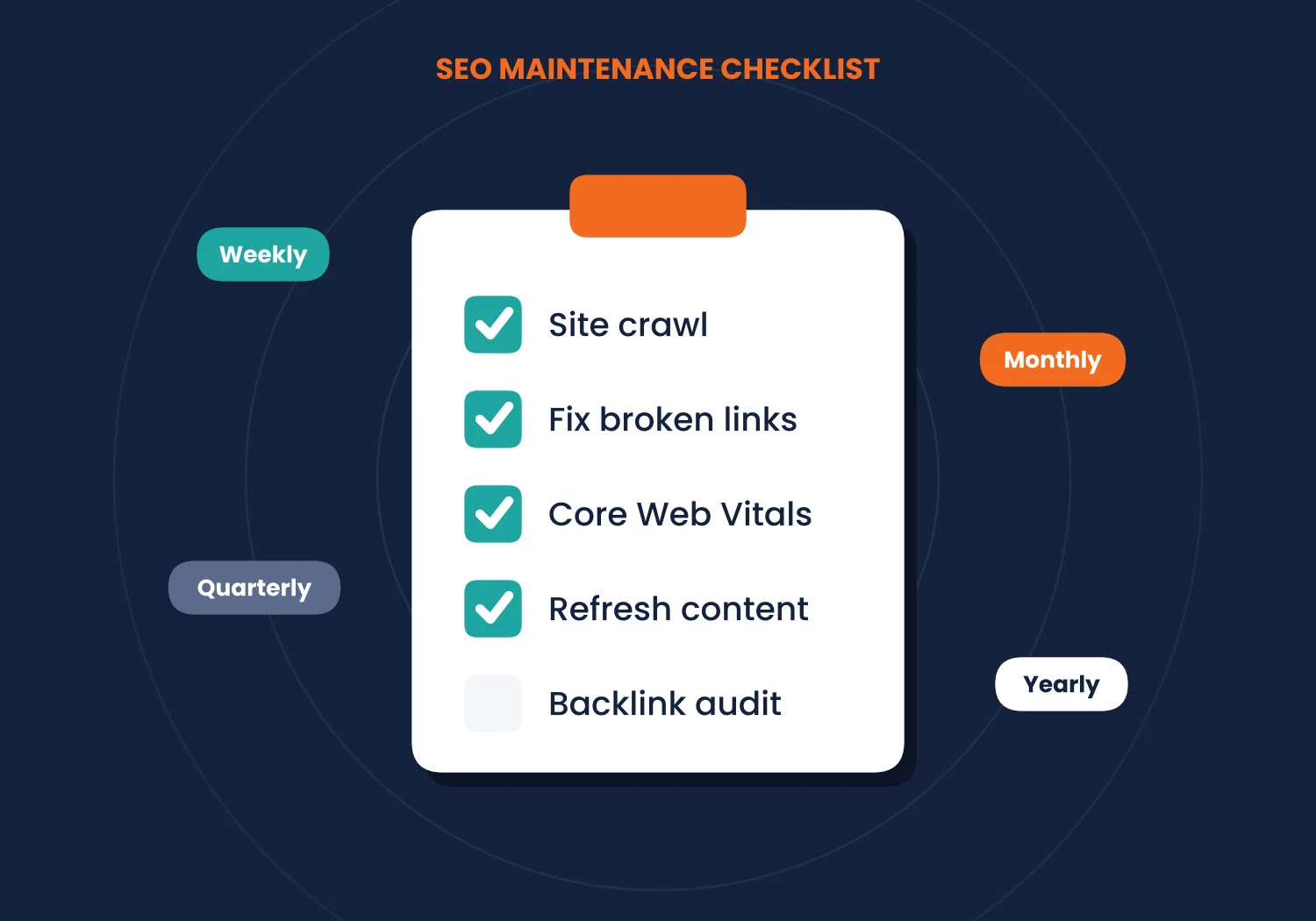
Good SEO for educational website projects starts with a site Google can crawl, understand and load fast on a phone. Work through this checklist once a quarter, or after any redesign or CMS migration.
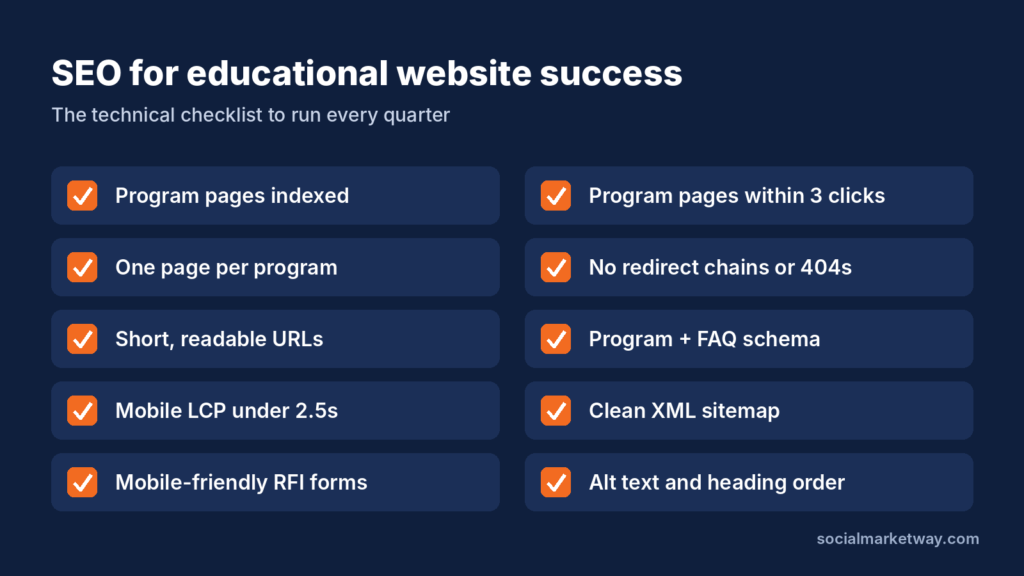
- Indexing: Every program, admissions and tuition page is indexed in Google Search Console; staging sites, PDFs of old catalogs and internal portals are blocked or noindexed.
- One page per program: No duplicate program pages across departments. Consolidate with 301 redirects and canonical tags.
- Clean URLs: Short, readable paths such as /programs/online-mba/ instead of /page.aspx?id=4821.
- Site speed: Core Web Vitals pass on mobile, with Largest Contentful Paint under 2.5 seconds. Compress hero images and limit heavy sliders.
- Mobile first: Navigation, program finders and RFI forms work on a phone without zooming.
- Internal linking: Every program page is reachable within three clicks of the homepage and linked from related blog content.
- Redirects: No redirect chains or 404s left over from catalog changes or retired programs.
- Schema markup: CollegeOrUniversity on the homepage, Course or EducationalOccupationalProgram on program pages, FAQPage on FAQ blocks, and Event on open houses.
- XML sitemap: Up to date, submitted in Search Console and free of redirected or noindexed URLs.
- Accessibility: Alt text on images, descriptive link text and proper heading order. This helps students using assistive technology and search engines alike.
Who should own technical SEO on a university website?
Assign one owner, usually in marketing or web services, with authority to approve changes across departments. Without one person accountable, duplicate pages and broken links return within months of every cleanup.
Higher Ed SEO for Multi-Campus Schools and Online Programs
Schools with several campuses, satellite centers or a national online division face a different challenge: each location needs to rank in its own market without the pages competing with each other. The approach is the same one franchise and multi-location brands use.
- One location page per campus, with its own address, map, programs offered, parking and visit details, and photos. Avoid copying the same text across campuses.
- One Google Business Profile per physical location, each linked to its matching campus page rather than the homepage.
- Program and location combinations where demand exists, such as “nursing programs in Orlando,” built only when the campus actually offers that program.
- A separate content plan for online programs, which compete nationally against large online universities and need stronger authority and outcomes content.
A clear multi-location search strategy keeps each campus visible locally while the main domain builds authority for every program.
How to Grow University Enrollment with SEO
To grow university enrollment with SEO, connect every ranking page to a clear next step and measure organic traffic by the applications it produces, not by visits. Rankings alone do not fill seats. These five practices turn search visibility into enrolled students:
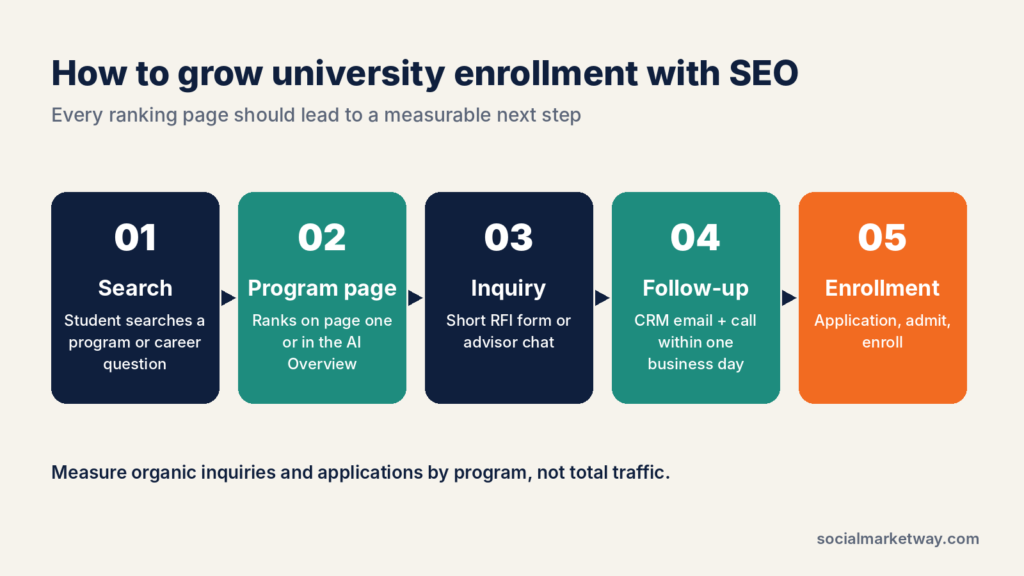
- Match the call to action to the search intent. A student reading “what can I do with a psychology degree” is not ready to apply. Offer a program guide or career quiz. A student on the tuition page is ready for “Talk to an advisor” or “Start your application.”
- Shorten the RFI form. Ask for name, email, phone and program of interest. Every extra field lowers completion rates.
- Prioritize programs with capacity and margin. Put SEO effort first behind programs with open seats, strong demand and healthy tuition revenue.
- Follow up fast. Organic inquiries go cold quickly. Route them into your CRM with automated email and a call from admissions within one business day.
- Retarget organic visitors. Use remarketing audiences built from program-page visitors so students who left without inquiring see your school again.
When these pieces work together, SEO becomes a predictable enrollment channel. Schools can forecast how many inquiries a ranking program page will produce each term and plan budgets around it.
6 Common Higher Education SEO Mistakes to Avoid
- Optimizing the homepage instead of program pages. Students search for programs, not institution names. Your homepage will rarely rank for “online accounting degree.”
- Using internal jargon. Students search “business degree,” not “Bachelor of Science in Organizational Leadership.” Use the official name on the page, but target the words students type.
- Hiding key facts in PDFs. Tuition, requirements and course lists buried in PDF catalogs are hard for search engines and AI tools to read. Put them on the page in HTML.
- Letting departments publish duplicates. Two or three pages about the same program split rankings and confuse students.
- Losing rankings in a redesign. Site relaunches without a redirect map can erase years of SEO progress overnight.
- Measuring traffic instead of enrollment. A blog post with 10,000 visits and no inquiries is worth less than a program page with 500 visits and 20 RFIs.
How Long Does Higher Education SEO Take?
Most schools see early movement in 3 to 6 months and strong, compounding results in 6 to 12 months. Low-difficulty program and long-tail keywords move first. Competitive national terms like “online MBA” can take a year or more.
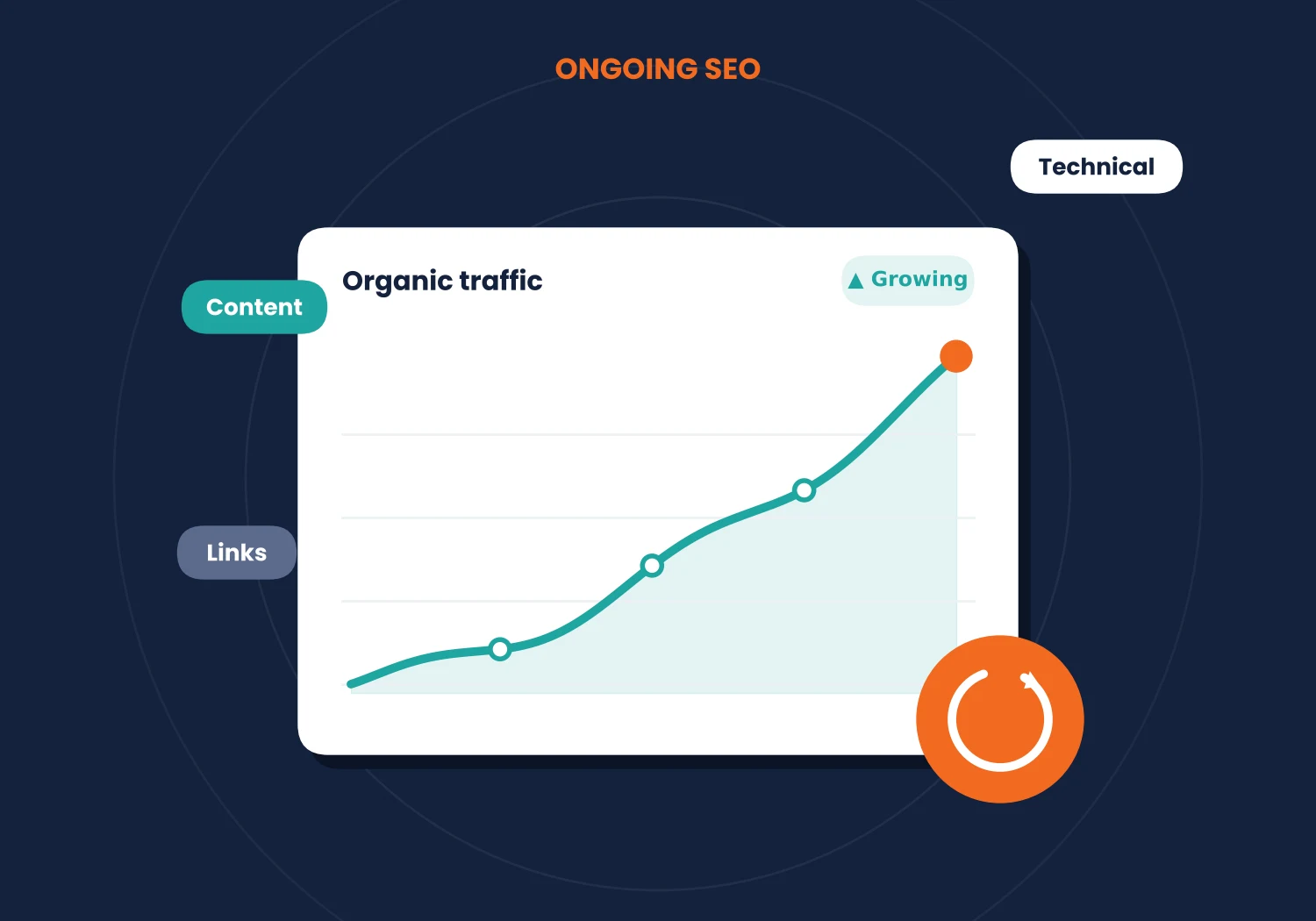
Results also depend on continued effort. Competitors publish new content, Google updates its algorithms, and programs change every catalog year. That is why search optimization is never a one-time project. The schools that win treat SEO as a monthly discipline, not a launch task.
Should you hire a higher education SEO agency or build in-house?
In-house teams know the institution, its programs and its approval process. Agencies bring specialists in technical SEO, content and link building, plus tools and benchmarks from other clients. Many universities combine the two: an internal owner who sets priorities and coordinates departments, and an agency partner that handles audits, technical fixes, content production and outreach.
Start Ranking for the Programs That Fill Your Seats
Higher education SEO is no longer optional. Students start their search online, AI tools narrow their choices to a handful of schools, and half of institutions still have no SEO plan. That gap is your opportunity.
Start with an audit, rebuild your highest-priority program pages, fix the technical basics and measure organic inquiries by program. Then keep going every month.
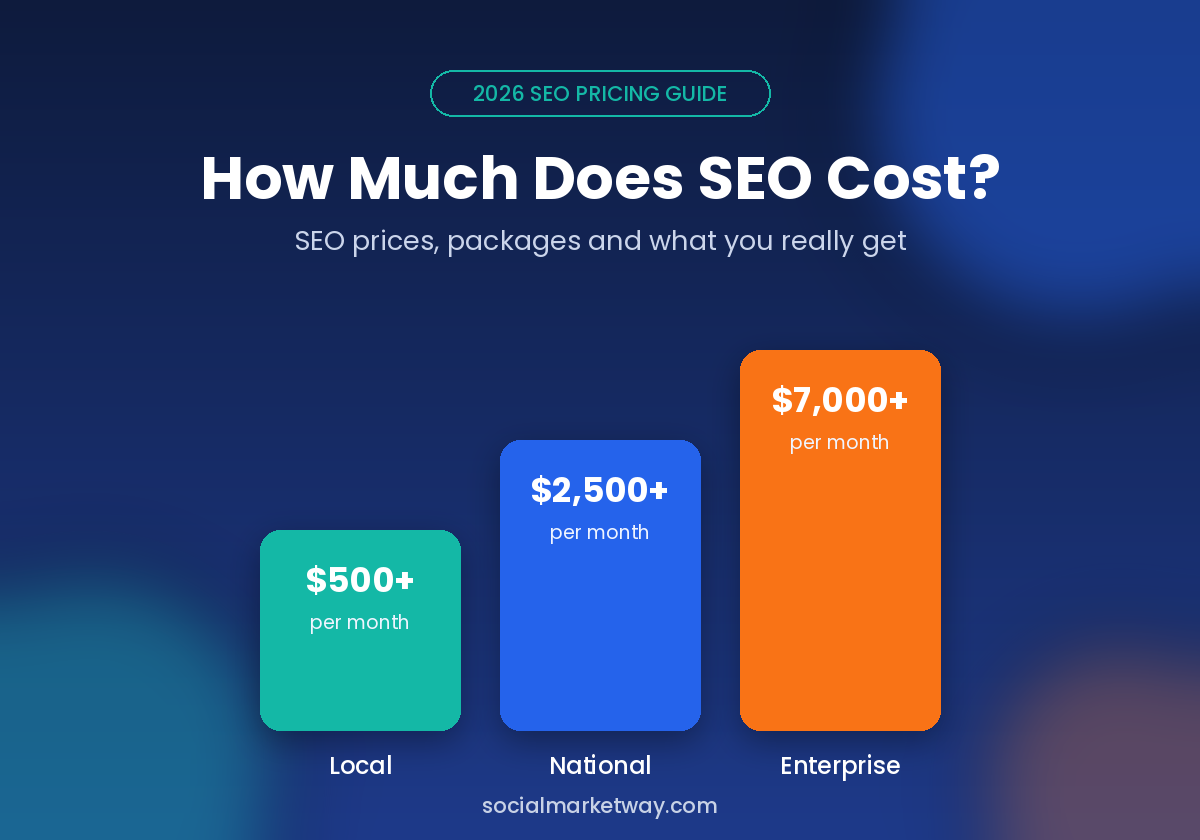
If you would rather have specialists handle it, Social Market Way builds SEO programs around enrollment goals. You can compare our monthly search plans and pick the level of support that fits your team, or contact us for a free SEO audit of your program pages.
Frequently Asked Questions About Higher Education SEO
Quick answers to the questions enrollment and marketing teams ask most.
01
What is higher education SEO?
Higher education SEO is the process of optimizing a college or university website so its program, admissions and campus pages rank in Google and AI search tools. The goal is to reach prospective students while they research programs and turn that traffic into inquiries, applications and enrollments.
02
Why is SEO important for higher education?
SEO is important for higher education because most prospective students start their research on a search engine, and most seriously consider three or fewer programs. Schools that rank on page one, or appear in AI Overviews, make that short list. Schools that don’t are rarely considered.
03
How do colleges and universities use SEO?
Colleges use SEO to rank program pages for degree searches, publish content that answers career and cost questions, optimize Google Business Profiles for each campus, fix technical website issues, and earn links from news sites and partners. The results are tracked as organic inquiries and applications by program.
04
What is the difference between SEO and search engine marketing for higher education?
SEO earns unpaid rankings that keep driving traffic after the work is done. Search engine marketing for higher education usually means paid search ads, which deliver traffic immediately but stop when spending stops. Most schools use paid search for fast results and SEO for lower long-term cost per inquiry.
05
How can you grow university enrollment with SEO?
To grow university enrollment with SEO, rank program pages for the terms students search, match each page’s call to action to the student’s stage, keep inquiry forms short, follow up within a day, and measure organic inquiries and applications by program rather than total traffic.
06
How long does SEO take for a university website?
Most university websites see early ranking gains in 3 to 6 months and strong results in 6 to 12 months. Long-tail program keywords move first. Highly competitive national terms, such as popular online degrees, can take a year or more.
07
What are the best SEO practices for an educational website?
The best practices for an educational website are one detailed page per program, answer-first content, fast mobile pages, clean URLs, strong internal linking, schema markup for programs and FAQs, a Google Business Profile for each campus, and regular audits for broken links and duplicate pages.
08
Does SEO in higher education still matter with AI search?
Yes. AI tools like Google AI Overviews and ChatGPT draw on pages that already rank well and answer questions clearly. Strong SEO in higher education is now how schools get cited in AI answers, not just listed in traditional search results.
09
What keywords should a university target for SEO?
A university should target program keywords (“online MSW program”), location keywords (“nursing schools in Dallas”), career and outcome questions (“what can I do with a biology degree”), cost questions, and branded searches about deadlines and requirements. Start with low-difficulty, high-intent terms.
10
Is SEO higher education’s most cost-effective marketing channel?
For many schools, yes, over the long term. SEO takes longer to build than paid ads, but once program pages rank, each additional inquiry costs very little. That usually gives SEO a lower cost per inquiry than paid search or lead vendors after the first year.