B2B Digital Marketing Strategy: The Complete Playbook for Getting Chosen Before the Sales Call
by Social Market Way Content Team
Yassin Aberra
Yassin Aberra is…
Published
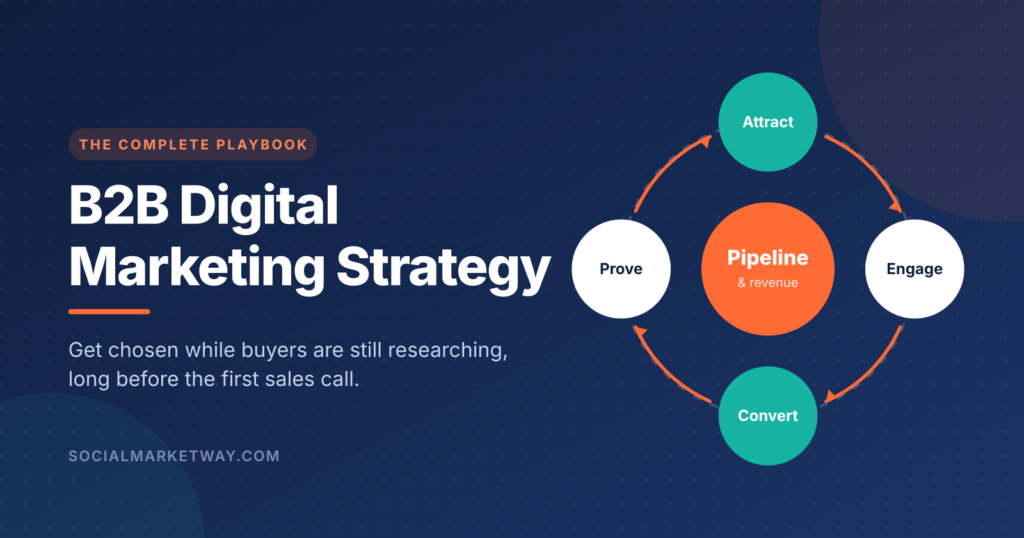
A B2B digital marketing strategy works as a flywheel: attract the right buyers, engage the whole buying committee, convert intent into conversations, and prove results to fuel the next cycle.
If you run marketing, sales, or the whole company at a B2B business, here is the hard truth: by the time a prospect fills out your contact form, the deal is already mostly decided.
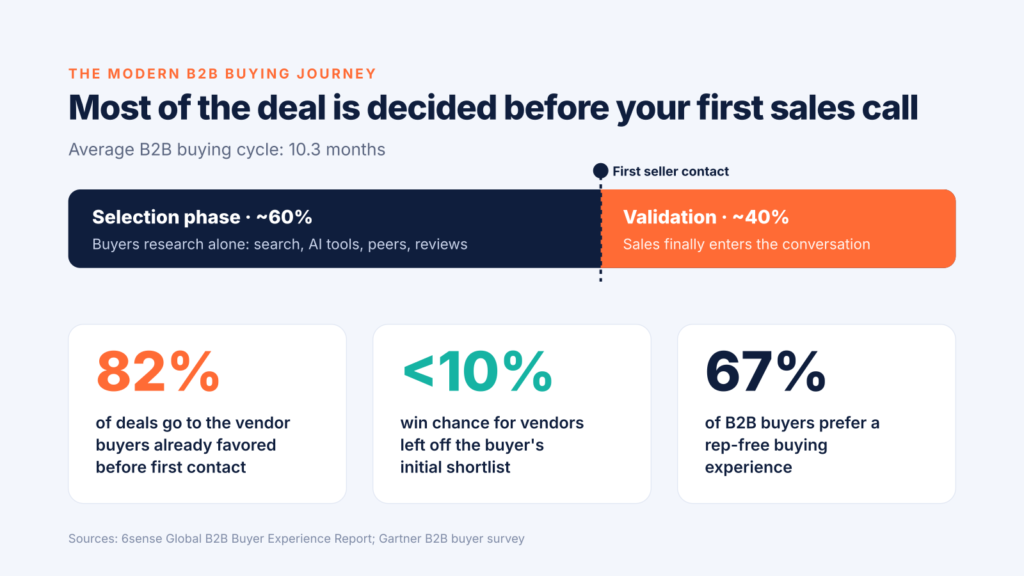
6sense’s latest Global B2B Buyer Experience Report found that buying groups spend roughly 60% of an average 10.3‑month buying cycle researching on their own before they contact a seller. The vendor they favored before that first conversation wins 82% of the time. Vendors that miss the initial shortlist have less than a 10% chance of winning.
That changes what a B2B digital marketing strategy has to do. Generating leads and handing them to sales isn’t enough anymore. Your strategy has to make you the obvious choice while buyers are still researching quietly: on Google, in AI answers, on LinkedIn, in peer conversations, and on your own website.
This guide shows you how to build that strategy step by step. It’s written for B2B founders, marketing leaders and sales leaders who want depth instead of another list of generic tactics. You’ll get a seven-step framework, a channel-by-channel breakdown, the SEO approach we use with B2B clients, best practices, a startup playbook, and a 90-day roadmap you can start on Monday.
Key takeaways
B2B buyers form their shortlist before they talk to you. Your marketing has to win the research phase, not just capture leads after it.
A strategy is a set of choices: who you target, what you say, which channels you use, and how you measure revenue. A list of tactics is not a strategy.
You need both demand capture (the ~5% of buyers in market now) and demand creation (the ~95% who will buy later).
SEO is the compounding backbone of most B2B programs, but today it also means being the source AI answers cite.
Measure pipeline and revenue, not traffic and MQLs alone.
A B2B digital marketing strategy is a plan for using online channels to attract, convince, and convert other businesses into customers. It covers your website, search, content, social, email, paid media and the data that connects them. It is built around how organizations actually buy, not how individuals shop.
The key word is strategy. Many companies say they have one when what they really have is activity: a blog that posts when someone has time, a LinkedIn page, some Google Ads, and a newsletter that goes out “most months.” A real strategy answers four questions clearly:
Who exactly are we trying to win? Which companies, which roles inside them, and what triggers them to buy.
Why should they choose us? Your positioning and the proof behind it.
Where and how will we reach them? The channels and content that fit their buying journey.
How will we know it’s working? The metrics that tie marketing to pipeline and revenue.
How digital marketing in B2B differs from B2C
Most marketing advice online is written for consumer brands. Copying it into a B2B context is one of the fastest ways to waste budget. Here’s what’s actually different:
B2C
B2B
Who decides
One person, sometimes a household
A buying group, often a dozen or more people
Cycle length
Minutes to weeks
Months, sometimes more than a year
What drives the decision
Emotion, convenience, price
Risk reduction, ROI, internal justification (with plenty of emotion underneath)
Content needed
Short, visual, entertaining
In-depth, proof-heavy, different for each role
Deal value
Usually low
Often thousands to millions
What to measure
Sales, ROAS, repeat purchases
Pipeline, win rate, customer acquisition cost, lifetime value
The biggest difference is that B2B buyers have to defend their decision to other people. Your marketing has to give your champion the arguments, numbers and proof they need to sell you internally when you aren’t in the room.
Why Digital Marketing for B2B Businesses Matters More Than Ever
Five shifts in buyer behavior make a deliberate digital strategy essential instead of optional.
67% of B2B buyers prefer a rep-free buying experience (Gartner)
13 + 9internal stakeholders and external influencers involved in an average purchase (Forrester)
~95%of potential buyers aren’t in market at any given time (LinkedIn B2B Institute)
1. Buyers would rather not talk to you, at least not early. A recent Gartner survey of 646 B2B buyers found that 67% prefer a rep-free experience. Buyers in the same research used an average of seven information sources during a recent purchase, and 45% used generative AI along the way. Your website, content and search presence are now your first sales conversation.
2. Buying groups keep getting bigger. Forrester’s State of Business Buying report shows an average of 13 internal stakeholders and nine external influencers in a B2B purchase, and more for complex deals. That means more people to convince, each with different concerns.
3. Shortlists form before first contact. As the 6sense research above shows, if you aren’t on the buyer’s day-one list, you’re unlikely to win. Being found during the research phase is now a revenue problem, not just a branding nice-to-have.
4. Most of your market isn’t buying right now. Research by Professor John Dawes of the Ehrenberg-Bass Institute, published by LinkedIn’s B2B Institute, gave us the “95-5 rule.” Only about 5% of B2B buyers are in market at any time. The other 95% will buy later, and they’ll buy from the brands they remember.
5. AI is changing how search works. Ahrefs found that when Google shows an AI Overview, the top-ranking page gets a 58% lower click-through rate on average. Ranking still matters, but you also need to be the source those AI answers cite and the brand people search for by name.THE MODERN B2B BUYING JOURNEYMost of the deal is decided before your first sales callAverage B2B buying cycle: 10.3 monthsSelection phase · ~60%Buyers research alone: search, AI tools, peers, reviewsValidation · ~40%Sales finally enters the conversationFirst seller contact82%of deals go to the vendorbuyers already favored before first contact<10%win chance for vendorsleft off the buyer’sinitial shortlist67%of B2B buyers prefer arep-free buyingexperience Sources: 6sense Global B2B Buyer Experience Report; Gartner B2B buyer surveyMost of the buying cycle happens before a seller is ever involved. Your digital presence does the selling during that phase.
B2B buyers spend roughly 60% of the buying cycle researching on their own, and the vendor they favor before first contact wins 82% of the time. Sources: 6sense, Gartner.
Put together, these shifts mean your digital marketing has two jobs. It has to be known before buyers enter the market, and it has to be easy to choose once they do. The framework below is built around both.
How to Do B2B Digital Marketing: A 7-Step Framework
This is the B2B internet marketing process we use with clients. Do the steps in order. Most failing programs skip steps one through three and jump straight to tactics.
Define your ideal customer and map the buying committee
Your ideal customer profile (ICP) describes the companies most likely to buy, succeed, and stay. Go beyond firmographics like industry, size and location. The useful ICP details are the triggers (what happens just before a company starts looking for a solution like yours) and the pains (what it’s costing them to do nothing).
Then map the buying committee. In most B2B deals you’ll find some version of these roles:
Economic buyer: controls the budget and cares about ROI and risk.
Champion: feels the pain most and pushes for change internally.
Technical evaluator: checks integrations, security and implementation.
End users: care about whether it makes their day easier or harder.
Procurement and legal: care about terms, compliance and vendor risk.
Do this first: interview 5–10 of your best recent customers. Ask what triggered the search, who was involved, what other options they considered, what nearly stopped the deal, and where they went for information. These answers will shape your messaging, keyword targets and channel choices more than any persona template.
Nail your positioning and messaging
LinkedIn’s B2B Institute calls one of the biggest problems in B2B the “sea of sameness”: every website in a category says the same things in the same words. Try this test: cover your logo on your homepage and a competitor’s. If a buyer couldn’t tell which is which, your positioning isn’t doing its job.
Strong positioning answers three questions: what category you’re in, what the buyer would do instead of choosing you, and what you do better than that alternative, with proof. Turn that into a messaging matrix by role. The CFO hears about cost, risk and payback. The operations lead hears about implementation time and workflow impact. The end user hears about what gets easier. Same product, different reasons to care.
Set goals that connect to revenue
“More leads” is not a goal. Start with your revenue target and work backward to know what marketing actually has to produce. Here’s an illustrative example. Swap in your own numbers:
New-business revenue target: $1,200,000
÷ Average contract value of $40,000 = 30 closed deals
÷ 25% opportunity win rate = 120 sales opportunities
÷ 50% of qualified meetings becoming opportunities = 240 qualified meetings
÷ 1 in 3 inbound conversions qualifying = 720 conversions a year (60/month)
÷ 2% website conversion rate = ~3,000 relevant visits per month
Now you know what “good” looks like. You also know which lever to pull. Doubling conversion rate from 2% to 4% does the same job as doubling traffic, and it’s usually cheaper. Track two layers of metrics:
Leading indicators (weekly/monthly)
Lagging indicators (monthly/quarterly)
Rankings and impressions for commercial keywords
Marketing-sourced and marketing-influenced pipeline
Qualified organic and paid traffic
Win rate and sales-cycle length
Conversion rate by page and offer
Customer acquisition cost (CAC)
Branded search volume and direct traffic
Revenue and CAC payback period
Choose a channel mix that captures and creates demand
This step gets its own section below because it’s where most budgets are won or lost. The short version: you need channels that capture buyers who are searching now, and channels that create familiarity with future buyers. Jump to the channel breakdown.
Build a content engine, starting at the bottom of the funnel
Most B2B companies start content marketing at the top of the funnel, with broad “what is” blog posts that attract readers who will never buy. Flip that. Build the pages closest to revenue first:
Service and solution pages that clearly explain what you do, who it’s for, how it works, and what it costs (or what affects the cost).
Comparison and alternative pages (“X vs. Y”, “in-house vs. agency”) for buyers who are actively evaluating.
Case studies with real numbers, timelines and named clients wherever you can get permission.
Industry and use-case pages so a buyer in your target vertical sees themselves on the page.
Middle-funnel resources like frameworks, calculators, templates and in-depth guides like this one.
Top-of-funnel education that builds authority and feeds the rest.
Then make every major piece of content work several times. One recorded webinar can become a pillar article, five LinkedIn posts, three short video clips, a newsletter issue and a sales follow-up asset.
Turn your website into a conversion engine
Your website is where every channel sends people, so it decides whether your marketing spend becomes pipeline. Check these essentials:
Above-the-fold clarity: within five seconds, a visitor should know what you do, who it’s for, and what to do next.
Proof everywhere: client logos, numbers, testimonials and case-study links near every call to action.
Multiple conversion paths: not everyone is ready for a sales call. Offer a high-intent option (book a call), a mid-intent option (an audit or assessment) and a low-intent option (a newsletter or guide).
Low-friction forms: ask only what you need to qualify and follow up.
Speed and mobile experience: plenty of executives do their first round of research on a phone.
Measure, attribute, and improve every month
Connect your analytics (GA4) to your CRM so you can follow a visitor from first touch to closed deal. Use consistent UTM tags on every campaign link. Add a free-text “How did you hear about us?” field to your main forms. It captures the podcast mentions, peer referrals and LinkedIn posts that software attribution misses. Then hold a monthly review that asks three questions: what produced pipeline, what didn’t, and what you’ll change next month.
Building Your B2B Online Marketing Strategy: The Channel Mix
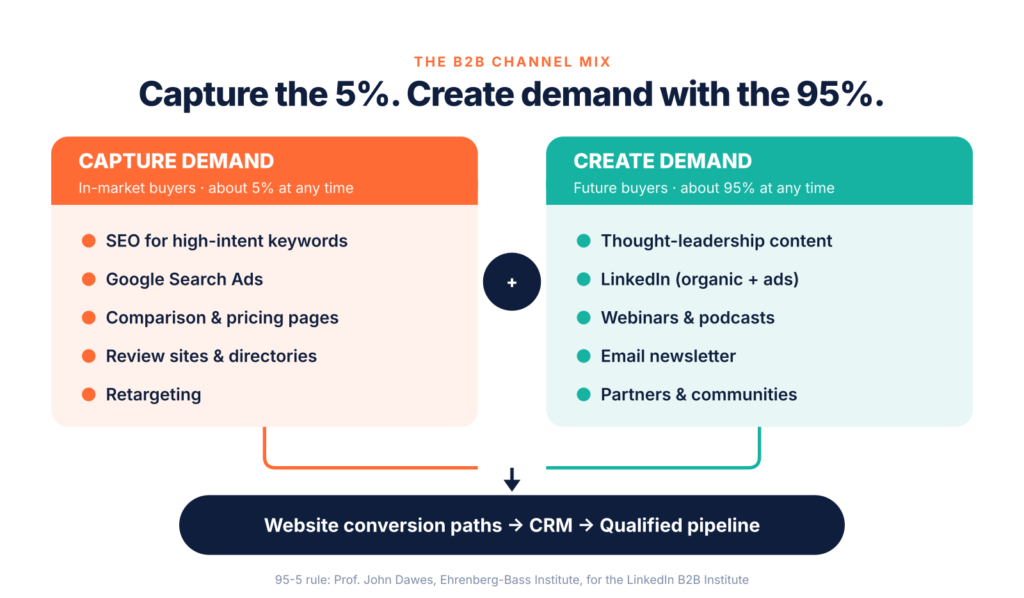
The 95-5 rule tells you how to split your attention. Demand-capture channels reach the roughly 5% of buyers who are in market today. Demand-creation channels make sure the other 95% remember you when it’s their turn. LinkedIn’s B2B Institute recommends investing in lead generation for the 5%, but investing far more heavily in reaching the whole category.
The B2B channel mix: demand capture channels like SEO and search ads win the 5% of buyers in market now, while LinkedIn, content and email create demand with the other 95%.
Capturing demand immediately on commercial keywords
Days
Cost per qualified opportunity
LinkedIn (organic)
Founder and expert visibility; building trust with buying committees
2–4 months of consistency
Engagement from ICP accounts, inbound DMs
LinkedIn Ads
Precise targeting by job title, company and industry
Weeks
Reach in target accounts, pipeline influenced
Email marketing
Nurturing the 95% until they’re ready
1–3 months
Replies, meetings booked
Webinars and podcasts
Showing expertise in depth; building a guest network
2–4 months
Attendee-to-meeting rate
Account-based marketing (ABM)
High-value target accounts with large buying groups
1–2 quarters
Engagement and pipeline in target accounts
Review sites and partners
Third-party validation during evaluation
Ongoing
Referral traffic, assisted deals
How many channels should you use? Fewer than you think. A team that does two channels well will beat a team that does six badly. A good starting combination for most B2B companies is SEO plus search ads to capture demand, and LinkedIn plus email to create it. Add channels only when the current ones are running smoothly and you have the capacity to do the next one properly.
SEO: The Backbone of B2B Online Marketing
If your buyers research on their own (and the data says they do), then search is where most B2B journeys begin. Unlike paid media, SEO compounds. A page that ranks well today keeps bringing in qualified visitors for months or years without paying for every click.
B2B SEO plays by different rules than consumer SEO, though. The keywords that matter most often have small search volumes. A phrase searched 50 times a month can be worth far more than one searched 5,000 times if those 50 searchers are budget-holding buyers. That’s why our B2B SEO services prioritize commercial intent and deal value over raw volume.
The five pillars of a B2B SEO program
Technical foundations. Fast load times, clean site structure, correct indexing, and no duplicate or thin pages diluting your authority.
High-converting service pages. Each core service gets its own page targeting its own keyword cluster, written for buyers, not just for search engines.
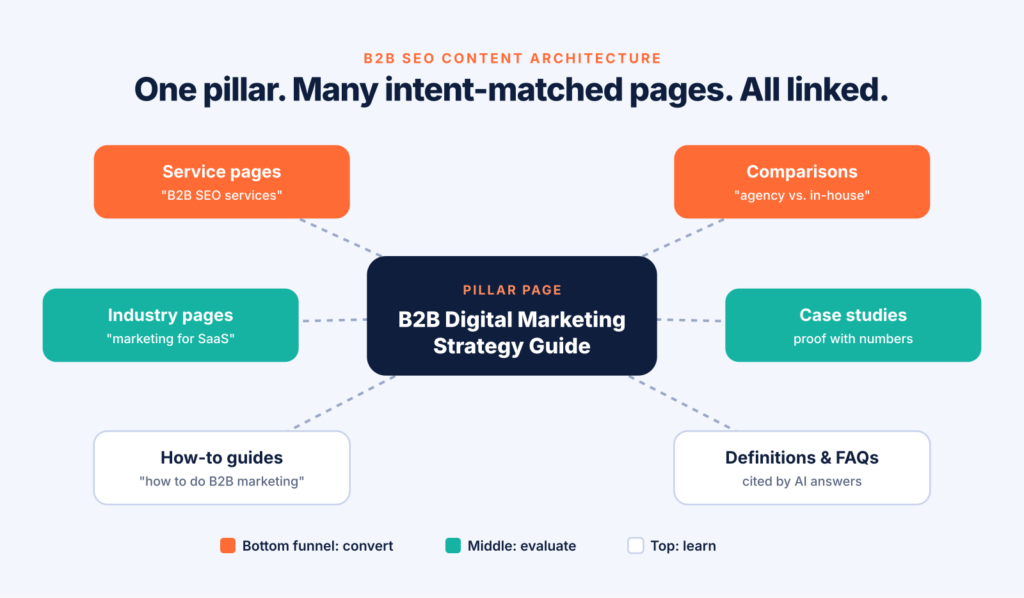
Topic clusters. A pillar page (like this guide) supported by related pages that link to each other, which signals deep expertise to search engines and AI systems.
Authority building. Earning links and mentions from industry publications, partners, podcasts and associations your buyers already trust.
AI search visibility. Clear definitions, original data, structured FAQs and consistent information about your company across the web, so AI tools can understand and cite you.
B2B SEO content architecture: one pillar page linked to service pages, comparisons, industry pages, case studies, how-to guides and FAQs, so search engines and AI tools understand your expertise.
Optimizing for AI answers as well as rankings
Because AI Overviews and chat assistants answer many informational questions directly, your content needs to be quotable. Open each section with a clear, direct answer. Use specific numbers and name your sources. Mark up your FAQs. Keep your company name, services and locations consistent across your site, Google Business Profile, directories and social profiles. Branded search and AI citations are becoming key indicators of B2B SEO success, alongside rankings.
Local, national, or international: match SEO to your market
Your SEO approach should match where your customers are. A B2B company selling across the United States needs a national SEO strategy. That means competing on non-local keywords, building authority at scale, and creating industry and use-case content instead of city pages.
If you sell across borders, international SEO adds another layer: hreflang tags, localized (not just translated) content, and separate keyword research for each market. Buyers in different countries search differently. For example, Brazilian buyers looking for this exact topic search for “marketing digital B2B” in Portuguese. A direct translation of your English pages won’t capture that intent.
Wondering whether the investment pays off? We wrote a candid breakdown in Is SEO Worth It? An Honest Answer for Business Owners. It covers when SEO makes sense, when it doesn’t, and what results to realistically expect. If you’re ready to compare options, our SEO packages lay out exactly what’s included at each level.
FREE B2B SEO OPPORTUNITY REPORT
Find the buyer keywords your competitors are winning
We’ll analyze your site against your top competitors and send you:
High-intent keywords you’re missing
Technical issues holding your rankings back
Your visibility in AI search answers
A prioritized 90-day action list
Full nameWork emailCompany websiteWhere do you sell? Select your market Locally / regionally Nationally (U.S.) Internationally Send my free report
Delivered by a real strategist, not an automated tool.
10 B2B Digital Marketing Best Practices
These are the habits we see consistently in B2B companies whose marketing actually produces pipeline.
1. Market to the buying committee, not one persona
With more than a dozen people involved in a typical decision, a single persona leaves most of the group unconvinced. Create content for each major role. Give your champion materials they can forward internally, like a one-page business case, an ROI summary or a security overview.
2. Lead with proof, not promises
Forrester’s latest research describes buyers as risk-averse and focused on proof. Specific numbers (“cut onboarding time from 6 weeks to 9 days”) beat adjectives (“fast, seamless onboarding”) every time. Put proof next to every call to action.
3. Be genuinely useful before you ask for anything
Ungate most of your educational content so buyers (and search engines) can actually read it. Save forms for high-value offers like custom audits, tools and benchmark reports, where giving an email feels like a fair trade.
4. Get sales and marketing to agree in writing
Define what counts as a qualified lead, how fast sales follows up, and what happens to leads that aren’t ready yet. Review the agreement every quarter. Misalignment here quietly wastes more budget than any bad campaign.
5. Respond fast
When a buyer finally reaches out, they’ve usually done most of their research and may be contacting your competitors too. A same-day, thoughtful reply is a competitive advantage. A three-day wait often isn’t recoverable.
6. Invest in brand and demand at the same time
Lead generation pays the bills this quarter. Brand building fills the pipeline next year. If you only fund the 5% who are in market now, you’ll eventually run out of buyers who already know your name.
7. Write for humans first, then make it easy for AI to quote
Clear definitions, original data, named experts, and structured FAQs help both readers and the AI systems that increasingly summarize your category for buyers.
8. Use first-party data and intent signals responsibly
Your CRM, website analytics and email engagement show which accounts are warming up. Use those signals to prioritize sales outreach and personalize content. Avoid cold, irrelevant outreach. Earlier Gartner research found that 73% of B2B buyers actively avoid suppliers who send it.
9. Refresh, merge, and prune your content
Outdated statistics and thin posts drag down your whole site. Review your top pages twice a year. Update what’s worth keeping, merge overlapping articles, and redirect or remove the rest.
10. Test one thing at a time and keep a log
Change one variable per test, whether it’s a headline, an offer, or a form length. Record the result. Over a year, a log of small wins turns into a major advantage that competitors can’t easily copy.
B2B Startup Marketing: What Changes When You’re Early
If you’re a B2B startup, you don’t have the budget, brand recognition or content library of established competitors. That’s fine. You have speed, focus and founder access instead. Here’s how B2B startup marketing should differ:
Narrow your ICP more than feels comfortable. “Mid-size companies” is not a niche. “Logistics companies with 50–200 employees running on spreadsheets” is. You can widen later.
Make the founder the face of the brand. Early buyers are betting on people. A founder posting honest, specific insights on LinkedIn every week often outperforms an entire paid budget.
Start SEO with bottom-of-funnel pages. You won’t outrank established sites for broad terms soon. You can rank for specific, high-intent phrases that bigger competitors ignore.
Turn every early customer into proof. Get a testimonial, a short case study, and permission to use their logo from your first five customers.
Pick one capture channel and one creation channel. Do them well for six months before adding more.
Do things that don’t scale. Personal video replies, hand-written follow-ups and one-on-one demos teach you what messaging works before you automate it.
Your 90-Day B2B Digital Marketing Roadmap
Strategy only matters once it’s in motion. Here is a realistic first-quarter plan for a B2B company starting fresh or resetting a scattered program.
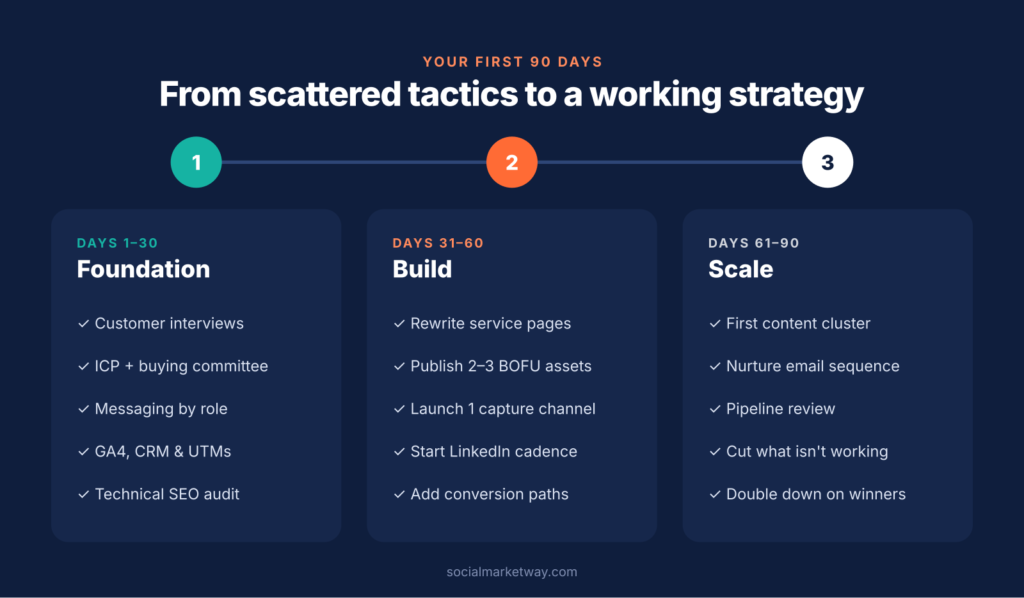
A 90-day B2B digital marketing roadmap: build the foundation in days 1–30, launch high-intent pages and channels in days 31–60, then scale what produces pipeline in days 61–90.
Days 1–30: Foundation
Interview customers, document your ICP and buying committee, and build your messaging matrix. Install proper tracking: GA4 connected to your CRM, consistent UTM conventions, and a “How did you hear about us?” field. Run a technical SEO audit and fix the critical issues. Don’t launch new campaigns yet. Every dollar you spend before this is done is harder to measure and easier to waste.
Days 31–60: Build
Rewrite your core service pages around your new messaging and target keywords. Publish two or three bottom-of-funnel assets, such as a comparison page, a case study and a pricing explainer. Launch one demand-capture channel (usually search ads on your highest-intent keywords) and start a consistent LinkedIn posting rhythm. Add mid-intent conversion paths to your site.
Days 61–90: Scale
Publish your first full topic cluster around your most valuable service. Launch a nurture email sequence for leads that aren’t sales-ready. Hold your first real pipeline review using the metrics from Step 3. Cut what isn’t working, and put that budget into what is.
Set expectations honestly: paid search can produce meetings within weeks. SEO and brand-building usually take three to six months to show meaningful pipeline, then keep compounding. Plan your budget so the fast channels fund the patience the slow ones need.
6 Mistakes That Quietly Kill B2B Marketing Results
Chasing traffic instead of buyers. Ranking for broad terms your buyers never search feels like progress but rarely produces pipeline.
Measuring MQLs instead of revenue. When marketing is rewarded for lead volume, lead quality falls and sales stops trusting marketing.
Spreading across too many channels. Six channels done at 30% effort beat nobody.
Sounding like everyone else. Generic claims like “innovative,” “customer-centric” and “end-to-end solutions” don’t make anyone’s shortlist.
Ignoring the existing customer base. Happy customers are your best source of case studies, referrals, reviews and expansion revenue.
Quitting too early. Many B2B companies abandon SEO and content in month four, right before the compounding starts.
Frequently Asked Questions
What is the best B2B digital marketing strategy?
There is no single best strategy, but the most effective ones share the same structure. They start with a narrowly defined ideal customer, use clear positioning backed by proof, combine demand-capture channels (SEO and search ads) with demand-creation channels (LinkedIn, content and email), and measure success by pipeline and revenue instead of traffic or lead volume.How long does B2B digital marketing take to work?
Paid search and well-targeted LinkedIn campaigns can generate meetings within a few weeks. SEO and content usually need three to six months before they produce consistent pipeline, and they keep improving after that. Brand-building effects show up over quarters and years, mainly as shorter sales cycles and higher win rates.Is SEO worth it for B2B companies?
For most B2B companies whose buyers research online, yes. SEO captures buyers while they’re forming their shortlist, and its results compound over time. It isn’t the right fit for every situation, though. Read our honest breakdown: Is SEO worth it?How much should a B2B company spend on digital marketing?
Budgets vary widely by industry, growth stage and deal size. Rather than copying a benchmark, work backward from your revenue target using the funnel math in Step 3. Then fund enough demand capture to hit near-term pipeline goals and enough brand building to keep future pipeline healthy. Our SEO packages show what different levels of SEO investment include.Which social media platform is best for B2B marketing?
For most B2B companies, LinkedIn is the priority because you can reach decision-makers by job title, company and industry. Personal posts from founders and subject-matter experts usually outperform company page posts. YouTube is a strong second for in-depth education and product demos.What’s the difference between B2B digital marketing and B2B online marketing strategy?
In practice the terms mean the same thing: a planned approach to using online channels such as search, content, social, email and paid media to win business customers. “Digital marketing” is the more common term today.
The Bottom Line
B2B buying has changed for good. Buyers research independently, involve more people, lean on AI tools, and make up their minds before they ever speak to a salesperson. The companies that win are the ones that show up with useful, credible, specific answers during that research phase, and then make the next step easy.
You don’t need to do everything at once. Get clear on who you serve and why they should choose you. Tie your goals to revenue. Run two or three channels well, with SEO as the backbone. Then measure, learn and compound.
SHARE THIS BLOG
Grow Smarter With Expert Insights
Get free, actionable marketing tips in your inbox.