


Local Marketing Strategies for General Contractors

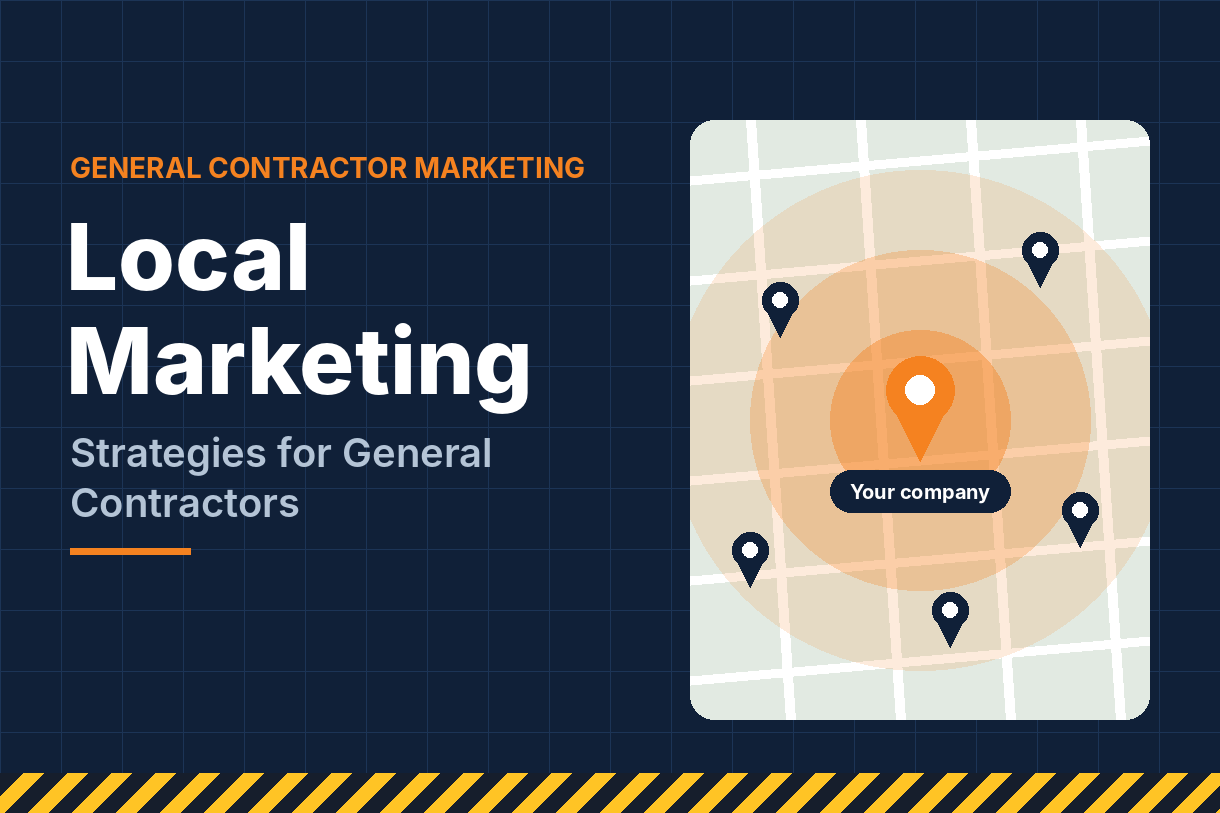
Every general contractor knows the feeling. You finish a beautiful addition on a quiet street, and within a month two neighbors call asking for quotes.
That’s local marketing at its most powerful. People hire builders they can see working nearby, that their neighbors trust and that show up when they search their own town. For a general contractor, the market isn’t the whole internet. It’s a handful of towns and neighborhoods where you want to be the obvious choice.
This guide covers nine local marketing strategies built for exactly that: winning more work close to home, from the jobsite sign in a client’s yard to the search results on their phone.
Why Local Marketing Works Differently for General Contractors
General contractors don’t sell to everyone. You sell to people within driving distance of your crews, usually a radius of 20 to 60 miles depending on your project size. That changes how you should market.
Three things make local marketing especially powerful for GCs:
- Projects are visible. A house addition or a new storefront is on display for months. Neighbors, drivers and passersby see your work and your name every day.
- Trust is local. Clients want a builder who knows local codes, inspectors, suppliers and subcontractors. Being “from here” is a real selling point.
- Referrals cluster. One happy client often leads to work on the same street, in the same subdivision or within the same business community.
The goal of local marketing is simple: become the general contractor people in your area see, hear about and find most often. National tactics and broad brand campaigns rarely help a GC. Concentrated effort in a handful of towns does.
Start by choosing your priority markets. List the three to five towns or neighborhoods where projects are most profitable, travel is reasonable and you want more work. Every strategy below should be focused there first.
1. Own Your Local Search Footprint
When someone in your area searches “general contractor near me” or “home addition contractor [town],” you want to appear in three places: the map pack, the organic results and local directories. Together, these make up your local search footprint.
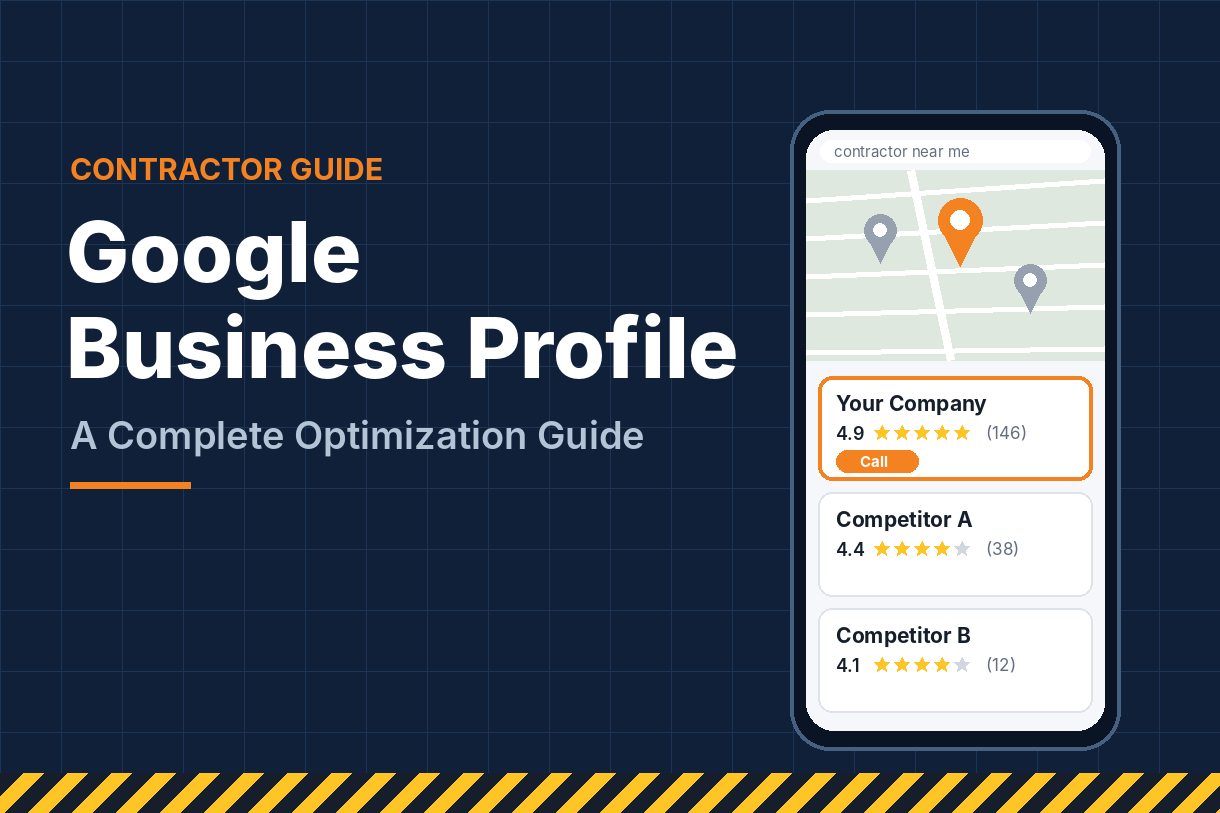
Start with the map pack. Your Google Business Profile is often the first thing local buyers see, with your star rating, photos and a call button. Choose “General contractor” as your primary category, add secondary categories for your main specialties, list every service and keep adding photos from real local jobs. Our Google Business Profile guide for contractors walks through every setting.
Then make sure your business is listed consistently across the directories that matter for builders:
- Bing Places and Apple Business Connect
- Houzz, Angi and BuildZoom
- The Better Business Bureau
- Your local chamber of commerce and builder associations
- Town or county business directories
Your company name, address and phone number should match exactly everywhere. Inconsistent listings confuse search engines and weaken your rankings.
Finally, connect it all with a local search strategy that targets each of your priority towns. Professional local SEO services combine profile optimization, citations, location content and local links so you show up across your whole service area, not just near your office.
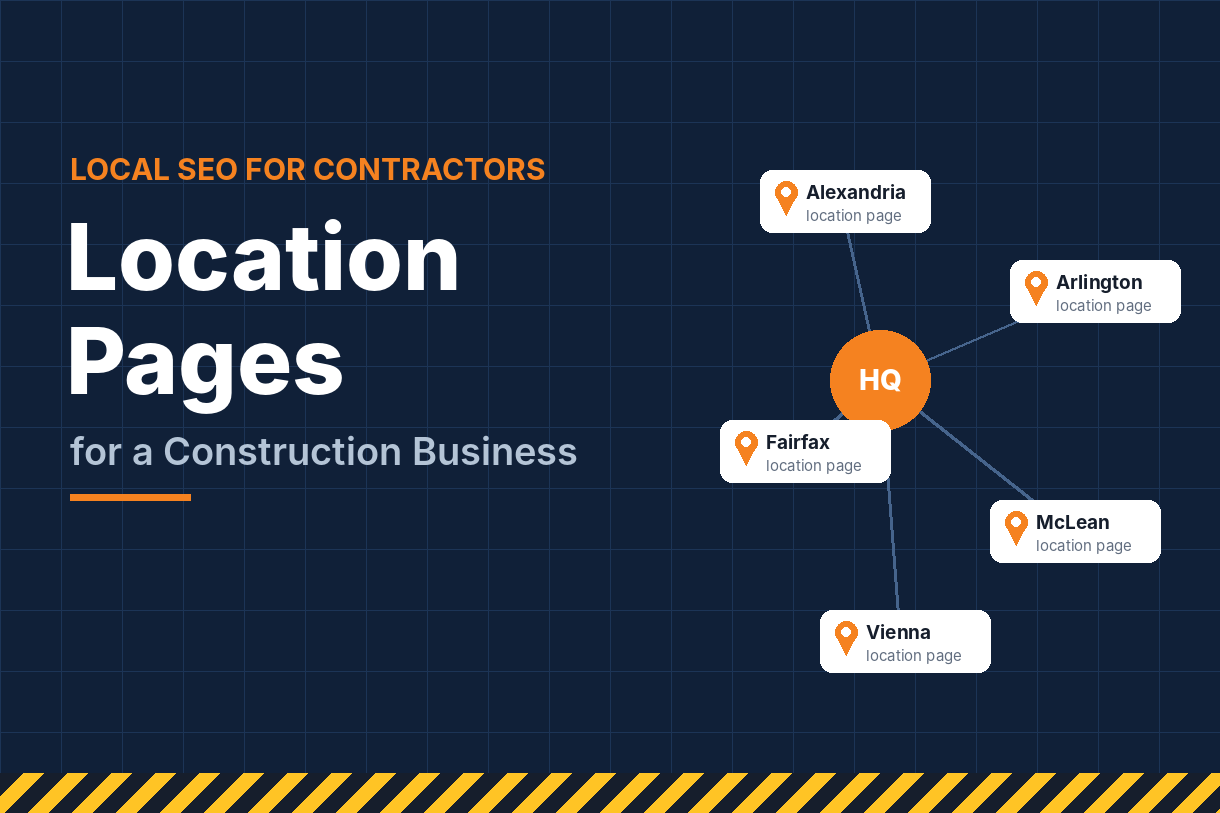
2. Build Location Pages That Actually Rank
Your Google Business Profile is tied to one address. To win searches in other towns, your website needs a dedicated page for each priority market.
The mistake most contractors make is creating thin “city pages” that copy the same text and swap the town name. Google sees through it, and so do buyers. A location page that ranks and converts includes real local substance:
- Projects completed in that town, with photos and short descriptions.
- Reviews from local clients, naming the neighborhood when possible.
- Local knowledge: permitting notes, common home styles, typical lot sizes or zoning considerations.
- The neighborhoods and nearby towns you cover from that area.
- A clear call to action with your phone number and estimate form.
Think of each location page as proof that you work there regularly. “Kitchen remodel in Old Town Alexandria, completed in eight weeks” builds far more trust than “We serve Alexandria.”
Each page also needs the technical basics: a unique title tag such as “General Contractor in Alexandria, VA,” a matching H1, descriptive image alt text and internal links to your related service pages. That page-level optimization is what on-page SEO covers.
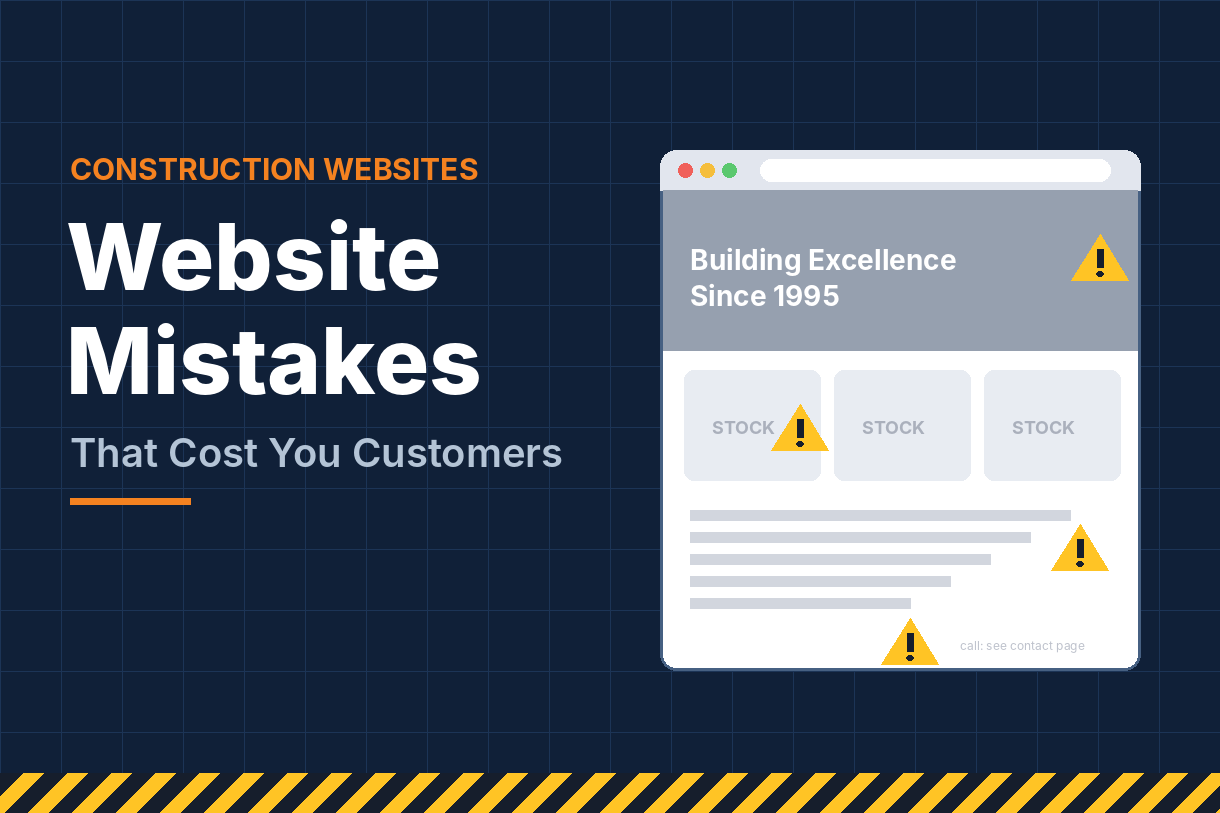
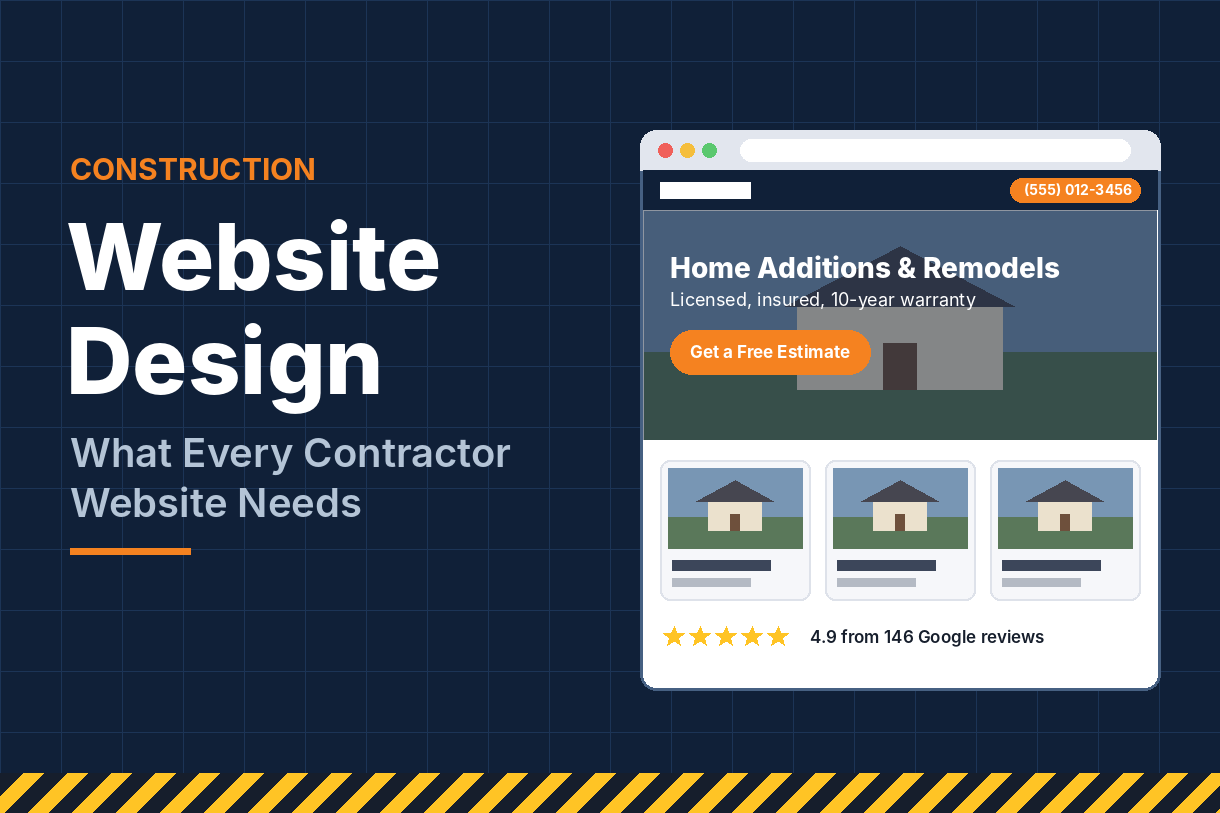
Location pages work best on a site that’s already built to convert local visitors, with a visible phone number, real project photos and a short quote form. Our guide on construction website design covers what the rest of the site needs.
3. Turn Every Jobsite Into Local Advertising
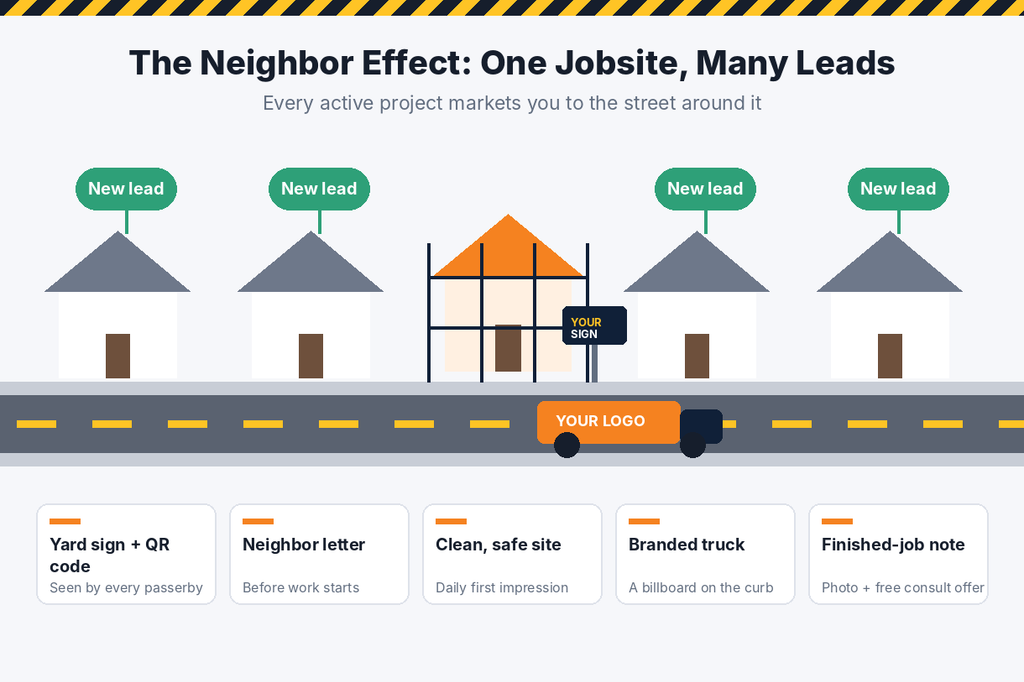
No other business gets free billboards quite like a general contractor. Every active project sits in front of the exact people most likely to hire you next: the neighbors.
Make the most of it:
- Yard and fence signs. Ask clients for permission to place a clean, professional sign during construction. Include your logo, phone number and website, and add a QR code that links to a page about that project type.
- Branded trucks and trailers. A clean, well-designed vehicle wrap works around the clock, parked on site or driving between jobs.
- Neighbor letters or door hangers. Before work begins, drop a short note to nearby homes. Introduce your company, share the expected schedule, apologize in advance for noise and give a number to call with questions. It builds goodwill and plants a seed for their own projects.
- A tidy, safe jobsite. Neighbors judge your company by how the site looks every day. Clean sites, organized materials and courteous crews are marketing too.
- Finished-project follow-up. When the job wraps up, send a second note to neighbors with a photo of the finished work and an offer for a free consultation.
This “neighbor effect” compounds. A single project in a subdivision can lead to two or three more on the same street, often without competitive bidding.
4. Get Involved in Your Community
General contractors who are visible in the community become the default name people think of when a project comes up. Community involvement also earns local links and mentions that help your search rankings.
Ways to build a local presence:
- Sponsor youth sports teams, school events or charity runs. You’ll usually get your logo on shirts or banners and a link from the organization’s website.
- Volunteer your skills. Habitat for Humanity builds, accessibility ramps for seniors or repairs for local nonprofits make a real difference and give you genuine stories to share.
- Exhibit at local home shows and community festivals, with project photos and a simple way to book a consultation.
- Host a workshop at the library or community center, such as “Planning a Home Addition: Permits, Budgets and Timelines.”
Then tell people about it. Local newspapers, community news sites, neighborhood newsletters and local TV stations are always looking for stories. A notable restoration, a charitable build or a new local hire are all worth pitching. Each piece of coverage builds credibility and, when it includes a link, local authority for your website.
Pick one or two causes that fit your company and stay with them. Consistent involvement over years builds a stronger reputation than scattered one-off sponsorships.
5. Build a Local Referral Partner Network
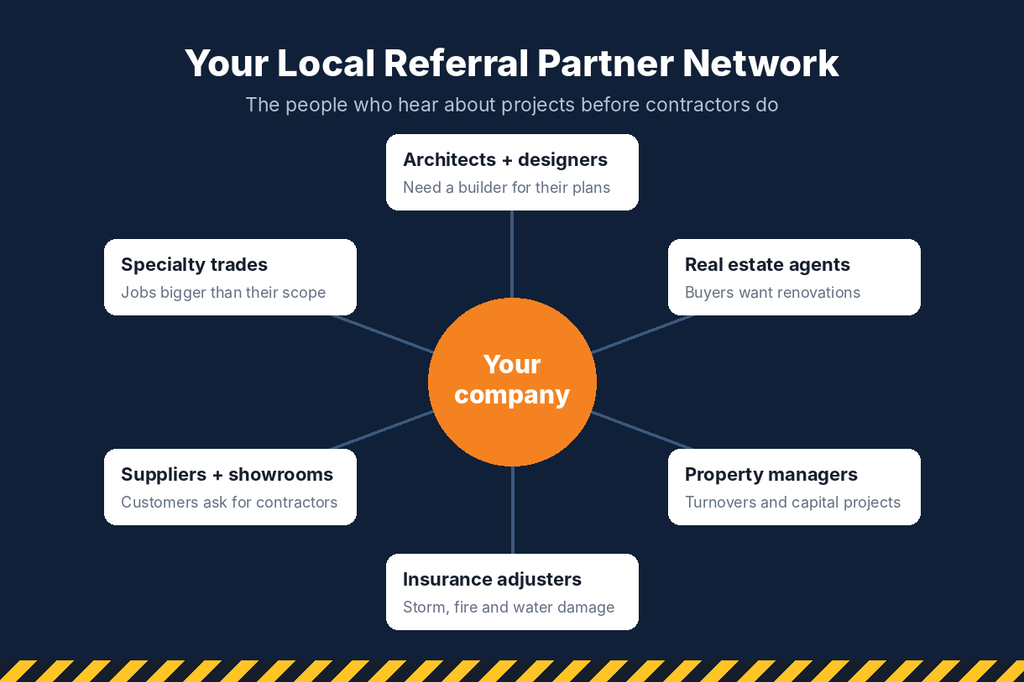
Many construction projects start long before a homeowner or business owner searches for a contractor. They start with a conversation with someone else: an architect, a realtor or an insurance adjuster. If those people know and trust you, they’ll send you work.
The most valuable local partners for general contractors:
- Architects and designers, who need reliable builders to bring their plans to life.
- Real estate agents, whose buyers often want renovations before or after closing.
- Property managers, who need ongoing repairs, turnovers and capital projects.
- Insurance agents and adjusters, who see storm, fire and water damage first.
- Suppliers and showrooms (lumber yards, cabinet and tile showrooms), whose customers ask for contractor recommendations.
- Specialty trades like roofers, electricians and plumbers, who come across jobs bigger than their scope.
Treat these relationships like any client relationship. Meet in person, show your best local projects, and make referring easy with a short one-page overview of your services. Follow up when a referral comes in, report back on how it went and send business their way whenever you can.
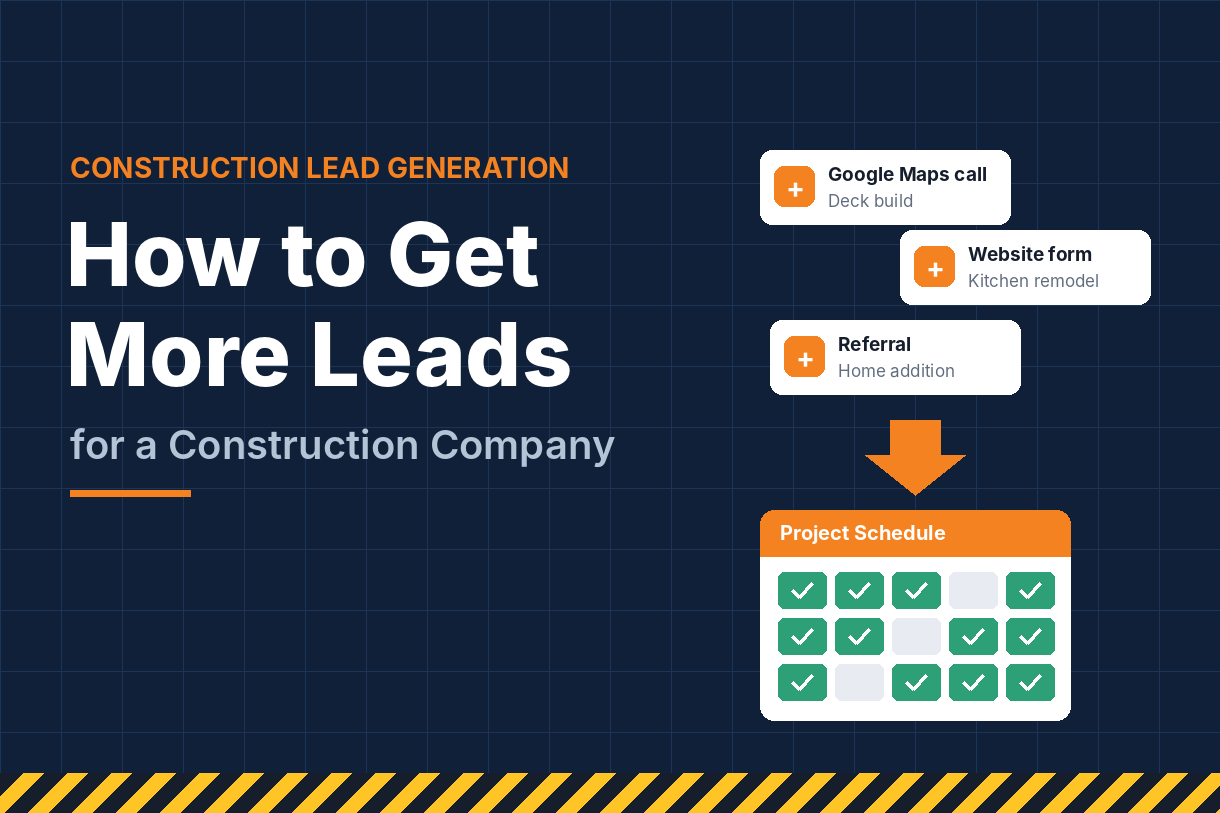
A handful of strong partners can supply steady, pre-qualified work every year. For more ways to fill your pipeline beyond partnerships, from bid networks to lead platforms, see our guide on how to get more leads for a construction company.
6. Show Up on Neighborhood Social Media
Social media works best for general contractors when it’s local. A post about “a kitchen we finished in Maplewood” gets more attention from Maplewood residents than any generic tip ever will.
Focus on the platforms where your neighbors already talk:
- Nextdoor. Claim a free business page, share completed local projects and respond helpfully when people ask for contractor recommendations. Happy clients can recommend you directly on the platform.
- Local Facebook groups. Community and town groups are full of “Can anyone recommend a contractor?” posts. Join as yourself, be genuinely helpful and avoid hard selling. Many groups ban promotion but welcome expert answers.
- Instagram and Facebook pages. Post before-and-after photos, short videos from active sites and team spotlights. Tag the town or neighborhood in each post.
A simple weekly rhythm works: one finished project, one behind-the-scenes clip and one helpful tip, all tied to your local area.
7. Build a Local Reputation That Sells for You
In local markets, reputation travels fast, in both directions. Online reviews make that word of mouth visible to everyone.
Ask every satisfied client for a Google review at project completion, and ask them to mention the type of project and their town. A review like “They built our sunroom addition in Brookfield on schedule” helps both future clients and your local search rankings.
Respond to every review, especially negative ones. A calm, professional reply shows prospects how you handle problems, which matters more to construction buyers than a perfect score. Then share your best reviews on location pages, in proposals and on social media, where local buyers will see them.
8. Run Geo-Targeted Paid Campaigns
Organic local visibility takes time to build. Paid campaigns let you show up in your priority towns right away, and only there.
The advantage for general contractors is precision. You can target specific ZIP codes, towns or a set radius around your office, and exclude areas you don’t want to serve. That keeps your budget focused on the neighborhoods where projects are profitable and travel is reasonable.
Useful local paid options include:
- Local Services Ads for residential services, with pay-per-lead pricing and a Google trust badge.
- Google search ads targeting town-specific searches like “home addition contractor [town]” or “commercial build-out [city].”
- Location assets that show your address, distance and star rating inside your ads.
- Facebook and Instagram ads targeting homeowners in specific ZIP codes, ideal for showcasing projects in their own neighborhood.
A focused, locally targeted PPC strategy can bring in leads from your best towns within days, and the data shows you which areas respond best.
Keep a close eye on spend, though. Construction clicks can be expensive, and campaigns drift toward irrelevant searches without regular review. Expert Google Ads management keeps geo-targeting tight, filters out wasted clicks and keeps your cost per lead under control.
9. Track Results by Town and Double Down
Local marketing gets far more effective when you measure it by location. Some towns will produce bigger, more profitable projects than others, and your marketing should follow the money.
For every lead, record:
| What to track | Why it matters |
|---|---|
| Town or ZIP code | Shows which markets respond best |
| Lead source | Map pack, website, referral partner, jobsite sign, ads |
| Project type and size | Reveals where your most profitable work comes from |
| Close rate | Separates busy markets from profitable ones |
| Contract value | The number that decides where to invest next |
After a few months, patterns appear. You may find that one suburb produces half your additions, or that a single architect sends your biggest commercial jobs. Put more location content, sponsorships and ad budget into the towns that perform, and pull back from the ones that don’t.
Local tactics also sit inside a broader search strategy. Our complete guide to SEO for construction companies covers the keyword research, technical work and link building that support every location page.
If you also run residential trades like roofing, plumbing or HVAC, our guide to SEO for home services shows how service businesses rank higher in competitive local markets.
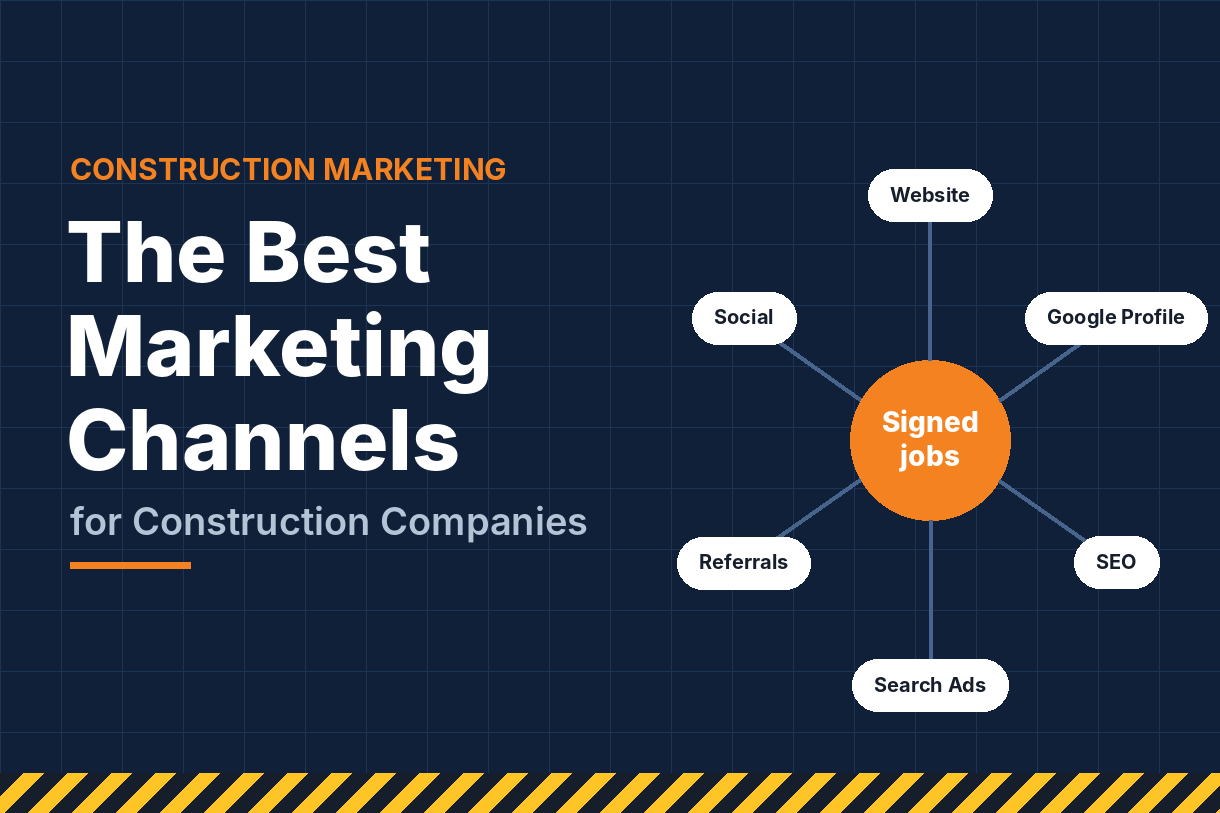
And for the full picture of how local efforts fit alongside your website, ads and follow-up, see our guide to construction company marketing.
Local visibility rewards consistency more than intensity. If you want steady, month-over-month progress without managing every task yourself, our SEO packages bundle local optimization, location content and reporting into one predictable plan.
Your 90-Day Local Marketing Plan
You don’t need to launch all nine strategies at once. Here’s a realistic rollout:
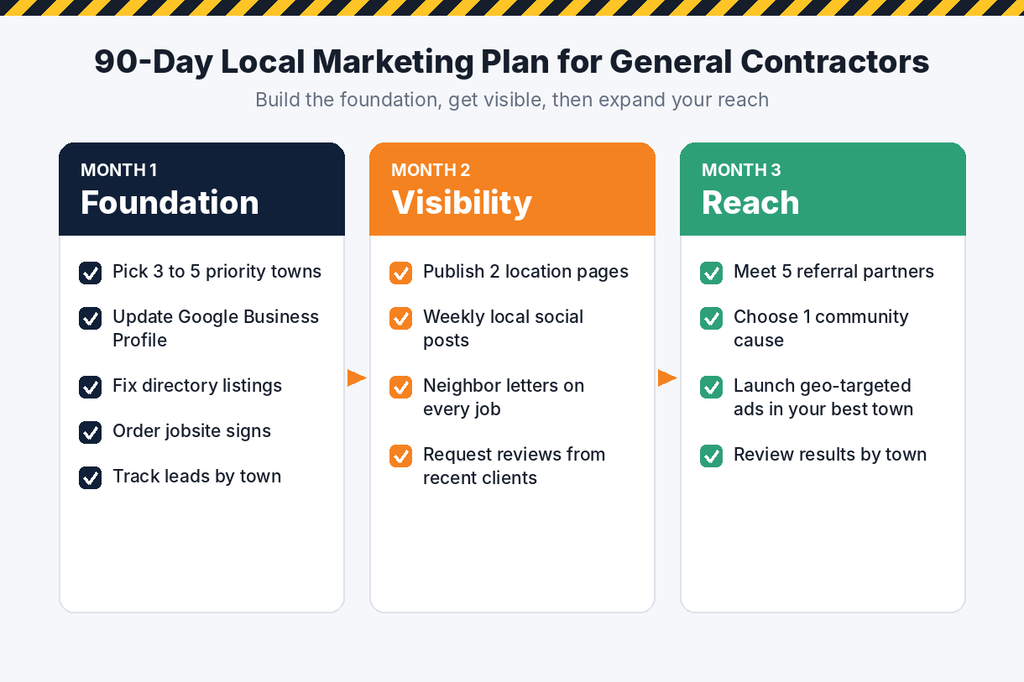
- Month 1: Foundation. Pick your priority towns, update your Google Business Profile, fix directory listings, order jobsite signs and set up lead tracking by town.
- Month 2: Visibility. Publish your first two location pages, start a weekly local social posting rhythm, send neighbor letters on every active job and request reviews from recent clients.
- Month 3: Relationships and reach. Meet five referral partners, choose one community cause to support and launch a geo-targeted ad campaign in your best town.
At the end of 90 days, review leads and contract value by town, then decide where to invest more.
Frequently Asked Questions
What is the best marketing strategy for a general contractor? For most GCs, the strongest results come from combining local search visibility with relationships: an optimized Google profile and location pages, plus referral partners, reviews and visible jobsites in your priority towns.
How far should a general contractor’s service area extend? It depends on project size. Smaller remodels usually make sense within 20 to 30 miles, while larger builds and commercial projects can justify longer travel. Focus marketing on the areas where jobs are most profitable.
Do yard signs still work for contractors? Yes. Jobsite signs reach neighbors who can see your work in person, and they pair well with neighbor letters and a QR code linking to similar projects.
Can I rank in towns where I don’t have an office? Yes, with well-built location pages, local reviews, local links and consistent listings, although proximity still plays a role in map pack rankings.
How long does local marketing take to work? Jobsite marketing and paid ads can produce leads quickly. Local SEO, partnerships and community reputation usually take several months but deliver the most durable results.
Become the Go-To Contractor in Your Area
The general contractors who win the most local work aren’t always the biggest. They’re the most visible, the most trusted and the easiest to find in the towns that matter to them.
Social Market Way helps general contractors build that local presence, from map pack rankings and location pages to geo-targeted campaigns that bring in the right projects. Contact our team today for a local visibility review and a plan to win more work close to home.