


How Construction Companies Can Use Case Studies to Win More Projects

A homeowner is comparing three contractors for a $150,000 addition. All three have good reviews. All three say they deliver quality work on time.
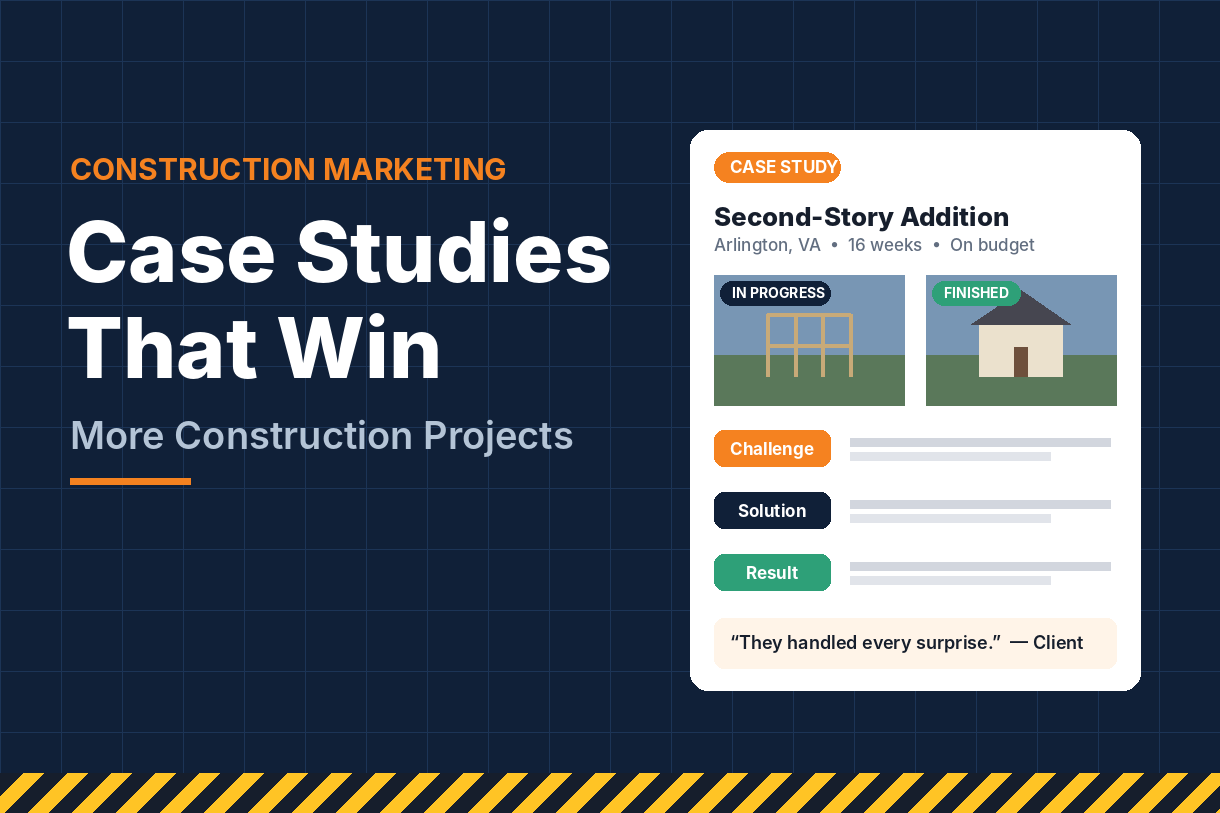
Then one of them sends a link: a detailed story of a nearly identical addition two miles away, with photos from demolition to final walkthrough, the timeline, how a surprise structural issue was handled and a quote from the homeowner. That contractor just stopped being one of three.
That’s the power of a case study. It turns your claims into evidence. This guide shows construction companies how to choose the right projects, capture the right material, write case studies that persuade and put them to work across your website, sales process and marketing.
Why Case Studies Win Construction Projects
Construction is a high-risk purchase for the buyer. They’re spending a large sum on something they can’t see until it’s finished, from a company they’ve probably never hired before. Every buyer is quietly asking: can this contractor handle my project without blowing the budget, missing the schedule or leaving a mess?
A photo gallery shows that you’ve built things. A case study shows how you build them. It answers the questions that actually decide who gets hired:
- Have you done a project like mine? A case study matched to their project type and size is far more persuasive than a general portfolio.
- What happens when something goes wrong? Every construction buyer knows surprises happen. Showing how you handled one honestly builds more trust than pretending projects go perfectly.
- Will you stick to the schedule and budget? Real timelines and outcomes make your promises believable.
- Were past clients happy? A quote from the client, tied to a specific project, carries more weight than an anonymous review.
Case studies also do something reviews and galleries can’t: they give your sales team a story to tell. Instead of “we do great work,” you can say, “Let me show you a project almost exactly like yours.”
For commercial contractors, case studies are often essential. Developers, property managers and general contractors evaluating bids want evidence of comparable projects, safety performance and schedule control. A strong case study library can be the difference between making the shortlist and being passed over.
Step 1: Choose the Right Projects to Feature
Not every job deserves a case study. The best candidates are projects that match the work you want more of, not just the most impressive thing you’ve ever built.
Use these filters:
- It’s the kind of work you want to win. If you want more commercial tenant improvements, feature those, not the one-off custom treehouse.
- The client was happy and willing to be featured. A real name, photo or quote makes the story far more credible.
- There’s a story. A tight deadline, a structural surprise, a historic home, a challenging site or a demanding owner. Projects with a problem you solved make better case studies than ones where nothing happened.
- You have good photos. Before, during and after images are essential. Without them, even a great project is hard to showcase.
- It’s in a town you want to grow in. Case studies double as local proof, so spread them across your priority markets.
Aim for a balanced library over time: a few case studies for each core service and each important town. Five strong case studies chosen this way are more useful than 30 thin project write-ups.
If you’re starting from zero, look back at the last 12 months. You probably already have two or three projects that fit, even if you didn’t document them perfectly. Reach out to those clients now while the experience is still fresh.
Step 2: Capture the Material While the Project Is Happening
The hardest part of a case study isn’t writing it. It’s realizing at the end of a job that nobody took photos of the demolition or wrote down why the schedule changed. Build documentation into your process so the material is ready when you need it.
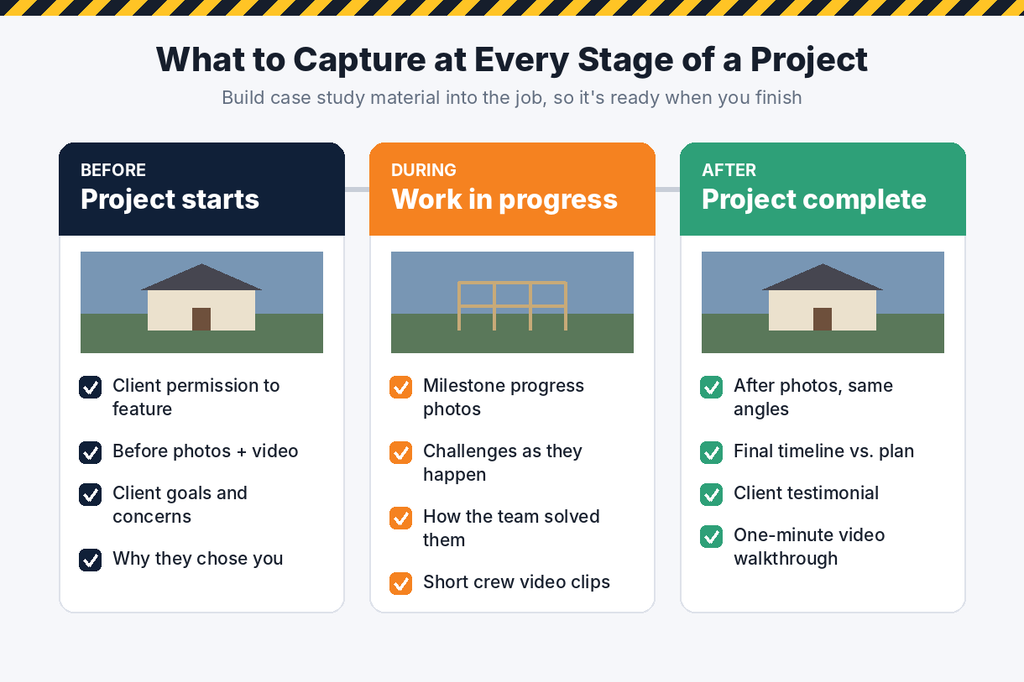
Before the project starts:
- Ask the client for permission to feature the project, and agree on what you can share (name, town, budget range, photos).
- Take “before” photos and video from consistent angles you can repeat at the end.
- Note the client’s goals, concerns and why they chose you, in their own words if possible.
During the project:
- Have the project manager take progress photos at key milestones: demolition, framing, rough-ins, finishes.
- Record challenges as they happen, such as hidden rot, permit delays or design changes, and how the team resolved them.
- Capture short video clips of crews at work and interesting construction details.
After completion:
- Shoot “after” photos in good light, from the same angles as the “before” shots, with the space cleaned and staged.
- Record the final timeline and outcome against the original plan.
- Ask the client for a short testimonial, ideally a few sentences on what they worried about and how it turned out. A one-minute video is even better.
A simple shared folder per project, with subfolders for before, during, after and notes, makes this easy for every project manager to follow.
Step 3: Structure and Write the Case Study
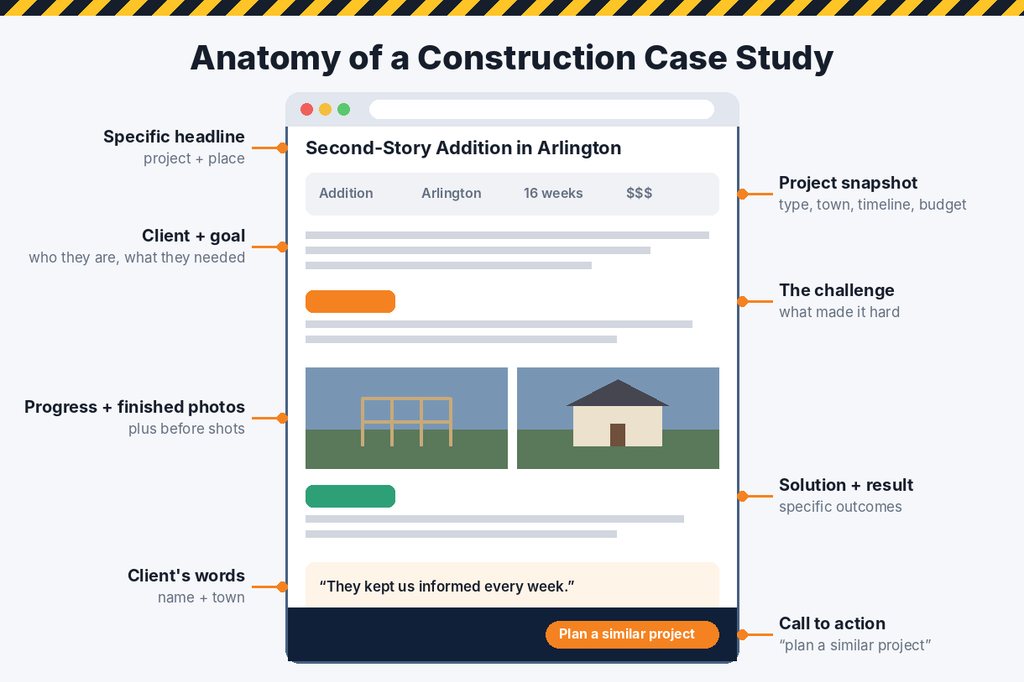
The best construction case studies follow a simple, repeatable structure. Buyers can scan it in a minute or read it in full, and your team can produce new ones quickly.
- A specific headline. “Second-Story Addition in Arlington: 1,200 Sq Ft Added in 16 Weeks” beats “The Johnson Project.”
- Project snapshot. A quick summary box with project type, location, size, timeline, and budget range if the client agrees.
- The client and their goal. Who they were and what they needed, in two or three sentences.
- The challenge. What made this project difficult: the site, the schedule, the structure, permitting, an occupied home or business.
- Your approach. How you planned and built it, including how you solved the main challenge.
- The result. The finished project, delivered against the original timeline and budget, with standout outcomes.
- The client’s words. A short testimonial quote, with their first name and town.
- Photos throughout. Before, during and after, each with a short caption.
- A call to action. “Planning a similar project? Get a free estimate.”
A few writing tips make a big difference:
- Be specific. “Finished two days ahead of schedule” is more believable than “completed quickly.”
- Be honest about problems. Buyers trust stories that admit challenges and show how you handled them.
- Write for the buyer, not for other builders. Explain technical decisions in plain language.
- Keep it scannable. Short paragraphs, clear subheadings and captions do most of the work.
Most strong case studies run 600 to 1,000 words plus photos. That’s long enough to tell the story and short enough to read on a phone.
Step 4: Publish Case Studies Where Buyers Will See Them
A case study buried three clicks deep in a “Projects” menu won’t do much. Put them where buyers are already making decisions.
Give each case study its own page. A dedicated URL like /projects/arlington-second-story-addition/ can be linked, shared and found in search. A gallery lightbox can’t.
Create a case study hub. A Projects or Case Studies page that lets visitors filter by project type and location makes it easy to find a story that matches their own job.
Link from service pages. Every service page should feature one or two relevant case studies. Someone reading about basement finishing should see a real basement project right there.
Link from location pages. Case studies are the strongest local proof you have. Each location page should highlight projects completed in that town. Our guide on how to create location pages for a construction business shows how case studies fit into a strong local page.
Feature one on the homepage. A single standout project near the top builds trust before visitors go any further.
Case studies work best on a site that’s fast, easy to navigate and makes contacting you simple. If your site buries the phone number or loads slowly, even great stories won’t convert. Our guide to construction website design covers the foundation every page needs.
Each case study page also needs solid on-page basics: a descriptive title tag, a clear H1, compressed images with descriptive alt text, and internal links to related services and locations. Professional on-page SEO services make sure every new case study is set up to be found.
Step 5: Use Case Studies to Strengthen Your SEO
Case studies aren’t just sales tools. They’re some of the most valuable content a construction website can publish for search, because they’re original, specific and impossible for competitors to copy.
Here’s how they help:
- They target specific searches. A case study titled “Historic Rowhouse Renovation in Capitol Hill” can rank for searches like “historic home renovation [neighborhood]” that a general service page might never reach.
- They add depth to your site. Each new case study expands your coverage of your services and towns, which reinforces your expertise in Google’s eyes.
- They create natural internal links. Linking case studies to service and location pages, and back again, helps search engines understand how your site fits together.
- They show real experience. Google looks for first-hand experience in content. A detailed account of a real project, with original photos, is exactly that.
- They earn links. Suppliers, architects, designers and local media are far more likely to link to an interesting project story than to a service page.
Case studies work best as part of a complete search strategy that also covers keyword research, technical health and link building. Our guide to SEO for construction companies walks through each piece.
If you also run residential trades like roofing, plumbing or HVAC, short project stories work the same way for service businesses. Our guide to SEO for home services covers how to apply them in competitive local markets.
For the strongest local impact, connect each case study to its town: mention the neighborhood, link to the matching location page and reference it in your Google Business Profile posts. A coordinated local SEO strategy ties case studies, location pages, citations and reviews together so each market builds on the others.
Step 6: Put Case Studies to Work in Sales and Bids
The moment a case study earns its keep is often during the sales process, not on your website. Train your team to use them at every stage.
- First call. When a prospect describes their project, send a link to the closest match: “Here’s an addition we finished last spring in your area.”
- Site visit. Bring a tablet with relevant case studies to show photos and timelines while you walk the property.
- Proposals. Include one or two matching case studies in every estimate. They reinforce your price by showing the quality behind it.
- Follow-up. When a prospect goes quiet after an estimate, a relevant case study is a far better follow-up than “just checking in.”
- Commercial bids and prequalification. Build a short project sheet for each case study, covering scope, value range, schedule and owner contact, to include with bids and qualification packages.
This is where case studies directly raise close rates. Prospects who see proof of a nearly identical project feel less risk, push back less on price and decide faster.
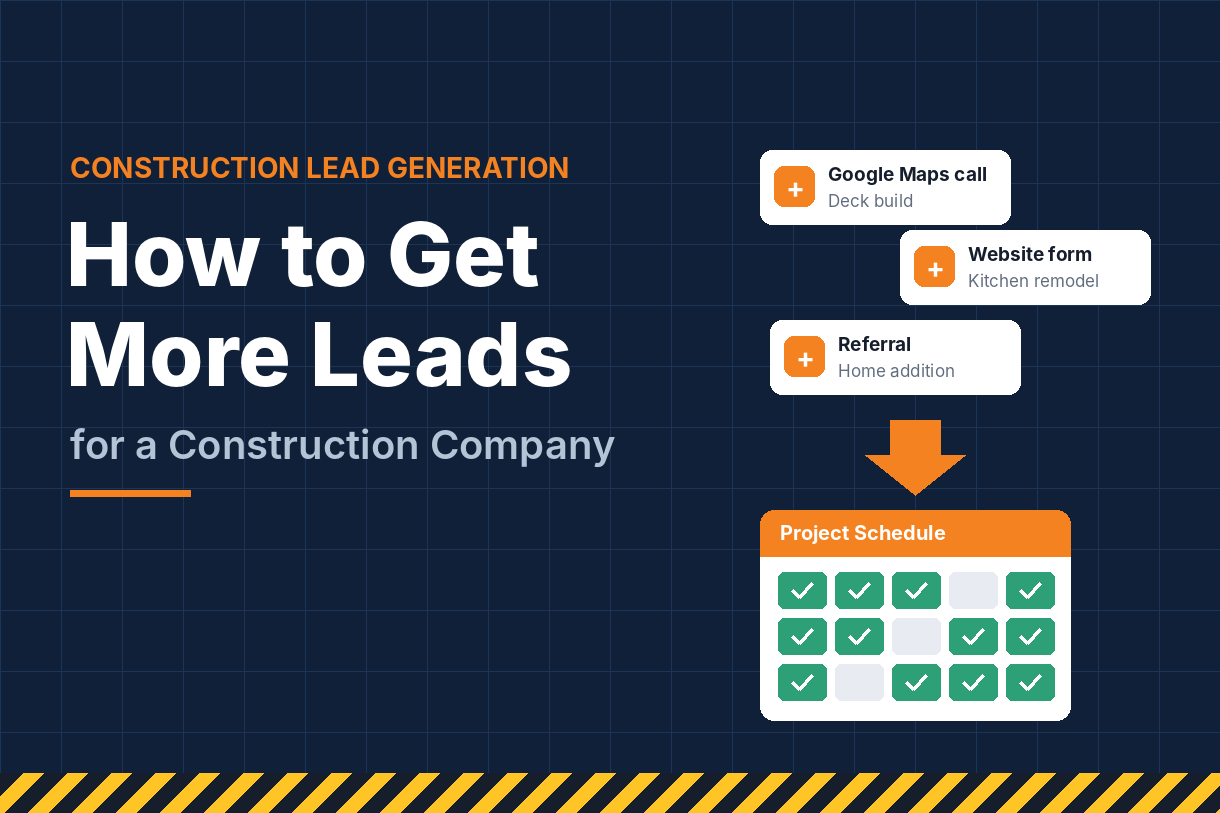
Case studies are one part of a broader system for turning inquiries into signed work. Our guide on how to get more leads for a construction company covers lead sources, response times, qualifying questions and follow-up in detail.
Step 7: Turn One Case Study Into Content for Every Channel
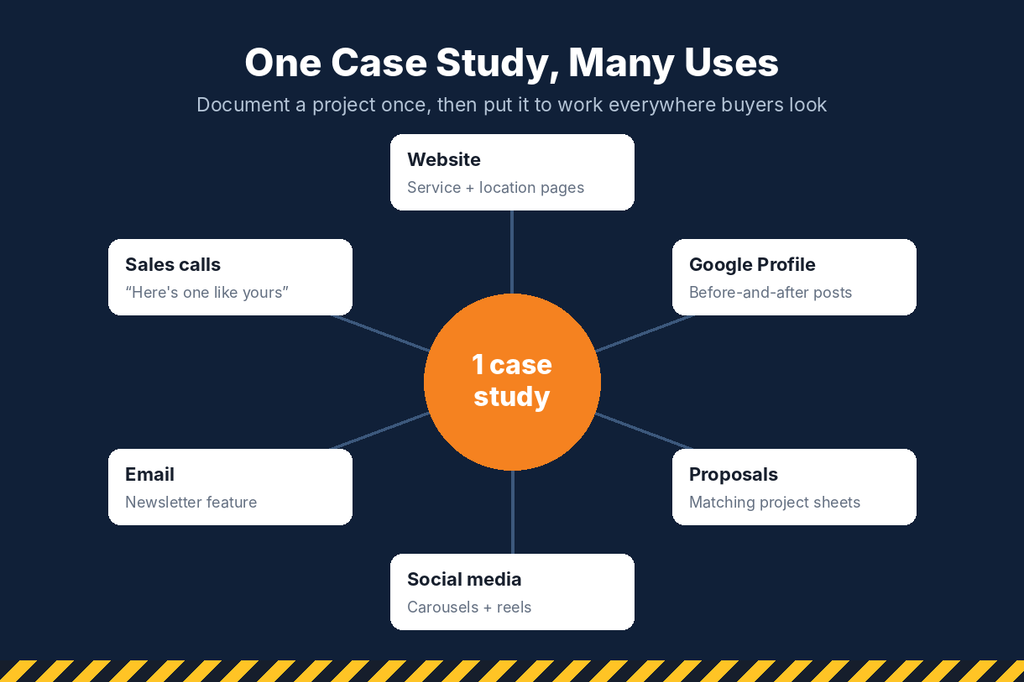
A single well-documented project can feed your marketing for weeks. Instead of writing new content from scratch, break each case study into smaller pieces:
- Google Business Profile: post the before-and-after photos with a short summary and a link to the full story. Fresh, real project photos keep your profile active. Our Google Business Profile guide for contractors covers how to post updates that drive calls.
- Social media: a before-and-after carousel on Instagram and Facebook, a short time-lapse reel, and a LinkedIn post for commercial projects.
- Email: feature the latest case study in your quarterly newsletter to past clients and open estimates.
- Video: a two-minute walkthrough with the project manager or the client, embedded on the case study page and posted to YouTube.
- Proposals and print: one-page project sheets for bids, home shows and leave-behinds.
Case studies also strengthen offline and community marketing. Jobsite signs can carry a QR code linking to the finished project story, and letters to neighbors after completion can point to it. Our guide to local marketing strategies for general contractors covers how to connect jobsite marketing and community visibility to your online presence.
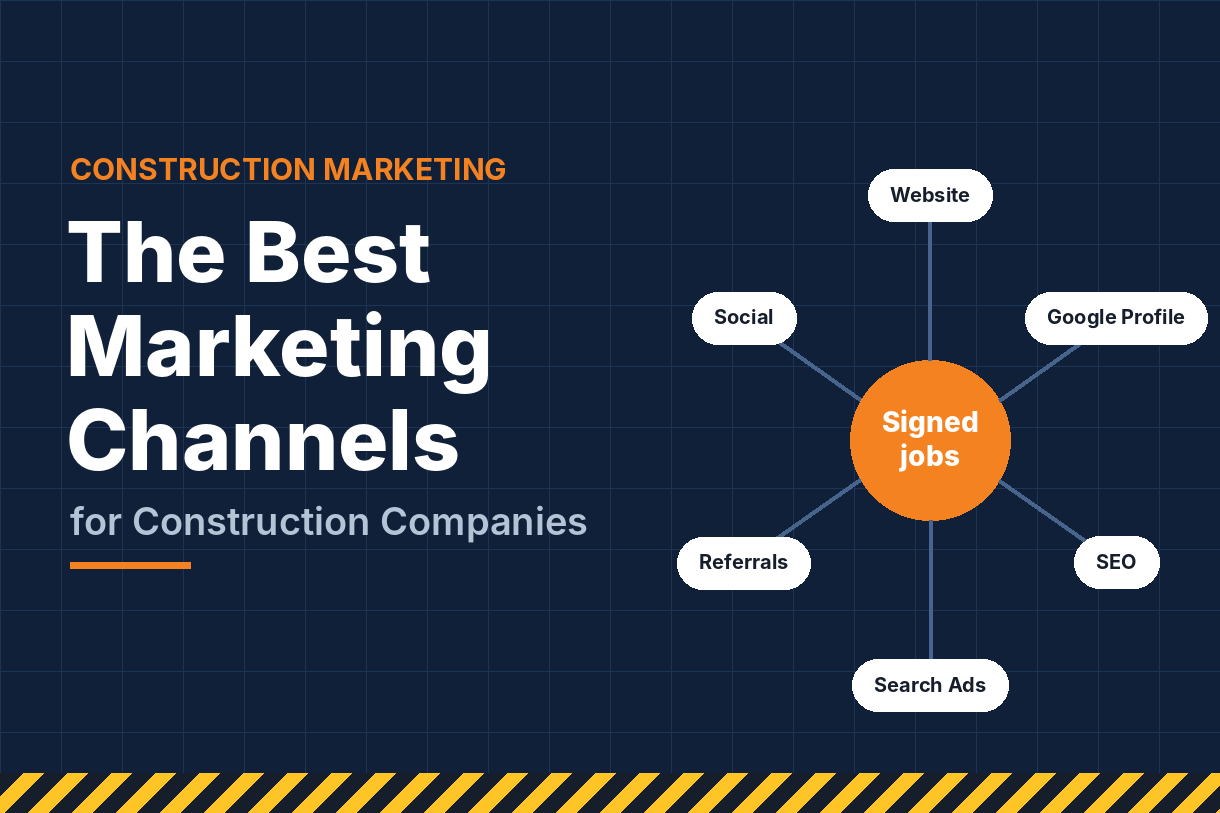
The key is matching each piece to the channel where your buyers already spend time. For a breakdown of which channels deserve the most attention for your type of construction business, see the best marketing channels for construction companies.
Case Study Mistakes to Avoid
- Calling a photo gallery a case study. Photos without the story, challenge and result miss the point.
- Featuring only perfect projects. Stories with no challenges feel like marketing copy. Honest problem-solving builds more trust.
- Vague results. “The client loved it” is weak. “Finished in 14 weeks, on budget, with no change orders” is persuasive.
- Publishing without permission. Always get written approval to use client names, photos and budget details.
- Hiding them. A case study nobody can find doesn’t win projects. Link them from service pages, location pages and proposals.
- Letting the library go stale. If your newest case study is three years old, buyers notice.
Case studies can’t fix a website that drives visitors away in the first few seconds. Our article on construction company website mistakes that cost you customers covers the site-wide problems worth fixing first.
How to Measure Whether Case Studies Are Working
Track a few simple signals:
- Page views and time on page for each case study in Google Analytics.
- Clicks from case studies to your contact or estimate page.
- Leads who mention a case study or ask about a specific project.
- Close rates on proposals that include case studies versus those that don’t.
Review these quarterly. Write more case studies for the project types and towns that drive the most engagement, and refresh older ones with new photos or results.
Case studies are one piece of a complete marketing system. For the full picture of how your website, Google profile, ads, reviews and follow-up work together, see our guide to construction company marketing.
Producing, publishing and promoting case studies consistently takes ongoing effort. If you’d rather have that handled alongside the rest of your search strategy, our SEO packages include content creation, on-page optimization and reporting in one predictable monthly plan.
Frequently Asked Questions
What is a construction case study? A construction case study is a detailed story of a completed project: the client’s goal, the challenges, how your team solved them, the outcome and the client’s feedback, supported by before, during and after photos.
How many case studies should a construction company have? Start with three to five covering your main services. Over time, aim for at least one or two for each core service and each priority town.
Do I need the client’s permission? Yes. Get written approval before using client names, photos, testimonials or budget details. Many clients are happy to be featured, especially when the project turned out well.
What if I don’t have good photos from past projects? Start documenting every new project now. For past jobs, you may be able to revisit a few finished projects with the client’s permission to photograph the result, and pair them with any progress photos your team already has.
Should I include project costs in case studies? Only with the client’s approval. A budget range, such as “$80,000 to $100,000,” helps prospects judge fit without revealing exact figures.
Let Your Best Projects Win Your Next Ones
Your completed projects are the most convincing marketing you have. Case studies turn them into proof that works on your website, in search results, in proposals and across every channel, helping buyers choose you with confidence.
Social Market Way helps construction companies turn their best work into case studies, location pages and search-optimized content that brings in better projects. Contact our team today for a review of your website content and a plan to put your project portfolio to work.